Our company logo

State

How to Read the Signs of a Bent Track


Published: Jan 29, 2026

That grating, scraping sound your garage door makes isn't just an annoyance. It’s a warning sign. It’s the sound of metal fighting against metal, a cry for help from a system under immense stress. While it’s tempting to ignore it or crank up the radio, that noise is often the first symptom of a misaligned or bent garage door track—a small issue that, if left unaddressed, can trigger a cascade of expensive failures.

Think of it like your car's wheel alignment. A slight pull to one side might seem minor at first, but over thousands of miles, it leads to uneven tire wear, suspension problems, and a costly trip to the mechanic. Your garage door works on the same principle. The tracks are the pristine highway your door travels on every day. When that highway has a pothole or a curve where there should be a straightaway, every component has to work harder, leading to premature aging and eventual breakdown.

This guide will help you become fluent in the language of your garage door. You’ll learn to spot the subtle imperfections that cause major wear, understand the chain reaction of damage they cause, and know exactly when it’s time to call in a professional.

The Anatomy of a Perfectly Aligned Track


Before we dive into the problems, let's appreciate what a healthy system looks like. Your garage door's tracks are elegantly simple: two parallel steel guides that run up the sides of the opening and curve to run along the ceiling. Their one and only job is to provide a smooth, consistent path for the rollers attached to the door.
For this to work flawlessly, a few things must be true:

  • Vertical tracks must be perfectly plumb (straight up and down).
  • Horizontal tracks must be level and have a slight upward slope away from the door opening.
  • The spacing between the tracks must be uniform from bottom to top.
  • Brackets must hold the tracks securely to the wall and ceiling.
When this perfect garage door alignment is maintained, the door’s weight is evenly distributed, allowing it to glide open and closed with minimal effort from the opener motor. It's a balanced, harmonious system.

Building: How to Spot the Subtle Signs of Trouble


You don't need to be a mechanic to perform a basic health check. The earliest signs of track trouble are often visible to the naked eye or audible to a listening ear. Grab a flashlight and spend a few minutes looking for these red flags.

Visible Gaps

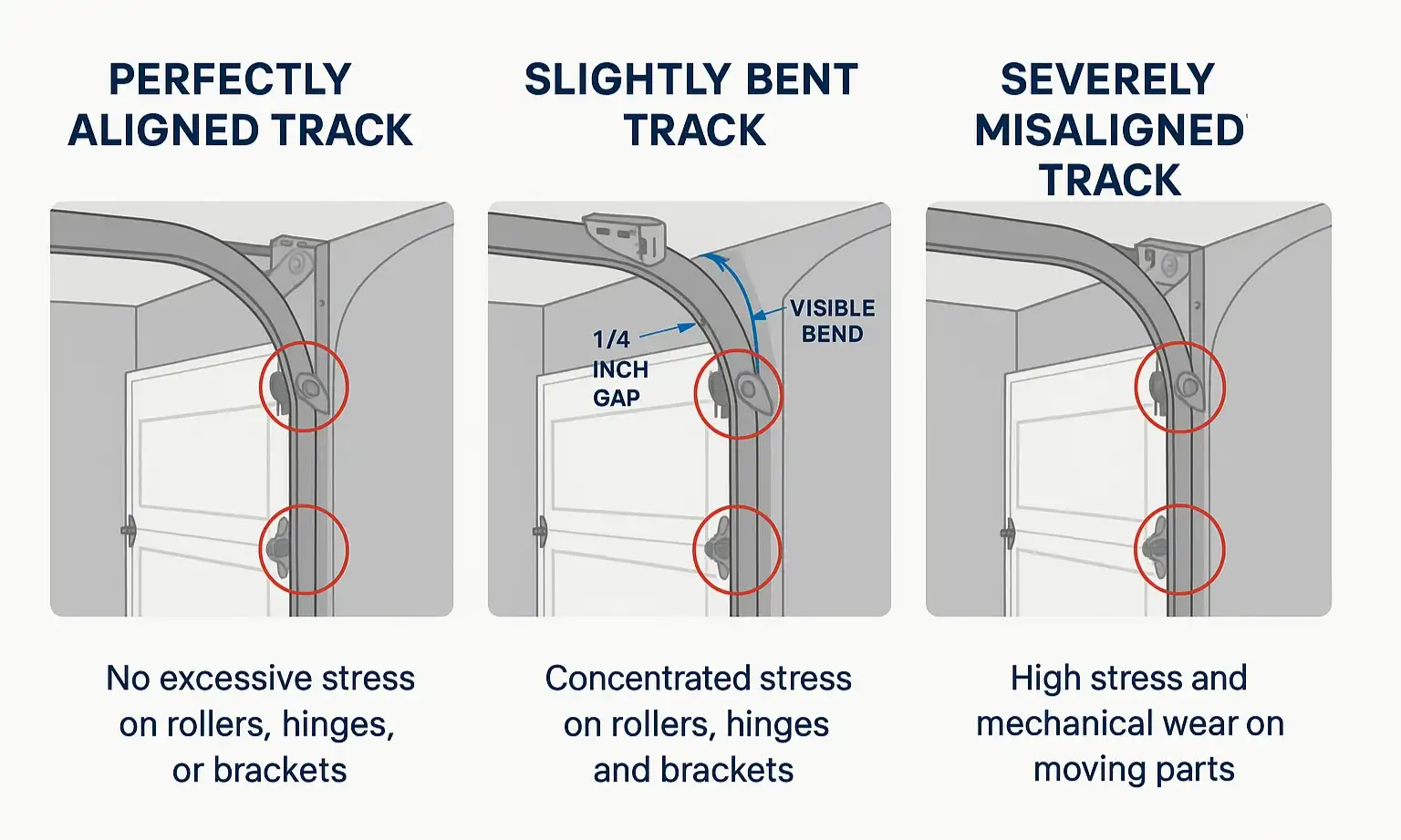
Look at the space between the vertical track and the wall. Are the mounting brackets holding it snug and secure? If you see a gap, it means the track is no longer properly supported. This instability allows the track to flex and shift during operation, putting uneven pressure on the rollers.
Visual comparison shows how small track flaws increase stress and signal when professional repair is needed.

Dents, Dings, and Bends

Run your eyes along the entire length of the tracks. Do you see any crimped sections or dents? It’s common for tracks to get bumped by cars, ladders, or lawnmowers. Even a slight bend in the steel can create a massive point of friction, forcing the roller to scrape and grind its way past the damage with every cycle. For deeper insights on this, you can learn more about a bent garage door track.

Scraping Noises or Jerky Movement

Stand back and watch your door as it moves. Does it travel in one fluid motion, or does it shudder, shake, or jerk? Listen closely. Grinding, scraping, or popping sounds are clear indicators that the rollers are struggling to move through a compromised section of the track.

Uneven Wear on Rollers

Your rollers should look uniform. If you notice that some are more worn down, cracked, or wobbly than others, it’s a sign that they are bearing an unequal load. This is a direct consequence of a misaligned track forcing specific rollers to do more than their fair share of the work.

Visual comparison shows how small track flaws increase stress and signal when professional repair is needed.

Mastery: The Cascade of Failure: How a Small Bend Leads to a Big Bill
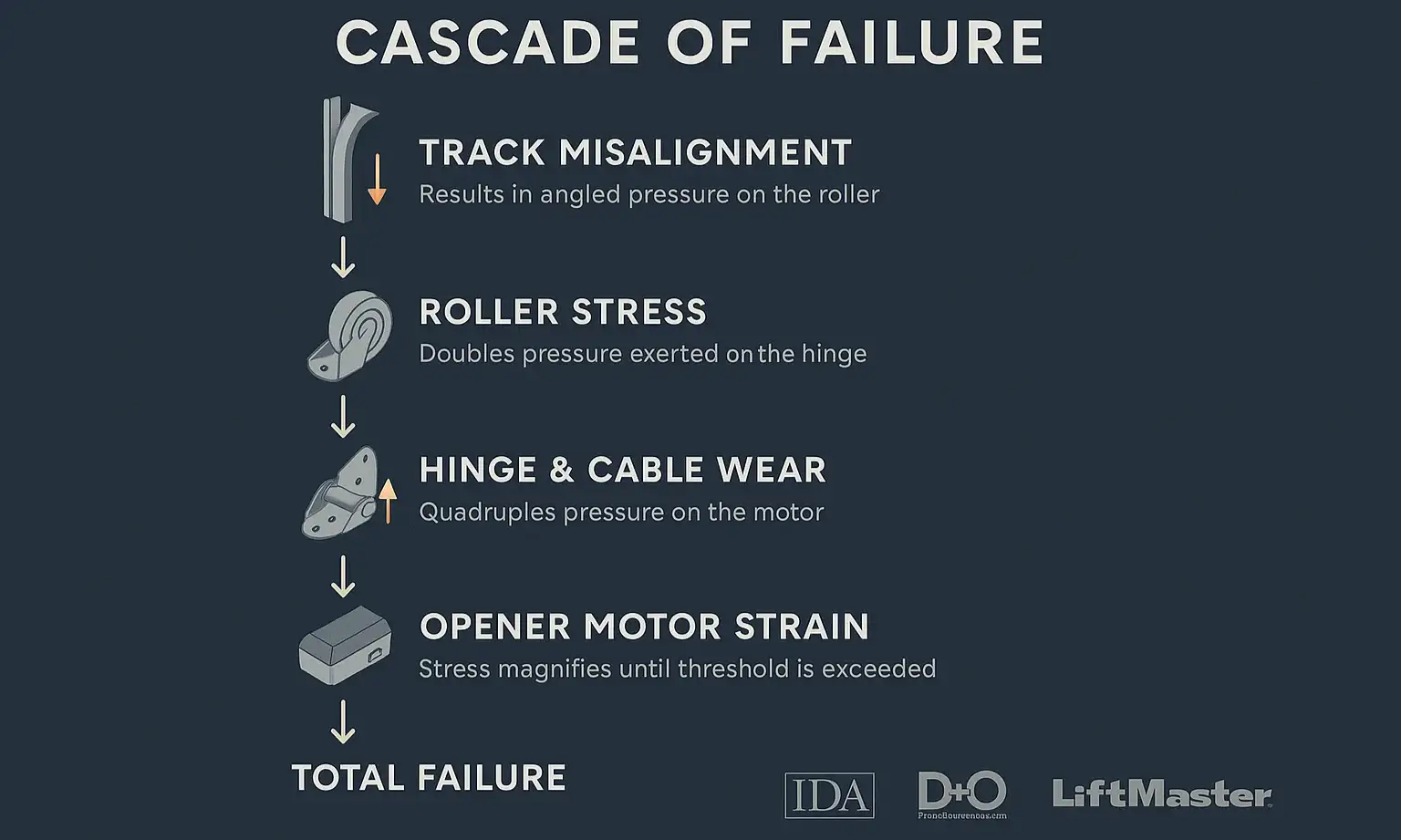

So, why does a quarter-inch gap or a minor dent matter so much? Because it triggers a chain reaction of mechanical wear that spreads through your entire garage door system. We call this the "Cascade of Failure."
This is the "aha moment" where you see how one small problem becomes a major headache.
Infographic explains how minor track misalignment causes costly damage and why proactive maintenance matters.
Stage 1: Track Misalignment. It starts here. A bracket comes loose, or the track gets hit by the car. The perfect path is now compromised.
Stage 2: Accelerated Roller Stress. The rollers are the first victims. Instead of rolling smoothly, they are now pinched, scraped, and forced against the steel track. Their bearings wear out, and the nylon or steel wheels begin to degrade, leading to the need for a premature garage door roller replacement.
Stage 3: Hinge and Cable Strain. The failing rollers transfer that stress directly to the hinges holding them to the door panels. This can cause hinges to crack or pull screws from the door. The added friction also puts more strain on the cables, which can cause them to fray or slip off their drums. You can learn more about how to check on them with our guide on how to adjust garage door cables.
Stage 4: Opener Motor Burnout. Your garage door opener is designed to lift a perfectly balanced door. When it has to fight against the friction of a bent track and failing rollers, it works exponentially harder. This intense strain overheats the motor, wears down the gears, and drastically shortens the lifespan of your opener, potentially leading to a full garage door motor installation.
Stage 5: Catastrophic System Failure. Eventually, something has to give. A roller finally pops out of the track, the door gets stuck halfway, a cable snaps, or the opener motor dies completely. What started as a tiny bend is now a major, expensive, and potentially dangerous repair.

Infographic explains how minor track misalignment causes costly damage and why proactive maintenance matters.

Action: The Homeowner's Triage Checklist: What to Check, When to Watch, and When to Call a Pro


Now that you can spot the signs, it's crucial to know what to do next. Attempting to fix a bent track with a hammer is one of the biggest mistakes a homeowner can make; it often makes the problem worse and can knock the door completely off its track.
Use this simple triage checklist to assess your situation safely.

Green Light: Monitor & Maintain

These are tasks you can safely monitor as part of your regular garage door maintenance.
  • Debris in Tracks: Use a cloth to wipe out any dirt, leaves, or cobwebs.
  • Minor Scuff Marks: Scuffs from normal operation are fine, but keep an eye on them to ensure they don't become deep gouges.
  • Squeaking Noises: This often just requires lubrication. Apply a silicone-based garage door lubricant to the rollers and hinges (but avoid spraying inside the tracks, as this can attract dirt).
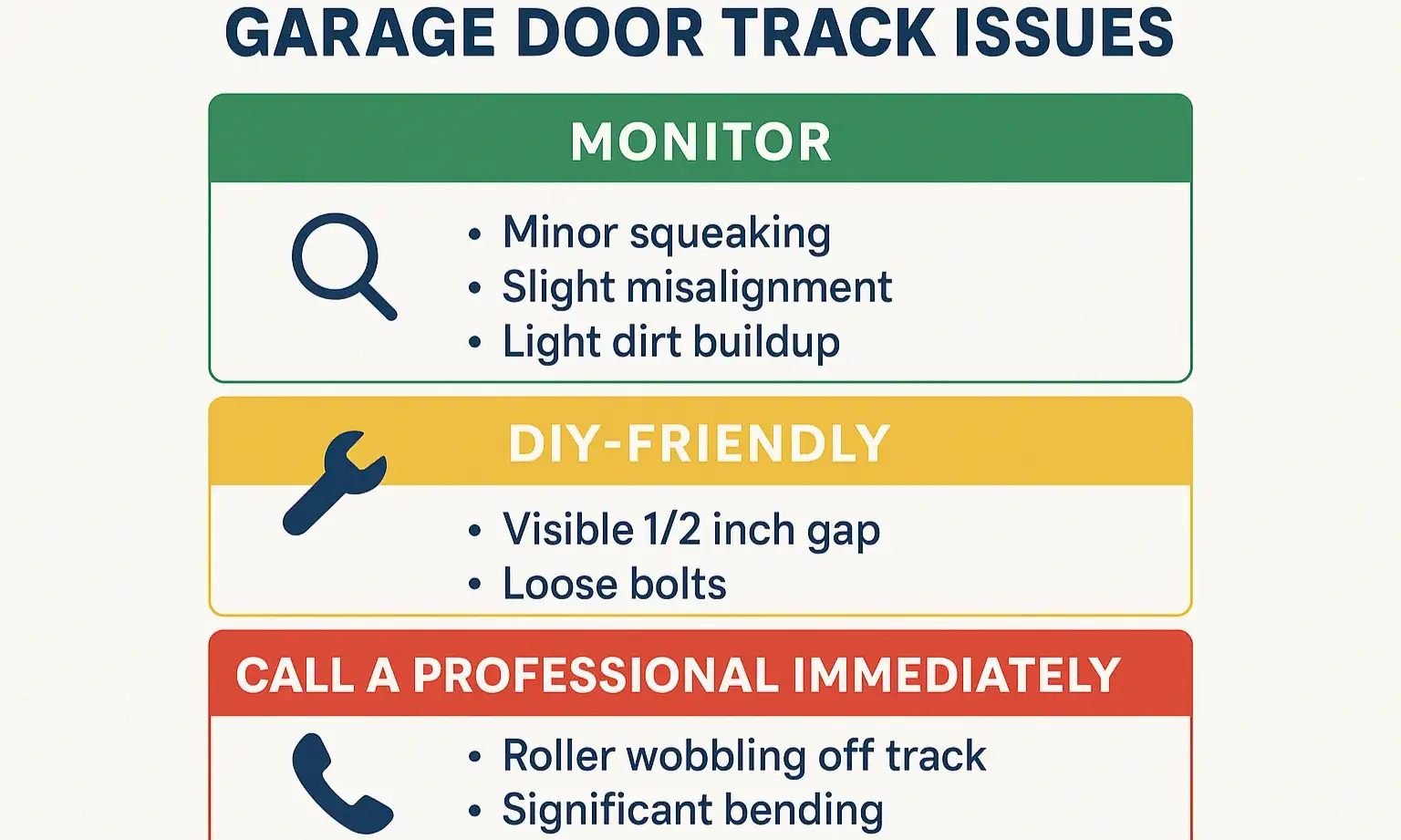
Triage checklist helps homeowners diagnose track issues and know when professional help is needed.

Yellow Light: Proceed with Extreme Caution

Loose Brackets: If you see a bracket that is slightly loose, you can use a socket wrench to gently tighten the bolts.
Crucial Safety Warning: Do NOT touch any brackets painted red or attached to the spring system. These are under extreme tension and can cause serious injury.

Red Light: Call a Professional Immediately

These issues require specialized tools and expertise. Attempting a DIY fix is dangerous and can lead to more costly damage.

  • Any Visible Bends or Dents in the Track
  • Gaps Between the Track and the Wall
  • A Door That is Crooked or Off its Tracks
  • Broken or Severely Worn Rollers
  • Frayed Cables or a Door That Seems Unusually Heavy
Proper garage door track alignment is a precise science. A professional technician has the training to not only fix the bend but also to recalibrate the entire system—including spring tension and opener limits—to prevent the problem from recurring.
Triage checklist helps homeowners diagnose track issues and know when professional help is needed.

Need more information?

Frequently Asked Questions About Garage Door Tracks


What causes garage door tracks to become misaligned?

The most common causes are accidental impact (bumping it with your car), loose hardware that allows the tracks to shift over time, and even the natural settling of your home's foundation.

How much does it cost to fix a bent garage door track?

The cost can vary depending on the severity of the damage. A simple alignment is far more affordable than addressing the consequences of the cascade of failure, like replacing a burned-out opener or a damaged door panel. Addressing it early is the most cost-effective solution.

Can't I just lubricate a noisy track to fix it?

Lubrication is great for routine maintenance, but it’s a bandage, not a cure. If the noise is caused by a bend or misalignment, the lubricant will only temporarily mask the sound of parts grinding themselves down.

Is a bent garage door track an emergency?

If the door is stuck, off its tracks, or making loud noises, you should stop using it immediately and call for an emergency garage door repair. Continuing to operate it risks further damage and poses a significant safety hazard.

Your Path to a Smooth and Silent Garage Door


Your garage door is the largest moving object in your home. Paying attention to its subtle signals is the key to ensuring its longevity, safety, and reliability. That little squeak or shudder is your opportunity to stop the cascade of failure before it even starts.
Regularly inspecting your tracks using our checklist is a fantastic first step. You can find more tips in our complete garage door maintenance checklist for homeowners.
At Up & Down Garage Doors, we believe in empowering homeowners with the knowledge to care for their homes. If you've spotted any of the "Red Light" warnings or are dealing with other garage door problems, don't hesitate to reach out. Our team of experienced technicians can diagnose the root cause and restore your door to its smooth, quiet, and safe operation.

You may also like


blog photo

Fixing Rust on Garage Door Tracks and Rollers

Ever been jolted by a sudden grinding, squeaking, or shuddering noise as your garage door opens or closes? It’s a sound that makes you cringe, and for good reason. That noise isn't just an annoyance; it's a warning sign. Your garage door is trying to tell you something important about its health, and often, the culprit is a small, creeping problem you might not have noticed: rust. Many homeowners see a bit of rust on their garage door tracks or rollers and dismiss it as a cosmetic issue. But that reddish-brown coating is a performance killer. It creates friction, forcing your entire system to work harder and leading to bigger, more expensive problems down the line. The good news? You can often tackle this problem yourself. Understanding what's happening and why it matters is the first step toward a smoother, quieter, and longer-lasting garage door system. If you're looking for a more general guide to a noisy garage door fix, we have you covered, but here we’ll focus specifically on the damage caused by rust.

blog photo

Converting a Standard Track Garage Door to a Vertical Lift System

Ever look up at the ceiling of your garage and see wasted space? That sprawling network of horizontal tracks from your standard garage door eats up a massive amount of overhead real estate—space that could be used for a car lift, a storage loft, or just an open, airy workshop. You've probably thought, "There has to be a better way." There is. It's called a vertical lift garage door system, and converting to one is one of the most transformative upgrades you can make to your home or business. But the moment you start researching, you fall down a rabbit hole of confusing forum posts, dense DIY manuals, and videos that skip crucial details. You're left with more questions than answers: Is my garage even tall enough? What's the difference between "high lift" and "vertical lift"? And what happens if I get it wrong? This guide is your clear path forward. We're going to walk through this fascinating process like a knowledgeable friend, focusing first on the most important question: Is this conversion right for you?