From Noisy Doors to Broken Springs: A Stamford Repair Guide
Published: Mar 12, 2026
That sudden, jarring noise from the garage. The door that stubbornly refuses to budge. We’ve all been there. Here in Stamford, our garage doors face a unique set of challenges—from the humid summers that can tax moving parts to the icy winters that put extra strain on the entire system. When something goes wrong, the first instinct is often a mix of frustration and uncertainty. What happened? Can I fix it myself? And the big one: What is this going to cost me?
You’re asking the right questions. Understanding your garage door is the first step toward making a smart, safe, and cost-effective decision. Think of this guide as your knowledgeable friend, here to walk you through the anatomy of your door, decode its strange behaviors, and give you a transparent look at what repairs actually cost right here in Stamford.
Foundation: The Anatomy of Your Garage Door
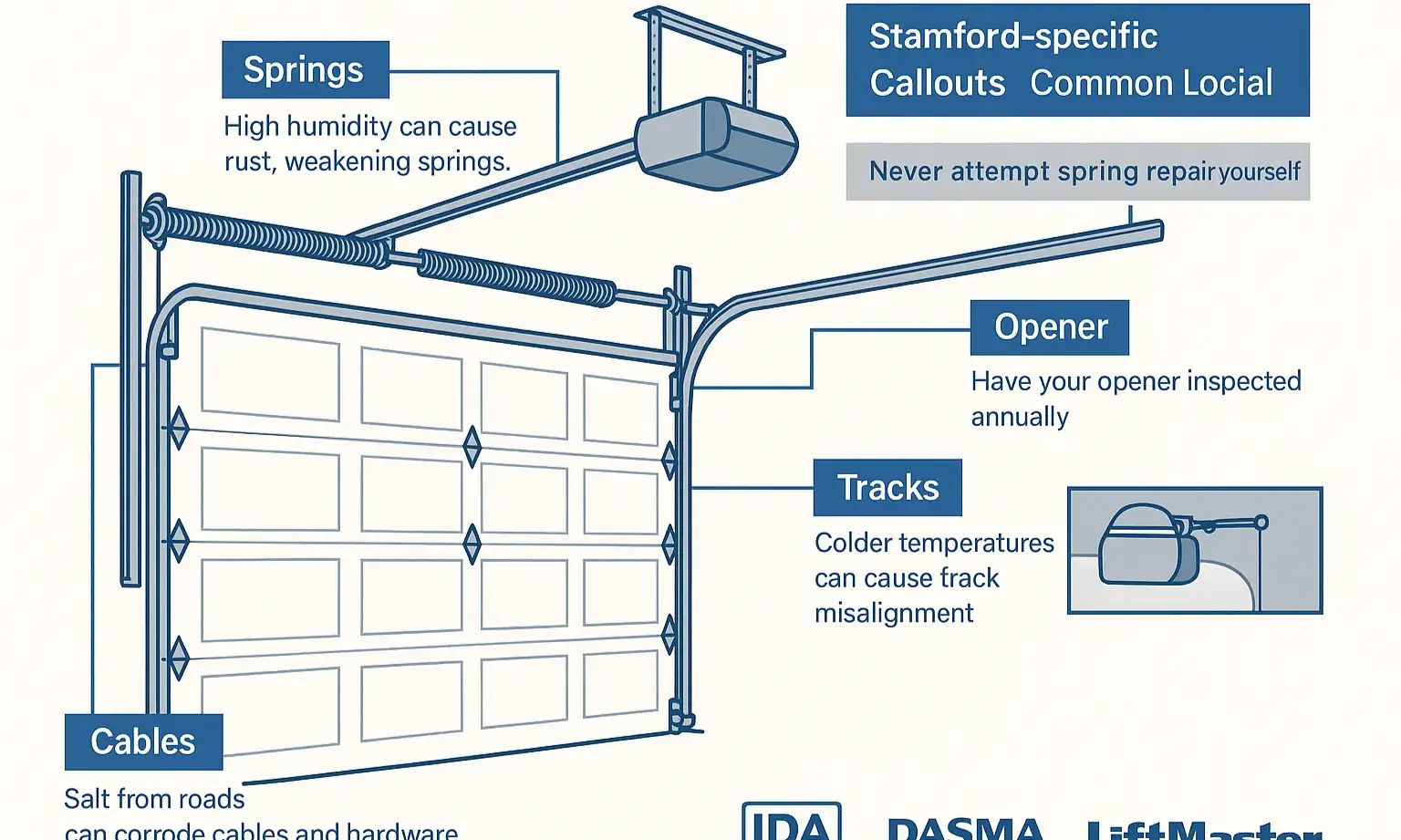
- The Springs (The Muscle): These are the real heroes. Whether they are long springs running alongside the tracks (extension springs) or a coiled spring on a bar above the door (torsion springs), they do the heavy lifting. The opener just guides the door; the springs provide the power.
- The Cables (The Support): These high-tension steel cables are attached to the bottom of the door and work with the springs to lift and lower it evenly and safely.
- The Opener (The Brains): The motorized unit, usually on the ceiling, that responds to your remote. It controls the opening and closing cycle.
- The Tracks (The Guide): The metal paths on either side of your door that the rollers move along. They need to be perfectly aligned for the door to operate smoothly.
- The Rollers (The Wheels): These small wheels run inside the tracks, allowing the door to move up and down with minimal friction.
- The Panels (The Face): These are the individual sections of your door. Damage to one can often be repaired without needing a full garage door replacement.
Building: The Common Problems (A Stamford Symptom-Checker)
Symptom 1: You Heard a Loud "BANG!"
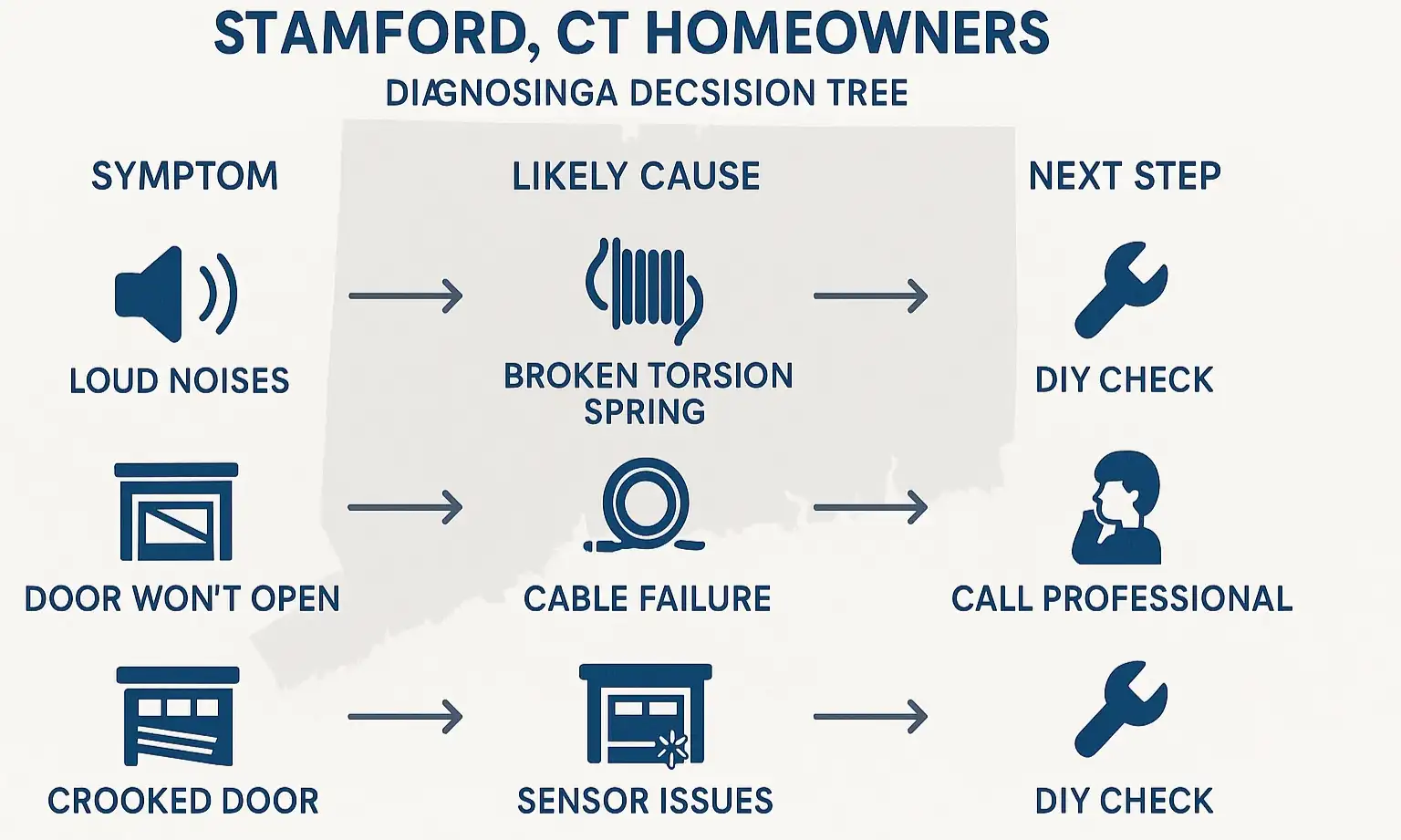
Symptom 2: The Door is Crooked or Jammed
Symptom 3: The Door Won't Open or Close
- No Power: The simplest answer! Check if the opener is plugged in and the circuit breaker hasn't tripped.
- Safety Sensor Misalignment: Look for the two small "electric eyes" near the bottom of the tracks. If they aren't aligned (indicated by a blinking light on one of them), the door won't close as a safety precaution.
- Opener Issues: The motor may have burned out, or the internal gears could be stripped.
- Stuck Door: Sometimes, you might just need to learn how to open a stuck garage door from the outside.
Symptom 4: The Door is Noisy (Grinding, Squeaking)
Need more information?
Get a free quote
Action: The "Pro vs. DIY" Safety Checklist
Safe for DIY:
Call a Stamford Pro:
Frequently Asked Questions
How long do garage door springs last in Connecticut?
Should I replace both springs if only one breaks?
Is it worth repairing an old garage door opener?
Can I just replace one damaged panel on my garage door?
What's the difference between torsion and extension springs?
You may also like