





Using Automotive Body Filler for Garage Door Dents
Published: Jun 22, 2026
For many types of dents, automotive body filler—often known by the popular brand name Bondo—is the secret weapon for a flawless finish. It’s not just for cars. When used correctly, this versatile compound can erase dents on metal garage doors, saving you hundreds of dollars. This guide will walk you through the entire process, from diagnosing your dent to applying that final, invisible coat of paint.
Foundation: Diagnose Your Dent & Door (The Most Important Step)
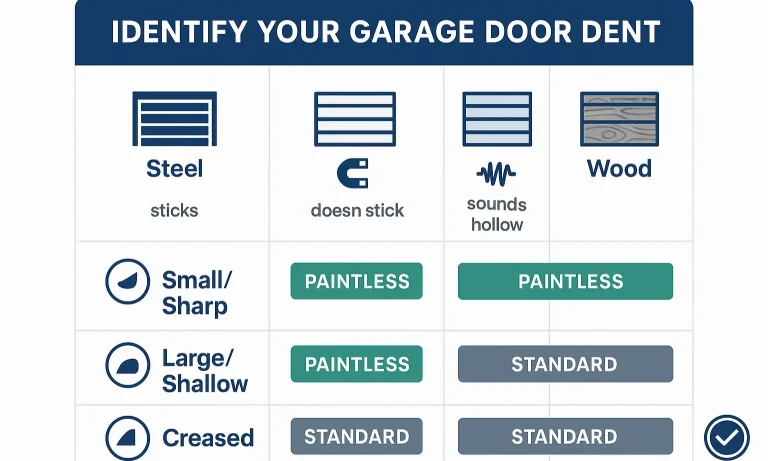
Before you grab any tools, the most critical step is to understand what you’re working with. A successful repair depends entirely on matching the right method to your specific door material and dent type. Trying to hammer out a small, sharp dent on an aluminum door can make things worse, while Bondo might be overkill for a shallow dent you can easily pop out from behind.
1. Identify Your Door Material:
Different materials have different properties. You can learn more about the pros and cons of different garage door materials, but here’s a quick test:
- Steel: Most common. A magnet will stick to it. It’s relatively strong but can dent.
- Aluminum: Lightweight and rust-proof. A magnet will not stick. It’s softer and can be more prone to dents.
- Wood or Wood Composite: The grain is usually visible. Dents are less common than splits or rot, which require different repair methods (wood filler, not automotive filler).
2. Assess the Dent Type:
- Large, Shallow Dent: A gentle, wide depression, often caused by leaning or pushing. These are sometimes repairable from the inside.
- Small, Sharp Dent: A focused impact point, like from a rock or hail. These are difficult to pop out and are prime candidates for filler.
- Creased Dent: The metal is sharply folded. This is the most difficult to repair. A crease weakens the metal, and while filler can smooth the surface, the structural integrity may be compromised.
Checkpoint: If you have a steel or aluminum door with a small, sharp dent or a shallow dent that won’t pop out, you’re in the right place. Proceed to the repair methods below. If you have a severe crease or a dented garage door with structural damage, a professional consultation is your best bet.
Building: The 3 Methods for DIY Garage Door Dent Repair
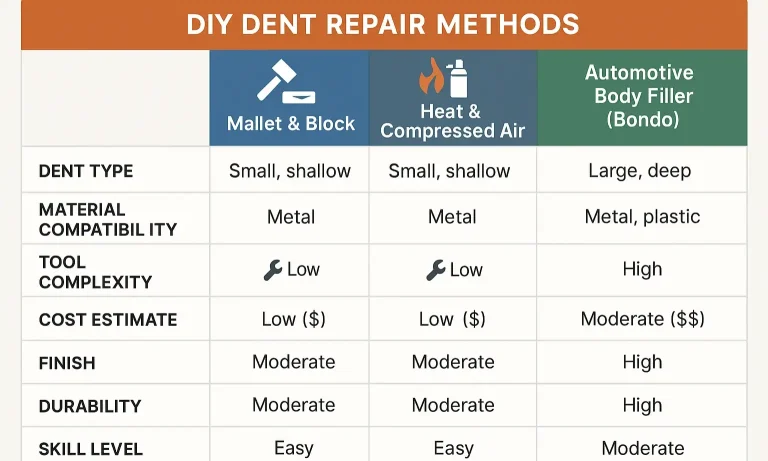
While we’re focusing on body filler, it’s helpful to know it’s one of three common DIY methods. Choosing the right one is key to a successful garage door dent repair.
Method 1: The Mallet & Block (The “Push”)
- Best For: Large, shallow dents on non-insulated, single-layer doors where you can access the back of the dent.
- How it Works: Place a flat wood block over the dent on the outside and gently tap the surrounding area from the inside with a rubber mallet. This slowly encourages the metal to return to its original shape.
- Pros: No chemicals, no sanding, no painting if the finish is intact.
- Cons: Can easily create more small high spots (“crowning”), making the dent look worse. Doesn’t work for sharp dents or insulated doors.
Method 2: The Heat & Compressed Air Trick (The “Pop”)
- Best For: Small to medium, shallow dents on steel or aluminum panels.
- How it Works: Heat the dent with a hairdryer or heat gun for about a minute, then immediately spray the area with a can of compressed air held upside down. The rapid temperature change causes the metal to contract, sometimes popping the dent out.
- Pros: Can be surprisingly effective and fast. No contact is made with the paint.
- Cons: Hit-or-miss results. Doesn’t work on sharp or creased dents. Risk of damaging the paint if you overheat the area.
- Best For: Imperfections that remain after trying other methods, or for small, sharp dents where pushing or popping isn’t an option.
- How it Works: You sand the damaged area, apply a filler to fill the depression, then sand it smooth to create a perfectly flat surface ready for paint.
- Pros: Can create a truly flawless, invisible repair on almost any dent.
- Cons: Most time-consuming method. Requires careful prep, application, and sanding skills.
Method 3: Automotive Body Filler (The “Fill & Smooth”)
Mastery: A Deep Dive into Bondo Application

Ready to make that dent disappear for good? Let’s talk about filler. Many homeowners worry, “Will Bondo crack on a vibrating garage door?” It’s a valid concern, but the answer is no—if you do the prep work correctly. The key to a durable, long-lasting repair isn’t the filler itself, but the bond it makes with the door surface.
Tools & Materials Checklist
- Safety Gear: Safety glasses, dust mask, and nitrile gloves are non-negotiable.
- Automotive Body Filler: A small can is plenty. Comes with a tube of cream hardener.
- Sandpaper: Assorted grits (80-grit, 180-grit, and 320-grit).
- Sanding Block: Essential for a flat, even finish.
- Degreaser/Cleaner: Dish soap and water work, but an automotive-grade degreaser is best.
- Plastic Putty Spreaders: Most filler kits include one.
- Clean Mixing Surface: A scrap piece of cardboard or a plastic lid.
- Primer: A spray-can of automotive filler primer.
- Paint: Color-matched to your garage door.
Step 1: Surface Prep is Everything
This is the most important step. Do not skip it.
1. Clean the Area: Wash the dent and surrounding area thoroughly with degreaser and water to remove all wax, dirt, and oil. Dry it completely.
2. Sand for “Tooth”: Using 80-grit sandpaper, sand the dent and about 1-2 inches around it. You need to sand down to the bare metal inside the dent itself. The goal is to create a rough, scratched surface (called “tooth”) that the filler can physically grip onto. If you find rust, you’ll need to sand it all away before proceeding. For stubborn spots, learn how to remove rust from a garage door to ensure a clean base.
3. Wipe Down: Clean the area one last time with a tack cloth or a clean rag with a bit of rubbing alcohol to remove all sanding dust.
Step 2: Mixing Bondo Like a Pro
This is the #1 point of failure for beginners.
1. Scoop the Filler: Scoop out a golf-ball-sized amount of filler onto your clean mixing surface.
2. Add the Hardener: Squeeze a line of the cream hardener across the top of the filler. The general rule is a 1-inch strip of hardener for every golf-ball-sized amount of filler. Too much hardener will make it cure too fast and become brittle; too little and it will never fully harden.
3. Mix Thoroughly: Quickly and thoroughly fold the hardener into the filler using your spreader. Don’t whip it like you’re making a cake—that introduces air bubbles. Mix for about 30-60 seconds until you have a consistent, uniform color with no streaks. You now have about 3-5 minutes of working time before it starts to harden.
Step 3: The Art of Application
1. Apply a Thin First Coat: With your spreader, apply a thin, tight layer of the mixed filler over the sanded area, pressing firmly to ensure it gets into all the sanding scratches. This is your “grip” coat.
2. Build in Layers: Immediately apply a second, slightly thicker layer, extending it just beyond the edges of the dent. The goal is to build the filler up so it’s slightly higher than the surrounding surface.
3. Feather the Edges: Use the edge of your spreader to smooth the filler and create a tapered, “feathered” edge that blends into the door.
Step 4: Sanding for a Flawless Finish
Wait until the filler is fully cured (usually 20-30 minutes). It should be hard and not gummy when you tap it.
1. Initial Shaping (80-Grit): Wrap 80-grit sandpaper around your sanding block. Sand in an “X” pattern across the repair. This helps prevent low spots. Your goal is to knock down the high spots and shape the repair until it’s level with the door surface.
2. Feathering (180-Grit): Switch to 180-grit sandpaper. This will smooth out the coarse scratches from the 80-grit paper and help you blend the edges of the repair into the surrounding paint.
3. Final Smoothing (320-Grit): Finish with 320-grit sandpaper to create a perfectly smooth surface, ready for primer. Run your hand over the area with your eyes closed. You shouldn’t be able to feel where the repair begins or ends.
Step 5: Priming & Paint Matching for an Invisible Repair
1. Prime the Area: Mask off the surrounding area and apply 2-3 light coats of automotive filler primer over the repair. Primer fills tiny pinholes and provides a uniform surface for the paint to adhere to.
2. Match the Paint: This is the final “aha moment.” Getting the color and sheen right is crucial. You can take a chip to a paint store for matching or check with your door’s manufacturer. There are many great garage door color ideas that can also inspire a full refresh.
3. Paint: Apply several light coats of your color-matched paint, letting each coat dry according to the manufacturer’s instructions.
Action: Pro Tips & Avoiding Common Disasters
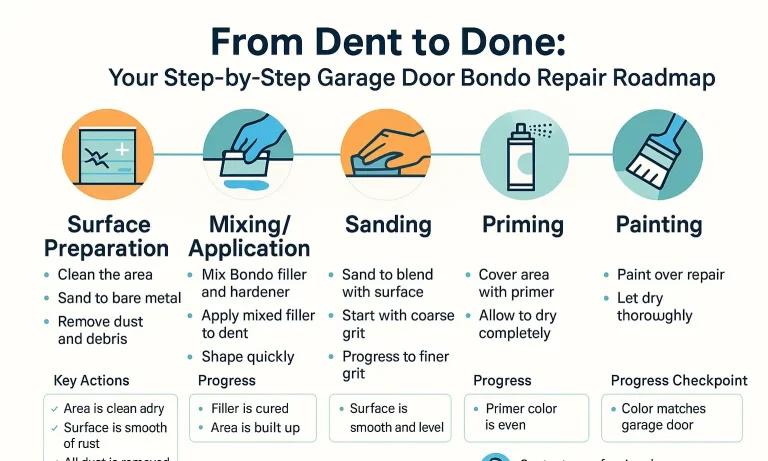
Now that you know the steps, here are a few extra tips to ensure your project is a success and you know when to call for help.
- Work in the Shade: Direct sunlight can make the filler cure way too fast, leaving you no time to work with it.
- Less is More: It’s always easier to add another thin layer of filler than it is to sand off a thick, lumpy one.
- Mind the Seams: If your dent is right on the edge of a panel or near a seam, the repair is much trickier. The vibration and movement are concentrated in these areas, making them poor candidates for a durable Bondo repair.
When to Call a Professional
This DIY guide can handle most cosmetic dents, but some situations require an expert touch. It’s time to call a professional if:
- The dent has creased the metal, which compromises its strength.
- The damage garage door panel is cracked or split.
- The door is knocked off its track or a garage door bent at top or bottom section is impeding its function.
- The damage is extensive enough to require a full garage door panel repair.
Frequently Asked Questions (FAQ)
Can I use Bondo on an insulated garage door?
Yes, but with caution. The process is the same for the outer skin. However, be careful not to sand so aggressively that you damage the insulation core. The outer metal skin on insulated doors is often thinner, so a gentle touch is key.
How long does Bondo take to dry?
In moderate temperatures (around 70°F / 21°C), it will start to harden in 3-5 minutes and be fully sandable in 20-30 minutes. Colder temperatures will slow this down, while hotter temperatures will speed it up.
Will the Bondo repair be noticeable?
If you follow the sanding and painting steps correctly, it should be completely invisible. The secret is in the final sanding with 320-grit paper and getting a perfect paint match.
What if my dent has a small hole in it?
For very small pinholes, Bondo can work. For anything larger than a pencil eraser, you should use a specialized filler reinforced with fiberglass for added strength.
Your Next Step to a Perfect Finish
Fixing a dent in your garage door is one of the most satisfying DIY projects you can tackle. With a little patience and by following these steps, you can erase that unsightly damage and restore your home’s curb appeal without breaking the bank. You’ve learned how to diagnose the problem, choose the right method, and master the art of applying filler for a flawless finish.
If you’ve assessed the damage and feel it’s beyond a simple cosmetic fix, don’t hesitate. At Up & Down Garage Doors, our team of licensed technicians is available 24/7 to handle everything from complex panel repairs to full replacements. We’re here to help when your DIY project becomes a “Don’t-Instead.”
You May Also Like
How to Remove Dents from a Garage Door: Step-by-Step Guide
Your kid’s bike tips over and the handlebar stamps a pea-sized dimple in the middle of your steel panel. The door still works, but that tiny dent catches your eye every time you pull in. If you’re searching for how…
Published Date: Oct 24, 2025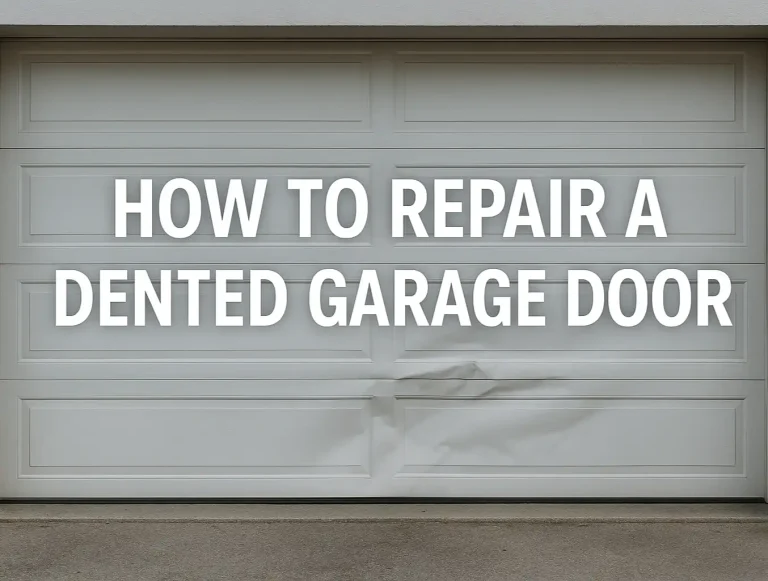
How to Repair a Dented Garage Door: Tips from Professionals
The kids are playing outside, and a ball glances off the panel. Later, the SUV’s bumper taps the door on the way in. Now there’s a crease you can spot from the street — and it might be more than cosmetic. If you’re…
Published Date: Oct 20, 2025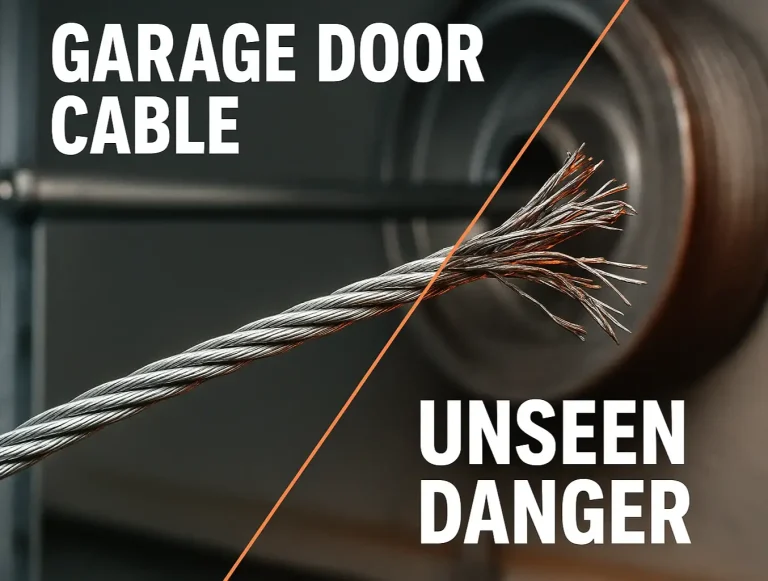
Identifying and Preventing Garage Door Cable Fraying
Listen closely the next time your garage door opens. Beneath the hum of the motor, do you hear a faint scraping, a subtle groan, or a slight vibration that wasn't there before? It’s easy to dismiss these small…
Published Date: Jan 19, 2026