Our company logo

State

The Complete Stamford Guide to Diagnosing Garage Door Problems


Published: Feb 19, 2026

It’s one of the most jarring sounds a homeowner can hear: a sudden, explosive BANG from the garage that echoes through the house. It's loud enough to make you think a car just crashed through the wall. You cautiously open the door to the garage and see... nothing. Everything looks normal, until you try to open the garage door. And it won't budge.

If this has happened to you, you're not alone. That alarming sound is the signature of a broken garage door spring, and it's the moment many Stamford homeowners begin their crash course in garage door mechanics.

Whether you're dealing with a sudden crisis or just a door that's started acting strange, understanding what's going on is the first step toward a safe and effective solution. This guide is your friendly, knowledgeable starting point—think of it as a conversation over coffee to demystify your home's largest moving object.

Foundation: Your Garage Door 101 for Stamford Homes

Before we dive into problems, let's get acquainted with the system itself. Most people think the electric opener does all the heavy lifting, but that's a common misconception. The real workhorse of your garage door is the spring system.
The springs are under immense tension to perfectly counterbalance the weight of your door, which can be several hundred pounds. The opener simply provides the push and pull to get it started. When the springs are working correctly, you should be able to lift the door manually with just one hand (when the opener is disengaged).
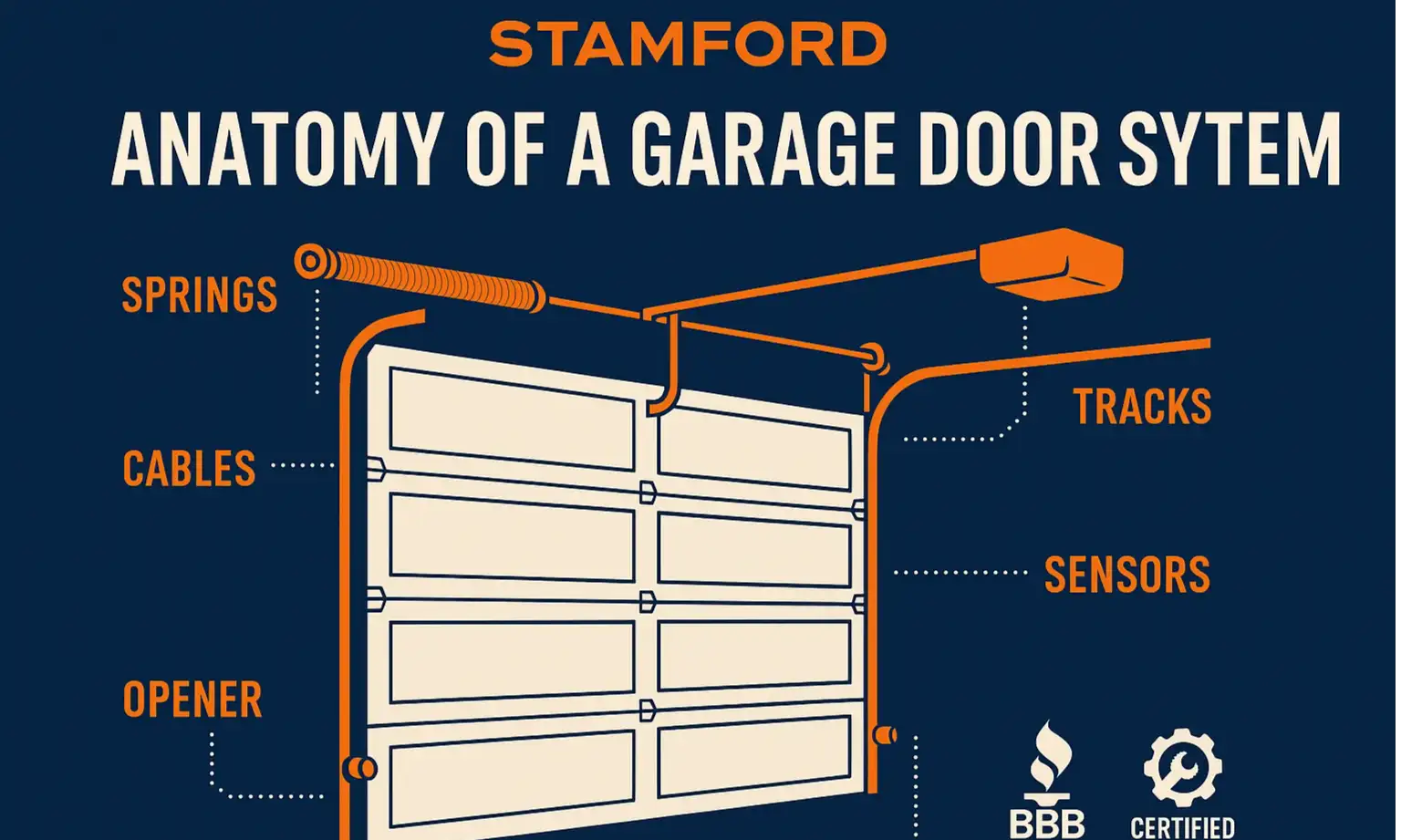
Anatomy of a Garage Door System
This system is a symphony of parts working together. Here are the main players:

  • Springs (Torsion or Extension): The powerhouse of the system.
  • Cables: Connect the springs to the door to transfer the lifting force.
  • Tracks: Guide the door's rollers as it moves up and down.
  • Rollers: The wheels that run inside the tracks.
  • Opener: The motor that automates the process.
  • Sensors: The critical safety feature that prevents the door from closing on an obstruction.
Anatomy of a Garage Door System
Detailed anatomy of a garage door system infographic builds trust by clarifying complex components and showcasing brand certifications to Stamford CT customers.
Anatomy of a Garage Door System

Building: The Symptom & Diagnosis Guide


Your garage door has its own language for telling you something is wrong. Here’s how to translate the signs.

"If You Hear THAT..."

  • Loud Bang: 99% of the time, this is a torsion spring breaking. The noise is from the spring releasing its stored energy all at once.
  • Grinding or Squeaking: This often points to rollers that need lubrication or are worn out. It could also mean the tracks are misaligned.
  • Popping or Banging During Operation: This can be a sign of the door's sections popping into place due to worn-out hinges or rollers.
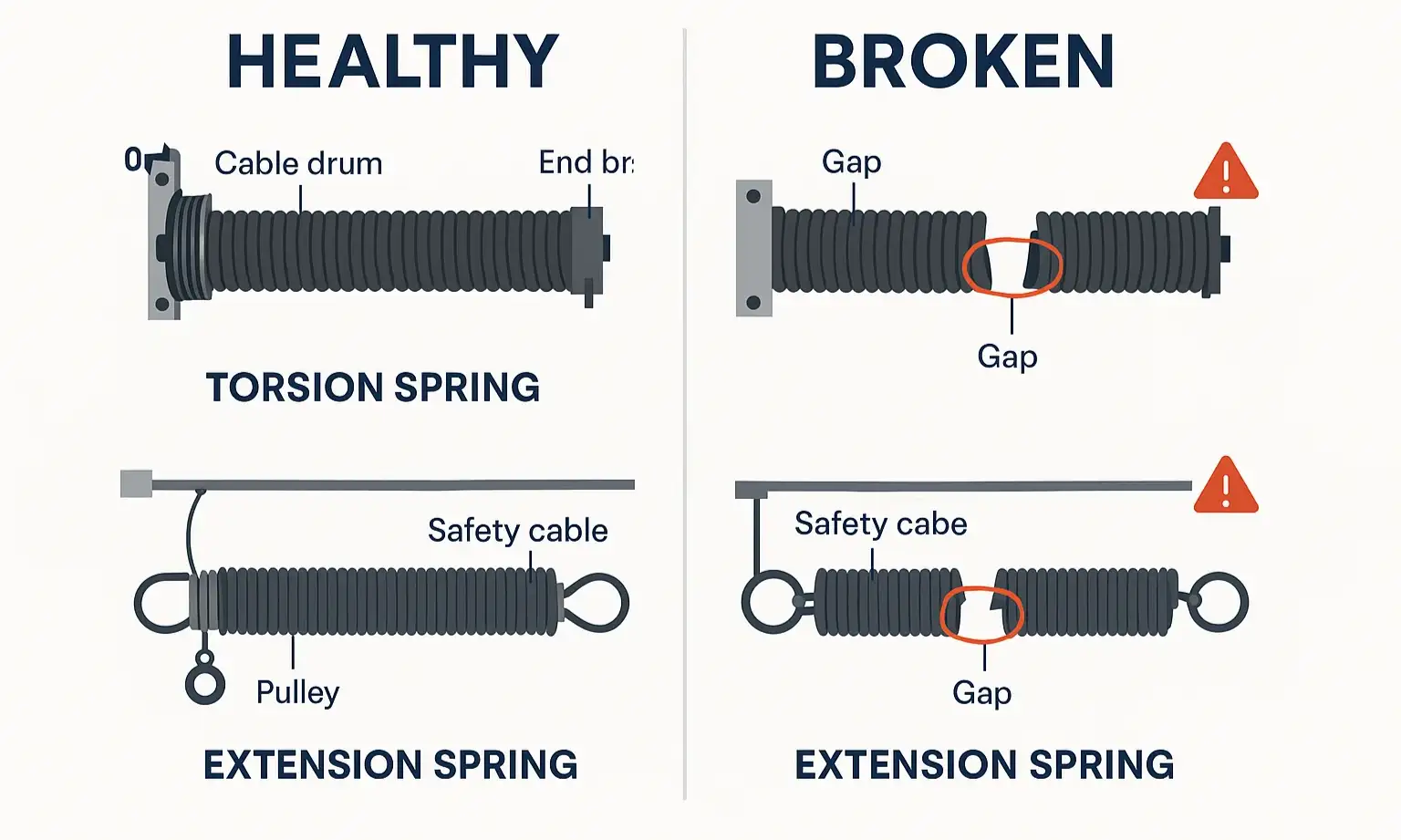
A visual guide to broken garage door springs

"If You See THIS..." (A Visual Glossary)

A picture is worth a thousand words, especially when you're trying to figure out what's wrong in your garage.
One of the most common points of failure is the spring system. You'll likely have one of two types:

  1. Torsion Springs: These are mounted on a metal bar directly above the garage door opening. When one breaks, you'll see a distinct 2-3 inch gap in the spring coil that wasn't there before.
  2. Extension Springs: These run along the sides of the door, parallel to the tracks. A broken extension spring will often be visibly dangling, and you might find a piece of it on the garage floor.
Other visual cues include frayed or snapped cables near the bottom of the door or rollers that have popped out of the tracks, causing the door to look crooked or "off-track."

"If Your Door is Doing THIS..."

  • Opens a few inches, then stops and closes: This is a classic symptom of a broken spring. The opener is trying to lift the full weight of the door on its own, and its safety mechanism kicks in to stop it from burning out the motor.
  • Closes too fast and slams shut: This is extremely dangerous and indicates that the tension system (springs or cables) has failed. The door is essentially in a free-fall.
  • Reverses immediately after hitting the floor: This usually means the "close-limit" setting on your opener needs adjusting. It could also be a sign of an obstruction or misaligned tracks.
A visual guide to broken garage door springs

Mastery: To Repair or Replace? A Stamford Homeowner's Dilemma


Once you've diagnosed the problem, the next question is whether to repair the part or replace a larger component—or even the whole door. Age, the extent of the damage, and cost are the key factors.
For a newer door, repairing a single broken part like a spring or cable is almost always the right call. However, if your door is over 15-20 years old, has multiple issues like rusted panels and worn-out hardware, or has sustained significant damage, a full replacement can be more cost-effective in the long run. Sometimes, the wisest financial decision is to invest in a new system. If you start exploring options for a new garage door installation near me, you're investing in safety, energy efficiency, and curb appeal that a simple repair can't match.

A Note on Safety: Why Some Repairs Aren't DIY Jobs


The internet is full of DIY tutorials for almost anything, but garage door spring repair should never be one of them. Those springs are under an incredible amount of tension, and releasing that energy improperly can cause severe injury or even death. The specialized tools and knowledge required are non-negotiable for a safe repair.
While you should leave springs and cables to the pros, many homeowners search for quick fixes for other issues. In a panic, you might search for things like "garage door opener off tracks near me" or try to diagnose a faulty motor yourself. Be cautious—tampering with the opener's electrical components or trying to force a door back on its tracks can lead to bigger problems and safety risks.

Need more information?

Action: The Safe Stamford Homeowner's Checklist
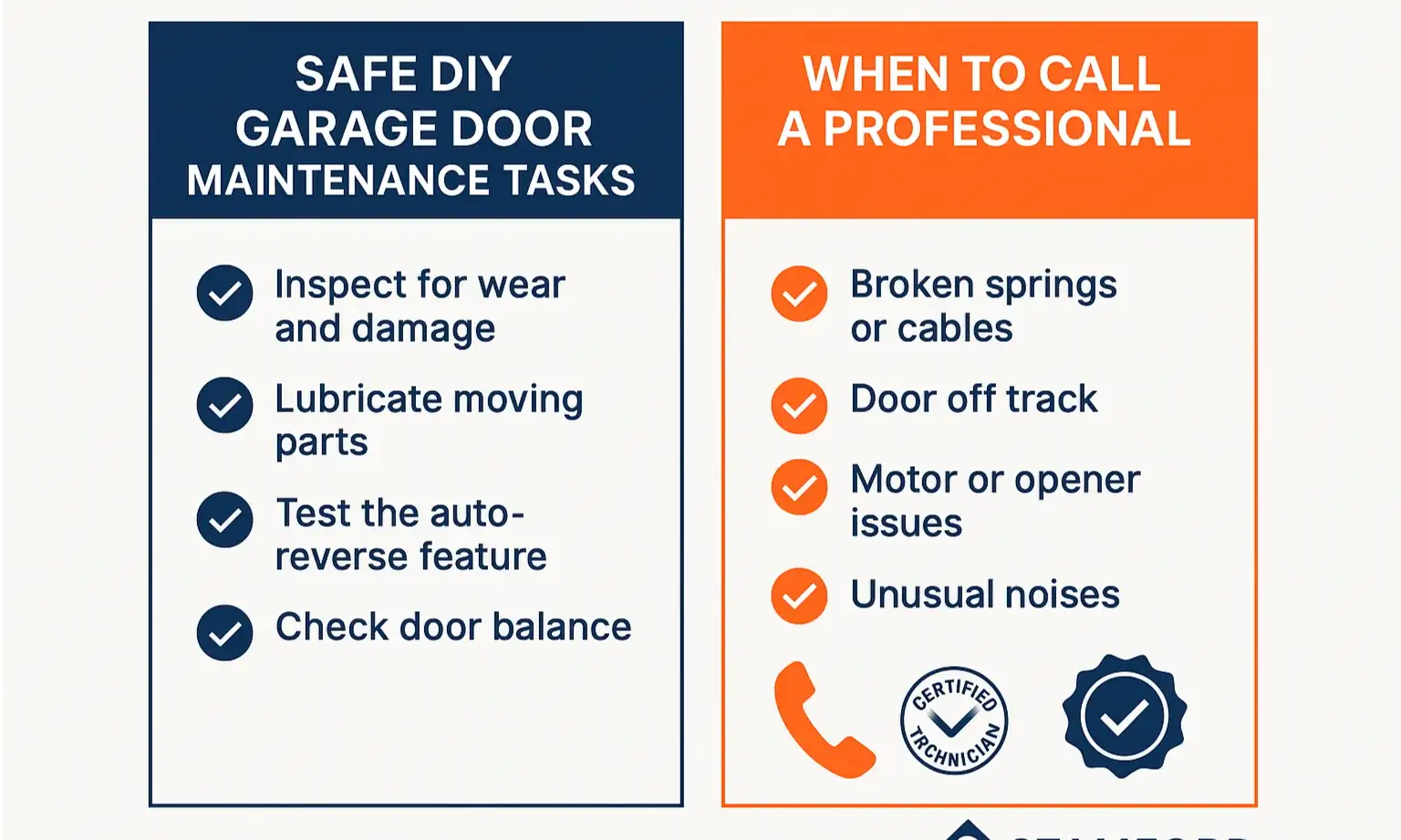

Empowering yourself doesn't mean doing dangerous repairs. It means knowing how to safely maintain your door to prevent issues and knowing when to call for help.
Garage Door Maintenance Checklist
Here are a few things you can do safely:

  • Lubricate Moving Parts: Once or twice a year, use a silicone or white lithium grease spray on the rollers, hinges, and springs to keep things running smoothly. Common Mistake: Avoid using WD-40, as it's a degreaser and can strip away necessary lubricants.
  • Test the Safety Sensors: Place a roll of paper towels on the ground in the door's path. When you press the close button, the door should see the obstruction and immediately reverse. If it doesn't, the sensors need adjusting or replacing.
  • Prepare for Connecticut Winters: Cold and moisture can be tough on a garage door. Ensure the weatherstripping at the bottom of the door is intact to prevent it from freezing to the ground. Keep tracks clear of ice and debris.
Garage Door Maintenance Checklist

Frequently Asked Questions (FAQ)


What was that loud bang in my garage?

That was almost certainly a torsion spring breaking. It's the sound of high-tension steel snapping and releasing its energy. Do not try to operate the door.

Can I still open my garage door with a broken spring?

Manually, it will be extremely heavy and dangerous to lift. Using the automatic opener is a bad idea, as you risk burning out the motor and causing more damage to the system. It's best to leave the door closed until it can be repaired.

Is it dangerous to replace a garage door spring myself?

Yes, extremely. It is one of the most dangerous home repairs a person can attempt without proper training and tools. The stored energy in the springs can cause serious injury. This job is best left to a trained garage door technician.

Why won't my garage door open all the way?

This could be a few things. The most common are a broken spring (the door feels too heavy for the opener), misaligned safety sensors, or the "up-limit" travel setting on your opener needing adjustment.
Your garage door is a key part of your home's security and daily function. By understanding how it works and what to look for, you're better equipped to handle any issue that comes your way. For the simple maintenance tasks, a little proactive care goes a long way. For everything else, knowing who to call is the smartest move you can make.
If you've gone through this guide and realized your door needs professional attention, the family team at Up & Down Garage Doors is here to help. We believe in clear communication and safe, reliable service for our neighbors in Stamford.

You may also like