Our company logo

State

How to Predict When Your Door Springs Will Break


Published: Jan 23, 2026

BANG!

It’s a sound you’ll never forget—a sudden, deafening report from the garage that sounds like a gunshot. Your first thought might be an intruder, but the reality is often more mundane, yet just as startling: a garage door spring has just snapped.

This isn’t just an inconvenience that traps your car; it’s a failure of a component under extreme tension, releasing its stored energy in a split second. Many homeowners assume this event is random, an unavoidable part of homeownership.

But what if you could predict exactly when it would happen? What if you could turn that sudden, expensive emergency into a planned, manageable maintenance task?

You can. And all it takes is a little bit of simple math. This guide will teach you how to read the "ticking clock" on your garage door springs, moving you from reactive panic to proactive peace of mind.

What is a Garage Door Spring "Cycle"? The Secret Language of Longevity


Before we can predict the lifespan of your springs, we need to understand how it’s measured. Forget years—the true measure of a spring's life is the "cycle."
One cycle = One full open and one full close of your garage door.
That’s it. Every time your door goes up and comes back down, you’ve used one cycle. The springs on your door—whether they are torsion springs (a bar-mounted spring above the door) or extension springs (running alongside the tracks)—are the workhorses that do the heavy lifting. To understand more about the specific system you have, it's helpful to learn the difference between a torsion vs extension spring garage door.
Most standard garage door springs are rated for 10,000 cycles. This number is the manufacturer's estimate of how many times the spring can lift and lower your door before it reaches its fatigue limit and is likely to break.
This brings us to a common and costly misconception.
Myth: All garage door springs last about 7-10 years.
Fact: A spring's lifespan is based on usage, not time. A calendar can't tell you when your spring will fail, but your family's daily routine can.

The Lifespan Formula: From Cycles to Calendar Dates
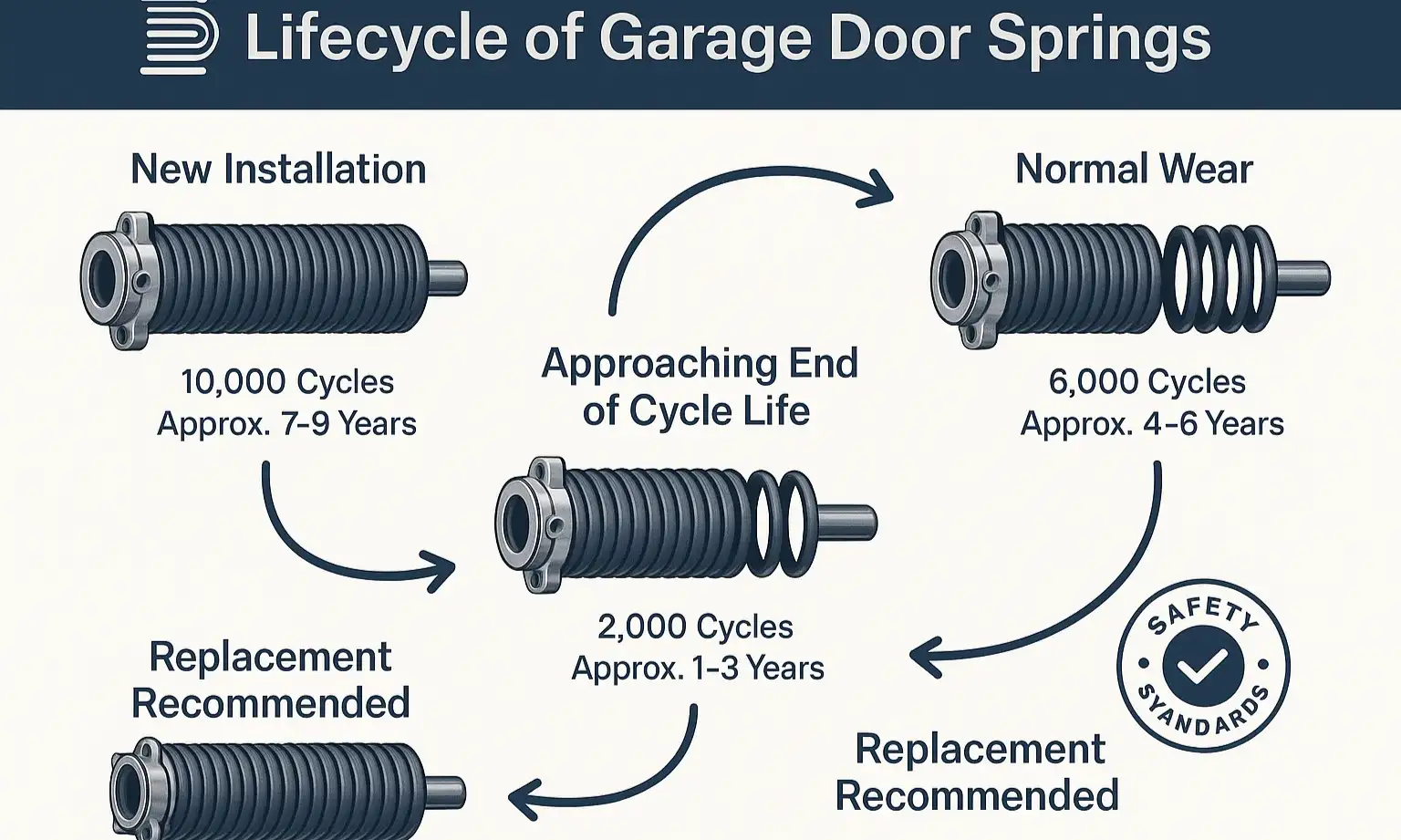

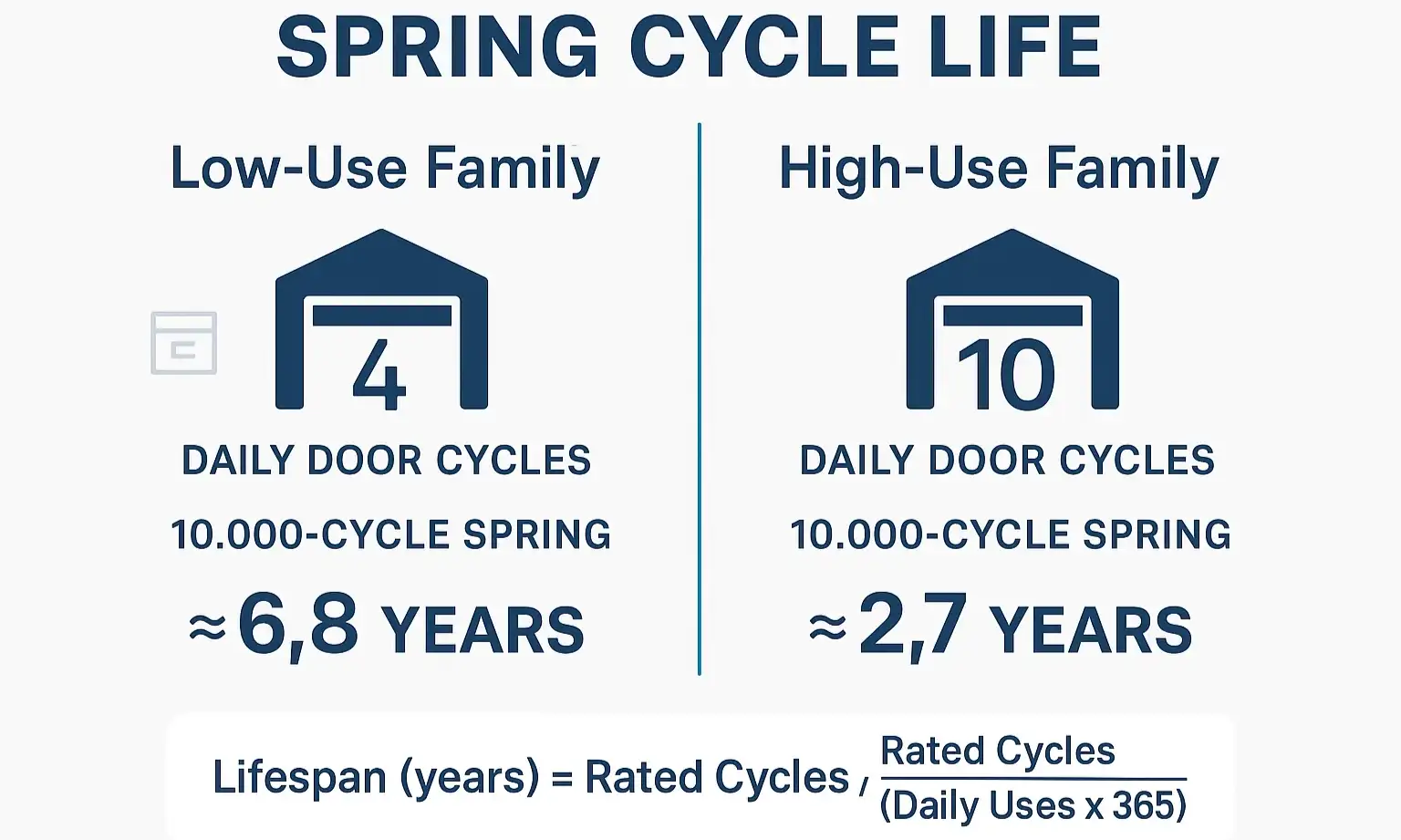
Comparison shows how higher daily garage door use sharply reduces spring lifespan.
Here is the "aha moment" that empowers you to get ahead of a broken spring. With this simple formula, you can translate the abstract 10,000-cycle rating into a tangible, personalized timeframe.
The Formula: Rated Cycles / (Daily Uses x 365 Days) = Lifespan in Years
Let's see how this plays out in two different households, both with standard 10,000-cycle springs:
The Low-Use Household: A couple leaves for work in the morning (1 cycle) and returns in the evening (1 cycle). They might open it one more time for an errand.

  • Daily Uses: 3
  • Calculation: 10,000 / (3 x 365) = 9.1 years
The High-Use Household: A busy family with two working parents and two teenagers who drive. The door opens for school runs, work commutes, after-school activities, and weekend outings.
  • Daily Uses: 10
  • Calculation: 10,000 / (10 x 365) = 2.7 years
Comparison shows how higher daily garage door use sharply reduces spring lifespan.
The same exact springs have a lifespan that differs by over six years! This is why relying on a generic "7-10 year" estimate can lead to a sudden and dangerous failure. Your usage pattern is the single most important factor.

Calculate Your Spring’s Lifespan & Explore Advanced Options


Ready to find your number? Take a moment to think about an average day.
  1. Count Your Daily Cycles: How many times does your garage door open and close? Be honest! Count commutes, school trips, taking out the trash, weekend projects, etc.
  2. Plug it into the Formula: 10,000 / (Your Daily Cycles x 365) = Your Spring's Estimated Lifespan in Years
Evaluate whether investing in high-cycle garage door springs makes sense for your daily usage needs with clear cost and lifespan comparisons.
This simple calculation gives you a powerful piece of information: your target replacement year.

Are High-Cycle Springs Worth It?

Once you know your usage, you can make a more informed decision about your next set of springs. Technicians often offer "high-cycle" springs, rated for 25,000, 50,000, or even 100,000 cycles. Are they just an upsell? Not if you’re a high-use household.
Let's revisit our busy family using the door 10 times a day:

  • Standard 10,000-Cycle Spring: Lasts 2.7 years.
  • High-Cycle 25,000-Cycle Spring: Lasts 6.8 years.
While the initial cost is higher, the high-cycle spring saves them from two additional replacement service calls over the same period, offering long-term value and convenience. For a low-use family, the standard spring is often perfectly adequate.
Of course, cycle count is the primary predictor, but other factors like proper balance, door weight, and regular garage door spring maintenance can also influence the total lifespan.
Evaluate whether investing in high-cycle garage door springs makes sense for your daily usage needs with clear cost and lifespan comparisons.

Your Proactive Maintenance Plan: Staying Ahead of the Break
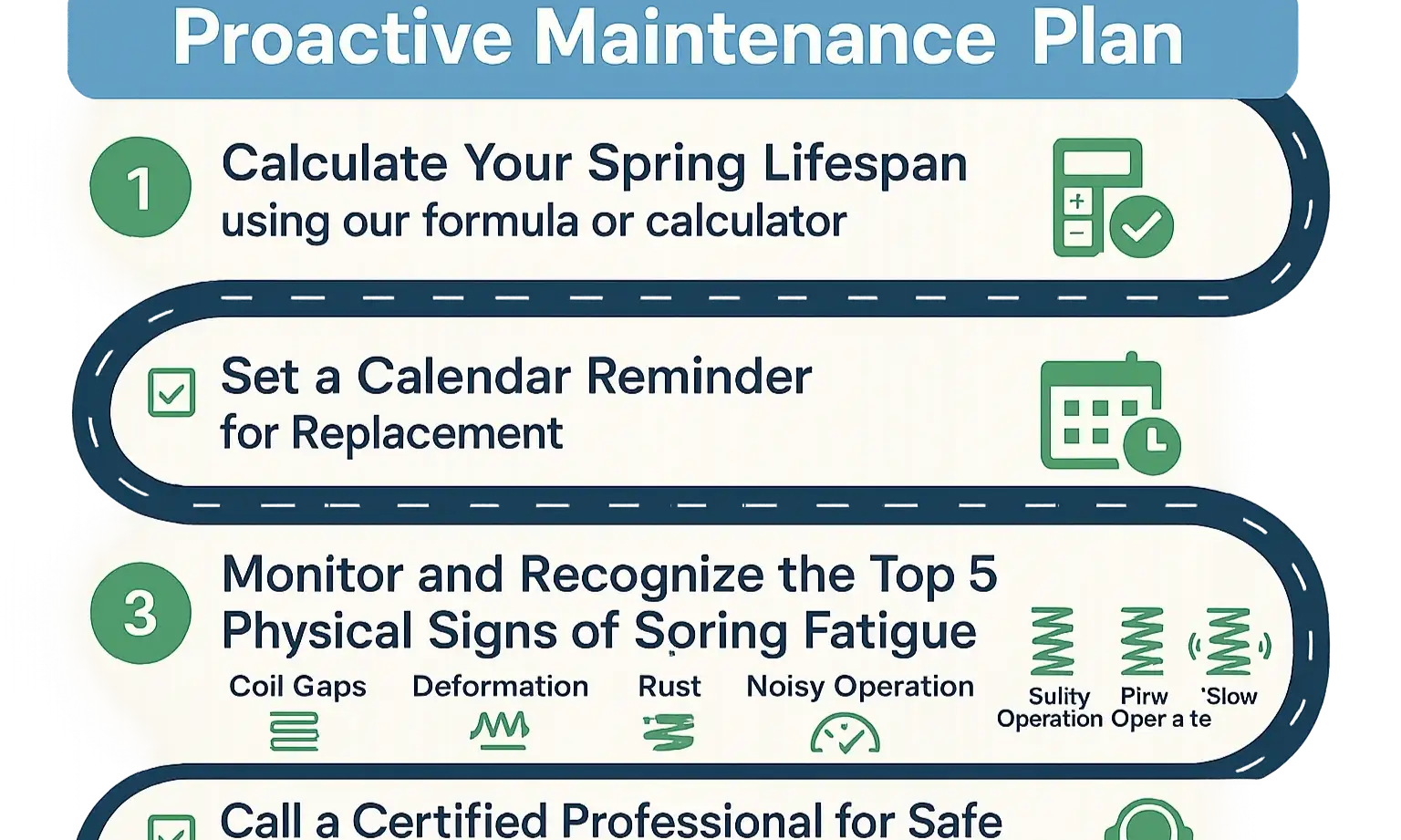

Knowledge is only powerful when you act on it. Now that you've calculated your spring's estimated lifespan, you can create a simple, proactive plan.
Simple roadmap for maintaining garage door springs to reduce breakage and unexpected repair costs.

  1. Calculate Your Replacement Year: Use the formula to determine the year your springs are likely to fail.
  2. Set a Calendar Reminder: Set a reminder for six months before that date. This is your window to schedule a professional inspection and replacement at your convenience, not during an emergency.
  3. Know the Warning Signs: Your calculation predicts the end of life, but sometimes springs fail prematurely. Keep an eye out for the visual garage door spring replacement signs you need to watch for, such as visible gaps in the coils, a door that feels heavy to lift manually, or jerky movements.
  4. Prioritize Safety: Never attempt to adjust or replace garage door springs yourself. The immense tension makes this one of the most dangerous DIY jobs in any home. Understanding the complexity of a professional garage door spring replacement highlights why expert service is essential.
Simple roadmap for maintaining garage door springs to reduce breakage and unexpected repair costs.

Need more information?

Frequently Asked Questions About Garage Door Springs


What happens when a garage door spring breaks?

When a spring breaks, it releases its stored energy instantly, creating a loud bang. The garage door opener will no longer be able to lift the door, as it's not designed to handle the full weight. The door will become incredibly heavy and may slam shut if it was in motion, posing a significant safety risk.

Should I replace both springs at the same time?

Absolutely. Garage door springs are installed at the same time and endure the exact same number of cycles. If one has failed due to metal fatigue, the other is not far behind. Replacing only one creates an imbalance that will strain the opener and cause the older spring to fail soon after, forcing you to pay for another service call.

What are the warning signs of a failing spring?

Besides reaching its calculated cycle life, look for these clues:

  • A visible 2-3 inch gap in the spring's coils.
  • The door feels extremely heavy when you try to lift it manually.
  • The door opens and closes with jerky, inconsistent movements.
  • The opener is straining, and you hear loud groaning or squealing noises.

Can I just keep using a door with a worn-out spring?

Using a door with a failing spring puts enormous strain on your garage door opener, which is designed to manage a balanced load, not lift the full 150-400 pounds of the door on its own. This can quickly burn out the opener's motor, turning a single repair into a much more expensive replacement of the entire system.

The Takeaway: From Guesswork to Peace of Mind


Understanding cycle life is about more than just garage doors; it’s about taking control of your home maintenance. By investing a few minutes to do some simple math, you can demystify one of the most common and disruptive home repairs. You can save money, avoid the stress of an emergency, and ensure your garage door continues to operate safely and reliably.
When your calendar reminder goes off, or if you notice any of the warning signs, don't wait for the bang. A professional inspection can confirm the health of your system. When it's time for a replacement, trust our experts to properly fit and install your garage door springs for safe, balanced, and long-lasting operation.

You may also like