Our company logo

State

A Guide to Intermittent Garage Door Sensor Failure


Published: Jan 22, 2026

It’s one of the most maddening homeowner mysteries. Your garage door works perfectly for weeks, then one sunny afternoon, it refuses to close. You check for obstructions, see nothing, try again, and it works. The next day, same problem. Or maybe it only acts up when it’s damp and rainy.

If you’re dealing with a garage door that plays by its own rules, you’re not alone. This unpredictable behavior isn't a sign that your door is haunted; it's a classic symptom of intermittent sensor failure.

The biggest "aha moment" for homeowners is realizing that garage door sensors don't just work or break—they degrade. Like any electronic component, they can start to show their age in strange, inconsistent ways long before they fail completely. Understanding these early warning signs is the key to catching a small annoyance before it becomes a major safety issue.

This guide will walk you through the subtle signs of a failing sensor, helping you diagnose those "sometimes" problems that other troubleshooting guides often miss.

How Your Garage Door Sensors "See" the World


Before we dive into the problems, let's quickly cover how your garage door sensors work. Think of them as an invisible tripwire stretched across your garage opening.

  • One sensor (the sender) shoots a focused beam of infrared light to the other sensor (the receiver).
  • As long as the receiver "sees" the beam, it tells the garage door opener, "All clear! You can close."
  • If anything breaks that beam—a child, a pet, your car—the receiver immediately signals the opener to reverse the door.
A complete failure is simple: the beam is permanently broken, and the door won't close at all. Intermittent failure is more complex. It means the tripwire is sometimes strong and sometimes weak, or that the receiver is sometimes getting blinded or confused.

The 5 Most Common Causes of Intermittent Failure


When your door’s behavior is inconsistent, it's usually due to one of these five culprits. They often masquerade as a completely broken system, but they have unique tells you can spot.

1. Slight Misalignment (The Vibration Problem)

Every time your garage door rumbles up and down its tracks, it creates small vibrations. Over months and years, these vibrations can act like a tiny, persistent nudge, slowly knocking one of the sensors out of perfect alignment.
It might not be enough to fail every time. But a slight shift can make the infrared beam hit the edge of the receiver's lens instead of the center. On a clear day, that might be fine. But add a little dust or a foggy morning, and the weakened signal is enough to trigger a reversal.
How to spot it: The problem seems random, with no clear pattern related to weather or time of day. You may notice one of the sensor's LED lights flickering faintly. Getting the perfect garage door sensor alignment is crucial, and even a millimeter's difference can be the source of your headache.

2. Sunlight Interference (The "Blinding" Effect)
This is one of the most common yet misunderstood issues. Homeowners often ask, "Why does my sensor only fail in the afternoon?" The answer is the sun.
The infrared beam from your sender sensor is relatively weak. The sun, however, is an incredibly powerful source of broad-spectrum light, including infrared. If direct sunlight hits the receiving sensor's "eye" at just the right angle, it completely overwhelms it.
Think of it this way: you’re in a dark room trying to see a small flashlight beam. It’s easy. Now, imagine someone shines a massive spotlight directly into your eyes. You won't be able to see that little flashlight beam anymore. That's exactly what's happening to your sensor. This is especially common in the mornings or late afternoons when the sun is low in the sky and can shine straight into the garage.
How to spot it: The garage door fails to close at specific times of day, almost like clockwork, on sunny days.
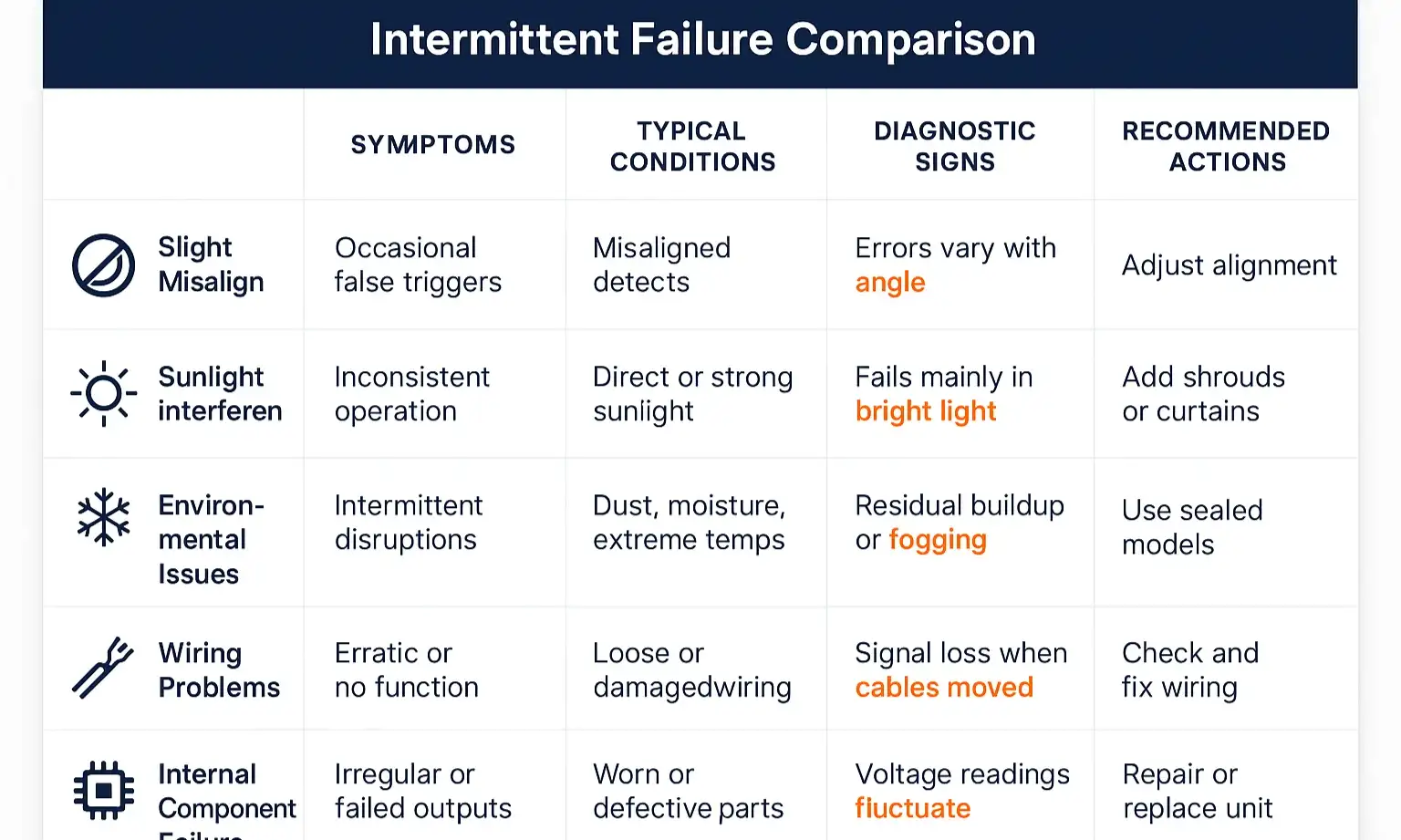
Table comparing causes, symptoms, and fixes for intermittent garage door sensor failures.

3. Environmental Issues & Debris

Your sensors live a tough life near the floor. They're exposed to dust, dirt, cobwebs, rain, and condensation. A thin layer of grime on the lens or a drop of moisture can be enough to partially obstruct the infrared beam.
This creates a "weak" signal that might work most of the time but fails when other minor issues are present, like a slight misalignment or high humidity in the air.
How to spot it: The problem is more frequent on rainy, foggy, or dewy mornings. A quick wipe of the sensor lenses with a soft, dry cloth often temporarily solves the problem.

4. Failing Wires

The low-voltage wires connecting your sensors to the opener unit can become damaged over time. A staple might have nicked the insulation, a rodent could have chewed on it, or simple corrosion could be setting in at a connection point.
This can create an "intermittent short," where the electrical connection is briefly lost when the wire is moved or when temperature and humidity changes cause it to expand or contract. The sensor loses power for a split second—just long enough to trigger a failure—and then works again.
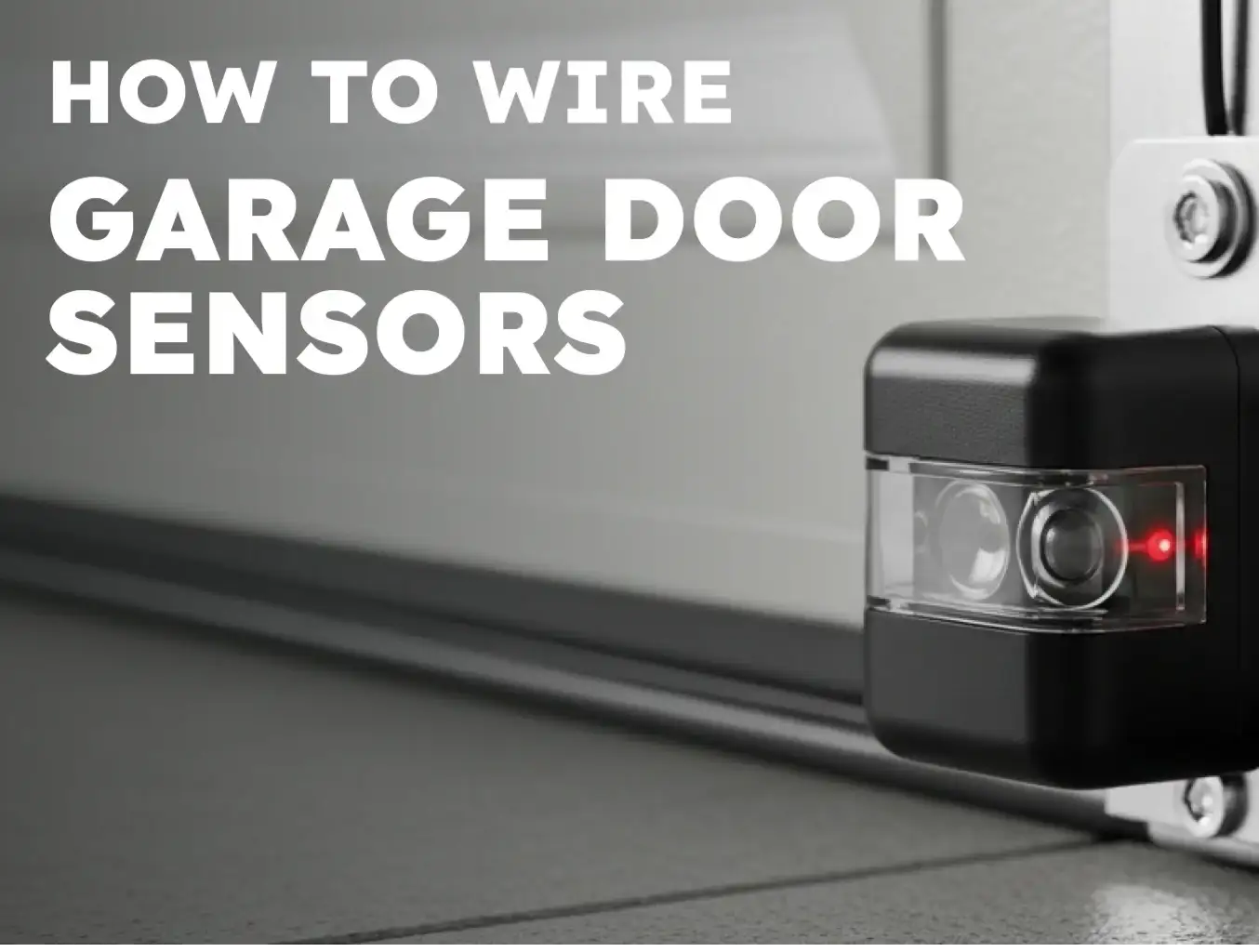
How to spot it: The failure is completely erratic and unpredictable. Jiggling the wires at the back of the sensor or at the opener unit might cause the sensor's LED light to flicker. For those comfortable with diagnostics, a detailed garage door sensor wiring guide can help you trace the issue.

5. Internal Component Failure

Sometimes, the problem isn't the alignment, the sun, or the wires—it's the electronics inside the sensor itself. After thousands of hours of operation, the infrared emitter can grow weak or the receiver's circuitry can become less sensitive.
This is a classic sign of aging. The system is simply wearing out. The sensors might work in perfect conditions but fail at the slightest provocation, like a hazy day or a bit of dust.
Myth Buster: A common mistake is thinking, "The lights are on, so the sensors must be fine." This is false. The indicator lights (often a green or amber/orange light) only confirm that the sensors have power and are roughly aligned. They don't tell you if the internal electronics are sending or receiving a strong, clear signal. You can have solid lights and still have a failing sensor. For instance, a garage door sensor orange light often indicates a specific type of issue that needs addressing.

Table comparing causes, symptoms, and fixes for intermittent garage door sensor failures.

Mastery: The Advanced Diagnostic Checklist


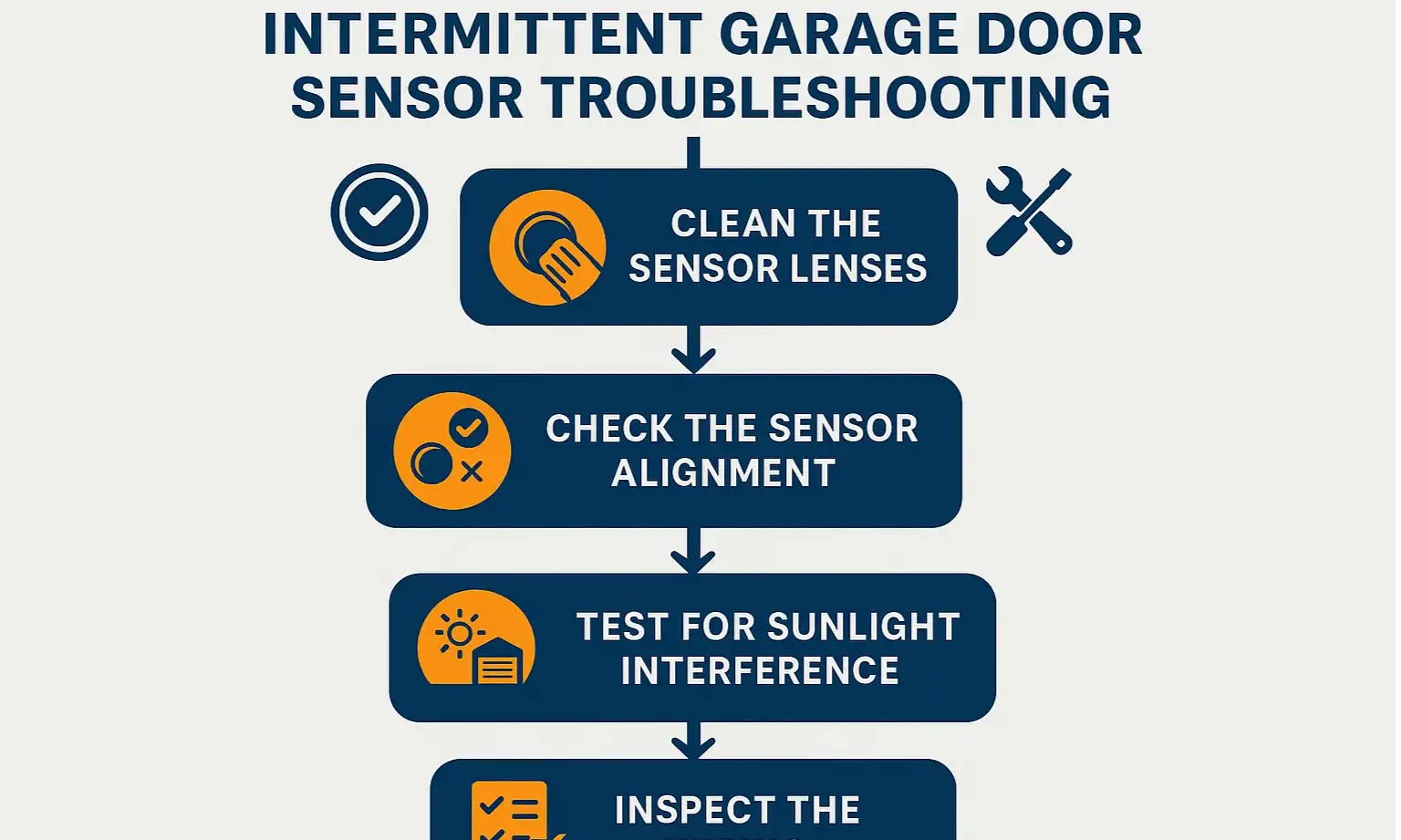
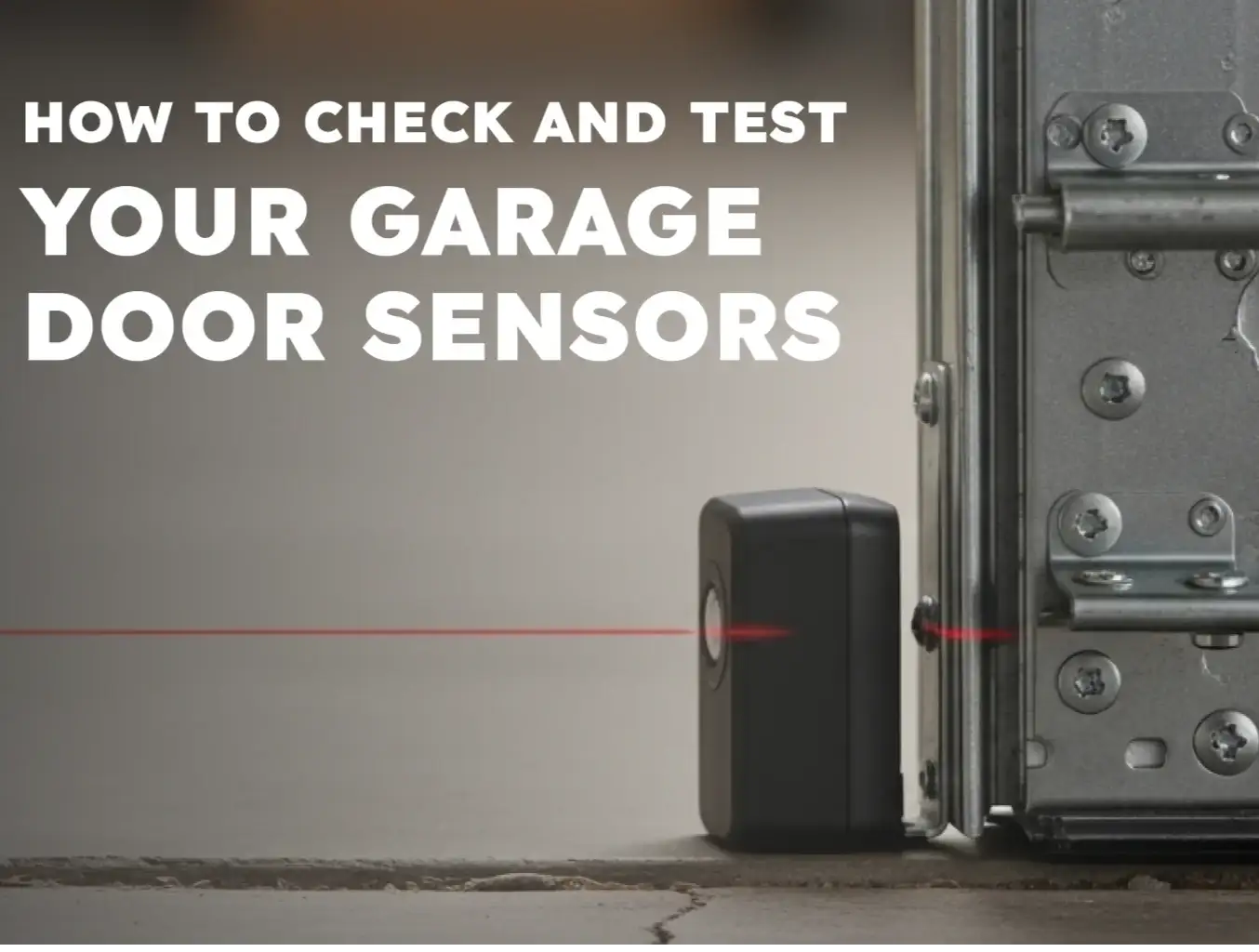
Ready to play detective? Follow these steps from simplest to most complex to pinpoint the exact cause of your intermittent sensor issue.

Step 1: The Clean & Wiggle Test.

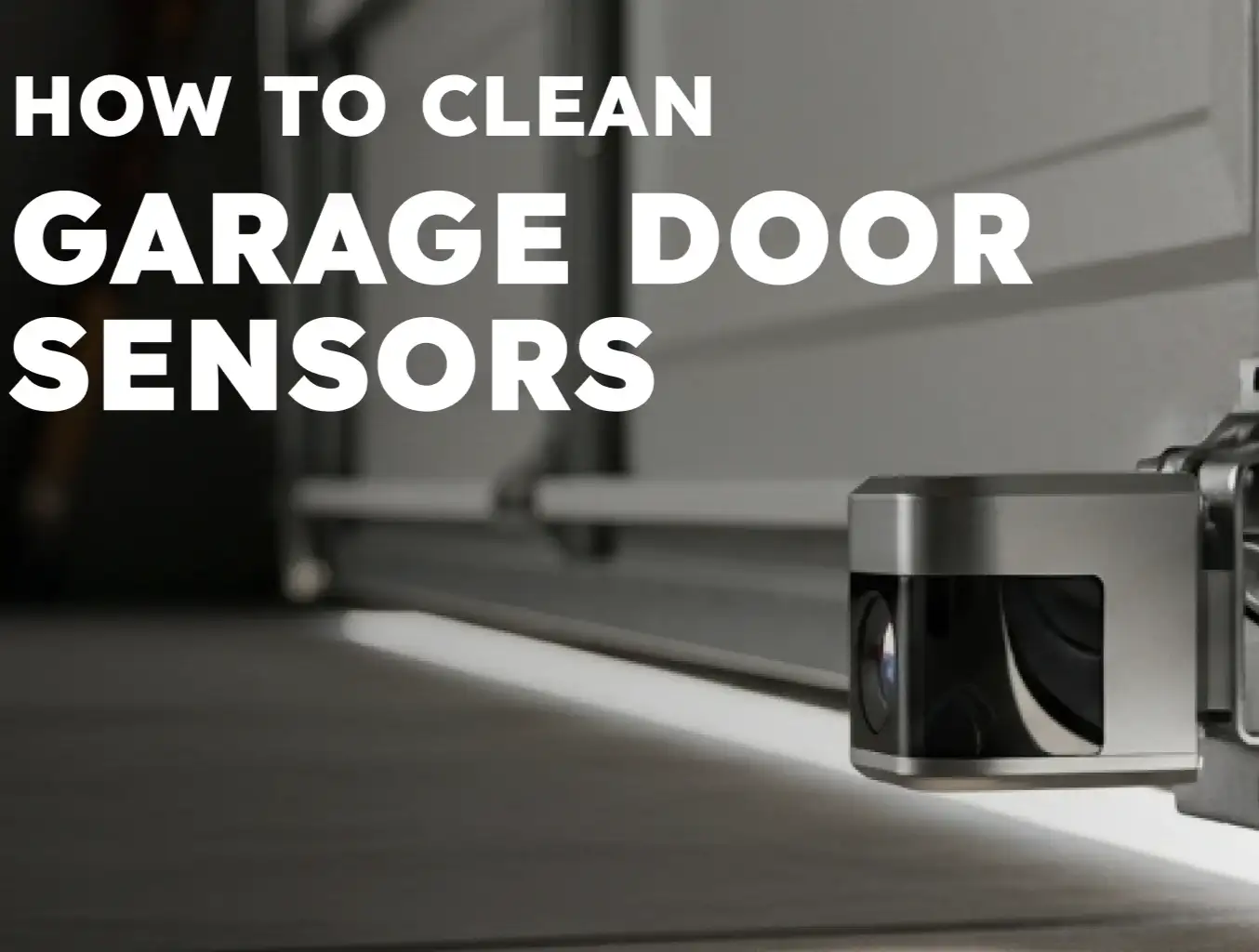
Take a clean, soft cloth and gently wipe the lenses of both sensors.
Gently wiggle each sensor. Does the LED light flicker? If so, the bracket is loose or the wiring right behind the unit is faulty. Tighten the mounting brackets.

Step 2: The Alignment Check.

Look at the LED lights on both sensors. Most systems have a sending unit and a receiving unit, each with its own light. A solid, steady light on both is a good sign.
If one is flickering or off, gently bend the bracket with your hands until both lights are solid. Have a helper try to close the door while you adjust.
Diagnostic checklist graphic for garage door sensors covering inspection, cleaning, alignment, sunlight, and wiring checks.

Step 3: The Cardboard Tube Test (For Sunlight).

If you suspect sunlight is the culprit, wait for a time of day when the door typically fails.
Take an empty paper towel or toilet paper tube and place it over the receiving sensor (the one that typically has the green light). This creates a "tunnel" that shields the sensor's eye from ambient sunlight while still allowing it to see the focused beam from the sender.
If the door closes consistently with the tube in place, you’ve found your problem: sunlight interference. You can solve this by swapping the sender and receiver so the sun hits the sender, or by purchasing commercial sensor sun shields.

Step 4: The Obstruction Test.

With the door open, block the sensors with a box or piece of wood. The lights on the sensors should change (e.g., the green light on the receiver will turn off).
Remove the obstruction. The lights should immediately return to their normal "solid on" state. If there's a delay or the lights flicker, the sensors are getting weak.

Step 5: The Wiring Inspection.

Visually inspect the wire from each sensor all the way back to the motor unit. Look for any obvious signs of damage, such as fraying, kinks, or areas where the wire is stretched tight.
Check the connections at the back of the opener motor. Are the wires securely fastened in their terminals? Give them a gentle tug to be sure.

Diagnostic checklist graphic for garage door sensors covering inspection, cleaning, alignment, sunlight, and wiring checks.

Need more information?

When to Repair vs. When to Replace


After running through the checklist, you should have a much clearer idea of the problem. Here’s how to decide on the next step:

  • You can likely DIY the fix if: The issue is a simple misalignment, dirty lenses, or a loose mounting bracket. These are quick adjustments that require no special tools.
  • You should consider replacing the sensors if: The "cardboard tube test" proves sunlight is the issue (and swapping sides doesn't help), the internal components are clearly failing (flickering lights despite perfect alignment), or the sensor casing is physically cracked and damaged. Knowing how long do garage door sensors last (typically 10-15 years) can help you decide if they're due for an upgrade. A full garage door safety sensor installation is a manageable project for many homeowners.
  • You should call a professional if: You suspect a wiring short, you're not comfortable working with electrical components, or you've tried all the DIY steps and the problem persists. Professional technicians can quickly diagnose complex wiring issues and ensure the system is both functional and safe.

Frequently Asked Questions


Can a garage door sensor be bad if the light is on?

Absolutely. This is the most common misconception. The LED light only confirms two things: the sensor has power and it's aligned well enough to see the other sensor. It does not guarantee the internal electronics are working correctly. The sensor can be "weak" and unable to send or receive a strong signal, causing intermittent failures even with solid lights.

Why do my garage door sensors work in the morning but not the afternoon?

This is almost always due to direct sunlight interference. As the sun moves across the sky, its angle changes. In the afternoon, it may be shining directly into the receiving sensor's lens, blinding it and preventing it from seeing the infrared beam from the sending sensor. Try the "Cardboard Tube Test" to confirm.

Can humidity or rain cause my garage door sensors to fail?

Yes. High humidity can cause condensation to form on the sensor lenses, which obstructs the beam just like dirt or dust. In very heavy rain or fog, the moisture in the air itself can sometimes be dense enough to scatter the infrared beam and cause a failure, especially if the sensors are already slightly misaligned or getting old.

Is it safe to bypass my garage door sensors?

No. It is extremely dangerous and against federal law for professionally installed doors. The safety sensors are the most critical safety feature of a modern garage door opener. Learning how to bypass safety sensors on garage door should only be for emergency situations, and the system should be repaired properly as soon as possible. Bypassing them removes the protection that prevents the door from closing on a person, pet, or object.

How do I know if the problem is my sensors or my opener?

Your opener unit will usually tell you. When the door reverses unexpectedly due to a sensor issue, the main light on the motor unit will typically flash a specific error code. For most brands (like LiftMaster and Chamberlain), flashing 10 times indicates a sensor problem. Check your owner's manual for your specific model's diagnostic codes.

You may also like