





Roll-Up vs. Sectional Doors for High-Traffic Commercial Loading Docks
Published: Apr 24, 2026
Choosing the wrong commercial door for your loading dock can cost you thousands of dollars a year in lost energy, unexpected repairs, and operational downtime. It’s a decision that goes far beyond the initial quote. You’re not just buying a door; you’re investing in a critical piece of equipment that impacts your facility’s productivity, security, and energy efficiency every single day.
Many business owners focus on the upfront price, only to find themselves paying for it later with frequent service calls or soaring energy bills. This guide helps you shift the focus from sticker price to lifetime value. We’ll break down the real-world differences between sectional and roll-up doors in a high-traffic environment, so you can make a choice that protects your bottom line for years to come.
The Fundamental Difference: How They Work in 60 Seconds
Before we dive into the details, let’s get a clear picture of how these two doors operate. Understanding their basic mechanics is the first step to seeing why one might be a better fit for your busy loading dock.
- Sectional Doors: Think of a typical residential garage door. They are made of large, horizontal panels (sections) connected by hinges. When the door opens, these panels slide up and back on a track system that runs along the ceiling. They essentially “park” overhead when fully open.
- Roll-Up Doors: Also known as coiling doors, these are built from much smaller, interlocking slats. When opened, the door rolls up and coils tightly into a drum directly above the opening. This design is incredibly compact and self-contained.
The core difference lies in their footprint. Sectional doors require significant overhead space for their tracks, while roll-up doors keep that ceiling space clear. This simple mechanical distinction has major implications for durability, speed, and even where you can place lighting or fire suppression systems.
The 5 Critical Factors for High-Traffic Docks
In a high-cycle environment like a warehouse or distribution center, a door isn’t just a barrier—it’s a workhorse. Here are the five factors that truly matter when making your decision.
Durability & Uptime: It’s All About the Cycle Life
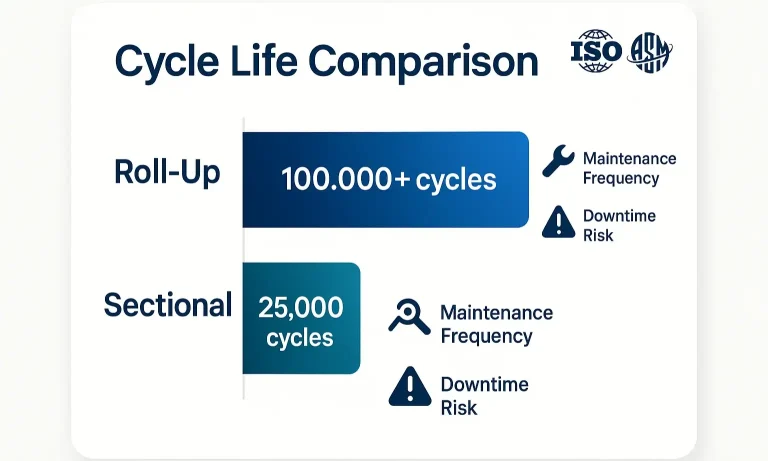
How many times will your door open and close each day? This number is the single most important factor in determining long-term durability. Every commercial door has a “cycle life” rating, which is the estimated number of open-and-close cycles the springs and hardware can handle before failure.
- Standard Doors: Might be rated for 25,000 cycles.
- Heavy-Duty/High-Cycle Doors: Can be rated for 100,000, 500,000, or even more.
Let’s put that in perspective. If your dock door opens 50 times a day for 250 workdays, that’s 12,500 cycles per year. A standard door might last only two years before needing major repairs, while a high-cycle door is built to last eight years or more under the same conditions. While roll-up doors are often engineered for higher cycle counts due to their robust design, heavy-duty sectional options are also available. The key is to match the door’s rating to your operational needs to minimize downtime and avoid some of the most common garage door maintenance mistakes.
Speed & Productivity: How a Few Seconds Save Thousands
Door speed isn’t a luxury; it’s a productivity multiplier. A high-speed door that opens at 24 inches per second compared to a standard door at 12 inches per second can save several seconds per cycle.
This may not sound like much, but across hundreds of cycles per day, it adds up to hours of saved labor and reduced forklift waiting time each year. Faster doors also minimize the time your dock is exposed to the elements, improving climate control and reducing energy loss. Exploring the benefits of high-speed garage door systems can reveal significant operational advantages you may not have considered. Generally, high-performance roll-up doors offer the highest speeds, but modern sectional doors can also be equipped with high-speed operators.
Space & Headroom: Visualizing the Footprint
This is where many facilities run into an unexpected roadblock. The amount of clearance you have above the door opening (headroom) and inside the building can immediately rule out one type of door.
- Sectional Doors require significant headroom and backroom. The tracks need to extend horizontally into the building, potentially interfering with lights, sprinklers, or overhead cranes.
- Roll-Up Doors are the ideal solution for tight spaces. Because the door coils into a compact drum, it requires very little headroom and almost no backroom, freeing up valuable ceiling space.
- Sectional Doors typically offer superior insulation. Their thick, insulated foam-core panels can achieve very high R-values, making them the go-to choice for environments where temperature stability is critical.
- Roll-Up Doors, particularly standard steel slat doors, often have lower R-values. However, insulated slats are available that significantly improve their thermal performance.
The roll up door installation process highlights this spatial efficiency, making it a critical consideration during the planning phase.
Insulation & Energy Costs: Protecting Your Bottom Line
For climate-controlled facilities like food-grade warehouses or pharmaceutical plants, insulation is non-negotiable. The door’s ability to resist heat transfer is measured by its R-value—the higher the R-value, the better the insulation.
If maintaining a specific temperature is a top priority, a well-insulated sectional door is often the most energy-efficient choice. You can learn more about the principles by seeing how to insulate a garage door for maximum thermal efficiency.
Total Cost of Ownership (TCO): The Most Overlooked Factor
Common Mistake #1: Choosing a door based on upfront cost alone.
The true cost of a commercial door isn’t the purchase price; it’s the Total Cost of Ownership over its entire lifespan. This includes the initial purchase, installation, energy costs, and, most importantly, maintenance and repairs.
A cheaper, lower-cycle door might save you money today, but it will likely lead to higher repair bills and costly downtime in a high-traffic setting. Conversely, investing in a durable, high-cycle door may cost more upfront but will save you money through greater reliability and lower energy consumption. A proactive commercial garage door maintenance plan is essential, but starting with the right door is the best first step.
Making the Right Choice: Which Door Fits Your Operation?
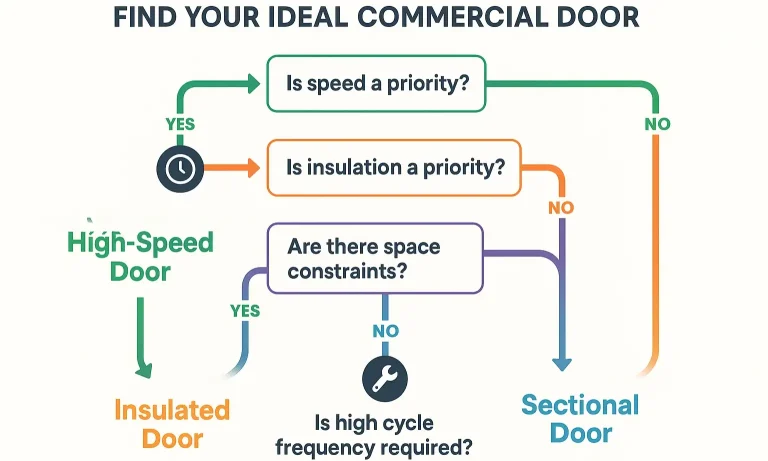
So, how do you decide? Instead of a simple “A vs. B” comparison, let your operational priorities guide you. This decision tree can help you determine the best path for your facility’s needs when considering commercial garage doors.
- If your #1 priority is MAXIMUM INSULATION: Start by looking at insulated sectional doors. Their panel design provides the best thermal protection for climate-controlled environments.
- If your #1 priority is DURABILITY AND HIGH CYCLES: A heavy-duty steel roll-up door is often the champion. Their simpler design with fewer moving parts (like rollers and hinges) often withstands extreme use better.
- If you have LIMITED HEADROOM or CEILING OBSTRUCTIONS: A roll-up door is your only practical option. Its compact coil is the perfect solution for tight spaces.
- If your #1 priority is SPEED AND PRODUCTIVITY: High-performance roll-up doors typically offer the fastest opening and closing speeds, minimizing wait times and exposure to the elements.
Frequently Asked Questions (FAQ)
What’s the main difference between roll-up and sectional doors?
The primary difference is how they open and the space they require. Sectional doors are made of large panels that slide on overhead tracks, requiring significant ceiling space. Roll-up doors are made of smaller slats that coil into a compact drum just above the door opening. For a more detailed look, you can compare the pros and cons of sectional vs roll up garage doors.
Which one is more durable for a busy warehouse?
Both can be durable, but it depends on the model. For extreme, high-cycle applications (100+ cycles/day), heavy-duty roll-up doors often have an edge due to their simpler, more robust construction. However, a high-cycle sectional door can also be very reliable. The key is to check the manufacturer’s cycle life rating.
What is the typical price difference?
Generally, a standard sectional door may have a lower upfront cost than a standard roll-up door. However, when you move into heavy-duty, high-cycle models, the prices can become very comparable. Always focus on the Total Cost of Ownership (TCO) rather than just the initial purchase price.
How much headroom do I actually need?
This varies by model, but as a rule of thumb, sectional doors may require 24 inches or more of headroom, while roll-up doors can sometimes be installed with as little as 12-18 inches. Always have a professional measure your space to confirm the exact requirements.
Your Next Step: Ensuring a Flawless Installation
Choosing the right door is half the battle. The other half is ensuring it’s installed correctly. A professional garage door installation is critical for the safety, performance, and longevity of your investment. An improperly installed door can lead to premature wear, operational hazards, and voided warranties.
By focusing on your unique operational needs and looking at the long-term value, you can confidently select a commercial door that will serve as a reliable asset, not a recurring headache.
You May Also Like
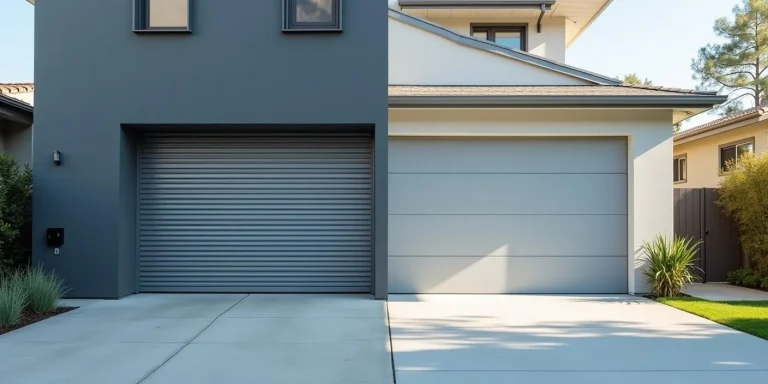
Sectional vs. Roll-Up Garage Doors: What’s Best?
Over time, garage doors have changed in both functionality and design to provide the convenience we rely on today. However, where there’s a plus, there’s also, unfortunately, a minus. The variety of options available…
Published Date: Jan 16, 2025
Sectional Overhead Garage Door Benefits, Uses, and Design Options
A sectional overhead garage door is one of the most common and trusted garage door styles used across the USA. It works well in homes, commercial buildings, and industrial spaces because it saves space, looks clean,…
Published Date: Dec 22, 2025
What Is a Sectional Garage Door: Benefits & Design
If you’re considering a new garage door for your home or building, you might be asking: What is a sectional garage door? Why is it such a common choice? These doors are made of hinged horizontal panels that open…
Published Date: Dec 10, 2025