





Garage Door Motor Troubleshooting: The Expert Guide to Diagnostics and Repair
Published: Jun 30, 2026
When evaluating garage door opener troubleshooting pathways, making the wrong call can destroy your opener’s motor or, worse, lead to severe injury. According to National Electronic Injury Surveillance System (NEISS) data, over 20,000 garage door-related injuries occur annually in the US. Industry statistics show that DIY repairs carry a 4.2 times higher injury rate than professional work, often leaving 68% of auto-reverse safety sensors non-functional.
To help you safely triage your system, we have built this diagnostic guide to isolate your problem in seconds.
Emergency 10-Second Safety Triage
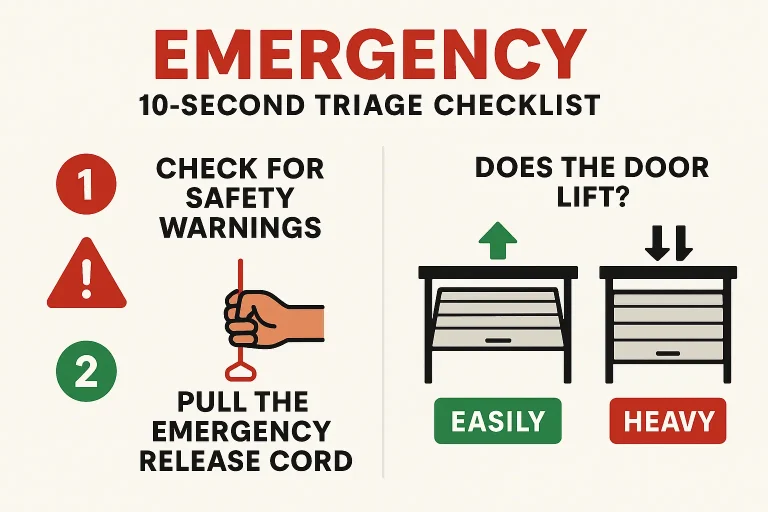
Before touching any tools, you must determine if your issue is electrical (the motor unit) or mechanical (the door weight, tracks, or springs).
To safely isolate the issue, pull your red garage door emergency release cord. This detaches the door from the automated trolley assembly.
- If you can lift the door easily with one hand: Your mechanical balance is correct. The failure point lies within your motor, logic board, or power supply.
- If the door feels incredibly heavy or won’t budge: STOP. Do not attempt to run the motor. You likely have a broken torsion spring. Running the motor under this load will instantly burn out the gear assembly or start capacitor. Read our guide on how to tell if your garage door spring is broken to confirm this.
Sound & Symptom Diagnostic Matrix
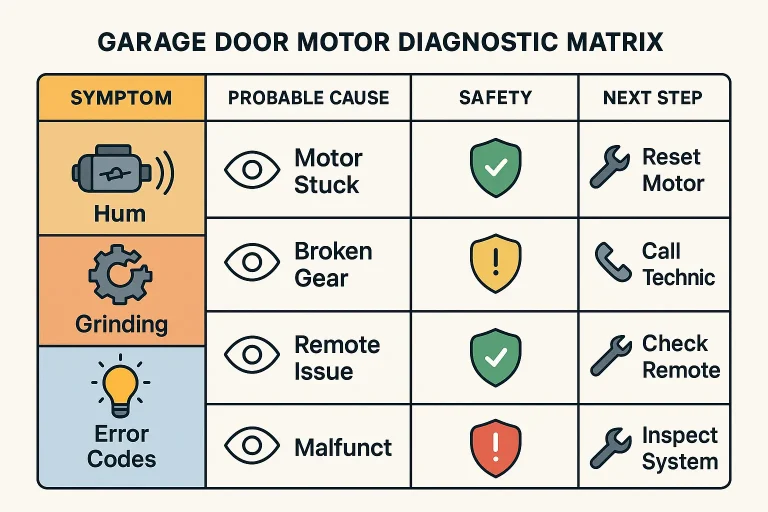
Your garage door opener communicates its health through sensory cues.
Use this matrix to identify the failure point by sound and symptom.
If your garage door will not open but motor is running, you are typically dealing with a stripped nylon drive gear or a disengaged emergency release carriage. If it hums continuously but cannot generate torque, your start capacitor is failing.
Deep-Dive Troubleshooting Modules
The Capacitor vs. Drive Gear Failure
When your motor hums for several seconds without moving the door, the culprit is usually a failing start capacitor. The capacitor acts as a battery boost, delivering the surge torque required to launch the motor. If it is swollen, bulging, or leaking oil, it must be replaced.
Alternatively, if the motor runs smoothly but the chain or belt remains stationary while emitting a grinding noise, look at the base of the chassis. If you see white, snowy plastic shavings inside the casing, your nylon drive gear has stripped against the metal worm gear. This requires disassembling the housing to install a gear-and-sprocket kit.
Troubleshooting Garage Door Remote Control Issues
If your wall console functions but your transmitter fails, a common culprit is radio frequency (RF) signal interference.
Many homeowners are unaware that modern LED light bulbs installed inside the motor housing emit electromagnetic interference on the 300-400MHz band. This RF noise blocks the signal, causing a garage door remote not working scenario unless you are standing inches from the receiver. Switching to specialized, shielded garage-door-safe LED bulbs immediately solves this issue.
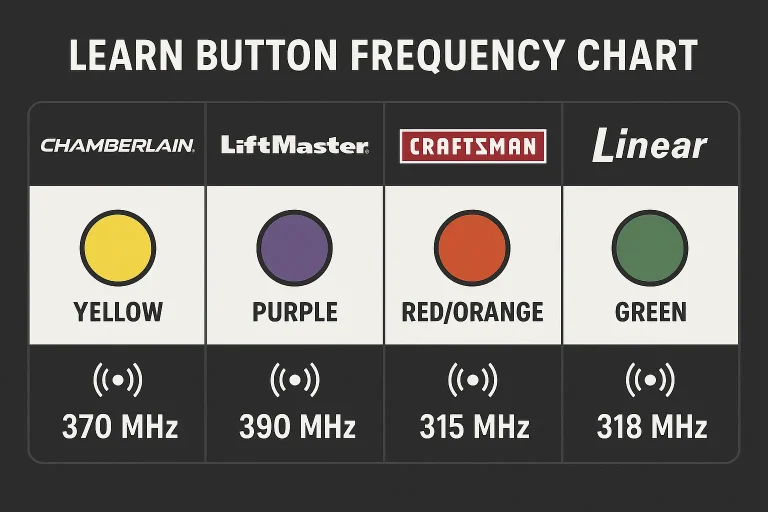
To re-pair your remotes, locate the smart learn button on garage door opener housings. The color of this button determines the specific garage door remote frequency your system uses (such as 315MHz or 390MHz) and dictates which remotes are compatible.
Faulty Logic Boards and Sensors
If your unit is dead after a lightning storm, or clicks rapidly without attempting to spin, the logic board is likely damaged. Look for diagnostic LED blink codes on the rear panel. For instance, Chamberlain and LiftMaster openers blink the main work light or arrow LEDs to indicate specific errors, such as a shorted wire run or garage door safety sensor not working signals.
Frequently Asked Questions
Why does my garage door motor hum for 30 seconds and shut off?
This usually indicates your emergency release carriage is disengaged, or your travel limits are set incorrectly, causing the motor to think the door is already fully open or closed.
Can I replace a garage door motor capacitor myself?
Yes, if you disconnect all power and discharge the old capacitor safely. However, because capacitors store high electrical charges even when unplugged, professional handling is recommended if you lack electrical experience.
Why does my remote only work when I am right next to the door?
This is almost always caused by RF signal interference. Check the bulbs inside your motor housing. Standard LED or compact fluorescent bulbs emit signals that jam the receiver.
Restoring Reliable Operation
Diagnostic tables and video guides are excellent resources, but handling heavy structural components and complex electrical circuitry carries inherent risks. Up & Down Garage Doors provides honest, family-backed expertise across Connecticut, Texas, New York, Illinois, and Arizona. Whether you need a simple capacitor replacement or a complete system upgrade, our fully trained, licensed technicians offer transparent pricing and 24/7 emergency service.
If your garage door motor is acting up, skip the risk of DIY complications. Contact us today for a professional, worry-free system evaluation.
You May Also Like
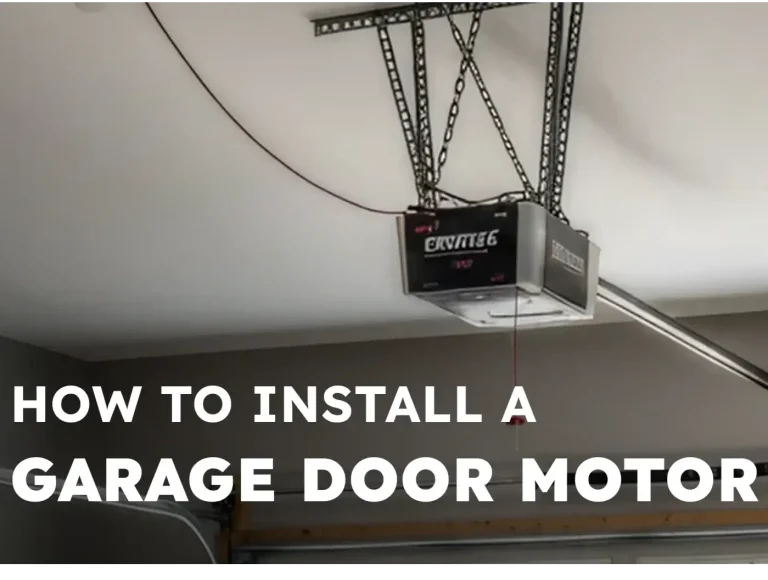
How to Install a Garage Door Motor: DIY Step-by-Step Guide
Thinking about tackling a garage door motor installation yourself? It’s possible — but it’s not a quick 10-minute task. Most installations take a few hours and involve working with heavy parts (so it’s better to have…
Published Date: Nov 21, 2025
How to Replace a Garage Door Motor: Safety Guide from a Pro
New place, same loud opener. For garage door opener safety and less noise, move to a belt-drive with a DC soft-start. It’s one of the first upgrades new homeowners tackle to cut noise and add reliability. With the…
Published Date: Oct 21, 2025
How to Insulate a Garage Door: A DIY Step-by-Step Guide
If extreme temperatures are making your garage uncomfortable to use as a workshop or storage space, it might be time to consider garage door insulation. This simple upgrade can help regulate temperature, cut down on…
Published Date: Nov 4, 2025