





Garage Door Opener Power Usage: Belt vs. Chain vs. Screw Drive
Published: Apr 17, 2026
It’s a sound most of us hear every day: the familiar hum and clank of the garage door opener, a simple convenience we take for granted. But have you ever paused to think about what that convenience costs on your electricity bill?
While it may not be the biggest energy user in your home, the choice you make when selecting an opener can have a surprising impact. We often focus on noise levels or price, but the mechanism whirring away above your car—whether it’s a chain, belt, or screw drive—has its own unique energy footprint. Understanding this difference is the key to making a smarter, more energy-conscious decision.
Let’s pull back the curtain and explore how these everyday machines work and which one truly wins the power-consumption showdown.
The Two Lives of Your Opener: Active vs. Standby Power
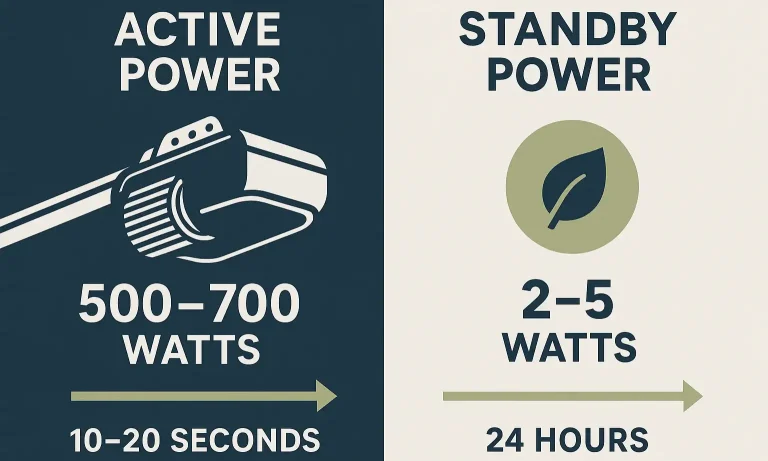
Before we compare the different drives, it’s crucial to understand that your garage door opener consumes electricity in two very different ways:
- Active Power (The Sprint): This is the big surge of energy used for the 15-20 seconds it takes to physically lift or lower your heavy garage door. During this brief period, the motor is working hard, drawing a significant amount of power—typically between 300 and 600 watts. Think of it like a microwave: it uses a lot of power, but only for a few minutes at a time.
- Standby Power (The Marathon): For the other 23 hours and 59 minutes of the day, your opener is in standby mode. It’s not moving the door, but it’s still drawing a small amount of electricity to power its radio receiver, safety sensors, and any smart features. This “phantom load” is tiny, often just 1 to 10 watts, but it runs 24/7. It’s like the little red light on your TV—always on, always drawing power.
Many homeowners only consider the active power draw, but over the course of a year, that constant standby trickle can add up. Modern units, especially the best smart garage door openers, can have slightly higher standby loads to power their Wi-Fi connections. The key is knowing how these two power modes relate to the opener’s design.
A quick note on terms: Wattage measures the rate of energy use, while Amperage measures the electrical current. For a deeper dive, our guide explains in detail how many amps a garage door opener uses. For this comparison, we’ll focus on watts, as it’s the most direct measure of energy consumption and what appears on your utility bill.
Meet the Contenders: How Chain, Belt, and Screw Drives Really Work
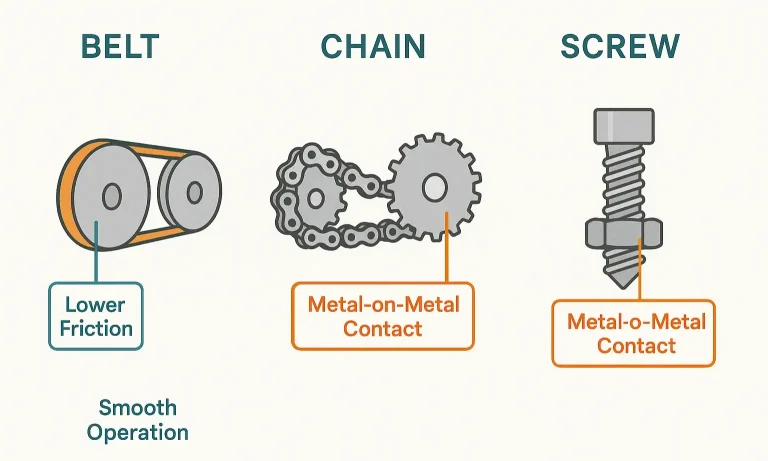
The reason different openers use varying amounts of power comes down to simple physics: friction and efficiency. Each of the main types of garage door openers uses a unique mechanism to transfer force from the motor to the door, and some are just plain smoother than others.
The Workhorse: Chain Drive
This is the classic. A motor turns a gear that pulls a metal chain, which in turn moves the trolley connected to the door.
- How it Works: Think of a bicycle chain. It’s strong, durable, and reliable.
- The Energy Factor: That metal-on-metal action creates significant friction. The motor has to work a little harder to overcome this resistance, which can lead to a slightly higher peak wattage during operation.
The Quiet Achiever: Belt Drive
Instead of a chain, this opener uses a steel-reinforced rubber belt to move the trolley.
- How it Works: The mechanism is similar to a car’s serpentine belt—incredibly strong but designed for smooth, quiet operation.
- The Energy Factor: The rubber belt glides with far less friction than a metal chain. This smoother operation means the motor doesn’t have to strain as much, often resulting in lower active power consumption and a more energy-efficient lift.
- How it Works: It’s a very direct transfer of power from the motor to the door, with fewer moving parts than a chain or belt system.
- The Energy Factor: While direct, the trolley is in constant contact with the entire length of the rotating screw. This creates a different kind of friction that can require a steady amount of energy, often placing its consumption between that of a chain and a belt drive.
The Direct Approach: Screw Drive
This design uses a long, threaded steel rod that rotates. The trolley moves along the threads of this rod to open or close the door.
The Head-to-Head Comparison: Which Opener is Most Efficient?
Now that we understand the mechanics, let’s put the numbers side-by-side. While exact figures vary by model, horsepower, and door weight, we can establish a clear general pattern of energy consumption.
Analysis of the Results
- Energy Efficiency Winner: Belt Drive. Thanks to its low-friction operation, the belt drive generally uses the least amount of active power to lift the same door. This makes it the champion for homeowners focused on minimizing energy use.
- The Standby Factor: Modern openers of all types have become much more efficient in standby mode. However, the overall annual cost is still lowest for belt drives because their active-use “sprints” are less demanding.
- The Big Picture: While the annual cost difference may only be a few dollars, it’s part of a larger story. A belt drive’s efficiency isn’t just about saving money; it’s a sign of a smoother, less strained mechanical operation, which often translates to a longer, quieter life for the opener. Regular upkeep is also key; proper maintenance and knowing how to reengage chain, belt, or screw drive openers if they disconnect can ensure they run as efficiently as possible.
How to Choose the Right Opener for Your Home
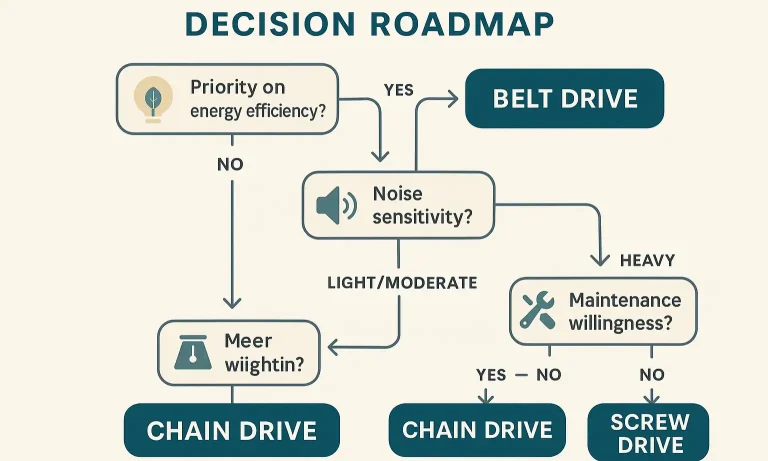
So, which opener is right for you? It depends on your priorities. Use this simple guide to find your perfect match.
- If your top priority is… minimal noise and maximum energy efficiency: A belt drive is your best choice. It’s perfect for homes with attached garages or bedrooms above the garage.
- If your top priority is… budget and lifting a very heavy, old wooden door: A chain drive is a time-tested, powerful, and cost-effective solution. Its durability is legendary.
- If your top priority is… a balance of power with fewer moving parts for easier maintenance: A screw drive is an excellent option, especially in climates with consistent temperatures.
Your Garage Door Opener Power Questions, Answered
Do garage door openers use a lot of electricity?
Individually, not a huge amount. The active use is high but very brief. The main factor is the 24/7 standby draw, which, over a year, can be equivalent to leaving a 5-watt lightbulb on continuously. The drive type you choose influences the total consumption.
How much does horsepower (HP) affect power consumption?
Horsepower (like 1/2 HP or 3/4 HP) determines the motor’s lifting capacity. A higher HP motor can lift a heavy door with less strain, which can be more efficient than a smaller motor struggling with the same load. However, for a standard, well-balanced door, the drive mechanism’s inherent friction (belt vs. chain) is a more significant factor in day-to-day energy use.
Do I need a dedicated circuit for my garage door opener?
Typically, no. Most residential openers are designed to run on a standard 120V, 15-amp circuit and don’t draw enough power to require their own. However, it’s always best practice to check the manufacturer’s specifications.
What about standby power for models with a battery backup?
A great question. A battery backup garage door opener will have a slightly higher standby power draw because it needs to keep the battery charged. This “trickle charge” ensures the battery is ready in case of a power outage. The increase is usually minor (an extra watt or two) but is an important consideration for the ultra-energy-conscious homeowner.
So, which garage door opener drive type is the most energy-efficient overall?
Based on the principles of friction and mechanical efficiency, belt drive openers generally hold the title. Their smooth, gliding operation requires less energy to start and run, making them the most efficient choice for both active and overall power consumption.
Beyond the Bill: Making an Informed Choice
Choosing a garage door opener involves more than just picking the one on sale. By understanding how the simple mechanics of a chain, belt, or screw drive affect everything from noise to your utility bill, you’re empowered to make a choice that fits your home, your budget, and your energy goals.
The small differences in wattage add up, not just in dollars, but in the performance and longevity of your machine. An efficient opener is often a smoother, quieter, and more reliable one—a true win-win for any homeowner.
You May Also Like
How Many Amps Does a Garage Door Opener Use: Power Requirements Explained
A new garage door opener can make everyday life more convenient — but there’s one detail that’s easy to overlook: power requirements. Whether you’re setting up a new garage or replacing an older system, Up & Down…
Published Date: Aug 21, 2025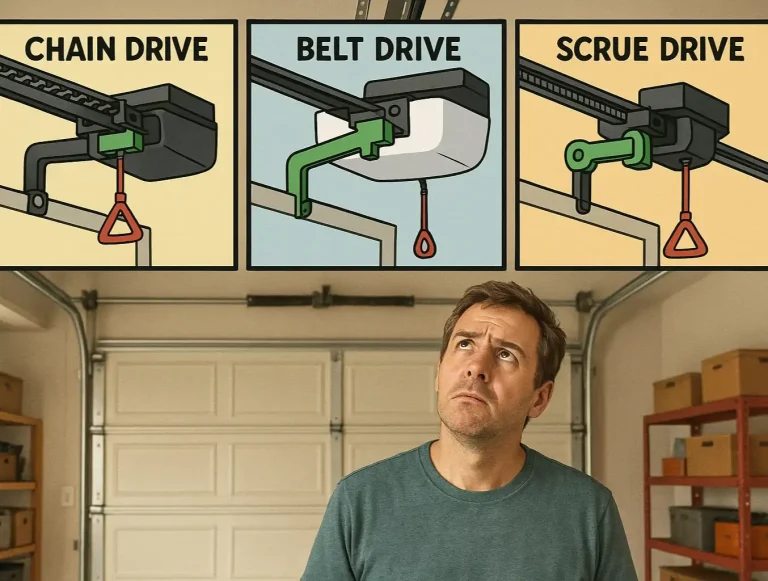
Reengaging Chain, Belt, and Screw Drive Openers
You followed the online guide perfectly. You pulled the red emergency cord, handled the power outage, and now you’re ready to reconnect your garage door. You press the button on the remote, the motor hums to life,…
Published Date: Apr 8, 2026
How to Reengage Your Garage Door Opener After a Power Outage
The power flickers back on. The clocks are blinking, and you’re resetting the coffee maker when you hit the button for your garage door. Nothing happens. Or maybe you hear a hum, but the door doesn’t move. It's a…
Published Date: Apr 7, 2026