





Guide To Prevent Garage Signal Theft: Code Grabber Security Tips
Published: Jul 7, 2026
Welcome to the world of “code grabbing,” a sophisticated electronic threat that allows intruders to duplicate your garage door opener’s signal and walk right in. While the 6-second break-in gets all the attention, this silent vulnerability could be leaving your home exposed without you ever knowing.
This isn’t about scare tactics; it’s about empowerment. Understanding how these devices work is the first step to making your home a fortress. Let’s pull back the curtain on the technology that keeps your largest door secure.
How Your Opener and Remote Have a Secret Conversation
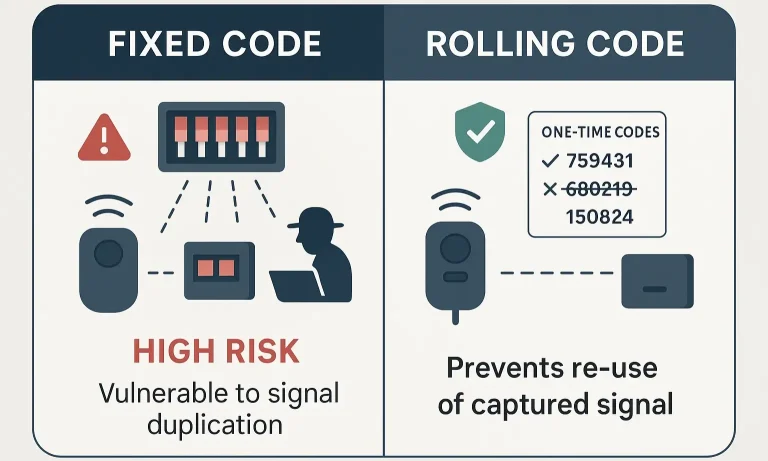
Every time you press that button on your remote, it sends a code to the opener motor, telling it to open or close. Think of it as a secret password. The problem is, not all passwords are created equal. This conversation happens in one of two ways:
The Old Way: Fixed Code Systems
Imagine you had one password for your garage: “OPEN.” Every time you press the remote, it shouts “OPEN!” to the receiver. It works, but anyone listening nearby with a simple radio scanner (a “code grabber”) can hear the password. Once they have it, they can shout “OPEN!” anytime they want.
These outdated systems are most recognizable by their DIP switches—a tiny row of physical switches inside the remote and the opener unit that you manually set to create your code. If your remote has these, your system is using a fixed code. It was the standard for openers made before 1993, and it’s as secure as leaving your key under the doormat. If you’ve ever wondered what is a dip switch garage door opener, it’s this exact vintage, vulnerable technology.
The Modern Way: Rolling Code Technology
Now, imagine your remote and opener share a secret list of a million unique passwords, in the exact same order.
When you press the button, your remote sends Password #1 from the list. The opener receives it, checks its own list, confirms it’s Password #1, and opens the door. Then, both the remote and the opener cross Password #1 off their lists. The next time you press the button, the remote sends Password #2.
If a code grabber captures the signal for Password #1, it’s completely useless. By the time they try to replay it, your opener is already waiting for Password #2. This is the genius of rolling code technology. It ensures that the code is new with every single use, making it virtually impossible to duplicate.
Building: Your 3-Step Homeowner's Garage Security Self-Audit
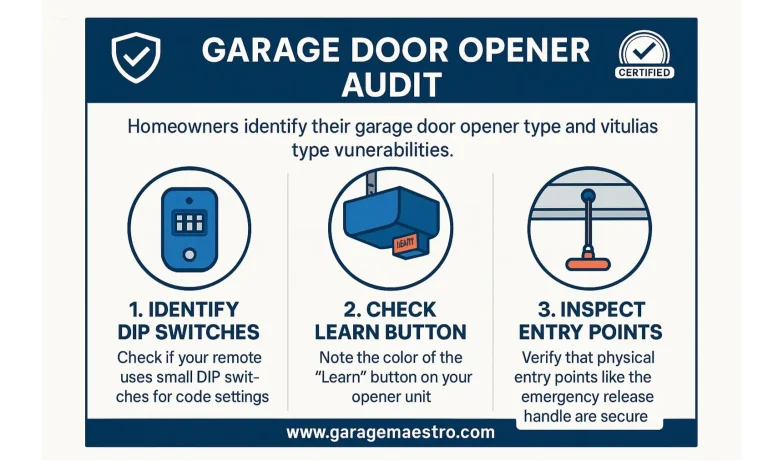
Feeling a little uncertain about your own system? You don’t need to be an expert to figure it out. Follow this simple audit to assess your garage door’s security level in minutes.
Step 1: Identify Your Remote’s Technology
Your remote control is the biggest clue.
- Look for DIP Switches: Open the battery compartment. If you see a small bank of 8-12 tiny, physical on/off switches, you have a high-risk fixed code system.
- Check the Date: Look for a manufacturing date on the back of the remote or the opener motor in the garage. Anything made before 1993 is almost certainly a fixed code system.
- Find a Security Logo: Modern remotes from major brands like LiftMaster or Chamberlain often display logos like “Security+®” or “Security+ 2.0®,” indicating an advanced rolling code system.
Step 2: Inspect Your Opener Unit
The opener motor itself holds important information.
- Find the “Learn” Button: Most openers made since the mid-90s have a “learn” or “program” button for syncing new remotes. The color of this button often signifies the technology generation. For example, on many LiftMaster/Chamberlain models, a purple or red/orange button indicates a modern, secure rolling code system. An older yellow or green button might signify an earlier, less complex version of rolling code.
Step 3: Check for Physical Vulnerabilities
Don’t forget the low-tech threats.
- The Emergency Release: Look at your emergency release cord (the red handle). Can you see the release mechanism from an exterior window? Is the top of your garage door sealed well, or is there a gap a wire could slip through? For extra security, a garage door emergency release kit can be installed to allow access from the outside with a key if needed, reducing the need for risky bypass methods.
Mastery: Your Action Plan for a Secure Garage
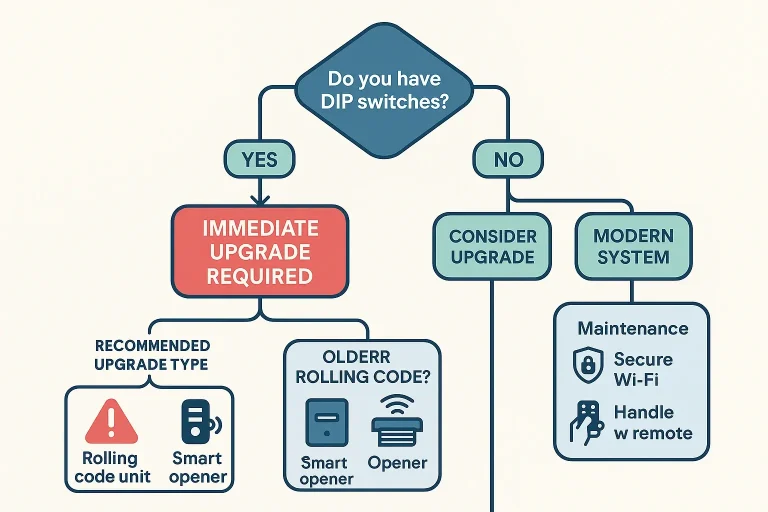
You’ve completed your audit. Now what? Your next steps depend entirely on what you found. Use this decision tree to choose the right path for your home.
If You Have DIP Switches (High Risk)
Your Action: Immediate Upgrade. This is not a suggestion; it’s a necessity. A fixed code opener is a major security liability. The only effective solution is to replace the entire opener system with a modern one that uses rolling code technology. Exploring modern garage door security upgrades will not only eliminate the code grabbing risk but also provide features like quieter operation and smart home connectivity.
If You Have an Older Rolling Code System (Medium Risk)
Your Action: Consider an Upgrade. Your system is not an easy target, but technology has advanced. Early rolling code systems (mid-90s to mid-2000s) use shorter encryption keys than today’s models, making them theoretically more vulnerable to determined, tech-savvy criminals. If your opener is over 15 years old or showing signs of wear, upgrading to a system with the latest encryption (like Security+ 2.0®) is a smart, proactive investment in your home’s security.
If You Have a Modern System (Low Risk)
Your Action: Maintain and Practice Good Habits. Congratulations, you have a secure system. Now, just focus on best practices:
- Don’t leave remotes in your car. A car parked in the driveway with a garage remote clipped to the visor is a prime target for a smash-and-grab.
- Secure your Wi-Fi. If you have a smart opener, its security is tied to your home network. Use a strong, unique password for your Wi-Fi.
- Be mindful of interference. A strong Wi-Fi signal is key for smart openers, but sometimes network equipment can cause issues. It’s rare, but some users report signal conflicts where troubleshooting the position of an ethernet cable vs garage door opener receiver can make a difference.
Frequently Asked Questions (FAQ)
Can someone really open my garage door with their own remote?
It’s extremely unlikely with modern openers. In the past, with limited fixed codes, it was possible for a neighbor’s remote to be on the same frequency and code. With billions of codes in modern rolling code systems, the odds of this happening are astronomically low. If you are experiencing garage door remote programming issues, it’s far more likely to be a battery or component problem than a random signal crossover.
How do I know if I have a rolling code opener without opening the remote?
The easiest way is to check the manufacturing date on the opener motor. If it was made after 1995, it almost certainly has some form of rolling code technology. Also, look for branding like “Security+®,” “IntelliCode®,” or “CodeDodger®” on the motor unit.
Are all new garage door openers secure?
All openers from major, reputable manufacturers (like LiftMaster, Chamberlain, and Genie) sold today use high-level rolling code encryption. The biggest risk comes from cheap, no-name universal remotes purchased online, which may not adhere to the same security standards. Always stick with trusted brands.
I did the audit and I’m secure. What else can I do?
Great! You can take security a step further with complementary measures. Consider adding motion-activated floodlights over the garage, using a security camera pointed at the door, or adding a garage door shield or lock that physically blocks the door from opening. True security comes in layers.
You May Also Like
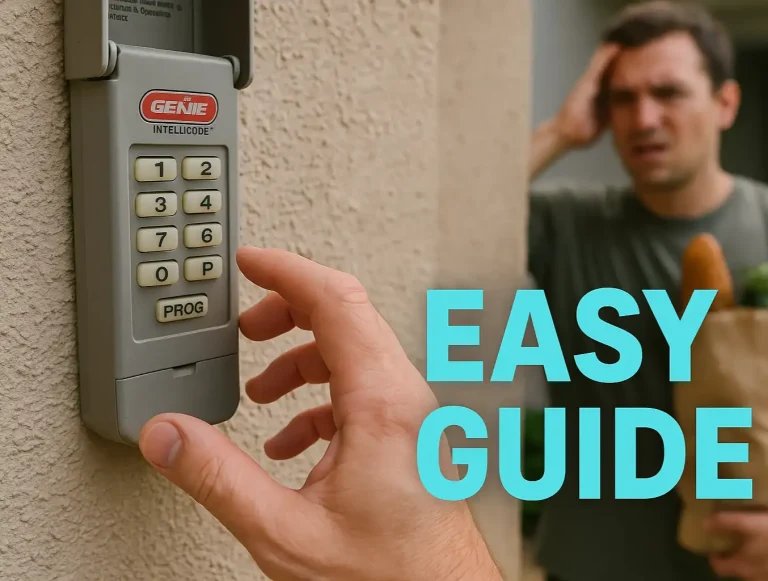
Changing the Code on Older Genie Intellicode Keypads
You’re standing outside, juggling groceries, and the familiar convenience of your garage door keypad suddenly feels like a betrayal. You punch in the code, and… nothing. You try again. Still nothing. After a quick…
Published Date: May 7, 2026
How to Reset Your Garage Door Code Without the Old PIN
It’s one of those moments no homeowner wants to deal with — you’re locked out because you forgot your garage door code. The good news? You’re not stuck. Even if you don’t remember the old PIN, it’s still possible to…
Published Date: Nov 6, 2025
How to Change a Code on a Garage Door Opener: Secure Your Access Fast
Moved into a new home? Shared your garage code during a renovation? Misplaced a remote? These are the kinds of situations when updating your garage door access code becomes a smart move. If you know how to change a…
Published Date: Jul 25, 2025