Our company logo

State

When to Call a Professional for Complex Garage Door Lock Repairs


Published: Apr 3, 2026

It’s a frustrating moment we’ve all faced. You go to lock or unlock your garage door, and something feels… wrong. The key spins endlessly, the handle grinds with a gritty protest, or the lock simply refuses to engage. Your first thought might be, "I can probably fix this." And sometimes, you can. But a garage door lock isn't just a simple mechanism; it's a critical security component for your home.

Knowing the difference between a simple tweak and a complex internal failure is the key to avoiding a costly mistake, a security risk, or hours of frustration. This guide is your diagnostic tool, designed to help you understand what your lock is telling you and decide with confidence when it’s time to step back and call a professional.

A Quick Look Inside: The Anatomy of a Garage Door Lock
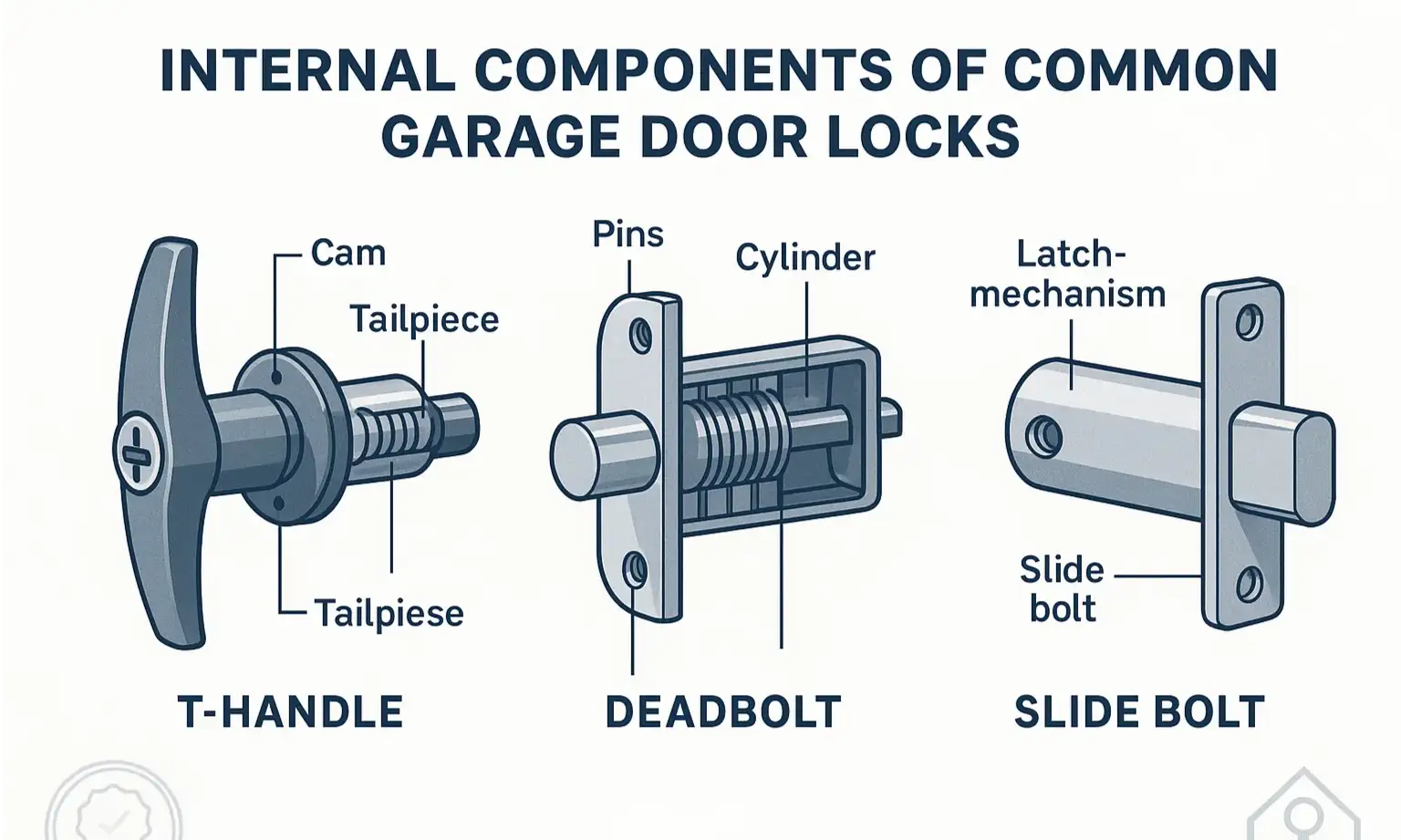

Diagram showing the internal components of various garage door lock types, including a T-handle with its cam, a slide bolt, and a cylinder deadbolt.
Before you can diagnose a problem, it helps to know what you’re looking at. While there are many styles, most manual garage door locks share a few core components. Think of it like knowing the basic parts of a car engine—you don’t need to be a mechanic, but knowing what a spark plug does gives you context when the engine misfires.
Most locks, like a T-handle or a simple deadbolt, have a cylinder where the key goes, which connects to a tailpiece or cam. This piece then moves the locking bars or latch, securing the door. When one of these internal parts fails, it creates the symptoms you experience on the outside.
Understanding the inner workings of your garage door lock builds confidence in identifying when professional help is needed. This diagram clarifies complex lock types and mechanisms for informed decisions.

Diagram showing the internal components of various garage door lock types, including a T-handle with its cam, a slide bolt, and a cylinder deadbolt.

The Garage Door Lock Symptom Checker: What's Your Lock Telling You?


Let’s translate your lock’s behavior into a clear diagnosis. Find the symptom you're experiencing below to understand the likely cause and, most importantly, where the "red line" is for a DIY attempt.
Quickly match your garage door lock symptom to likely causes and see the recommended action level to confidently decide when professional help is essential.

Symptom 1: The Key Spins Freely or Won't Turn at All

You put the key in and turn, but you feel no resistance. It just spins. Or, you feel a solid wall, and it won't budge. This points to a disconnect or a seizure within the lock's core.
Likely Causes: The most common culprit is a snapped tailpiece, the small metal bar connecting the key cylinder to the latching mechanism. It could also be a worn-out cylinder or seized internal pins due to rust or debris. These are some of the most common garage door lock issues.
The "Red Line" Test: STOP and call a professional if:
  • A piece of the key has broken off inside the lock.
  • You hear or feel a grinding or crunching sound, suggesting shattered internal parts.
  • The lock was working one minute and completely seized the next after a period of difficult operation.
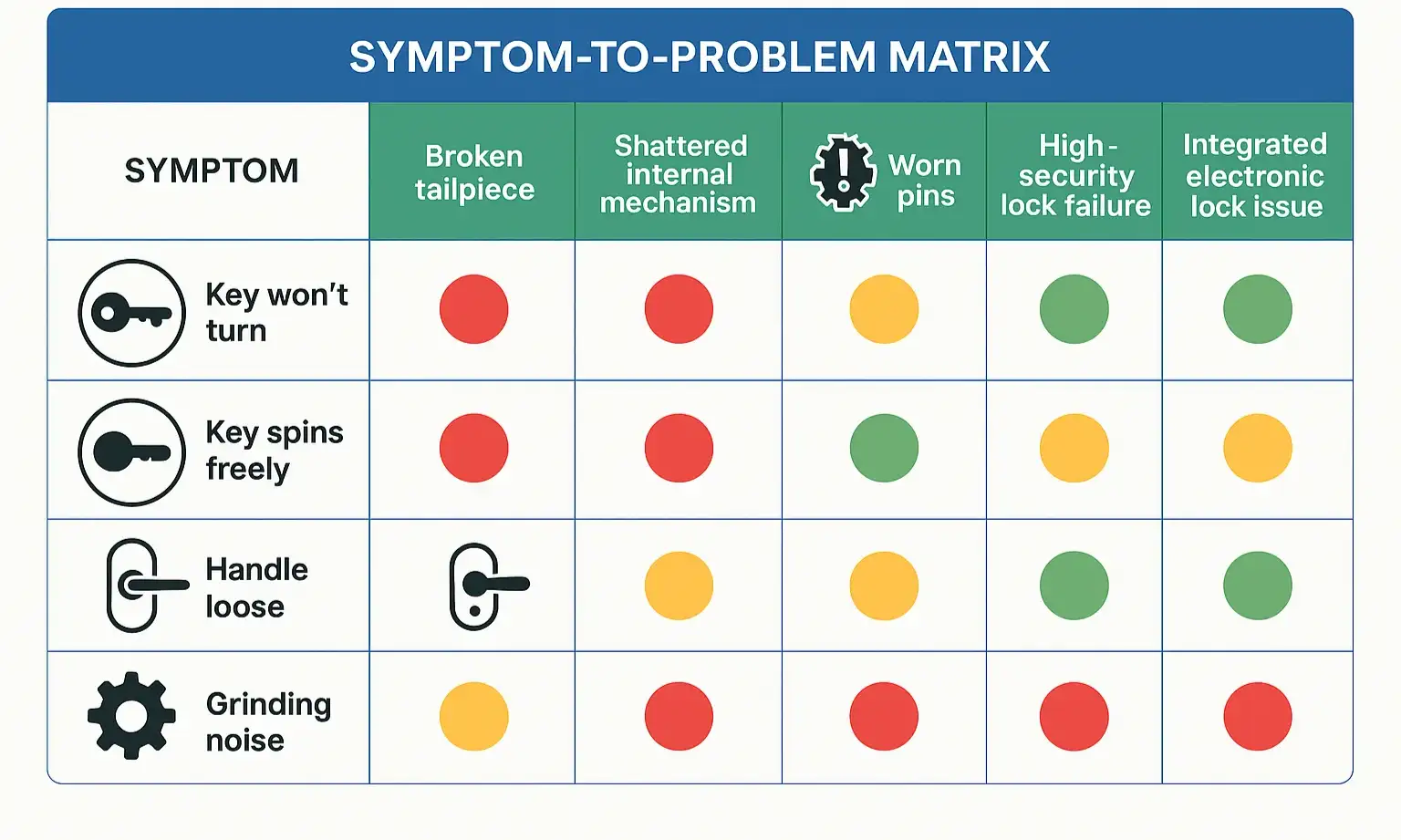
“Garage Door Lock Symptom Checker” flowchart linking common issues to causes with color-coded actions: DIY, caution, or call a pro.

Symptom 2: The Handle is Loose, Stiff, or Makes a Grinding Noise

When you turn the handle, it feels wobbly, requires excessive force, or makes a sound like grinding sand. This is a clear warning sign of internal mechanical failure.
Likely Causes: A loose handle could be simple mounting screws, but stiffness or grinding often indicates a broken internal cam, stripped gears, or a bent locking bar that’s binding against the track.
The "Red Line" Test: STOP and call a professional if:

  • The handle feels gritty. This signals that metal components have shattered inside. Continuing to force it can cause more damage.
  • The handle comes completely off, but the lock remains engaged.
  • You need a complete garage door lock replacement but are unfamiliar with the precise parts required.

Symptom 3: The Lock is Jammed and You're Locked Out

This is perhaps the most urgent scenario. The lock is stuck, and you can't get the door open. The temptation to apply brute force is high, but that’s the worst thing you can do.
Likely Causes: The issue might be a total internal lock failure, but it could also be a misaligned latch due to the door shifting or foundation settling. A warped door track can also put pressure on the locking bars, causing them to bind.
The "Red Line" Test: STOP and call a professional if:
  • You are completely locked out. While there are methods for how to open a locked garage door, they carry risks. A failed attempt can damage the door panel, weather stripping, or the track itself.
  • You suspect the door is misaligned. Forcing a jammed lock on a crooked door can derail the door from its tracks—a dangerous and expensive situation.
“Garage Door Lock Symptom Checker” flowchart linking common issues to causes with color-coded actions: DIY, caution, or call a pro.

Beyond the Basics: When a Pro is Non-Negotiable


Some lock systems are complex from the start. For these, the "red line" is crossed the moment the problem appears. Attempting a DIY fix is almost never worth the risk.
Navigating complex garage door lock issues is easier with this step-by-step guide, helping you minimize risk and make confident professional hiring decisions.

High-Security and Electronic Locks

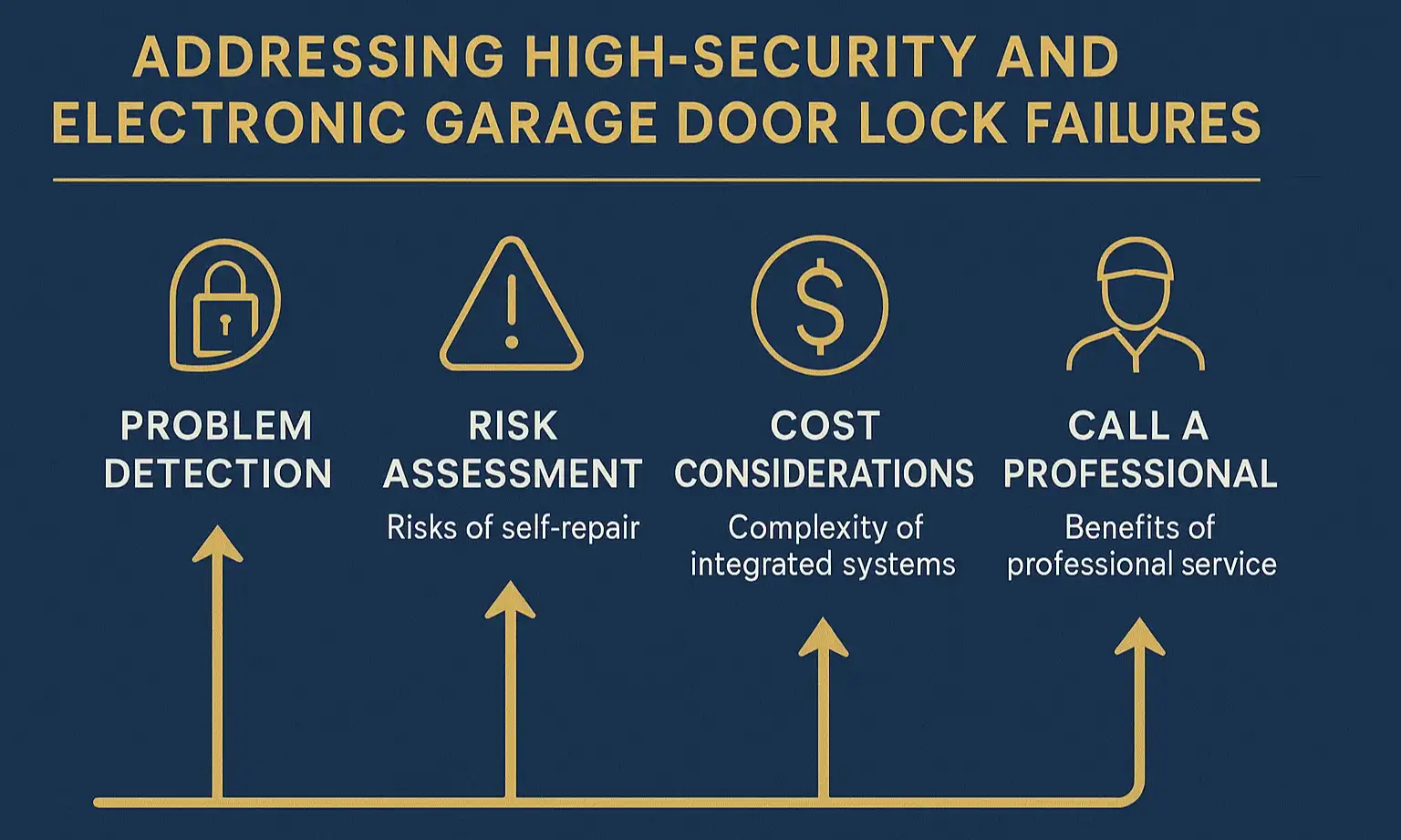
If you have a high-security lock (often with unique key shapes) or a smart lock that integrates with an app, these are professional-only repairs.
Why? They have tighter tolerances, proprietary parts that aren't available at a hardware store, and complex pin-and-tumbler systems. Electronic locks have delicate circuit boards and wiring. One wrong move can fry the electronics, void the warranty, and compromise your home's digital security.
Decision tree guiding complex lock issues—from identifying type (smart or high-security) to a clear call-a-pro outcome.

Locks Integrated with Your Garage Door Opener

Many modern systems feature an automatic deadbolt that engages when the opener closes the door. If this lock fails, it can create a system-wide headache.
Why? A malfunctioning automatic lock can prevent the door from opening or closing properly, putting immense strain on the opener motor. This can easily be misdiagnosed as an opener failure. If you're running through garage door opener troubleshooting steps without success, the lock might be the real culprit. A professional can diagnose the entire integrated system.

Decision tree guiding complex lock issues—from identifying type (smart or high-security) to a clear call-a-pro outcome.

Weighing the Risks: Why Some Repairs Aren't Worth the DIY Gamble


Deciding between a DIY fix and a professional call often comes down to a simple risk assessment. It's not just about your skill level; it's about the potential consequences of a mistake. Before you start any project, consider the core question of DIY garage door repair versus calling in an expert.

  • The Security Risk: Your garage door is a primary entry point to your home. A poorly repaired lock can offer a false sense of security, potentially leaving your family and property vulnerable.
  • The Financial Risk: Trying to force a jammed part can turn a $150 lock repair into a $1,000+ door panel replacement. Professionals have the right tools to diagnose and fix the issue without causing collateral damage.
  • The Time & Frustration Risk: What might take a technician 45 minutes could take you an entire weekend of research, multiple trips to the hardware store for the wrong parts, and immense frustration.

Need more information?

Frequently Asked Questions (FAQ)


Can't I just lubricate it first?

Absolutely! Using a silicone-based or graphite lubricant is a great first step for a stiff or sticky lock. However, lubrication is a maintenance task, not a repair. If the lock feels gritty, spins freely, or is clearly broken internally, lubricant will not fix the underlying mechanical failure and may even gum up the works further.

What's the difference between a locksmith and a garage door technician for this job?

While a locksmith is an expert on the lock cylinder itself (re-keying, extracting broken keys), a garage door technician understands the entire system. For issues involving handles, locking bars, and integration with the door and opener, a garage door professional is typically the better choice as they can diagnose the full context of the problem.

My whole garage door is acting up, not just the lock. What should I do?

If the lock issue is combined with other problems—like the door being heavy, making strange noises, or looking crooked—it's a definite sign to call a professional. These symptoms can point to issues with high-tension springs or cables, which are dangerous to handle without training. A comprehensive service like a garage door repair in McKinney, TX, for example, would involve inspecting the entire system to find the root cause.

Taking the Next Step


Understanding your garage door lock is about empowerment. It allows you to handle the simple tasks with confidence and, more importantly, to recognize when a problem requires a skilled hand. If your diagnosis has led you to a "Red Line" scenario—a gritty feel, a shattered mechanism, a high-security system, or an integrated failure—the safest and most effective next step is to contact a trusted professional. They have the expertise and tools to secure your home correctly, saving you time, money, and peace of mind.

You may also like


blog photo

Installing a Garage Door Opener on an Unbalanced or Older Door System

You’ve got it. The brand-new, Wi-Fi-enabled, whisper-quiet garage door opener you’ve been wanting. You’ve set aside your weekend, unboxed the parts, and laid out the instructions. But before you mount that new motor, there's a critical step—a "Step Zero"—that most installation guides completely ignore. Skipping this step is the number one reason new openers grind, strain, and burn out years before their time. The secret isn't in the opener's box; it’s in the condition of your existing garage door. Installing a powerful new opener on an old, heavy, or unbalanced door is like putting a V8 engine in a car with four flat tires. It’s a recipe for failure. This guide is your essential pre-installation checklist. We’ll walk you through a simple 10-minute diagnosis to ensure your door is ready, saving you from a costly mistake and ensuring your new investment lasts for a decade or more.

blog photo

The Maintenance Mistake Most Homeowners Make

You have the paperwork tucked away in a file cabinet—a warranty for your new garage door, your promise of protection against defects and failures. But what if that promise has a giant loophole you don't know about? Imagine this: a few years after installation, a critical part fails. You pull out the warranty, make the call, and are met with a surprising rejection. The reason? You can't prove you’ve been taking care of the door. It's a frustratingly common scenario. Some industry sources estimate that over 75% of warranty claims are denied due to skipped maintenance or missing documentation. That piece of paper isn't a magic shield; it's a contract. And your side of the bargain is regular, documented upkeep. Think of your warranty not as a passive guarantee, but as an investment that requires active protection. This guide will walk you through exactly what manufacturers expect, how to keep your coverage valid, and how to ensure you're fully protected when you need it most.