





Converting Carports to Garages in Small Footprint Properties
Published: Jun 25, 2026
You look at that carport every day. It does a decent job of keeping frost off the windshield and the worst of the rain off your car, but you can’t help but dream of what it could be. A secure, fully-enclosed garage. A place to store tools, bikes, and seasonal decor. An actual, functional extension of your home.
But then you look at the tight space, the low ceiling, and the support posts exactly where a garage door track should go. It feels like an impossible puzzle.
Here’s the secret: converting a carport on a small-footprint property isn’t about forcing a traditional garage into a space that wasn’t designed for it. It’s about a clever rethink of the components, starting with the single most important one—the garage door.
The Small-Space Challenge: More Than Just Walls
Enclosing a carport seems straightforward on the surface. Add walls, add a door, and you’re done, right? Not quite. For properties where every inch counts, the primary constraints aren’t just the walls; they are the “invisible” dimensions that a standard garage takes for granted.
- Headroom: This is the vertical space between the top of the door opening and the ceiling or rafters. Traditional sectional garage doors need a significant amount of headroom (often 12 inches or more) for the tracks and springs. Many carports simply don’t have it.
- Sideroom: This is the space on either side of the proposed door opening. It’s needed for the vertical tracks of a sectional door. Narrow carports can make this a tight squeeze.
- Depth: The length of the carport must be sufficient to accommodate both your vehicle and the arc of the garage door as it opens and travels along its overhead tracks.
The “aha moment” for many homeowners is realizing the garage door isn’t the final piece of the puzzle; it’s the first. The type of door you choose dictates the entire structure of the conversion.
Door Type Options for Small Spaces
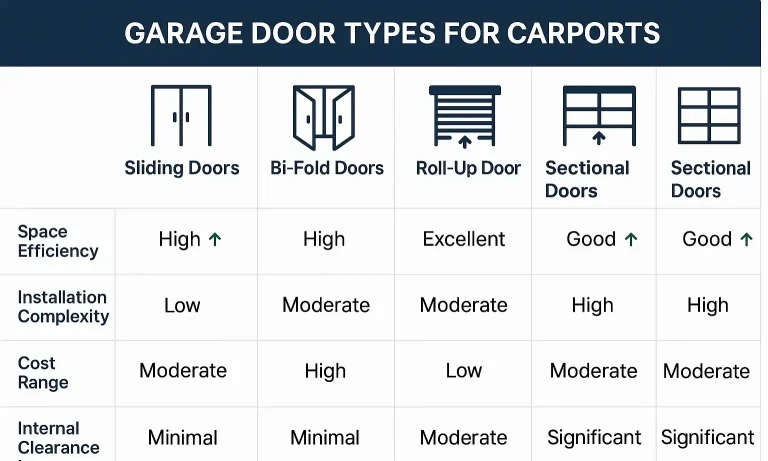
Your carport’s unique dimensions will point you toward a specific type of garage door. Forget the one-size-fits-all approach. Let’s look at the contenders that excel in tight quarters.
The Classic Sectional Door: Mind the Headroom
This is the door most people picture: hinged panels that roll on tracks up and along the ceiling. They are secure and well-insulated, but they are the most demanding when it comes to space. If you have limited headroom, you might need special low-headroom track hardware, which can solve the problem but adds to the complexity and cost.
The Space-Saving Roll-Up Door: A Compact Contender
Often seen in commercial settings, roll-up doors (or roller shutters) are brilliant for residential conversions with low ceilings. Instead of running along the ceiling, the flexible door curtain coils tightly into a barrel-shaped housing just above the opening.
Key Advantage: They require almost no headroom inside the garage, making them a game-changer for carports with low rafters or obstructions.
The Elegant Side-Hinged Door: A Classic Reimagined
Also known as “carriage house doors” or “swing-out doors,” these function like a standard pair of entry doors. They swing outward to open, mounted on hinges on the sides of the frame.
Key Advantage: They use zero interior space for operation. No tracks on the ceiling or walls. The entire ceiling area is free for storage. The only catch is you need enough clearance in your driveway for the doors to swing open.
Structural Reinforcement & Expertise
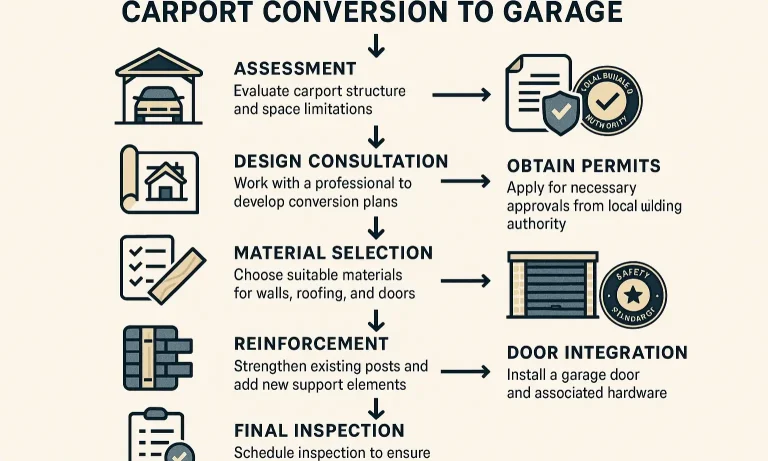
A carport is fundamentally an open-air structure, often built with just enough support for its roof. Transforming it into a garage that can support the weight and constant motion of a garage door requires careful structural planning.
This isn’t just about framing an opening. You need to ensure:
- A Proper Header: A strong horizontal beam (header) must be installed above the door opening to bear the weight of the roof. The carport’s existing front-facing beam may not be sufficient.
- Solid Jambs & Framing: The sides of the new door opening (jambs) must be sturdy enough to anchor the door hardware and withstand years of use.
- Code Compliance: Most municipalities require building permits for a carport-to-garage conversion. An expert can ensure the new structure meets local building codes for safety and stability.
Simply enclosing a carport without reinforcing it properly can lead to structural sagging, door malfunctions, and unsafe conditions.
Cost-Benefit & Space Optimization
Is enclosing your carport worth the investment? For most homeowners, the answer is a resounding yes. Beyond the convenience, you’re adding tangible value and functionality to your home.
- Increased Property Value: A full garage is a highly sought-after feature for homebuyers, often providing a significant return on investment.
- Enhanced Security: Protect your vehicles, tools, and stored items from theft and vandalism in a securely locked space.
- Protection from the Elements: Shield your vehicles from sun, hail, snow, and wind, preserving their finish and reducing wear and tear.
- Expanded Usable Space: A garage instantly becomes a workshop, a storage area, or a hobby space—something a carport can never truly be.
Frequently Asked Questions About Carport Conversions
Do I need a permit to enclose my carport?
Almost certainly, yes. You are changing the fundamental structure and use of the space, which falls under the purview of local building authorities. A permit ensures the work is done safely and to code, which is critical for your home’s safety and insurance.
Can I use the existing concrete slab as the garage floor?
Usually, but it must be inspected first. A professional will check for significant cracks, proper drainage slope (to prevent water from pooling inside), and whether its thickness is adequate.
How much headroom do I really need for a garage door?
It varies dramatically. A standard sectional door often needs 12-15 inches. A low-headroom kit can reduce that to as little as 4-5 inches. A roll-up door needs about a foot of space for its housing but leaves the rest of the ceiling completely clear.
What’s the biggest mistake people make?
Choosing the garage door last. Homeowners often frame the walls and opening and then try to find a door to fit, only to discover their options are severely limited. Designing the conversion around the best door for your space saves time, money, and major headaches. Trying to fix a poorly planned installation often requires extensive garage door repair and reframing work down the line.
Your Next Step: From Idea to Action Plan
Converting a carport into a garage on a small lot is a project of precision. It’s less about brute force and more about smart planning. By understanding the interplay between your available space, the structural requirements, and the mechanics of different door types, you can unlock the full potential of your property.
Armed with this knowledge, you’re ready to take the next step. Grab a tape measure, assess your headroom and sideroom, and start imagining which door style could transform that open-air carport into the secure, functional garage you’ve always wanted.
You May Also Like

Securing Narrow or Street-Facing Garage Doors
Living in the city has its perks—the energy, the convenience, the walkability. But when your garage door opens directly onto a busy sidewalk or a narrow alley, that convenience can feel like a vulnerability. You've…
Published Date: Jun 24, 2026
Side-Mounted (Jackshaft) Garage Door Openers
Ever stood in your garage, looked up, and felt like you were losing a battle for space? The culprit is often hiding in plain sight: that bulky, chain-driven garage door opener hanging right in the middle of your…
Published Date: Jun 23, 2026
The Best Garage Door Solutions for Small Spaces and Compact Homes
The trend towards smaller homes is becoming increasingly common, but that doesn’t mean you have to sacrifice function or style. With thoughtful planning and the right garage door installation choices, you can have an…
Published Date: Jun 6, 2025