





Side-Mounted (Jackshaft) Garage Door Openers
Published: Jun 23, 2026
Ever stood in your garage, looked up, and felt like you were losing a battle for space? The culprit is often hiding in plain sight: that bulky, chain-driven garage door opener hanging right in the middle of your ceiling. It’s the gatekeeper to your home, but it’s also a space-hog, dictating where you can (and can’t) install storage shelves, a car lift, or even just enjoy a clean, uncluttered look.
What if you could reclaim all that valuable real estate?
This is where the side-mounted, or “jackshaft,” garage door opener comes in. It’s a sleek, powerful solution that doesn’t live on your ceiling—it mounts discreetly on the wall beside your garage door. For homeowners with small garages, low ceilings, or big plans for their overhead space, this is more than an opener; it’s a game-changer.
What is a Jackshaft Opener and How Does It Work?
Think of a traditional opener as a tug-of-war rope. A motor sits on the ceiling and pulls a trolley along a rail, which in turn pulls your door open. It’s effective, but it requires a long, central apparatus.
A jackshaft opener works more like a key in a lock. It mounts on the wall and fits directly onto the end of the garage door’s torsion bar (the spring-loaded rod above your door). When activated, the opener simply rotates the bar, which winds or unwinds the cables and lifts the door smoothly and efficiently.
This simple change in mechanics delivers some incredible benefits:
- The “Space Equation”: This is the biggest “aha moment.” By removing the motor and rail from the ceiling, you reclaim a massive amount of overhead space. A typical ceiling-mounted opener can occupy up to 39 cubic feet of prime real estate. A jackshaft gives it all back to you.
- Whisper-Quiet Operation: With no clanking chain or rumbling belt stretching across your garage, jackshaft openers are remarkably quiet. If you have a bedroom or living space above the garage, this is a major quality-of-life improvement.
- Enhanced Security: Many modern jackshaft models, like those from LiftMaster, come with an automatic deadbolt. When the door closes, a physical bolt locks it into the track, making it virtually impossible to force open from the outside.
- Clean, Modern Aesthetics: Let’s be honest—traditional openers aren’t pretty. A wall-mounted unit creates a minimalist, uncluttered look, perfect for a finished or multi-purpose garage.
Is a Jackshaft Opener Right for YOUR Garage? The 3-Point Compatibility Check
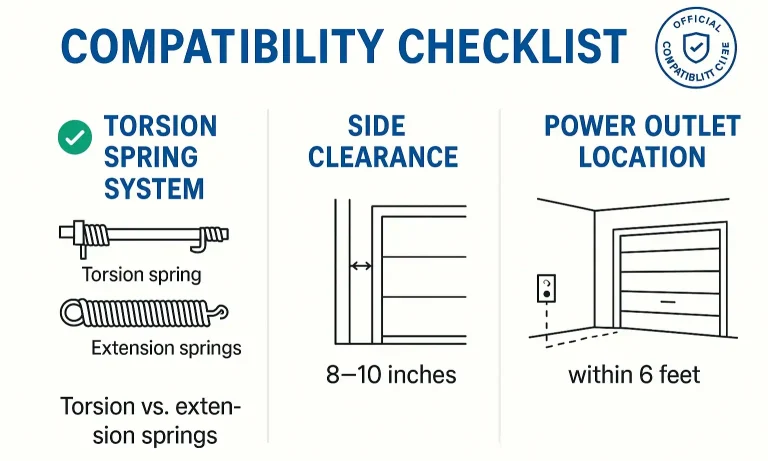
Before you get too excited, it’s crucial to know that jackshaft openers have a few specific requirements. They aren’t a universal fit. But figuring out if your garage is compatible is surprisingly simple. Just run through this quick 3-point check.
1. Do you have a torsion spring system?
A jackshaft opener must connect to a torsion bar. Look above your closed garage door. If you see a bar with one or two large springs wrapped around it, you have a torsion system. If you see long, skinny springs running alongside the door tracks, you have extension springs, which are not compatible. Understanding the difference between torsion vs extension spring garage door systems is the first critical step.
2. Do you have enough side clearance?
The opener needs a place to live. You’ll need about 8-10 inches of clear wall space on either the left or right side of the garage door. Measure from the edge of the door track to the nearest obstruction. This feature makes it an ideal low headroom garage door opener for situations where ceiling height is limited.
3. Is there a power outlet nearby?
The opener needs to be plugged in. Ensure you have a standard 120V electrical outlet within about 6 feet of where the unit will be mounted.
Pros of Jackshaft Openers
- Frees Up Overhead Space: Clears out the ceiling area, leaving plenty of room for overhead storage, car lifts, or high ceilings.
- Ultra-Quiet Operation: Runs incredibly quietly, making it the perfect choice for garages attached to living areas.
- High-Lift Compatibility: Works seamlessly with high-lift door setups to give you maximum vertical clearance.
- Enhanced Security: Comes packed with advanced safety features, including automatic deadbolts.
- Aesthetic Appeal: Offers a clean, sleek, and minimalist appearance on your wall.
- Higher Initial Investment: Comes with a higher upfront price tag compared to most standard belt- or chain-driven openers.
- Specific Spring Requirements: Only works with a torsion spring system, meaning it is not compatible with extension springs.
- Wall Clearance Needs: Requires specific side clearance alongside the door track, usually around 8 to 10 inches.
- Complex Setup: Professional installation is highly recommended due to the precise mounting and tension alignment required.
- Track Limitations: May not function properly with certain low-headroom track configurations.
Cons of Jackshaft Openers
Unlocking Maximum Space: Pairing Jackshafts with High-Lift Doors
If your goal is to fit a car lift or create the maximum possible overhead clearance, a jackshaft opener is only half of the perfect equation. The other half is a “high-lift” door conversion.
Normally, your garage door tracks curve just a few inches above the door opening. A high-lift system replaces your standard tracks with longer, vertical lift garage door tracks that allow the door to travel much higher up the wall before it curves back.
Because a jackshaft opener doesn’t use a central rail, it’s the _only_ type of automatic opener that works with a high-lift setup. The combination of the two is the ultimate solution for reclaiming vertical space in your garage.
Beyond the Basics: Installation and Advanced Features
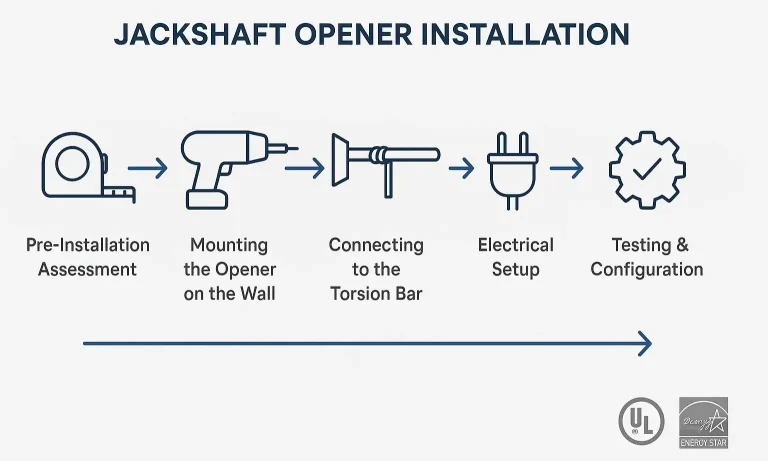
While the concept is simple, the garage door motor installation for a jackshaft opener requires precision. The unit must be mounted securely, and the tension on the torsion bar must be perfect for safe, reliable operation. This is one job where calling a professional technician is the smartest move.
Once installed, modern jackshaft openers come packed with technology:
- Smart Home Compatibility: Many models have built-in Wi-Fi, allowing you to control and monitor your garage door from your phone using an app like myQ. Checking your smart garage door opener compatibility is key to integrating it into your smart home ecosystem.
- Battery Backup: A power outage can trap your car in the garage. Many premium models include a garage door opener with battery backup so you can still get in and out when the lights go out.
- LED Lighting: Bright, integrated LED lights illuminate your whole garage, often with motion-sensing activation.
FAQ: Your Jackshaft Opener Questions, Answered
How long do jackshaft openers last?
With proper installation and maintenance, a quality jackshaft opener has a similar lifespan to traditional models, typically around 10 to 15 years. For more details, you can explore the average garage door opener lifespan.
Are wall mount garage door openers better than ceiling mount?
It depends entirely on your needs. If overhead space is your top priority, then a wall mount garage door opener is objectively better. If you have plenty of ceiling height and are more budget-conscious, a traditional belt or chain drive opener is still a great, reliable choice.
Can I install a jackshaft opener myself?
While some experienced DIYers might attempt it, we strongly advise against it. Torsion springs are under extreme tension and can cause serious injury if handled improperly. A professional ensures the opener is mounted securely and the door is perfectly balanced for safety and longevity.
How much space do I really save?
Imagine a box that’s 10 feet long, 1.5 feet wide, and 2 feet tall. That’s the approximate space a traditional opener and its rail occupy. A jackshaft gives you all of that back. It’s enough room for several overhead storage racks, a kayak, or the clearance needed for a two-post car lift.
Making the Right Choice: Is a Jackshaft Opener Worth It?
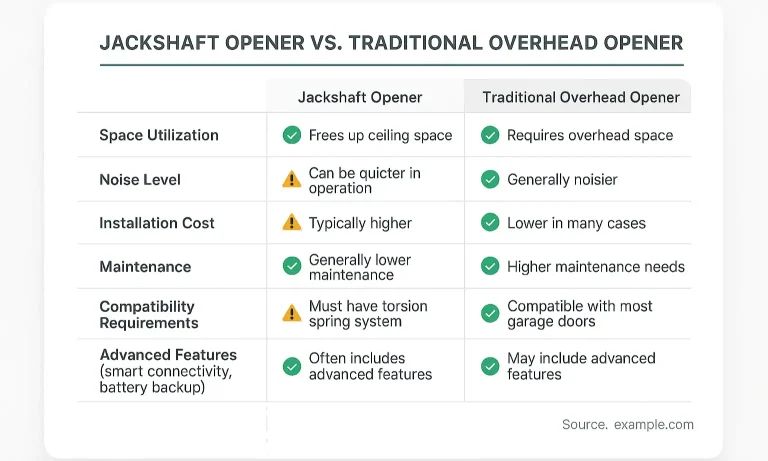
A jackshaft opener is an investment in your home’s potential. It’s for the homeowner who sees their garage as more than just a place to park the car—it’s a workshop, a gym, a storage hub, or a showroom.
So, is it worth it for you?
- Choose a Jackshaft Opener if: You need more overhead storage, you have a low ceiling, you want to install a car lift, or you value quiet operation and a clean aesthetic.
- Stick with a Traditional Opener if: You have ample ceiling height, overhead storage isn’t a priority, and your primary decision factor is the upfront cost.
Ultimately, the best opener is the one that fits your space and your lifestyle. By reclaiming your ceiling, a jackshaft opener doesn’t just lift your garage door—it lifts the possibilities for your entire home.
Ready to explore how a jackshaft opener could transform your garage? Understanding your specific setup is the next step. Our team of experts is always here to answer your questions and help you find the perfect fit—no pressure, just friendly advice.
You May Also Like
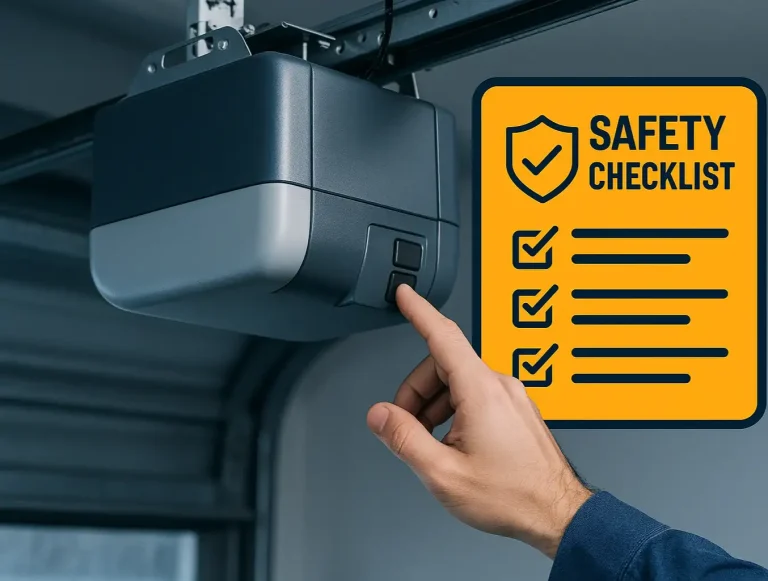
Precautions Before and After Resetting Your Garage Door Opener
It’s a familiar frustration. You press the button on your remote, and… nothing. Or maybe the door closes part-way, then mysteriously reverses. Your first instinct, fueled by countless online forums, is probably to…
Published Date: Jun 19, 2026
Roll-Up vs. Sectional Garage Doors: Maximizing Driveway Clearance
Living in the city has its perks, but a sprawling driveway usually isn't one of them. You've mastered the art of parallel parking and can navigate a tight alley like a pro. But there's one daily puzzle you still…
Published Date: Jun 22, 2026
The Best Garage Door Solutions for Small Spaces and Compact Homes
The trend towards smaller homes is becoming increasingly common, but that doesn’t mean you have to sacrifice function or style. With thoughtful planning and the right garage door installation choices, you can have an…
Published Date: Jun 6, 2025