





Roll-Up vs. Sectional Garage Doors: Maximizing Driveway Clearance
Published: Jun 22, 2026
Living in the city has its perks, but a sprawling driveway usually isn’t one of them. You’ve mastered the art of parallel parking and can navigate a tight alley like a pro. But there’s one daily puzzle you still haven’t solved: the tight squeeze between your car’s bumper and the garage door.
You’re thinking about a new garage door, but a nagging question stops you. Will a new door make the parking situation even worse? Could it actually prevent you from using your driveway at all?
It’s a common fear for homeowners on small urban lots, and it highlights a critical factor that most garage door guides completely overlook. They talk about insulation, materials, and cost, but they miss the most important question for you: How does the door move?
Welcome to the ultimate guide on choosing a garage door that gives you back your driveway.
The Two Contenders: Understanding the Basic Mechanics
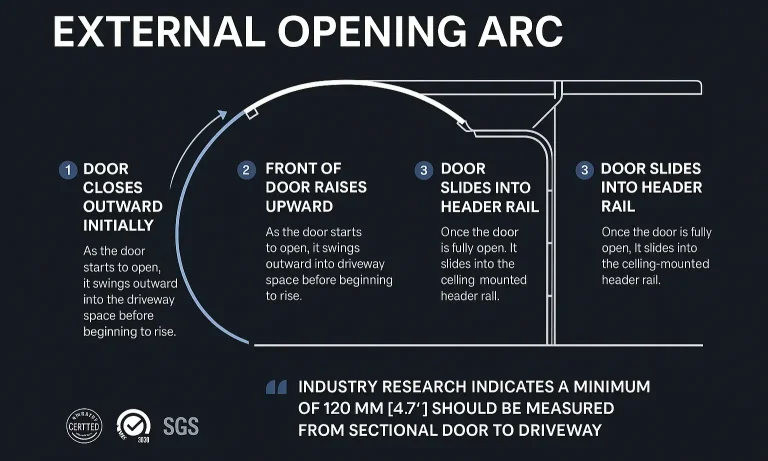
Before we dive into the driveway clearance issue, let’s quickly get to know our two main options. Think of it like comparing a window shade to a folding fan.
Sectional Garage Doors
This is the most common residential garage door in the U.S. It’s made of several horizontal panels (sections) hinged together. When it opens, these panels bend at the hinges and glide along a track up and into the ceiling of your garage. It’s reliable, comes in countless styles, and offers great insulation.
Roll-Up Garage Doors
Often seen in commercial settings but increasingly popular for modern homes, a roll-up door is typically made of a single curtain of steel or aluminum slats. When it opens, this curtain rolls up into a compact coil directly above the door opening. It’s like a super-durable, secure version of a window shade.
Building: The Most Overlooked Factor - Driveway Clearance
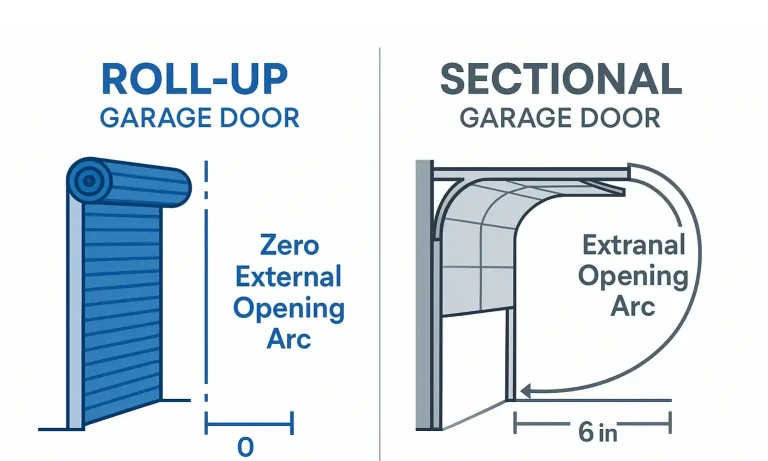
Here’s the part that changes everything for homeowners with short driveways. People always focus on the space a door takes up inside the garage (headroom). But the real problem often lies in the space it takes up outside during the first few seconds of opening.
We call this the External Opening Arc—and it’s the hidden culprit that steals your parking space.
A sectional door doesn’t just go straight up. To clear the doorframe, the top panel has to tilt, kicking the bottom of the door outward into your driveway by several inches before it begins its upward journey.
A roll-up door, on the other hand, has a Zero External Arc. It moves straight up, coiling into its housing without ever protruding into the driveway.
For a large suburban driveway, this tiny kick-out movement doesn’t matter. But when your SUV’s bumper is just a foot from the garage, that kick-out could mean the difference between parking comfortably and getting a nasty scratch.
Mastery: A Practical Decision Framework
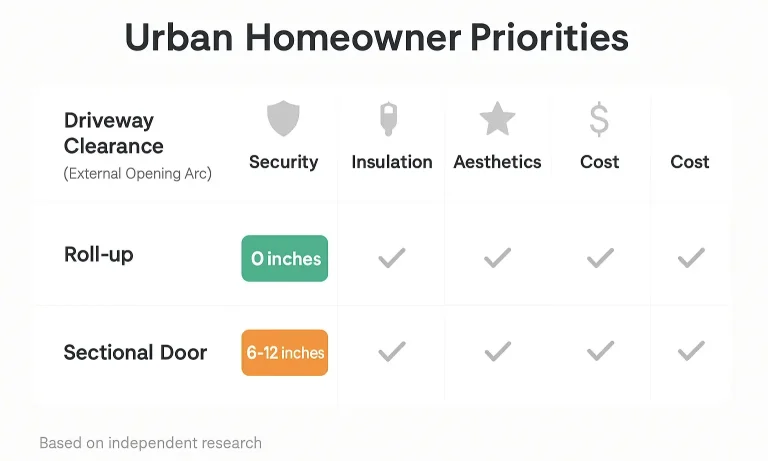
Choosing the right door isn’t just about clearance. It’s about finding the best balance for your home’s needs. Let’s compare them on the factors that matter most to urban homeowners.
Driveway Clearance (Winner: Roll-Up)
As we’ve established, the roll-up door is the undisputed champion here. Its vertical path provides zero driveway intrusion, making it one of the best space saving garage doors available. A sectional door requires you to leave several inches of buffer space.
Insulation and Energy Efficiency (Winner: Sectional)
Traditionally, sectional doors have offered superior insulation options. Their thick, insulated panels are excellent at keeping your garage warmer in the winter and cooler in the summer. However, technology is catching up, and modern insulated roll up garage doors now provide significant energy savings as well.
Security (Winner: Roll-Up)
Because they are made of a continuous curtain of interlocking steel slats without hinges, roll-up doors are incredibly difficult to pry open. This makes them a formidable garage security door. While modern sectional doors are very secure, their panel-and-hinge construction can present more potential leverage points for intruders.
Aesthetics and Style (Winner: Sectional)
Sectional doors offer a vast array of materials, window options, colors, and designs—from traditional carriage house styles to sleek modern looks. Roll-up doors typically have a more industrial or minimalist aesthetic, which can be perfect for contemporary homes but may not suit all architectural styles.
Durability and Maintenance (Winner: Tie)
Both door types are built to last. Roll-up doors have fewer moving parts exposed to the elements (no hinges or rollers running along the entire height), which can mean less maintenance. Sectional doors are extremely reliable, but their springs and rollers may require periodic checks and lubrication.
Action: Making the Right Choice for Your Urban Home
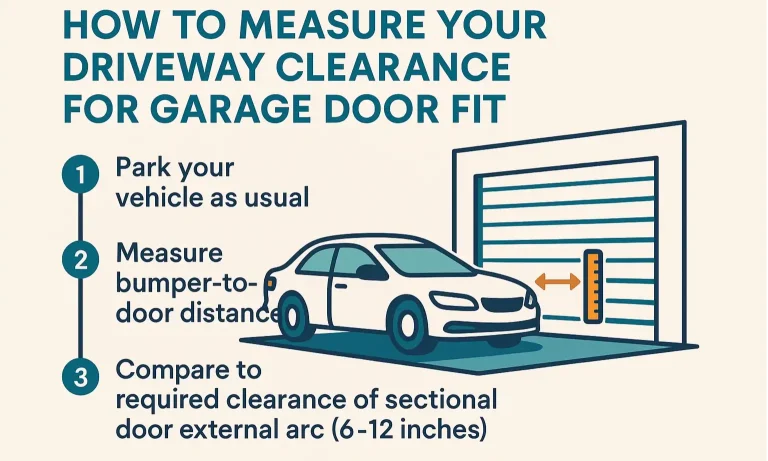
Theory is great, but let’s get practical. How can you know for sure if a sectional door’s External Opening Arc will be a problem for your specific driveway? It’s time to take a simple measurement.
The Bumper Test: A 2-Minute Guide to Your Driveway Clearance
- Park Your Car: Pull your largest vehicle into your driveway, parking it as close to the garage door as you comfortably would on a normal day.
- Measure the Gap: Grab a tape measure. Measure the distance in a straight line from the flattest part of your garage door to the part of your vehicle’s bumper that is closest to it.
- Check the Golden Rule: If that distance is less than 8 inches, a sectional door could pose a risk of impact. You are a prime candidate for a roll-up garage door to maximize your space.
This simple check removes all the guesswork. For a more detailed walkthrough, you can learn exactly how to measure a garage door and its surrounding space.
Frequently Asked Questions
Are roll-up doors noisy?
Modern residential roll-up doors are designed for quiet operation, often using nylon wind-locks and smooth-gliding mechanisms. While older industrial models could be loud, today’s versions are comparable to their sectional counterparts.
How much headroom do I need inside the garage for a roll-up door?
This is another area where roll-up doors excel. Because the door rolls into a compact box just above the opening, they typically require very little headroom—often around a foot. This is a huge benefit for garages with low ceilings.
Is a roll-up garage door more expensive?
The cost can be comparable, depending on the materials, size, and features. A basic, non-insulated roll-up door might be more affordable than a high-end, insulated sectional door. It’s best to compare quotes for the specific styles you’re interested in.
Can I install a roll-up door myself?
While it might seem simpler, any garage door installation involves heavy components and powerful springs, which can be dangerous. Professional installation is always recommended to ensure safety, proper function, and warranty coverage.
The Final Verdict for Your Urban Oasis
Choosing a garage door for a home with a short driveway isn’t just an aesthetic decision—it’s a spatial one.
If you have ample driveway space and prioritize a wide range of traditional styles and insulation options, a sectional door remains an excellent choice.
However, if maximizing every single inch of your driveway is your top priority, the choice is clear. A roll-up garage door is the superior solution, offering a zero-clearance opening that guarantees you’ll never have to worry about your car’s bumper meeting your garage door again.
By understanding the simple mechanics of how each door moves, you can reclaim your parking space and make the confident, informed choice for your home.
You May Also Like
The Best Garage Door Solutions for Small Spaces and Compact Homes
The trend towards smaller homes is becoming increasingly common, but that doesn’t mean you have to sacrifice function or style. With thoughtful planning and the right garage door installation choices, you can have an…
Published Date: Jun 6, 2025
Precautions Before and After Resetting Your Garage Door Opener
It’s a familiar frustration. You press the button on your remote, and… nothing. Or maybe the door closes part-way, then mysteriously reverses. Your first instinct, fueled by countless online forums, is probably to…
Published Date: Jun 19, 2026
Safety Risks of Operating a Bent Garage Door
That new dent in your garage door is glaring. Maybe a car bumped it, or a stray basketball found its mark. Your first thought might be about the cosmetic damage, but the real issue isn't what you see—it's what you…
Published Date: Jun 19, 2026