





Quiet Space, Active Life: The Complete Soundproofing Guide for Garage Conversions
Published: Jul 17, 2026
Converting your garage is one of the smartest ways to add functional square footage to your home. But whether you are imagining a focused home office or a high-energy home gym, you will quickly face a frustrating acoustic reality. Standard garages are echo chambers. They are built to park cars, not to block sound, leaving you exposed to disruptive street noise—or leaving your neighbors exposed to your early-morning workouts.
If you have researched solutions online, you have likely seen two extremes: cheap DIY hacks like gluing egg cartons or light foam to the walls (which only reduces echo, not noise transmission) or professional recording studio builds costing upwards of $30,000.
For a highly functional residential garage door conversion, you do not need a multi-thousand-dollar recording studio. You need a practical, high-performance strategy that achieves an isolation rating of STC 45 to 55 without breaking the bank.
The Physics of Quiet (Why Your Garage is an Acoustic Sponge)
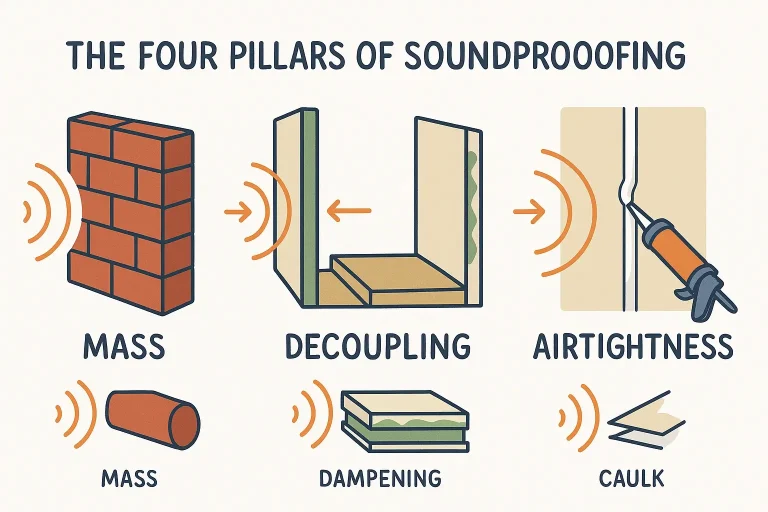
To block sound effectively, we must first understand how it behaves. Acoustic engineering relies on four fundamental pillars:
- Mass (heavy materials)
- Decoupling (creating air gaps to break physical connections)
- Dampening (absorbing vibrations)
- Airtightness (sealing air leaks).
- A standard uninsulated steel garage door has a Sound Transmission Class (STC) rating of only 20 to 24. This means it allows over 80% of mid-frequency sounds to pass through completely unfiltered.
The biggest culprit in any garage is the air gap. In acoustics, a mere 1% air gap in a wall or door assembly can leak up to 50% of the sound, completely neutralizing expensive wall insulation. To achieve a peaceful workspace or gym, we must address both airborne sounds (like traffic or voices) and impact sounds (like dropped weights or footsteps).
The Garage Door Dilemma (Operational vs. Framed-Over)
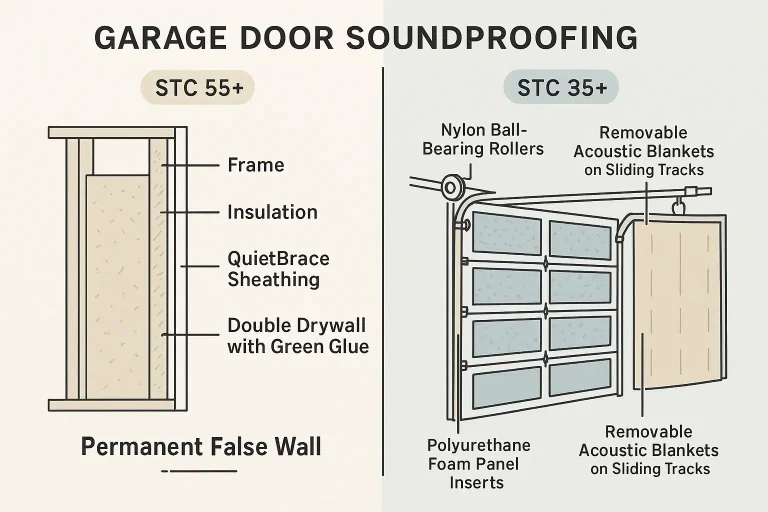
The largest choice you face is deciding what to do with the actual overhead door. Many homeowners want to retain the door’s functionality for resale value or HOA compliance, while others prefer to seal it permanently.
Option A: The Active Operational Door (Target: STC 35+)
If you choose to keep your door functional, you must optimize its parts. Start by addressing mechanical noise. Upgrading your tracks and comparing nylon vs steel garage door rollers is crucial; precision nylon rollers glide quietly, ending the grinding noise of steel-on-steel.
Next, upgrade to a professionally soundproof garage doors setup. Polyurethane-injected insulated panels dramatically increase mass and reduce panel vibrations. Finally, you must learn how to seal garage door gaps using heavy-duty industrial weatherstripping and magnetic perimeter seals to eliminate that critical 1% air leak.
Option B: The Permanent False Wall (Target: STC 55+)
If you do not need the door to open, you can build a decoupled false wall directly behind it. This creates a deep dead-air cavity. By framing a secondary stud wall slightly detached from the garage door, adding dense insulation, and sheathing it with specialized acoustic materials, you can completely block external street noise.
Material Showdowns (QuietBrace, MLV, Rockwool, and Drywall)
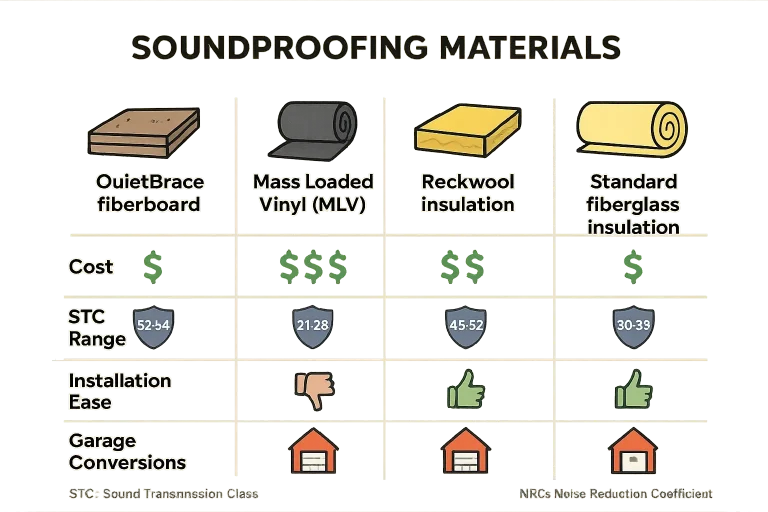
When choosing interior wall materials, selecting the right components saves both budget and labor.
The Sheathing Battle: QuietBrace vs. MLV vs. QuietRock
- QuietBrace: An asphalt-impregnated, sound-deadening fiberboard. It offers excellent noise reduction at a budget-friendly price, making it perfect for breaking structural sound paths.
- Mass Loaded Vinyl (MLV): Extremely dense and flexible, MLV is fantastic for adding mass in tight spaces, though it is heavier and more expensive to install.
- QuietRock: A premium engineered drywall containing a dampening polymer layer. It provides exceptional STC ratings but comes with a higher price tag.
The Cavity Battle: Rockwool Safe’n’Sound vs. Fiberglass
While standard fiberglass garage door insulation offers thermal control, Rockwool Safe’n’Sound features a much denser stone wool composition designed specifically to absorb sound waves in wall cavities, making it the superior choice for acoustic isolation.
Choosing the Right Windows (Decoding Glass STC Ratings)
Windows are a notorious weak spot for noise. Standard double-pane residential windows only achieve an STC of 26 to 28 because the symmetrical glass panes vibrate at the same harmonic frequency, letting street noise pass right through.
For garage conversions, look for windows utilizing dissimilar glass (e.g., combining a 1/4″ pane with a 1/8″ pane) to disrupt harmonic vibration, raising your rating to STC 32 to 34. For maximum isolation, choosing laminated glass with a PVB plastic interlayer acts as an acoustic dampener, achieving a rating of STC 35 to 40+.
The Gym vs. The Office
The Home Gym Playbook
Gyms generate heavy, low-frequency impact vibrations. Because concrete slab floors transmit structural vibrations directly into the main house, you need a decoupled floor. Install a dense rubber underlayment or commercial-grade vulcanized rubber tiles to absorb shock before it travels through your home’s foundation.
The Home Office Playbook
Home offices require isolation from airborne mid-to-high frequency noises (such as lawnmowers or sirens). The weakest link is often the interior door leading from the garage into your home. Replacing a hollow-core door with a solid-core composite door and adding an automatic drop-down door sweep can immediately reduce noise transmission by up to 15 decibels.
Frequently Asked Questions
Can I soundproof my garage without losing the garage door functionality?
Yes. By upgrading to a polyurethane-insulated door, installing nylon ball-bearing rollers to stop the garage door making noise, and using high-quality perimeter seals, you can achieve a quiet workspace while keeping the door operational.
Does acoustic foam on the walls stop noise from entering or leaving?
No. Acoustic foam is lightweight and porous; it only absorbs echoes inside the room to make your voice sound clearer. It does not possess the mass or decoupling ability needed to block sound from traveling through walls.
What is the difference between STC and NRC?
STC (Sound Transmission Class) measures a material’s or wall’s ability to block sound from traveling from one space to another. NRC (Noise Reduction Coefficient) measures how much sound a material absorbs inside a single room to reduce echo.
Your Next Steps to a Quieter Space
A successful garage conversion relies on precise planning and execution. If you want to transform your garage into a quiet home office or high-performance gym, we can help. Contact Up & Down Garage Doors today for a professional consultation on high-STC insulated garage doors, precision noise-reduction retrofits, and professional sealing.
You May Also Like
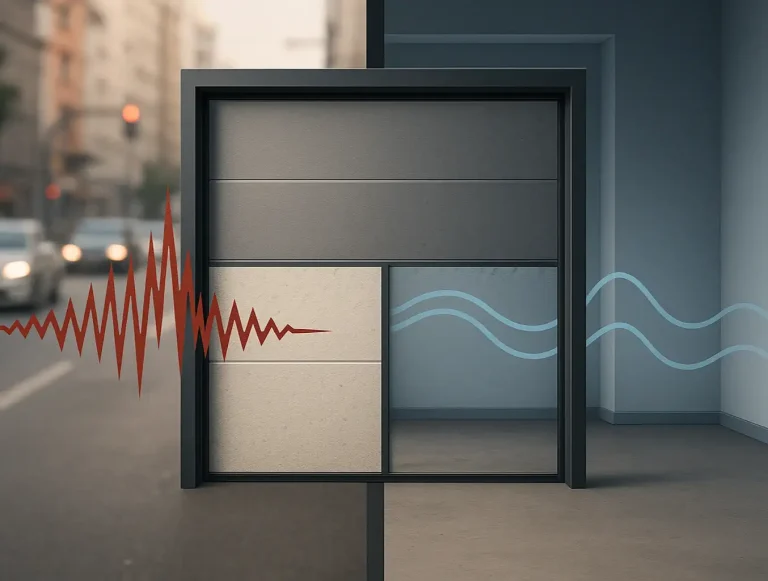
How Insulated Garage Doors Muffle Street Sounds and Opener Noise
Is your garage door the loudest part of your house? For many, the answer is a resounding yes. It might be the jarring rattle and hum of the opener that wakes the whole family, or perhaps it's the constant drone of…
Published Date: May 26, 2026
Diagnosing Garage Door Sounds and Issues in Houston
That sudden, jarring BANG ! from the garage. The grinding, protesting squeal as the door struggles to lift. Or maybe, just silence when it should be moving. A broken garage door is more than an inconvenience; it’s a…
Published Date: Feb 16, 2026
The Ultimate Guide to Garage Door Window Privacy
It feels like a choice between an inviting, light-filled space and a secure, private fortress. But it doesn’t have to be. You can have the best of both worlds. The solution lies in obscuring the view, not blocking…
Published Date: Jul 7, 2026