





How Insulated Garage Doors Muffle Street Sounds and Opener Noise
Published: May 26, 2026
Is your garage door the loudest part of your house? For many, the answer is a resounding yes. It might be the jarring rattle and hum of the opener that wakes the whole family, or perhaps it’s the constant drone of street traffic that turns your garage—and the rooms above it—into a less-than-peaceful space.
Most people think of garage door insulation purely in terms of temperature control. And while keeping your garage warmer in winter and cooler in summer is a major plus, you might be overlooking one of its most valuable benefits: silence.
An insulated garage door can transform the single largest moving part of your home from a source of noise pollution into a formidable sound barrier. Let’s explore how it tackles noise from both the outside world and its own machinery.
Foundation: The Two Types of Garage Noise & How to Fight Them
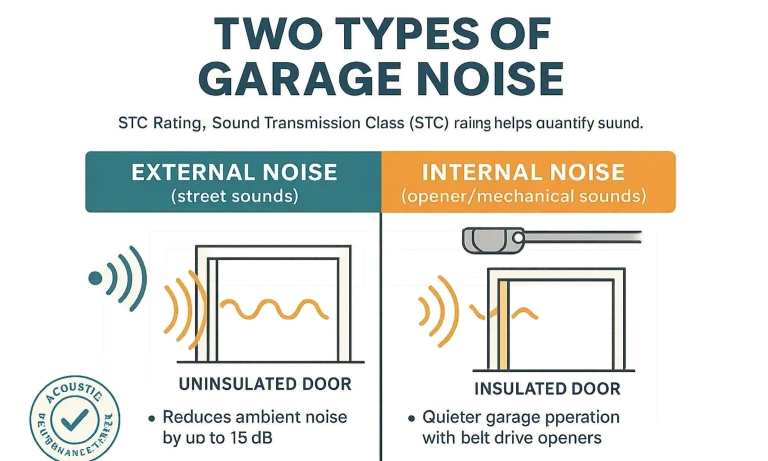
Before you can solve your noise problem, you need to understand where it’s coming from. Garage noise isn’t a single issue; it’s two distinct problems that require different solutions.
- External (Ambient) Noise: This is the sound that travels through the air from outside your home. Think of passing cars, neighborhood chatter, lawnmowers, or barking dogs. A standard, uninsulated garage door is often a thin sheet of metal that does little to stop these sound waves from entering your garage and home.
- Internal (Mechanical) Noise: This is the sound generated by the garage door system itself. It’s the squeaking, grinding, and rattling of metal parts, plus the vibration of the opener motor that can travel through the ceiling joists into living spaces.
The “aha moment” for many homeowners is realizing that a truly quiet garage requires a two-part strategy: a door built to block outside sounds and a system maintained to minimize its own noise. An insulated door is the cornerstone of the first part of that strategy.
Building: How Insulation Muffles Street Sounds
You know insulation resists heat transfer—that’s what its R-value measures. But the same materials that trap air to slow down temperature changes also happen to be fantastic at absorbing and dampening sound waves.
When sound waves from the street hit a hollow, uninsulated steel door, they cause the entire panel to vibrate, effectively turning your door into a giant speaker cone that projects the noise into your garage.
Insulation changes the equation completely. It adds mass and density to the door panels. Instead of vibrating through, sound waves get trapped and absorbed by the layers of insulation. The result is a significant drop in audible noise.
Quantifying the Quiet: What the Numbers Mean
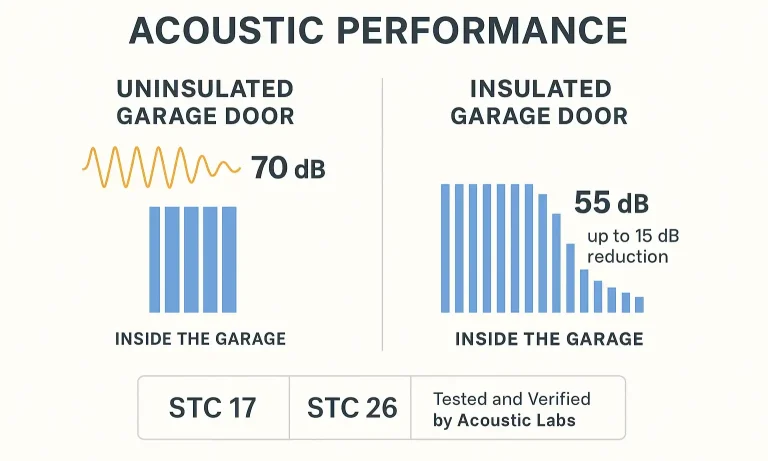
How much of a difference does it really make? Research and industry tests show that an insulated garage door can reduce outside noise by 10 to 15 decibels (dB).
That might not sound like a lot, but the decibel scale is logarithmic. To the human ear, a 10 dB reduction is perceived as making a sound half as loud. This can be the difference between hearing every car that drives by and enjoying peaceful quiet.
For those looking for a more technical measure, some premium doors come with a Sound Transmission Class (STC) rating. Think of it like an SPF rating for soundproofing—the higher the number, the better the door is at blocking noise. While not standard on all garage doors, an STC rating provides a certified level of sound performance. If you’re considering using your garage as a workshop, gym, or office, looking into the benefits of upgrading to an insulated garage door with a high STC rating is a smart move.
The type of insulation also plays a role. Doors with polyurethane insulation often provide slightly better sound dampening than those with polystyrene because polyurethane is denser and fills the entire panel cavity, leaving no air gaps. You can learn more by exploring the debate between an insulated vs non insulated garage door.
Mastery: Taming the Machine: A Guide to Opener & Mechanical Noise
Blocking street noise is a huge win, but what about the racket from the door itself? An insulated door helps here, too. The added rigidity of an insulated panel means it’s less likely to rattle and shake as it moves.
However, to achieve true silence, you need to address the mechanical components. This is the second part of our “total quiet” strategy.
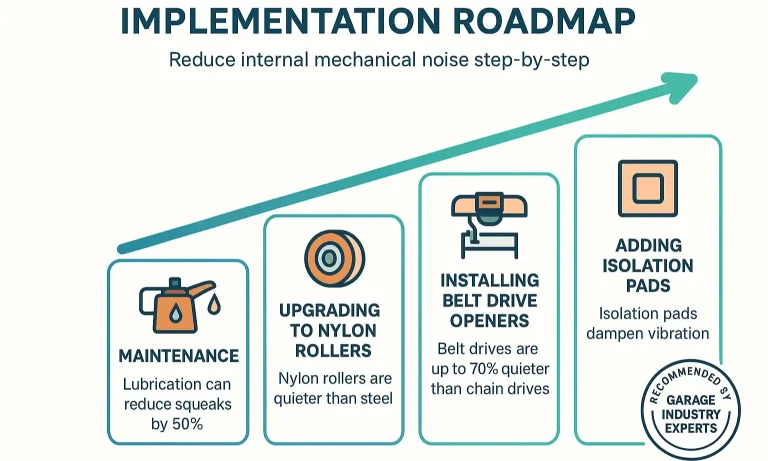
Here is the hierarchy for silencing your system, from simple fixes to major upgrades:
1. Proper Maintenance: The number one cause of a noisy door is friction. Regularly lubricating all moving parts—rollers, hinges, and springs—is the easiest and cheapest fix.
- Common Mistake Alert: Do NOT use WD-40! It’s a solvent, not a lubricant, and can strip away existing grease. Use a white lithium grease or a silicone-based lubricant designed for garage doors. Proper garage door maintenance can solve a surprising number of noise issues.
1. Upgrade Your Rollers: Standard garage doors often come with steel rollers, which create a lot of metal-on-metal noise. Swapping them for nylon rollers is a game-changing, inexpensive upgrade that dramatically reduces track noise.
2. Choose a Quieter Opener: If your opener is the main culprit, it might be time for an upgrade.
- Chain Drive: The most common and most affordable, but also the loudest due to the metal chain.
- Screw Drive: Quieter than chain drives but can still be noisy and require frequent lubrication.
- Belt Drive: The gold standard for quiet operation. These openers use a steel-reinforced rubber belt, making them whisper-quiet. If a bedroom is located above or next to the garage, a belt drive is the quietest garage door opener you can get.
Action: The Complete Garage Noise Reduction Checklist
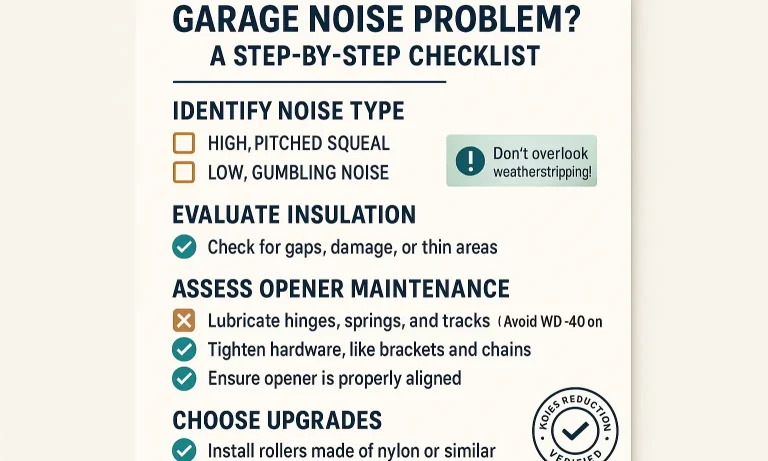
Ready to diagnose your noise problem and find the right solution? Use this checklist to pinpoint the source and determine your next steps.
Frequently Asked Questions
Is garage door insulation really worth it for noise reduction?
Absolutely. While primarily marketed for thermal efficiency, its ability to reduce perceived noise by up to 50% (a 10-15 dB drop) is one of its most immediate and noticeable benefits, enhancing the comfort of your home.
Will insulating my existing door make it quieter?
Yes, adding a DIY insulation kit can help reduce some ambient noise and panel rattling. However, it won’t be as effective as a professionally manufactured insulated door, which features a solid core of insulation bonded between steel layers for superior rigidity and sound dampening.
What’s more important for noise, the door’s R-value or the type of insulation?
Both matter, but in different ways. A higher garage door R-value usually means thicker or denser insulation, which helps with sound. However, the type can be more impactful. A door with injected polyurethane garage door insulation will typically offer better soundproofing than a similar R-value door with rigid polystyrene garage door insulation panels.
My garage door is loud when it opens and closes. Will a new insulated door fix this?
It will help significantly by reducing panel vibration, but the primary cause of opener noise is the mechanical system. For the best results, combine an insulated door with our other garage door noise reduction tips, like switching to nylon rollers and a belt drive opener.
From Loud Liability to Quiet Asset
Your garage door doesn’t have to be a source of constant noise. By understanding the two types of noise—external and internal—you can create a holistic plan to reclaim your peace and quiet.
An insulated garage door is the single most effective upgrade for blocking out the world, while a well-maintained system with modern components silences the machine itself. Together, they transform your garage door into a quiet, reliable, and valuable part of your home.
You May Also Like
Insulated Garage Door Benefits for Workshops
You’ve finally done it. You’ve claimed the detached garage as your own—a sanctuary for woodworking, a gym for personal records, or a studio for your next masterpiece. But as the seasons change, you notice something.…
Published Date: May 25, 2026
Insulated vs. Uninsulated Garage Doors: Which Option Offers the Best Value for Your Home?
Are you tired of walking into a freezing garage in the winter or a stifling one in the summer? Or maybe you’re looking to upgrade your garage to enhance your home’s appearance. The right garage door can make a big…
Published Date: Dec 26, 2024
Which Insulated Garage Door Type Offers the Best Thermal Performance
Ever get that feeling that your home is working overtime just to stay comfortable? You’ve checked the windows and sealed the front door, but there's one massive weak spot many homeowners overlook: the garage door.…
Published Date: May 13, 2026