





Garage Door Opener Hums But Door Doesn’t Move: Common Causes
Published: Apr 30, 2026
You press the button on your remote, and instead of the familiar rumble of your garage door rising, you hear a low, persistent hum. The motor is clearly running, but the door isn’t moving an inch. It’s a frustrating moment that can feel like a major, expensive problem.
But here’s a surprising insight: that hum is actually good news.
It tells you that your opener is getting power and the motor is trying to work. This means you can immediately rule out issues like a tripped breaker or a dead outlet. The problem isn’t with the power; it’s with the connection between the motor and the door.
Think of it like a car with its engine revving but the transmission is in neutral. The engine is working fine, but the power isn’t reaching the wheels. We just need to figure out where that disconnect is happening. This guide will walk you through a step-by-step diagnostic process, starting with the simplest and most common causes, to help you solve the mystery.
Foundation: The 60-Second Sanity Check (The Easiest Fixes First)
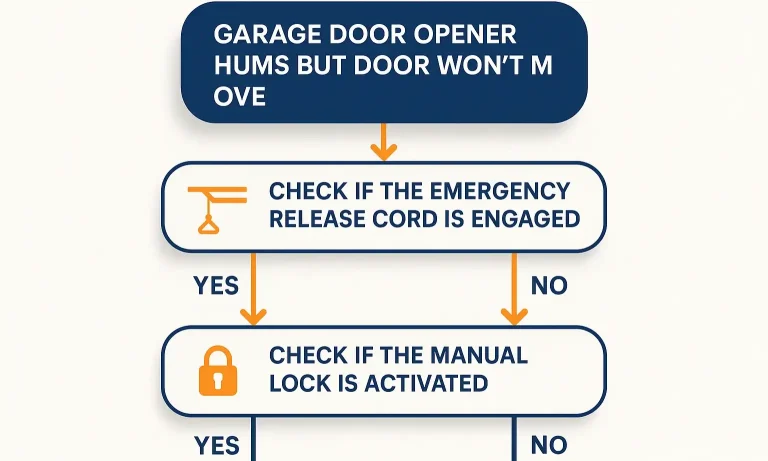
Before you even think about grabbing a toolbox, let’s check the two most frequent culprits. These issues account for a surprising number of service calls and can be fixed in less than a minute.
1. The Emergency Release Cord is Engaged
This is, by far, the number one reason for a humming-but-not-moving opener. That red cord with the plastic handle dangling from the opener rail isn’t just for decoration; it’s a manual override that disconnects the door from the opener’s trolley (the part that moves along the track).
- What it looks like: A red rope hanging from the metal rail above your door.
- Why it happens: It can be pulled by accident, sometimes by catching on something tall in your car or even by kids playing.
- The Fix: Make sure the garage door is fully closed. To re-engage the trolley, you can often just press your remote button again. The opener will run, and the trolley should automatically click back into the shuttle on the door. If not, you may need to pull the cord down and toward the door to reset the spring mechanism before running the opener. Understanding the function of the garage door emergency release is crucial for any homeowner.
2. The Manual Door Lock is Activated
Many garage doors have a manual lock, either a handle that turns or a sliding bolt on the inside. If this lock is engaged, the opener motor will try its best to lift the door, but the physical lock will prevent it from moving, resulting in that telltale hum.
- What to look for: A sliding metal latch on the inside of the garage door track or a T-handle in the middle of the door.
- The Fix: Simply disengage the lock. Once you do, the door should open normally with the remote. If you don’t use the manual lock often, consider a modern keyless garage door lock system for a more secure and convenient alternative.
If you’ve checked both of these and the door still won’t budge, it’s time to move on to the next level of diagnostics.
Building: Intermediate Diagnostics (Is the Door Itself the Problem?)
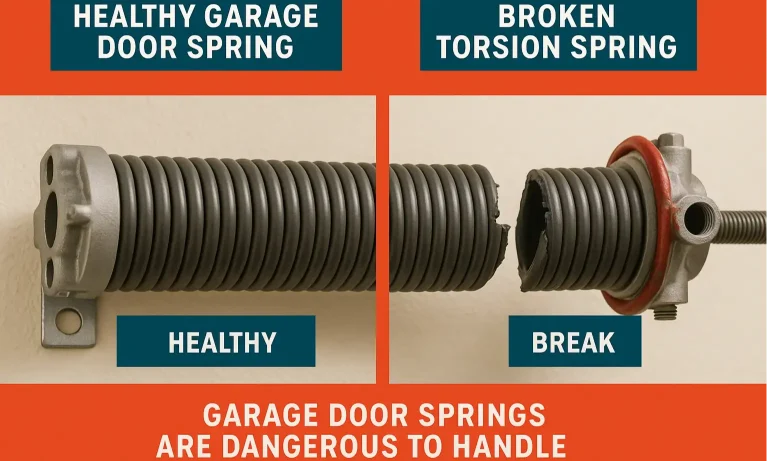
The next step is to determine if the issue is with the opener or the door itself. The opener motor is strong, but it can’t lift a door that is physically jammed or impossibly heavy due to a mechanical failure.
Test the Door’s Balance
First, you need to safely disconnect the door from the opener.
- Close the door completely. This is a critical safety step.
- Pull the red emergency release cord. The door is now in manual mode.
- Try to lift the door by hand.
Here’s what you’re looking for: A well-balanced garage door should feel relatively light. You should be able to lift it smoothly with one or two hands without significant straining. It should also stay open on its own when you let go about halfway up.
If the door feels incredibly heavy or if it slams shut when you let go, you likely have a broken spring.
The Critical Issue: A Broken Spring
The springs (either torsion springs above the door or extension springs on the sides) do the vast majority of the heavy lifting. The opener just guides the door along the track. When a spring breaks, the opener motor is suddenly trying to lift the full weight of the door—a task it isn’t designed for. This strain causes the motor to hum without being able to move the door.
SAFETY FIRST: Garage door springs are under extreme tension and can be incredibly dangerous. A spring replacement is not a DIY job. If you suspect a broken spring, do not attempt to operate the door and call a professional immediately. It’s important to know how to tell if your garage door spring is broken so you can make a safe and informed decision.
If the door moves up and down smoothly by hand, the problem isn’t the door. It’s time to look inside the opener itself.
Mastery: Advanced Diagnostics (Is it the Opener's Internals?)
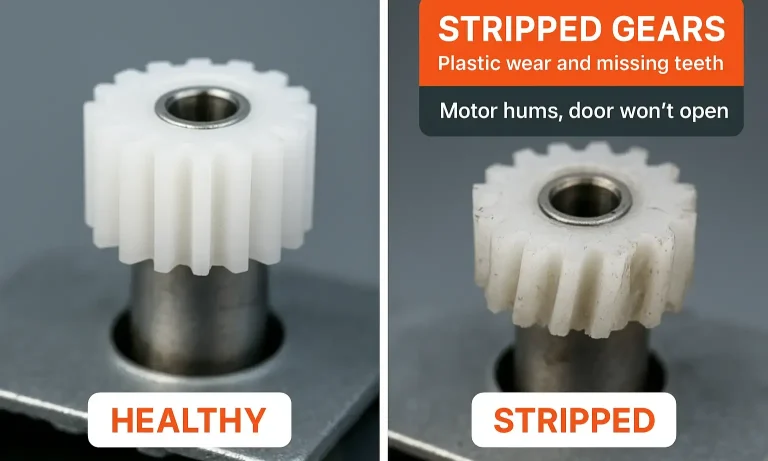
If you’ve ruled out the simple fixes and confirmed the door is balanced, the issue is likely within the opener unit. This involves taking the cover off the motor housing to inspect the internal components.
Before you begin: Unplug the garage door opener from the electrical outlet to prevent any risk of electric shock.
The Main Drive Gear is Stripped
Inside your opener is a set of gears that transfer power from the motor to the chain or belt that moves the door. The main drive gear is often made of nylon or plastic to reduce noise and wear. Over time, this gear can wear down and strip, especially after years of service or a major jam.
- How to check: Once the opener is unplugged, remove the outer cover (usually held on by a few screws). Look for the main gear that connects to the sprocket for the chain/belt.
- Signs of failure: You’ll see plastic shavings that look like fine dust inside the opener housing. The teeth on the gear will be visibly worn down, smoothed out, or completely gone in some spots. When the motor hums, the metal worm gear from the motor spins, but it can’t grip the stripped plastic gear to turn it.
The Motor Capacitor has Failed
This is a concept that many guides explain poorly, but it’s simple when you think about it. The capacitor is like a small battery that gives the motor a powerful “kick-start” to get it moving from a dead stop. It provides the initial torque needed to overcome the door’s inertia.
- How it works: When you press the remote, the capacitor discharges a burst of energy to get the motor spinning.
- Signs of failure: A failing capacitor can’t provide that initial jolt. The motor gets electricity—which is why it hums—but it doesn’t have the starting torque to begin turning. You might hear the hum followed by a “click” as the motor’s overload sensor shuts it down. If you have a specific brand, a dedicated LiftMaster garage door opener troubleshooting guide can provide more model-specific details.
Replacing a capacitor is possible for a skilled DIYer, but it requires handling electrical components safely. If you’re not comfortable with this, it’s best to call a professional.
Action: Your Clear Path to a Fix
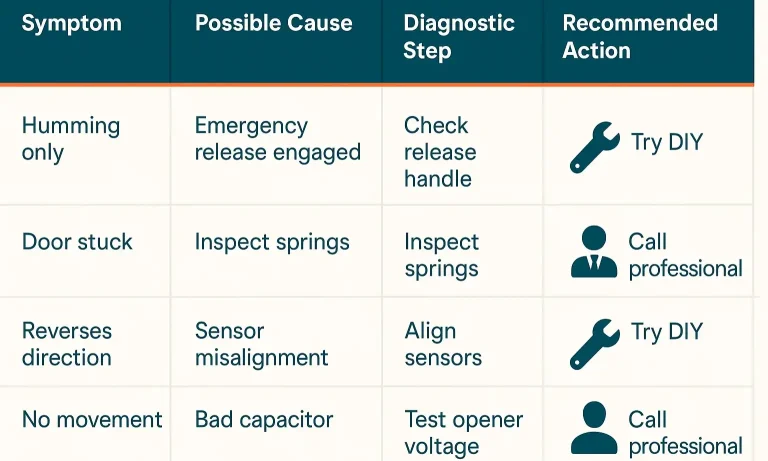
You’ve gone from a panicked button-presser to an informed diagnostician. Based on what you found, here is your clear path forward:
- The trolley was disconnected from the shuttle: The emergency release was likely pulled. Simply re-engage the trolley by running the opener, and the door should start working normally again.
- The door wouldn’t move at all: A manual lock might be engaged. Double-check the hardware on the door itself and disengage any physical locks.
- The door was extremely heavy to lift by hand: This is a strong indicator of a broken spring. Call a professional immediately. Do not attempt to use or fix the door yourself, as spring replacement is a highly dangerous, safety-critical repair.
- You found plastic shavings inside the opener housing: This is the classic symptom of a stripped main drive gear. If you are handy, you can order a replacement gear kit and follow a detailed guide for your specific model. Otherwise, this is a great time to schedule a professional repair.
- The motor just hums and then clicks off: The most likely culprit is a failed motor capacitor. For those comfortable working with basic electronics and safely discharging capacitors, you can swap this part out yourself. If not, call a pro to handle the repair safely.
For any issues requiring a technician, a trusted local service can repair garage door opener problems safely and efficiently, ensuring your system is running perfectly without putting you at risk.
Frequently Asked Questions (FAQ)
Could the humming be a sign that my whole opener needs to be replaced?
Not usually. The fact that the motor is humming means the core of the opener is still functional. The issue is almost always a replaceable part like a gear, a capacitor, or a broken spring on the door itself.
Can I just give the door a push to help it get started?
Please don’t. While this might seem to work if the capacitor is weak, you’re masking the root problem and putting enormous strain on other opener components. It’s also unsafe to be interacting with a powerful motor trying to move a heavy door.
Why did my opener’s gear strip?
It’s typically a result of years of normal wear and tear. However, the process can be accelerated if the door is unbalanced (due to weak springs) or if the door has ever been blocked while closing, causing the gear to grind. Sometimes, a problem like the garage door sticking when opening can put extra strain on the gear over time.
What if the opener hums and the chain is loose?
This is another strong indicator of a stripped gear. The sprocket that drives the chain is connected to the main gear. If the gear isn’t turning, the sprocket won’t turn, and the chain will appear to sag or stay loose.
By walking through these steps, you can confidently diagnose the issue and take the right steps to get your garage door back in working order.
You May Also Like
Why Your Garage Door Won’t Open & How to Fix It Fast
A garage door is one of those conveniences we rarely think about until it stops working. When it fails, your day can easily be thrown off track, with plans interrupted and unnecessary frustration added to your…
Published Date: Feb 19, 2025
Safety Precautions and Essential Tools for DIY Garage Door Chain
It’s a sound every homeowner dreads: a sudden clatter and grind from the garage, followed by the sight of a sagging, useless chain dangling from the opener. Your first thought might be an expensive repair call, but…
Published Date: Apr 23, 2026
Seasonal Garage Door Alignment
Does your garage door have a mind of its own when the seasons change? One day it glides smoothly, and the next, it’s groaning, sticking, or stubbornly refusing to close. If you’ve ever found yourself asking, "Why…
Published Date: Apr 23, 2026