





The Smarter Way to Predict and Prevent Garage Door Repairs
Published: Mar 25, 2026
It’s one of the most jarring sounds a homeowner can experience: a sudden, explosive BANG from the garage that sounds like a gunshot. You rush to see what happened, only to find your garage door won’t open and a snapped, angry-looking metal coil is hanging where it shouldn’t be.
That sound is the final cry of a garage door spring pushed beyond its limit. For most people, it’s a complete surprise—an unexpected and urgent expense. But what if it wasn’t a surprise? What if you could see it coming years in advance?
Most garage door advice relies on a simple, one-size-fits-all calendar: “get your door serviced once a year.” But that’s like telling every car owner to get an oil change every 5,000 miles, regardless of whether they drive cross-country or just to the local grocery store. It doesn’t account for the single most important factor: how much you actually use it.
This guide will introduce you to a smarter way to think about garage door care. We’ll shift the focus from time to usage, transforming you from a reactive owner waiting for a breakdown to a proactive one who can predict issues before they happen.
Foundation: Your Garage Door's Mileage - Introducing the Cycle
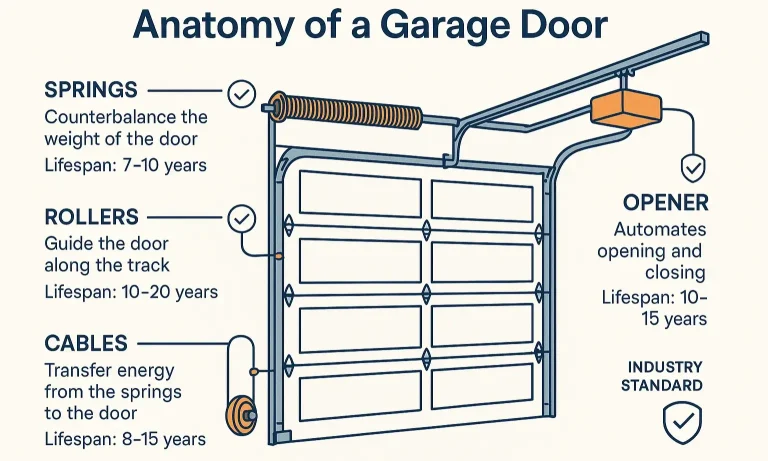
Think of your car’s odometer. It tracks mileage, giving you a precise measure of wear and tear. Your garage door has a hidden odometer, too, but instead of miles, it counts “cycles.”
What is a garage door cycle? It’s simple: one full opening and one full closing of the door.
This single metric is the key to understanding your garage door’s health. A retired couple who uses their door twice a day puts about 730 cycles on it per year. A busy family of four leaving for work, school, and soccer practice might use it 10 times a day, racking up 3,650 cycles annually.
Over five years, that’s the difference between 3,650 cycles and 18,250 cycles. The family’s garage door is experiencing five times the wear and tear. Suddenly, the “service it once a year” advice feels completely inadequate, doesn’t it? By understanding cycles, you can start creating a maintenance plan tailored to your life, not a generic calendar.
Building: The Component Lifespan Cheat Sheet
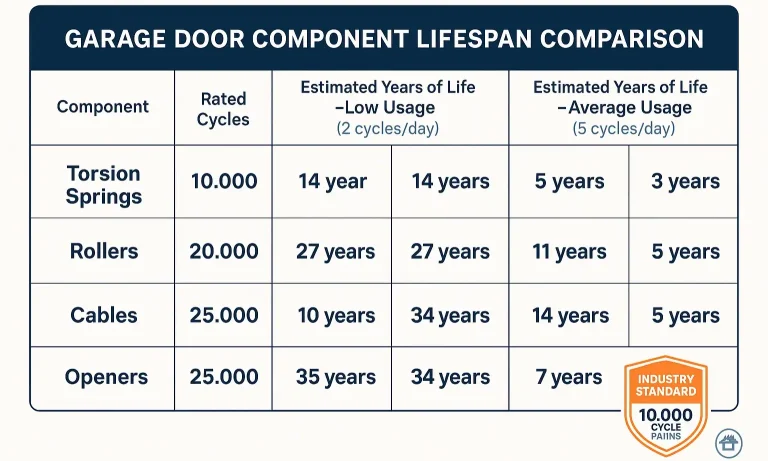
Every major part of your garage door system has an expected lifespan, measured in cycles. The most critical component—and the one that often fails most spectacularly—is the torsion spring. The industry standard for a builder-grade torsion spring is 10,000 cycles. While that number seems high, you’ll soon see how quickly those cycles can add up.
Here’s a breakdown of the typical lifespans for key components. We’ve translated the cycle counts into estimated years for low (2-4 uses/day), average (4-6 uses/day), and high (8+ uses/day) usage households to give you a clearer picture.
Garage Door Component Lifespans
- Torsion Springs (10,000 Standard Cycles): Expect 7-9 years for low use, 5-7 years for average use, and only 2-4 years for high use.
- Nylon Rollers (12,000 – 15,000 Cycles): Expect 10-14 years for low use, 7-10 years for average use, and 4-6 years for high use.
- Lift Cables (8,000 – 15,000 Cycles): Expect 7-14 years for low use, 5-10 years for average use, and 2-6 years for high use.
- Garage Door Opener (10,000 – 15,000 Cycles): Expect 10-14 years for low use, 7-10 years for average use, and 4-6 years for high use.
Seeing the numbers laid out like this creates an “aha moment.” A high-use household might need to replace their springs in just three years, while a low-use household could go for nine. Knowing this helps you budget for future repairs and understand why professional inspections are so valuable. It also helps you understand how long garage door springs last under different conditions.
Mastery: The Personalized Maintenance Calculator
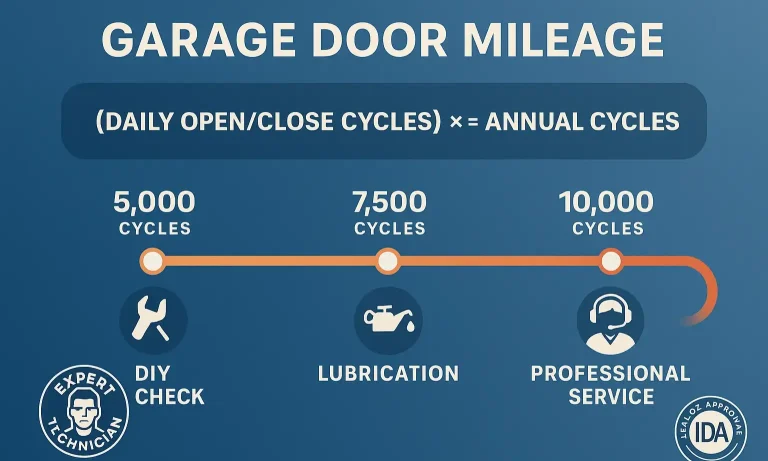
Now it’s time to find your garage door’s “mileage.” You don’t need a fancy tool—just a moment of honest reflection and some simple math.
Step 1: Estimate Your Daily Cycles
Think about a typical weekday. How many times does the garage door open and close?
- You leave for work (1 cycle)
- Your partner leaves for work (1 cycle)
- Kids leave for school (1 cycle)
- Deliveries or coming home for lunch? (Add cycles)
- Everyone returns home (1-3 cycles)
- Leaving for evening activities? (1+ cycles)
Be realistic. It’s easy to underestimate. Let’s say your family averages 8 cycles per day.
Step 2: Calculate Your Annual Cycles
This is the magic formula:
(Your Daily Cycles) x 365 = Your Annual Cycles
For our example family:
8 cycles/day x 365 days = 2,920 annual cycles
Step 3: Predict Your Component Lifespans
Now you can use this number to see into the future. How long will that standard 10,000-cycle spring last?
10,000 cycles / 2,920 annual cycles = 3.42 years
Suddenly, that three-year mark isn’t a surprise—it’s an expectation. You now know that as you approach the end of year three, it’s time to have your system professionally inspected before you hear that gunshot sound. This proactive approach is the key to avoiding emergency calls and potentially more expensive damage.
Action: Your Custom Service Schedule (DIY & Pro)
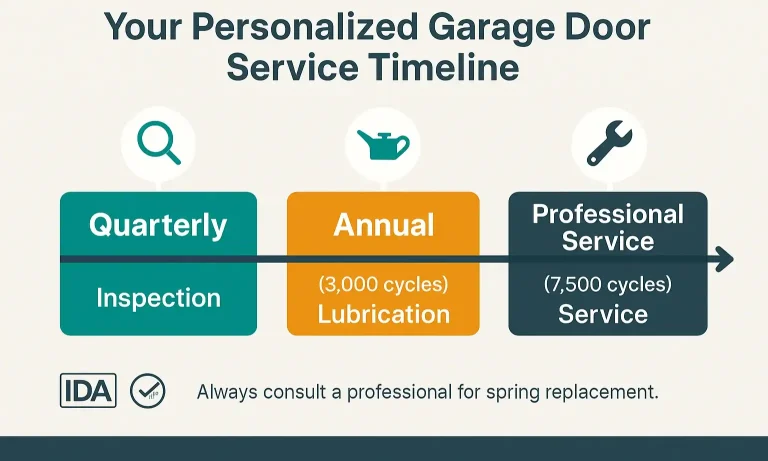
Your cycle count doesn’t just predict failure; it dictates your service schedule. Instead of a generic calendar, you can now build a timeline based on usage milestones. Proper garage door maintenance isn’t just about fixing what’s broken, it’s about preserving what isn’t.
Here is a sample schedule based on our high-use example (2,920 cycles/year):
Quarterly DIY Check (Every ~730 Cycles)
These are simple visual and auditory checks you can do yourself in minutes.
- Listen: Open and close the door. Do you hear any new grinding, scraping, or squeaking sounds?
- Look: Visually inspect the springs, cables, and rollers. Do you see any fraying on the cables or rust on the springs?
- Test Sensors: Wave an object (like a broom handle) under the door as it’s closing. It should immediately reverse.
- Check Balance (with caution): With the door closed, pull the emergency release cord. You should be able to lift the door manually with moderate effort. If it feels incredibly heavy or flies up, the spring balance is off.
Annual / ~3,000-Cycle Check
This involves a bit more hands-on work and is a great time for some basic preventative care.
- Lubricate Moving Parts: Apply a garage-door-specific lubricant (not WD-40!) to the rollers, hinges, and springs.
- Tighten Hardware: Vibrations can loosen nuts and bolts over time. Check and gently tighten any loose hardware.
- Perform DIY Checks: Repeat all the checks from your quarterly inspection. A focused garage door spring maintenance routine can significantly improve safety and longevity.
- Professional Inspection: A technician will measure spring tension, inspect cables for wear at the connection points, and check the opener’s force settings.
- Proactive Replacement: This is the ideal window to replace your springs and cables before they fail. It turns an emergency situation into a planned, controlled service call, saving you stress and preventing potential damage to your door or opener when a spring breaks under load.
Pro-Level / ~7,500-Cycle Service (Approaching End-of-Life)
As your door approaches the 7,500-cycle mark (around 2.5 years for our example family), it’s time to call in a professional. They have the trained eye and specialized tools to spot wear that you can’t.
Following a usage-based schedule is the most effective form of garage door preventive maintenance you can practice.
A Critical Safety Warning
While DIY checks are encouraged, some components are under extreme tension and are extremely dangerous. Never attempt to adjust, repair, or replace your garage door springs or cables yourself. These parts hold enough energy to cause serious injury or even death. This is a job that should always be left to a trained and insured professional. If you suspect an issue, the safest thing you can do is learn how to fix a broken garage door spring by calling a qualified technician.
Frequently Asked Questions (FAQ)
What are the main signs my garage door needs service?
Beyond tracking cycles, look for these warning signs: loud noises (grinding, popping, squealing), slow or jerky movement, the door feeling unusually heavy when lifted manually, or visible damage like frayed cables and gaps in the spring coils.
How long do garage door openers last?
Like the door itself, a garage door opener lifespan is best measured in cycles, typically around 10,000 to 15,000. For most families, this translates to 10-15 years. Signs of failure include inconsistent operation, slow movement, and the motor making noise without the door moving.
Are nylon or steel rollers better?
Both have their place, but nylon rollers are generally quieter and require less frequent lubrication than their metal counterparts. You can explore a detailed comparison of nylon vs steel garage door rollers to see which is right for your home.
My garage door cable looks frayed. Is that a big deal?
Yes, it’s a very big deal. A frayed cable is a sign that it’s about to snap. The cables work with the springs to lift the heavy door, and a failure can cause the door to slam shut. If you see fraying, stop using the door and call for a professional garage door cable replacement immediately.
How long do garage door springs last, really?
It all comes down to cycles. The standard is 10,000 cycles, but you can opt for high-cycle springs rated for 25,000, 50,000, or even 100,000 cycles. While they cost more upfront, they can be a smart investment for high-usage families, lasting many times longer than the standard option. It’s an important factor to consider when learning how long do garage door springs last.
Your Next Step: From Knowledge to Action
You are now equipped with a powerful new way to look at your garage door—not as a ticking clock, but as a system with a predictable, usage-based lifecycle. You know how to calculate your annual cycles, predict when key parts will wear out, and create a custom service plan that makes sense for your home.
Stop waiting for the gunshot. Take a few minutes to calculate your cycles and see where you stand. By being proactive, you can ensure your garage door remains a safe, reliable, and quiet part of your daily life.
You May Also Like
How Often Should My Garage Door Be Serviced
Your garage door is an essential part of your home. Therefore, its proper and regular maintenance ensures security and peace of mind. Meanwhile, neglecting it may potentially lead to serious malfunctions and costly…
Published Date: Aug 26, 2024
Commercial vs. Residential Garage Doors
Think about the difference between your family car and a commercial delivery truck. The car might make a few trips a day to work, school, and the grocery store. The delivery truck, however, runs 12 hours straight,…
Published Date: Mar 24, 2026
Is Annual Garage Door Maintenance Really Necessary
You just invested in a beautiful, brand-new garage door. It runs smoothly, looks great, and you barely even use it—maybe once on the weekend. Yet, you keep hearing the same advice: “Get your garage door serviced…
Published Date: Mar 20, 2026