





Driveway Gate Opener & Motor Repair: The Master Diagnostic & Decision Guide
Published: Nov 19, 2026
When an automated entrance fails, property owners face a immediate challenge: security exposure and trapped vehicles. Deciding whether to undertake a quick sub-component fix or hire a licensed technician comes down to accurately isolating the failure point.
Emergency Triage: Vehicle Release Protocol
If your gate is unresponsive and your vehicle is trapped, disengaging the operator manually is your immediate priority. For sliding gates, locate the clutch release keyhole near the base of the motor housing, insert the key, turn it 90 degrees clockwise, and manually slide the panel back. For swing gates, remove the quick-release pin connecting the linear actuator arm to the gate bracket. Always know how to execute a garage door manual release protocol before attempting internal electrical troubleshooting.
Interactive Gate Opener Diagnostic Decision Tree
Isolating an operator fault quickly prevents wasting money on unneeded components. Industry field data reveals that roughly 40% of control board failures stem from electrical surges or pest intrusion (insects shorting high-voltage board traces), 35% of motor issues trace back to mechanical binding or gear wear, and 15% relate to safety sensor misalignment.
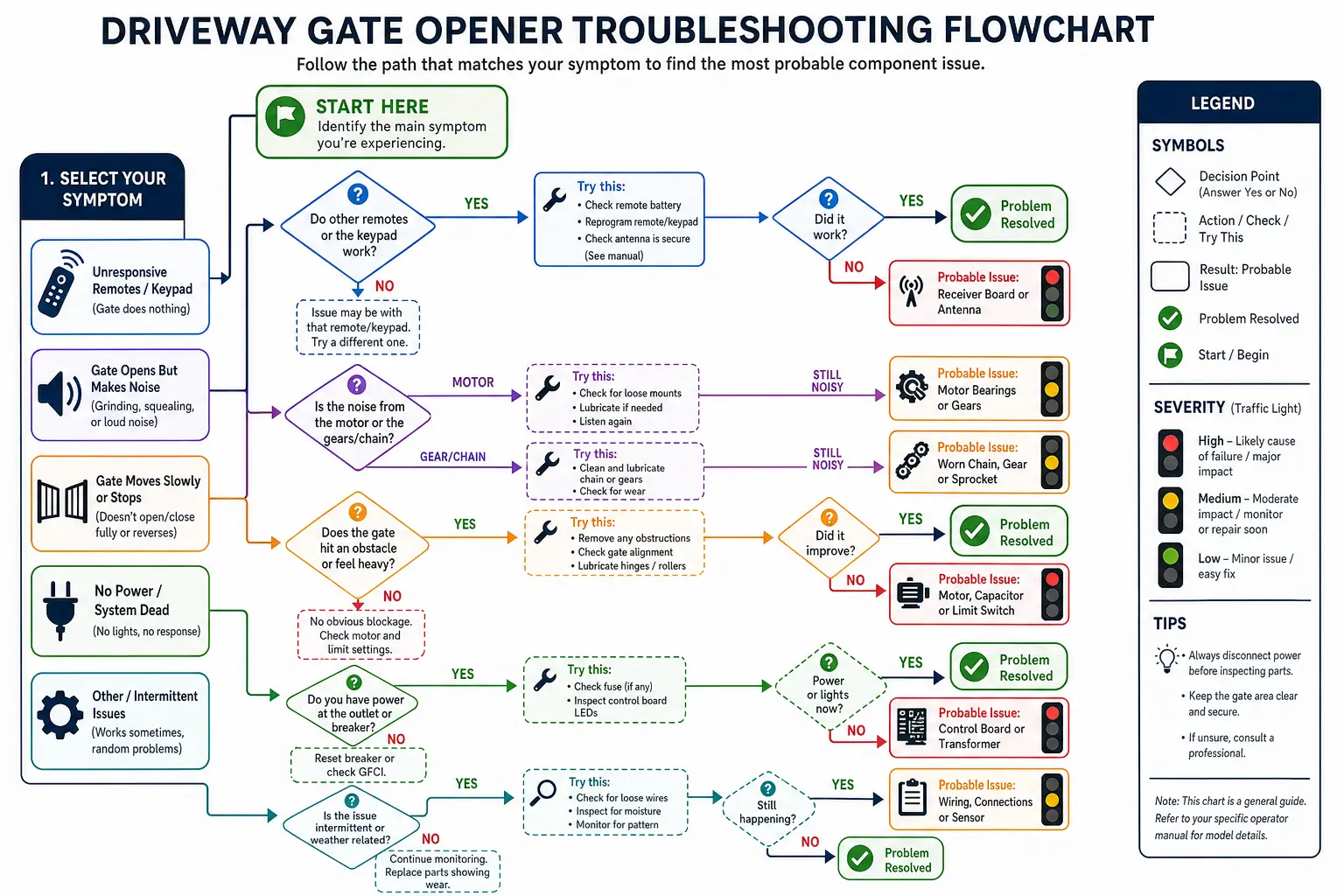 This interactive diagnostic flowchart guides users step-by-step through common driveway gate opener issues, helping quickly isolate the failure cause from power problems to motor or sensor faults.
To systematically isolate the issue:
- Zero Power / No Board LEDs: Test secondary transformer voltage with a digital multimeter. A dead main board often requires inspecting your GFCI outlet, checking line voltage (120V/240V vs 24V DC secondary), or evaluating the garage circuit board traces for visible burn spots.
- Gate Reverses Mid-Cycle: Under UL 325 safety standards, modern operators mandate monitored entrapment protection. Inspect optical lenses for dirt or physical alignment shift using our guide on garage door sensors troubleshooting.
Decoding Motor Sounds and Mechanical Breakdown
Sound is your most reliable acoustic diagnostic cue when evaluating motor internal wear.
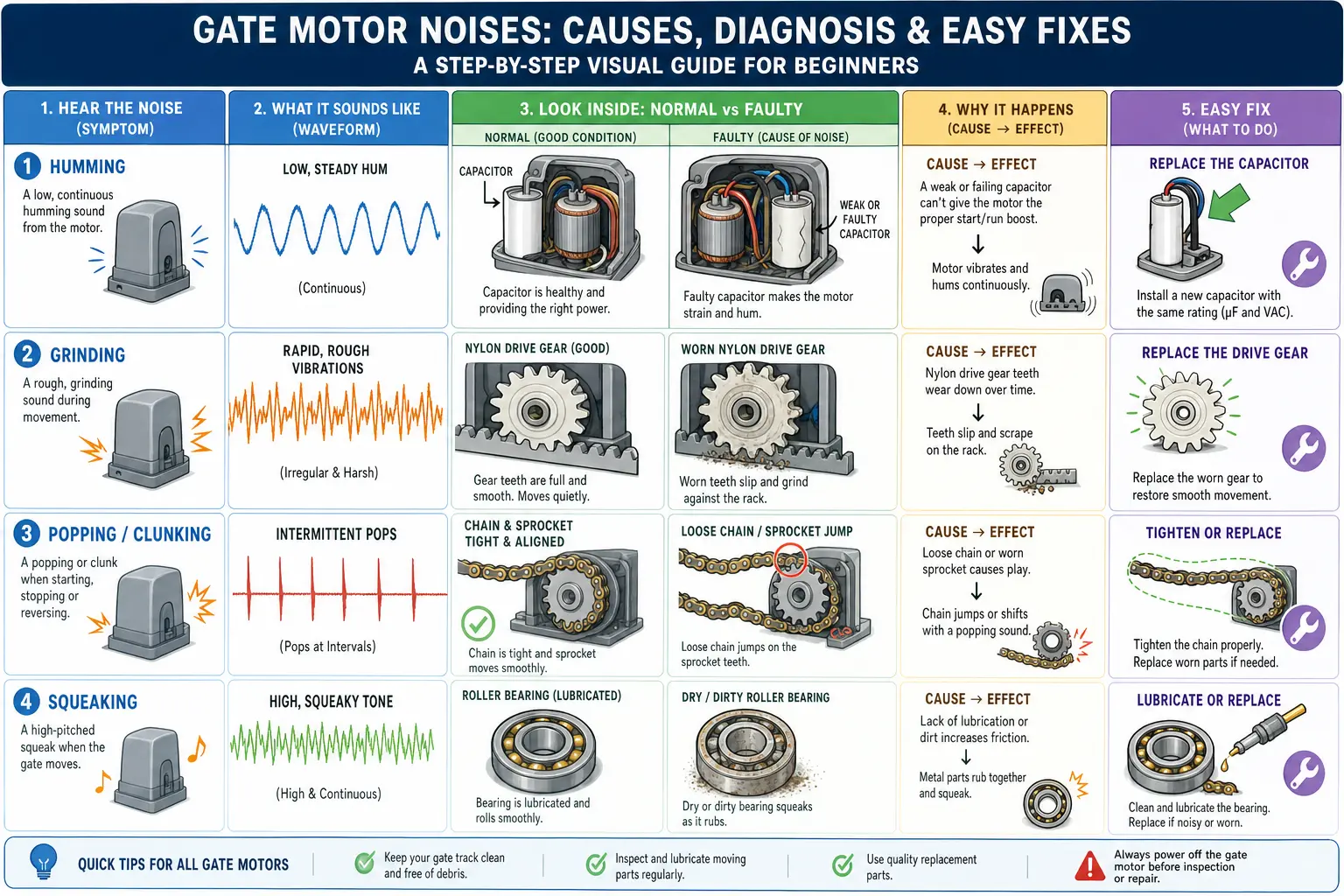 This illustrated noise decoder teaches how to identify mechanical issues within gate motors by matching distinct sounds to probable faulty components, enabling targeted repairs and cost-effective DIY fixes.
- Low Humming Sound: Indicates a failed start/run capacitor ($15–$30 part) or jammed gearbox. The motor attempts to draw current but lacks start torque.
- Loud Grinding Noise: Signifies stripped internal nylon drive gears or dry, ungreased rack-and-pinion teeth. Neglecting track friction overloads the force limit, stripping internal gears.
- Popping or Jumping: Points to excessive chain slack or worn sprocket teeth on sliding mechanisms.
For full system overhauls, review options for electric garage gate installation and services.
Control Board & Remote Signal Diagnostics
Popular budget sliding operators (like CO-Z SL600AC/SL1500ACL) and commercial LiftMaster units rely on specific board jumper configurations for signal execution.
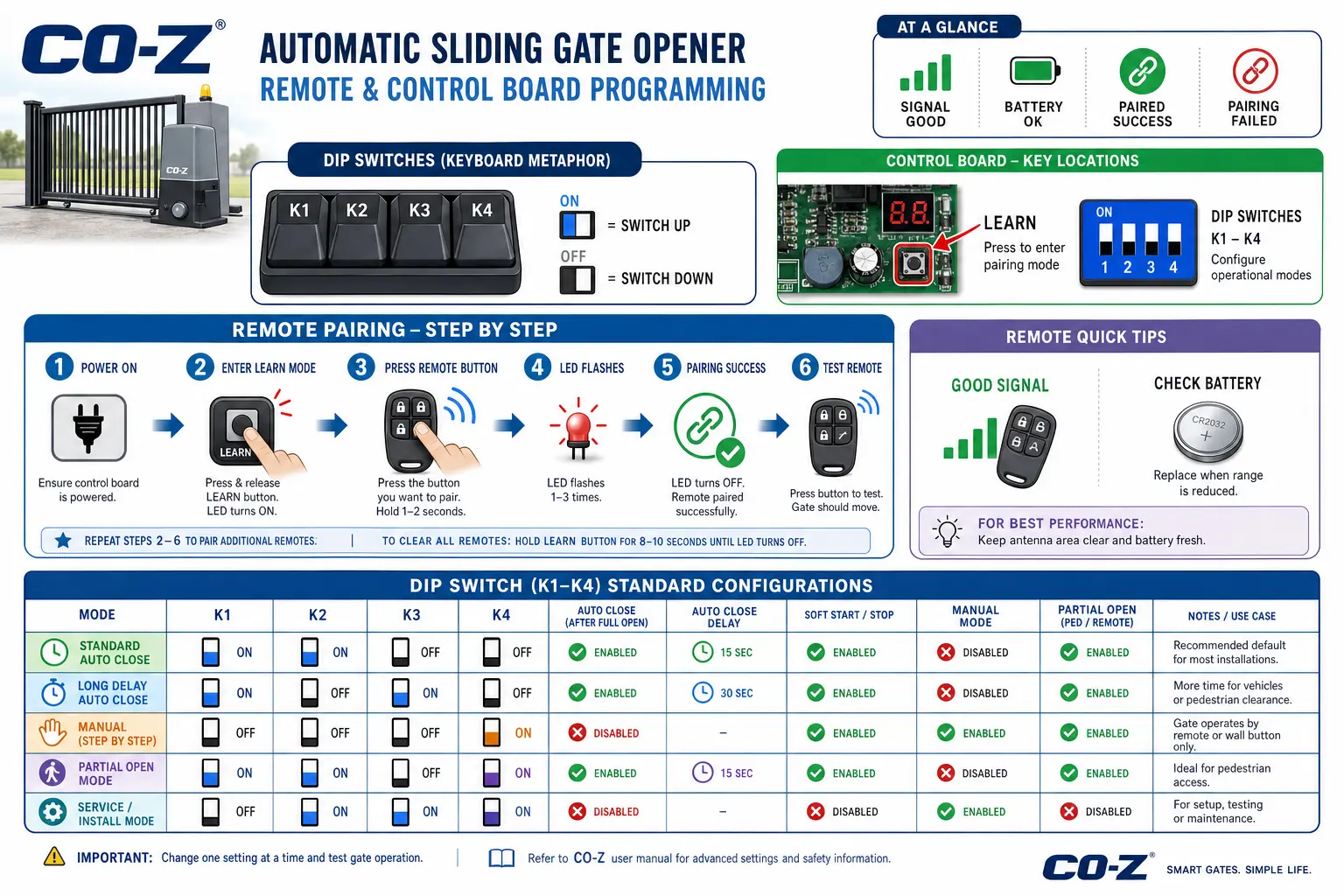 A concise, brand-specific programming matrix for CO-Z gate openers that visually anchors DIP switch settings and remote pairing steps, making complex configuration instantly approachable.
If your remotes are completely non-responsive, review how to fix garage door remote signal loss by checking transmitter batteries (433.92 MHz frequency) and clearing stored remote codes on the receiver board. Adjust auto-close timing and force-sensitivity limits properly via your board’s dip switch garage door opener matrix.
Frequently Asked Questions
Why does my driveway gate motor hum without moving the gate?
A distinct humming sound typically indicates a failed motor start capacitor or a physical mechanical obstruction in the gate track. The capacitor supplies the electrical boost needed to turn the motor rotor; when it fails, the motor draws current but cannot initiate rotational force.
How do UL 325 safety standards affect gate opener repairs?
UL 325 safety standards mandate that modern automated gate operators feature monitored secondary entrapment protection devices, such as optical photo-eyes or safety edge sensors. If the logic board detects an open circuit or voltage drop in these sensors, it automatically blocks the gate from closing.
Should I replace my gate circuit board myself or call a professional?
Replacing a circuit board yourself is viable if you are comfortable taking multimeter readings and matching terminal block wiring. However, if the board failed due to a power surge or a shorted motor winding, installing a new board without fixing the root cause will destroy the replacement board instantly.
Need professional diagnostic support for your gate system? Up & Down Garage Doors brings family-owned integrity, transparent pricing, and 24/7 service across CT, TX, NY, IL, and AZ.
You May Also Like
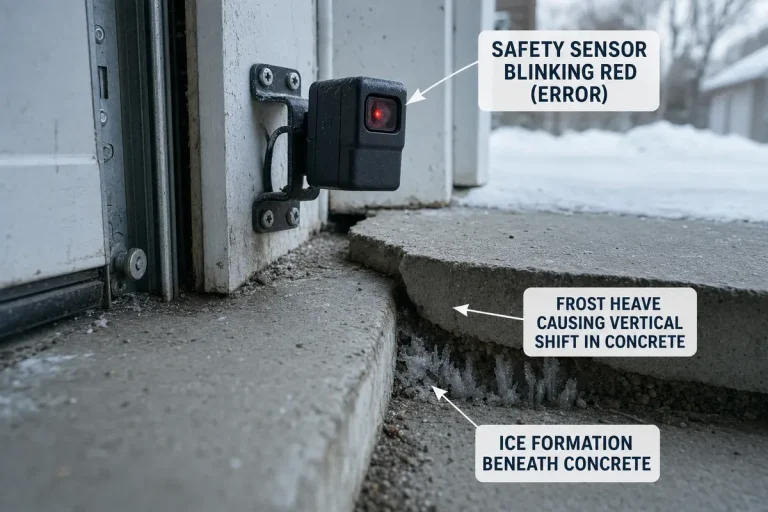
Photo-Eyes Misaligned After Frost Heave: How to Fix Garage Sensors When Your Concrete Slab Lifts
Published Date: Nov 17, 2026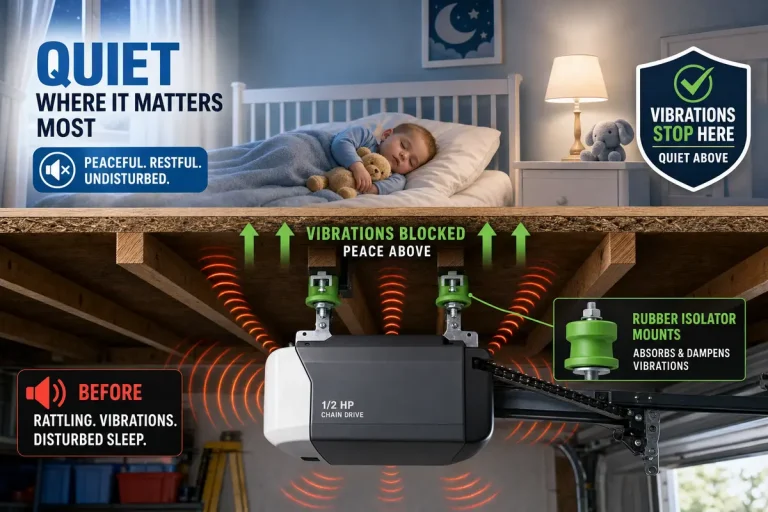
Do Garage Door Opener Vibration Isolator Kits Work for Overhead Rooms?
Published Date: Nov 16, 2026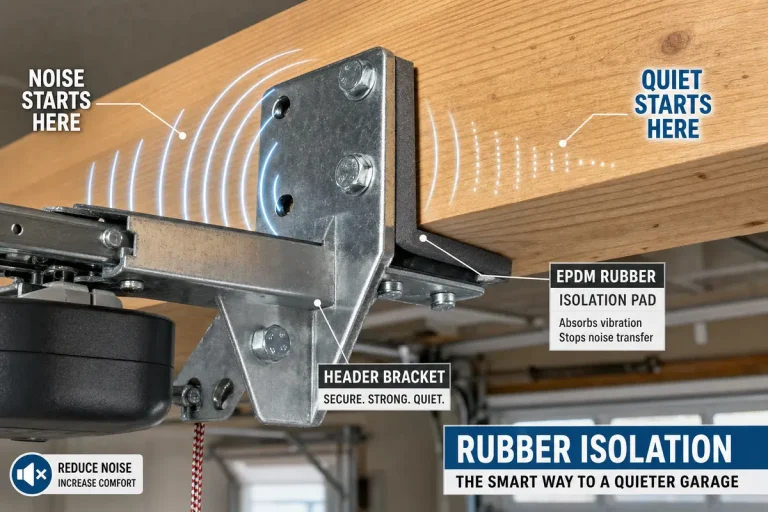
Rubber Isolation Between Opener Rail and Header Bracket: The Engineering Guide
Published Date: Nov 10, 2026