




Photo-Eyes Misaligned After Frost Heave: How to Fix Garage Sensors When Your Concrete Slab Lifts
Published: Nov 17, 2026
During severe winter freezing, many homeowners experience sudden garage door failures: the door begins to close, reverses abruptly, and flashes its overhead light. While standard troubleshooting guides suggest simple fixes like wiping the lens or tightening wing nuts, they miss the root mechanical cause during cold months: sub-slab frost heave physically shifting the mounting foundation of your photo-eye safety sensors.
Evaluating whether to re-align your sensors immediately, modify your bracket placement, or seek structural concrete remediation requires understanding how seasonal soil physics directly impacts garage door opener mechanics and UL 325 safety compliance.
The Physics of Winter Frost Heave on Garage Floors
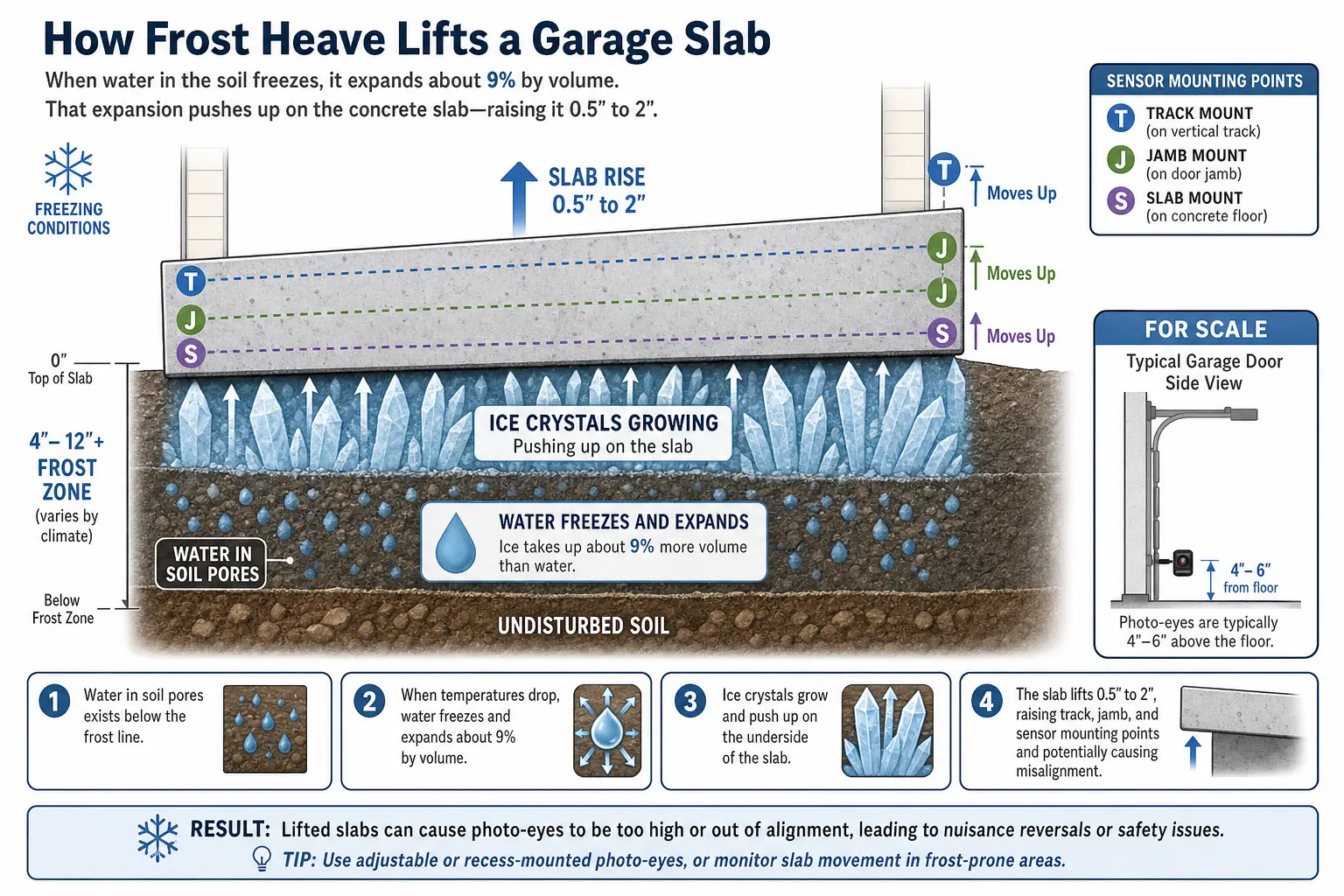
Subsurface water expands by approximately 9% in volume upon freezing. In moisture-saturated or high-clay soils beneath uninsulated garage slabs, this volumetric expansion exerts immense upward hydraulic pressure. During sustained sub-zero temperatures, frost heave can elevate a concrete slab-on-grade by 0.5 to 2 inches.
Because standard residential infrared photo-eyes operate within a strict beam divergence tolerance of less than 3 to 5 degrees, a vertical slab elevation of just 0.375 inches (3/8″) across an 8- to 16-foot door span completely severs the optical line of sight. When floor-anchored or track-mounted brackets shift unevenly due to differential heave, the transmitter and receiver suffer multi-axis misalignment across pitch, roll, and yaw angles.
Diagnosing Frost Heave Misalignment vs. Sensor Failure
When freezing weather disrupts operation, determining whether you face an electrical sensor failure or physical displacement is essential. If your garage door won’t close, start by inspecting the diagnostic light emitting diodes (LEDs) located on the sensors and opener head.
Unlike seasonal issues where a garage door won’t close when sunny due to infrared washout, physical track binding and ground heave produce continuous diagnostic warnings:
- LiftMaster / Chamberlain: A 4-blink sequence on the diagnostic arrow indicates safety sensor optical misalignment or wire displacement.
- Genie Systems: A blinking red LED on the receiving sensor signals receiver misalignment, whereas a dark LED indicates power disruption.
Cross-referencing manufacturer-specific garage door opener error codes confirms whether the obstruction signal stems from physical ground elevation rather than shorted wiring from ice buildup.
UL 325 Compliance and Safety Rules During Slab Elevation
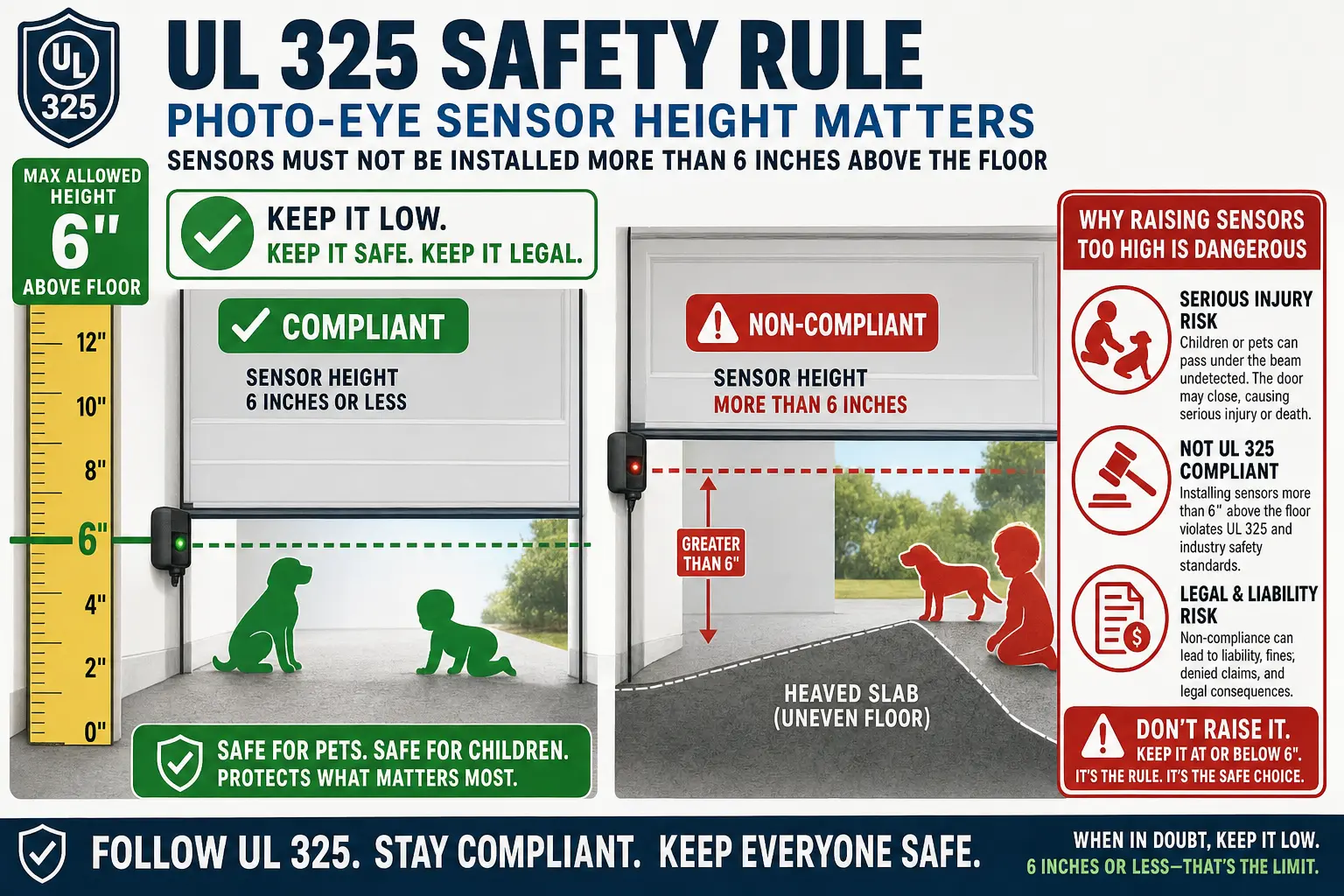
Federal law under Underwriters Laboratories (UL 325) standards dictates that safety photo-eyes must trigger auto-reversal within 2 seconds of obstruction and be mounted no higher than 6 inches (152 mm) above the finished floor level. This standard protects pets and small children from low-profile pinch points.
When frost heave creates an uneven slab crown across the garage opening, measuring clearance becomes critical. Adjusting photo-eyes upward to clear an elevated floor section can inadvertently raise sensors higher than 6 inches above the lowered points of the slab, rendering the installation non-compliant and hazardous.
Step-by-Step Repair and Seasonal Adjustment Protocol
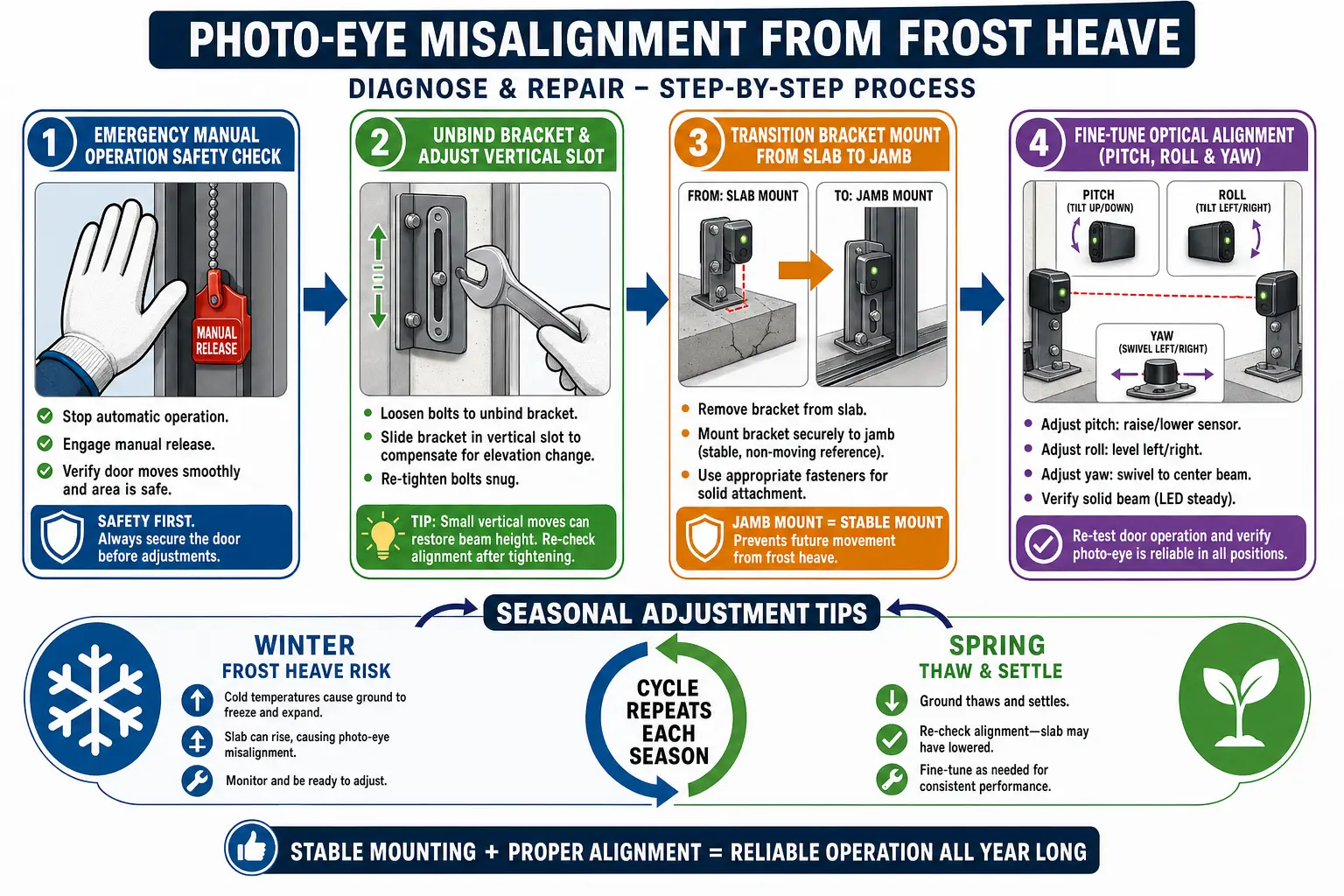
To eliminate seasonal realignment frustration without creating unnecessary mounting holes each winter, follow this two-season structural adjustment protocol:
- Perform Safety Disconnect: Disengage the manual release cord to ensure safe handling during hardware modifications.
- Shift to Wall-Jamb Mounts: Transition brackets away from floating concrete slabs or track bottoms. Anchoring sensors directly to structural wall framing eliminates up to 80% of seasonal sensor failures. Addressing structural framing integrity via proper garage door frame repair ensures wall jambs remain square year-round.
- Install Slotted Floating Brackets: Secure sensors with slotted steel brackets, permitting 1.5 inches of vertical play without requiring re-drilling during the spring thaw.
- Optical Axis Calibration: Run a string line or laser level between sensor centers. Adjust pitch and yaw until both sender and receiver indicator LEDs remain solid and unblinking.
Evaluating Long-Term Structural vs. Overhead Solutions
When frost heave exceeds 1 inch, vertical track compression can cause mechanical binding, putting severe strain on the opener drive gear. Homeowners must weigh immediate mechanical adjustments against foundation repairs:
- Mechanical & Track Adjustments: Setting floating bracket clearances and adjusting opener travel limits resolves immediate operation issues. Scheduling professional garage door repair ensures that compressed tracks and bound torsion assemblies are safely re-tensioned.
- Foundation Remediation: Techniques such as polyurethane foam injection (polyjacking) or installing perimeter edge insulation (rigid EPS boards) reduce groundwater freezing beneath the slab, eliminating the underlying cause of frost heave.
Frequently Asked Questions
Will my garage sensors automatically realign when the ground thaws in spring?
While the concrete slab lowers as ice lenses melt during the spring thaw, soil settlement is rarely completely uniform. Sensor brackets aligned during peak winter conditions will likely require a minor secondary adjustment in spring to restore accurate alignment and maintain UL 325 height compliance.
Can I bypass my photo-eye sensors when frost heave stops my door from closing?
Pressing and holding the push-button wall console acts as a manual safety override to close the door in an emergency. However, permanently bypassing or shorting safety photo-eyes violates UL 325 regulations and creates serious safety risks for occupants.
Should photo-eye brackets be mounted to the track or to the wall jamb?
Mounting photo-eyes directly to the wooden or steel wall jamb is preferable in cold climates. Track-mounted brackets react to track compression and slab movement, whereas wall jambs remain far more structurally stable throughout seasonal freeze-thaw cycles.
You May Also Like