




Safety Sensor Sun Glare: Why Your Garage Door Won’t Close on Sunny Afternoons
Published: Sep 25, 2026
It is a classic, frustrating scenario. You are trying to leave for work on a bright morning or rush out on a sunny afternoon, but your garage door refuses to close. Instead, it reverses halfway down, the opener lights flash, and you are left stuck. If this pattern only seems to happen when the sun is shining directly at your garage opening, you are dealing with safety sensor sun glare.
At Up & Down Garage Doors, we believe in giving homeowners straightforward, honest solutions before they spend money on a service call. Here is exactly how to bypass the issue immediately, why it happens, and how to fix it permanently without falling for overpriced manufacturer gimmicks.
The 5-Second Emergency Override
If you are currently trapped and need to secure your home right now, you do not have time to dissect optical physics. You need an immediate bypass.
To force your door closed, walk over to your wired wall console inside the garage. Press and hold the wall button continuously until the door is fully shut. Do not let go of the button until the door seals against the floor.
This manual override forces the opener’s firmware to bypass the photo-eye interruption signal. Please note that for security and safety reasons, wireless remote control transmitters, keypads, and smartphone apps will not allow this override. If you find your garage door sensors green door wont close when pressing the remote, the physical wall console is your fast track to safety. If you are facing a deeper mechanical failure and need urgent help, our team is always ready to assist with emergency garage door services.
The Anatomy of Blinding: Why Sunlight Stops Your Door
To understand why this happens, we have to look at how modern safety sensors function. Under UL 325 safety standards, residential garage door openers must reverse if the safety beam is interrupted for more than 100 milliseconds.
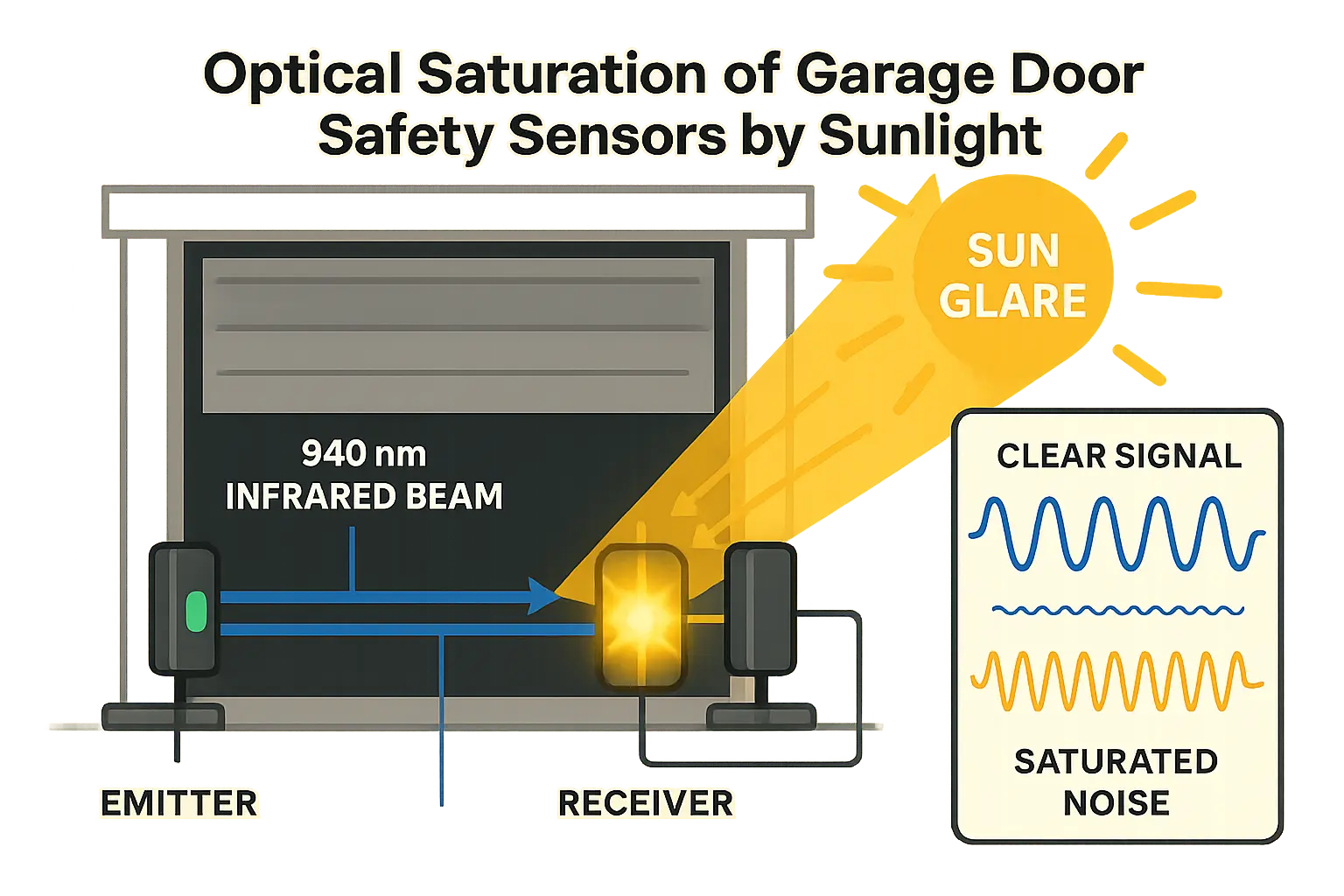
These sensors work by projecting an invisible, near-infrared light beam at a specific 940 nm wavelength, modulated at a rapid 38 kHz pulse. The transmitting sensor (the emitter) sends this pulsed beam across your driveway to the receiving sensor (the receiver).
When direct sunlight strikes the receiver at a low angle—common during sunrise or late afternoon—it floods the internal photodiode with continuous, massive infrared radiation. This creates “optical receiver saturation.” The intense sun glare raises the sensor’s signal-to-noise floor so high that the internal filter can no longer distinguish the 38 kHz pulses from the background sunlight. The system assumes a physical obstruction is present and safely reverses the door.
Diagnostic Phase: Locate Your "Receiver"
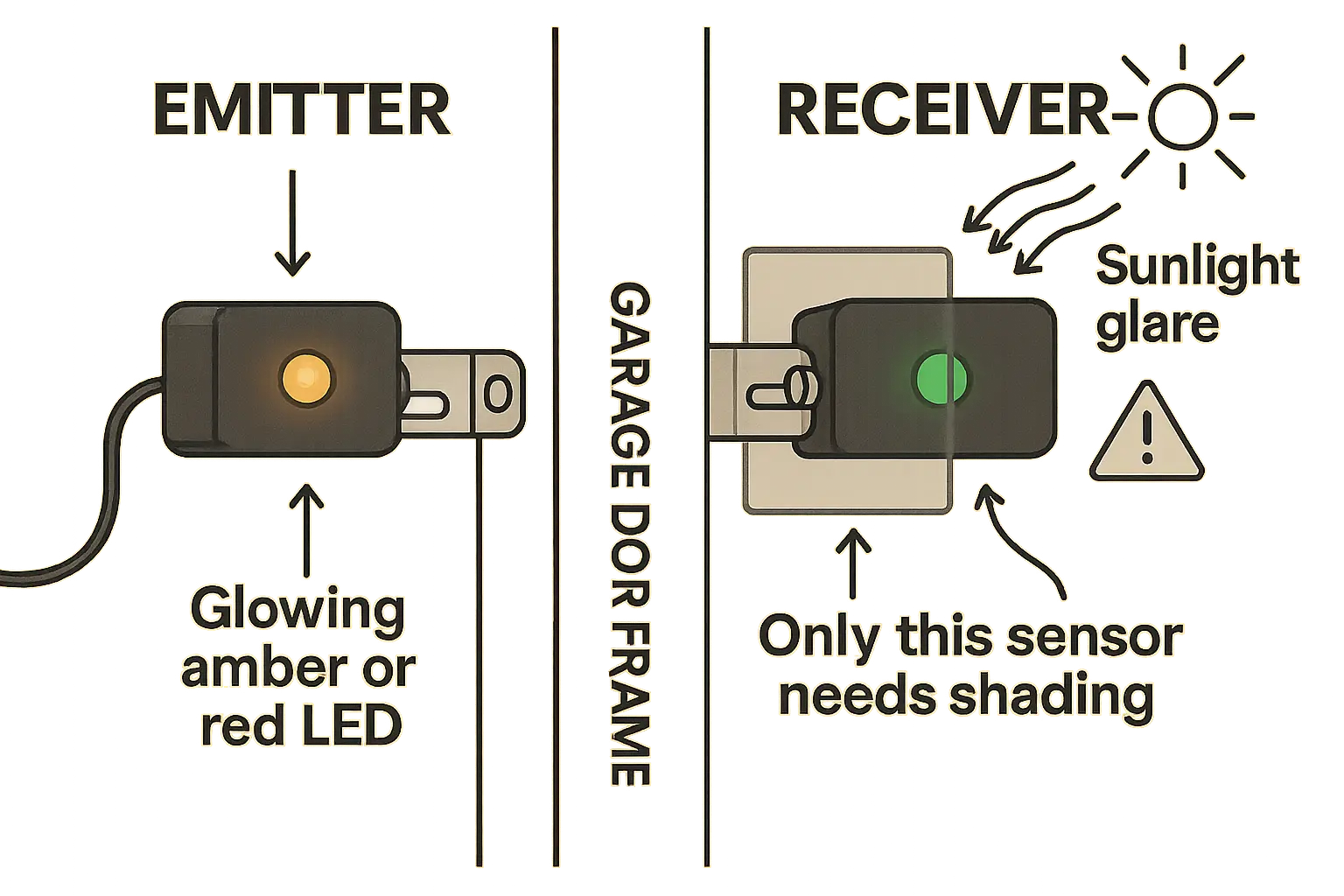
You only need to shield one side of the doorway to solve this problem. Trying to fix both sensors is a waste of time because sun glare only impacts the receiving unit, which interprets the light signal.
To find out which sensor is the receiver, look at the LED lights on your specific brand:
- Chamberlain / LiftMaster / Craftsman: The emitter has a solid amber LED. The receiver has a solid green LED. Focus only on the green light.
- Genie / Overhead Door: The emitter has a solid red LED. The receiver has a solid green LED. Focus only on the green light.
If you are wondering, “should both garage door sensors be green“, the answer varies by brand, but the green light is universally the one that acts as the eye. If that green LED is flickering or completely dark when the sun hits it, you have found your culprit.
The Solution Matrix: Evaluating Your Options
Once you identify the receiving sensor, you have several ways to address the problem. Let’s evaluate the most common remedies so you can choose the right path for your budget and home aesthetics.
1. The Cardboard Hack (Quick & Free DIY)
Many homeowners slide an empty toilet paper roll or a small piece of cardboard over the receiving sensor to create a makeshift shadow box. While this costs nothing and works immediately, it is highly vulnerable to wind, rain, and moisture, and looks unsightly on your home’s exterior.
2. OEM Sunblocker Kits (The “Cardboard Tax”)
Official kits, such as Chamberlain Part 041B0873, retail for up to $25.00. However, these commercial kits are literally pre-folded pieces of cardboard. Paying $25 for cardboard is a steep price for a product that will eventually rot or blow away in a heavy storm.
3. Clip-On ABS Plastic Hoods (Best Aesthetic Value)
For $10 to $15, you can find UV-resistant, 3D-printed plastic hoods online that snap directly onto your existing metal brackets. They offer a clean, professional look and resist the elements far better than cardboard.
4. The “Sensor Swap” Hack (Permanent & Free)
The most reliable, zero-cost, permanent solution is to physically swap the locations of your emitter and receiver. If the sun shines directly into the receiver on the left side of your garage during the afternoon, unscrew both sensors and swap them. Placing the receiver on the right side—which naturally stays shaded by the door frame during peak sunlight hours—permanently eliminates optical saturation.
When It's Not the Sun: Troubleshooting Secondary Issues
If swapping your sensors or shading the receiver does not resolve the issue, the sun might not be the primary culprit. Over time, garage doors shift, brackets get bumped, and wiring degrades.
First, verify that your sensors are not physically misaligned. If you need help getting them back in line, you can learn how to align garage door sensors using simple household tools. Additionally, check for loose wiring connections or dirty lenses. If your system continues to malfunction even after the sun goes down, you may need to dig deeper into why is garage door light blinking and not opening to diagnose a potential circuit board or wiring fault.
Frequently Asked Questions
How do I know if my garage door sensor is broken or just affected by the sun?
If the door closes perfectly at night, on cloudy days, or during the morning but fails only during peak sunny hours, it is a sun glare issue. If the receiver’s LED is completely dark or continuously blinking regardless of the time of day, you likely have a physical misalignment, a loose wire, or a failed sensor unit.
Can I permanently bypass my garage door safety sensors?
No. Under federal safety regulations (UL 325), safety sensors are mandatory for all residential garage door openers manufactured after 1993. Operating a door without them poses a severe safety hazard to children, pets, and property. While you can use the manual wall-button override in an emergency, the system must have functioning sensors to operate remotely.
Will cleaning the sensor lenses help with sun glare?
Cleaning dirty or dusty lenses improves the overall strength of the 940 nm infrared beam, which can slightly improve the sensor’s resistance to minor light interference. However, if direct, low-angle sunlight is shining straight into the receiver lens, cleaning it will not prevent optical saturation; you will still need to physically shade the lens or swap the sensor locations.
You May Also Like