




Commercial Rolling Steel Door Frozen in the Guides: Emergency Thawing & Long-Term Prevention
Published: Nov 13, 2026
When an industrial overhead coiling door freezes inside its structural guide channels, facility operations grind to a sudden halt. Unlike residential sectional garage doors, commercial coiling doors slide within heavy structural steel angle tracks. Attempting to force an ice-bound door risks severe mechanical and structural damage.
Evaluating your emergency options and preventative retrofits requires understanding the physics of guide channel icing, safe thermal management, and sub-zero component protection.
Immediate Action Protocol for Frozen Coiling Doors
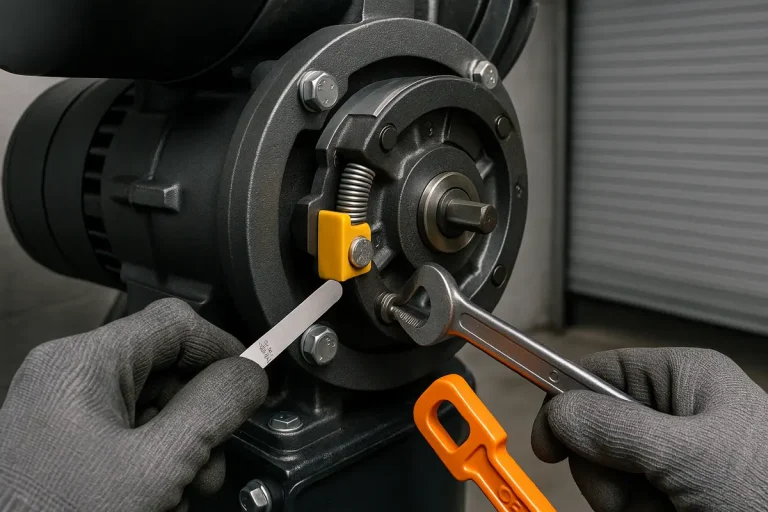
Before attempting to thaw or dislodge the door curtain, protect your motor drive system. Commercial operators generate between 250 and 1,000+ lbs of lifting torque. Pushing an operator against an immovable ice anchor frequently shears windlock rivets, buckles steel curtain slats near the overhead barrel shaft, or burns out motor windings—costing between $1,500 and $4,000 in structural repairs.
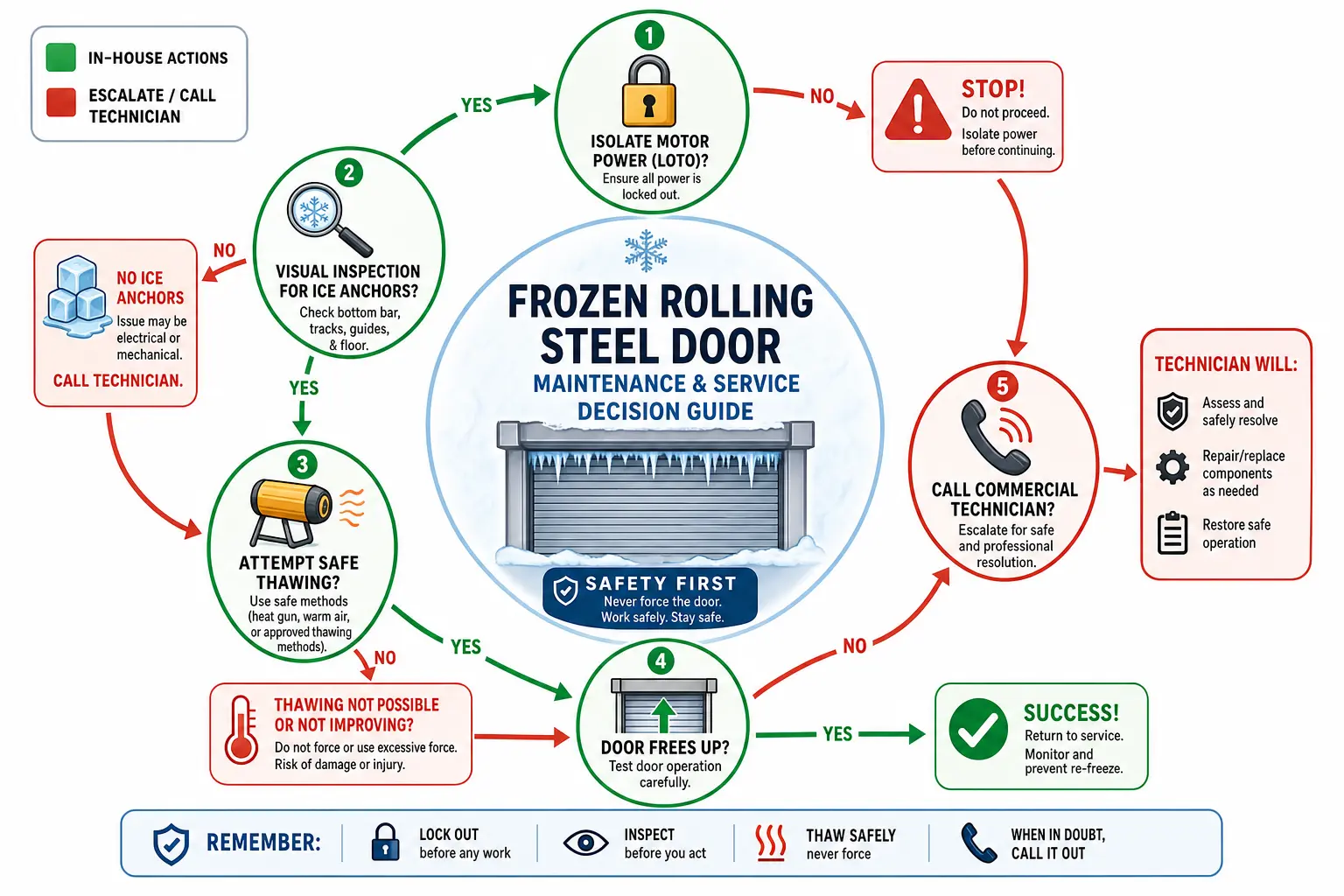
- Execute Lockout/Tagout (LOTO): Isolate electrical power to the motor operator per OSHA 1910.147 standards. This prevents automatic timer-closes or remote activation while personnel inspect the guides.
- Disengage Drive System Systematically: Only disengage the drive clutch or manual hand chain operator if the door curtain is resting fully in the closed position. Never disengage manual overrides on a partially raised door with suspected binding.
- Locate Ice Anchor Points: Inspect the structural steel guide channels (E-guides or Z-guides) along both sides to locate specific ice bond points around endlocks, windlocks, and bottom bar seals.
Routine commercial roll up door maintenance helps identify clearance tight spots before winter weather seals them shut.
Safe Thawing Matrix: Heat vs. Chemical Methods
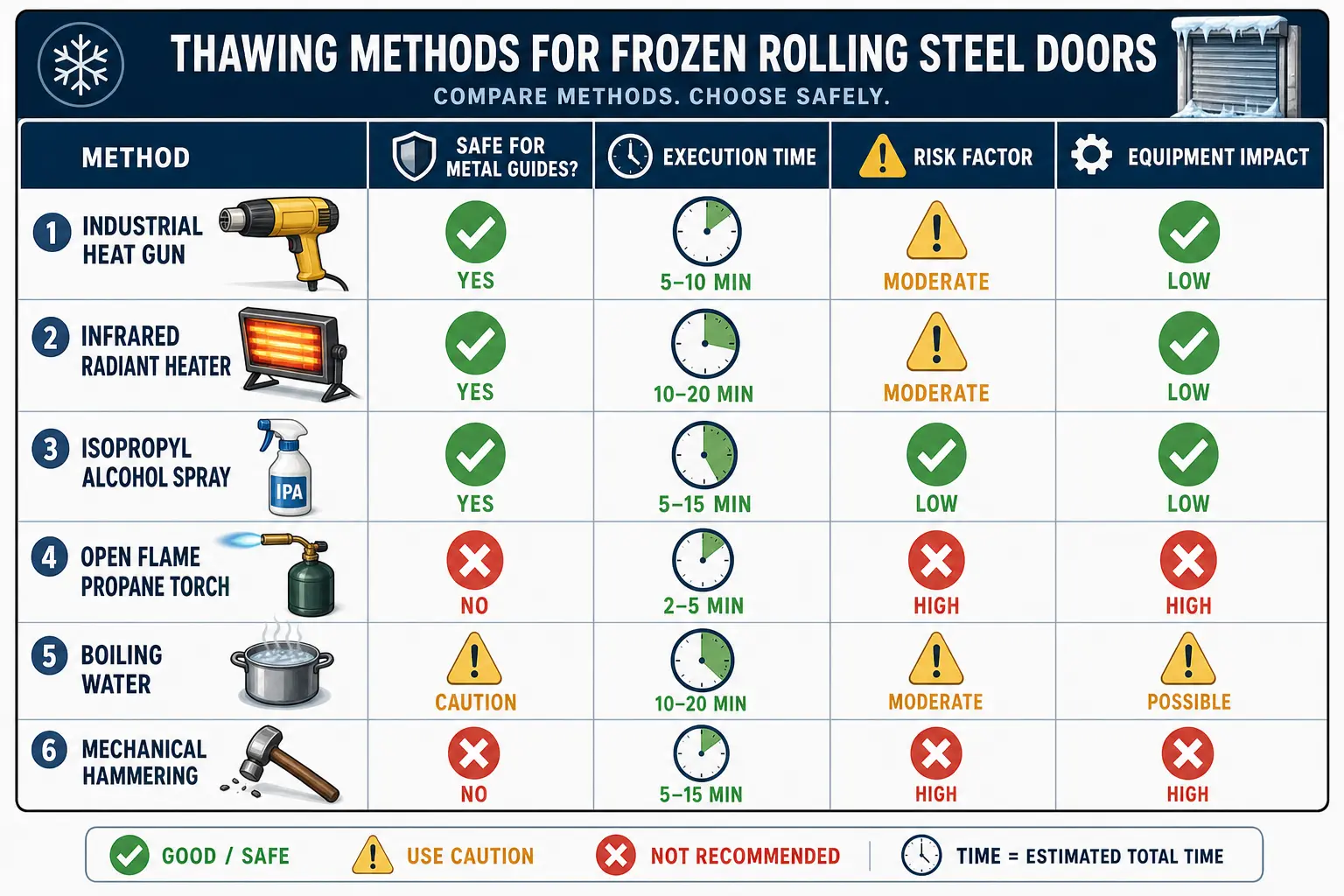
Selecting the correct thawing intervention prevents permanent equipment damage. Thermal shock from boiling water can crack protective finishes and refreeze inside structural channels within minutes at sub-zero temperatures. Open flames warp steel angles and ignite weather seals.
- Industrial Heat Gun (Low/Medium Setting): Apply controlled heat along the exterior face of the steel guide angle from top to bottom. Safe for paint, endlocks, and synthetic weather seals.
- Infrared / Radiant Heaters: Position portable radiant heaters 3 to 5 feet away from the guide channels for uniform, hands-free warming along the track length.
- 90%+ Isopropyl Alcohol De-Icing Spray: Spray directly into guide channel slots. Isopropyl alcohol rapidly depresses the freezing point of ice and evaporates dry without leaving moisture behind.
If your facility experiences recurring freeze lockouts, review our guide on handling a garage door frozen shut.
Diagnosing the Root Cause
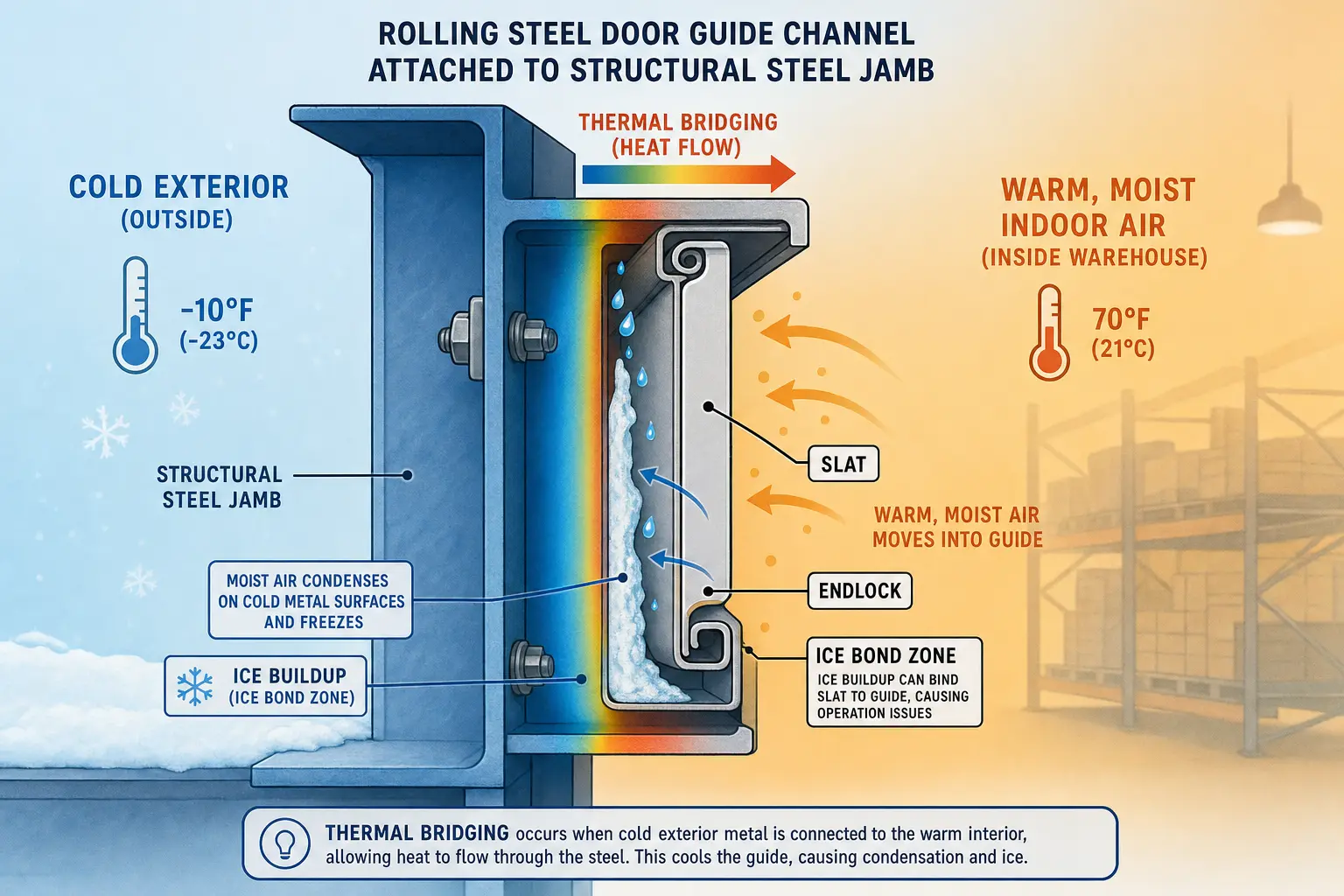
Structural steel guide channels feature high thermal conductivity ($k approx 50 text{ W/m}cdottext{K}$). Cold exterior air quickly chills the entire steel jamb assembly. Warm, humid air from inside heated loading docks condenses directly on the freezing internal surface of the uninsulated guide channels, locking the slat edges solid.
Understanding the engineering differences between sectional & rolling doors helps clarify why coiling doors are uniquely vulnerable: tight tolerances inside structural steel guides leave minimal clearance when condensation freezes.
Preventative Modifications and Sub-Zero Retrofits
To prevent recurring cold-weather lockouts, facility managers evaluate three primary technical solutions:
- Self-Regulating Heat Trace Cables: Installing 3W/ft or 5W/ft self-regulating heat trace cables along the back of the steel guide angles maintains channel temperatures above freezing automatically during cold snaps.
- Guide Channel Weatherstripping & Insulated Slats: Installing heavy-duty nylon brush seals blocks moist air infiltration into guide slots. Combining seals with insulated roll up garage doors significantly minimizes thermal bridging across opening jambs.
- Sub-Zero Lubricant Upgrades: Standard petroleum grease thickens below $32^circtext{F}$, increasing motor drag by up to 300%. Apply dry PTFE or silicone sprays rated down to $-40^circtext{F}$ inside guide channels; save synthetic greases strictly for internal drive gears.
Optimizing commercial loading dock doors through structured commercial garage door maintenance keeps critical supply lines moving year-round.
Maintenance Checklist and Service Decision Tree
Use this diagnostic workflow to determine whether frozen guide issues can be resolved in-house or require escalation to professional technicians.
Frequently Asked Questions
Why shouldn’t I use a propane torch to thaw frozen door guides?
Open flames create extreme localized heat that warps structural steel angles, destroys powder coatings, and ignites internal brush weatherseals or nylon endlocks, causing permanent damage and fire hazards.
Can standard WD-40 prevent rolling steel door channels from freezing?
No. Standard WD-40 washes away protective coatings and leaves a thin residue that attracts dust and grit. Use dry PTFE or silicone lubricants rated for sub-zero operation down to $-40^circtext{F}$.
What causes ice inside metal guide channels when it isn’t raining?
Thermal bridging chills the structural steel guide channels. Warm, humid indoor air from heated warehouse bays condenses against the freezing steel surfaces inside the track, forming solid ice anchors around the slat endlocks.
Ready to protect your facility from winter operational downtime? Up & Down Garage Doors brings over 15 years of commercial door expertise across multiple states, offering 24/7 emergency response, guide heat trace retrofits, and customized preventative maintenance programs.
You May Also Like