




Rolling Steel Door Tension Adjustment: Signs the Barrel Needs It
Published: Nov 11, 2026
When a high-frequency commercial rolling steel door begins to hesitate during opening, drop unexpectedly, or trip its motor circuit breaker, facility managers face a crucial technical fork in the road: is the electric operator failing, or has the counter-balance barrel lost its mechanical spring tension?
Unlike residential sectional garage doors, heavy-duty coiling steel doors rely on a specialized internal torsion spring assembly housed inside a steel pipe barrel. As the curtain opens, it coils directly around the shaft, creating a dynamic weight system where effective weight suspended in the guide channels changes second by second. Identifying whether operational hiccups stem from barrel spring degradation saves thousands of dollars in premature motor replacements and prevents catastrophic loading dock downtime.
Diagnostic Quick Reference
| Operational Symptom | Travel Zone Affected | Primary Mechanical Cause | Recommended Corrective Action |
|---|---|---|---|
| Floor slamming / Heavy initial lift | Bottom 33% | Under-tensioned barrel spring | Recalibrate initial spring turns |
| Uncontrolled rapid rise | Top 33% | Over-tensioned barrel spring | Release spring tension safely via winding wheel |
| Mid-travel curtain drift | 33% to 66% | Natural spring relaxation (creep) | Perform 3-Foot Balance Test & adjust tension |
| Telescoping curtain / Slat wear | Entire Travel | Asymmetric dual-spring tension | Synchronize multi-spring barrel assembly |
| Motor thermal overload tripping | Opening Cycle | Severe spring tension loss (180%+ FLA strain) | Check motor amp draw; re-tension counter-balance |
The Physics of Rolling Steel Counter-Balance Barrels
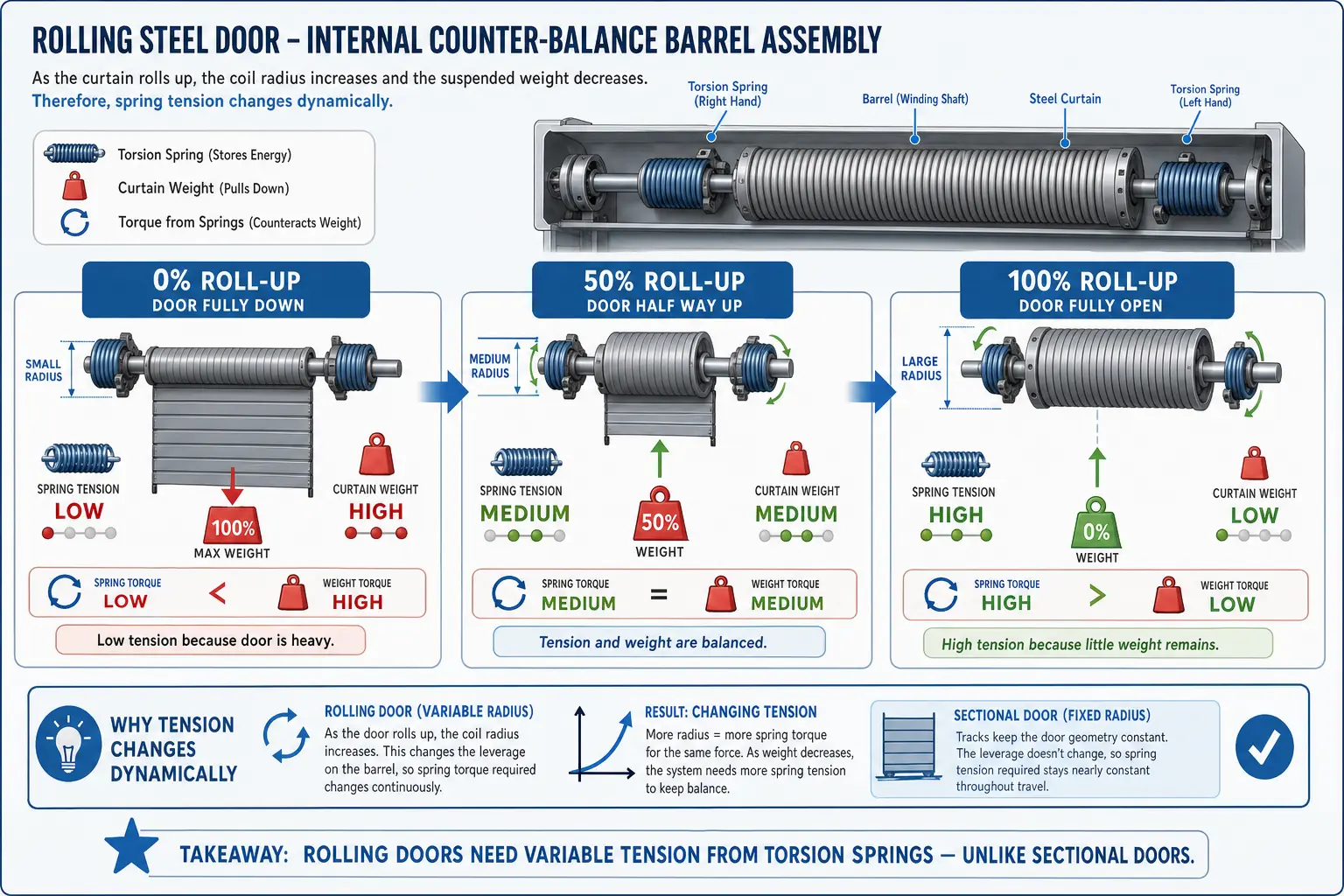
Understanding rolling steel curtain mechanics requires visualizing dynamic torque curves. When the door is fully closed, 100% of the curtain weight hangs in the vertical guide tracks, requiring maximum counter-balance torque from the internal springs. As the door travels upward, the curtain wraps around the barrel pipe shaft. This increases the coil radius while simultaneously reducing the suspended weight in the guides.
Commercial torsion springs experience natural steel stress relaxation, known in metallurgy as spring creep. According to Technical Data Sheet #271 from the Door & Access Systems Manufacturers Association (DASMA), commercial springs lose between 3% and 7% of their initial nominal tension within the first 1,000 operational cycles. Over a standard 10,000 to 20,000 cycle lifespan, this gradual tension decay fundamentally alters how the door balances across its three primary travel zones.
Definite Signs Your Barrel Needs Tension Adjustment
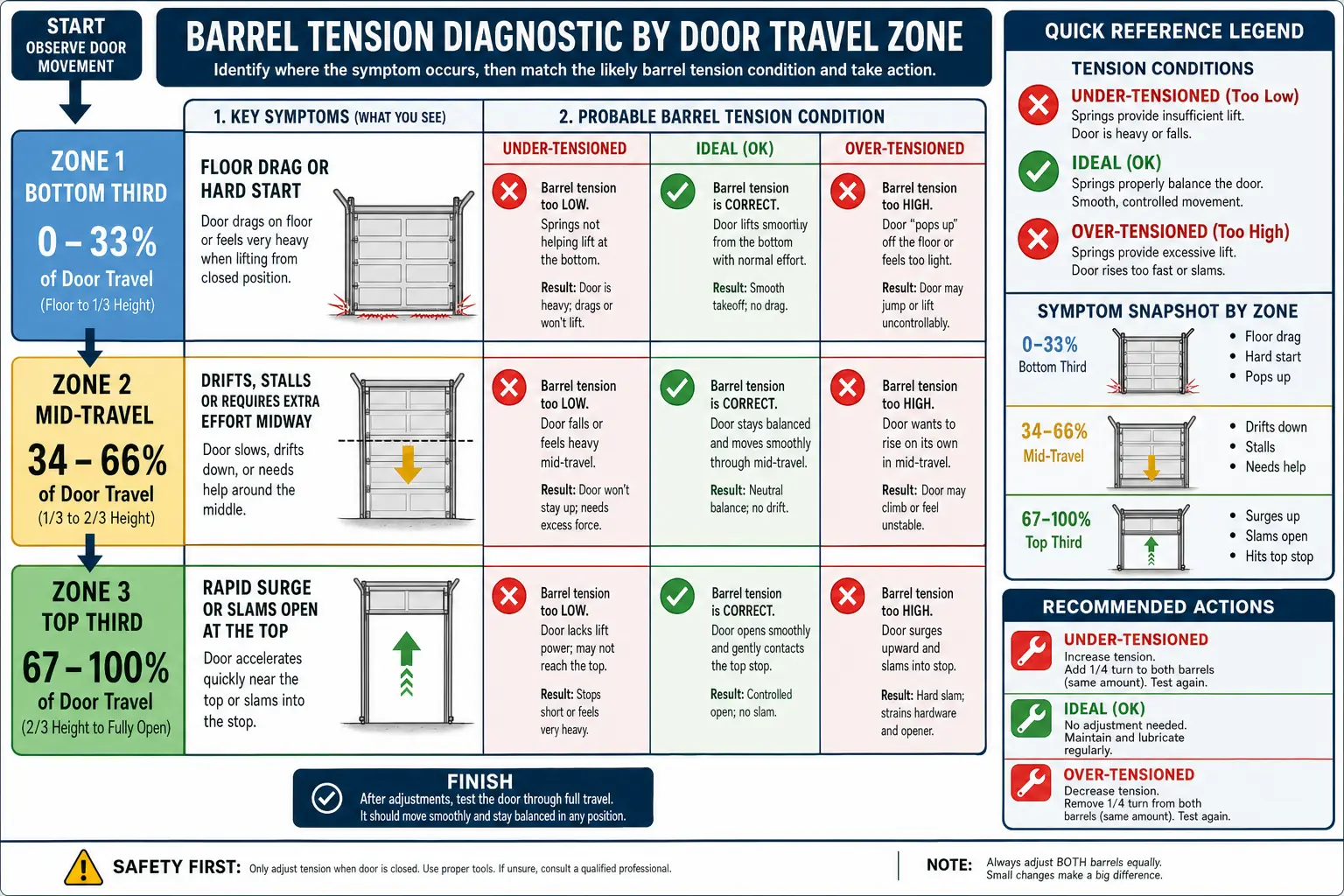
Identifying tension degradation early prevents severe hardware failure. Watch for these five field-verified indicators:
1. Bottom-Zone Drag and Floor Slamming
When tension degrades, the barrel can no longer support the curtain’s full weight during the final 33% of down-travel. If your operational door accelerates near the bottom header and your garage door slams shut, the initial spring charge has dropped below baseline specifications.
2. Top-Third Rapid Rise or Fail-to-Close
Conversely, an over-tensioned barrel displays aggressive upward momentum near the top third of travel. The curtain may struggle to initiate closing or fly upward uncontrollably when manual disengagement is pulled, risking slat damage at the head plates.
3. Mid-Travel Drift (Failure of the 3-Foot Test)
To execute a field balance check, disengage the operator drive chain and manually raise the curtain 3 feet off the floor. A properly tensioned barrel holds the curtain steady. If the door drifts downward, spring tension has dropped below operational equilibrium.
4. Slat Scuffing and Curtain Telescoping
Heavy commercial barrels frequently house dual internal torsion springs. If one spring loses tension faster than the other, the curtain coils unevenly around the pipe shaft. This imbalance causes slat ends to drag along guide brackets, leading to metal scoring and telescoping coils.
5. Motor Operator Amperage Spikes
Operating an under-tensioned door forces electric operators to lift pure deadweight. Under these conditions, electric motors pull 180% to 240% of their rated full-load amperage (FLA), causing internal thermal overload switches to trip and accelerating gear reducer wear by 300%. Routine warehouse door operator maintenance should always include motor amp draw verification to catch hidden tension loss.
Differential Diagnosis: Tension Loss vs. Structural Faults
Before adjusting barrel tension, isolate the issue from broader commercial garage door issues:
- Broken Internal Spring vs. Tension Drift: A complete spring breakage results in sudden, total curtain drop and zero counter-balance resistance. Tension drift presents as a progressive loss of lift support across weeks of operation.
- Track Friction vs. Spring Decay: Bindings caused by bent guide rails or lack of slat lubrication generate screeching noises and jerky travel regardless of door position. Tension issues produce smooth travel that simply accelerates or decelerates in specific zones.
Safety Protocol & Decision Matrix: Adjust, Rewind, or Replace?
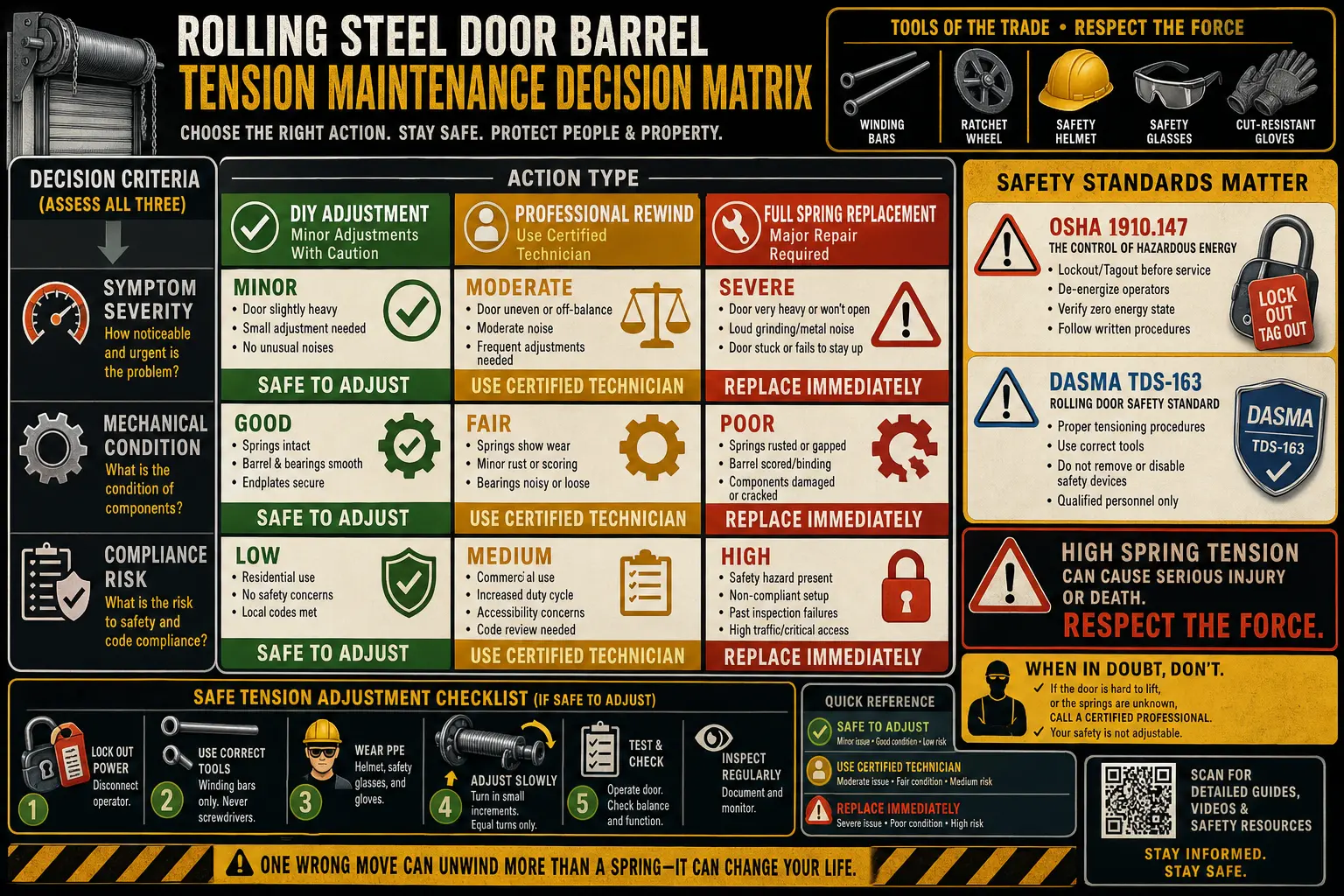
Commercial tension adjustment carries extreme mechanical torque risks. Under OSHA 29 CFR 1910.212(a)(1) guidelines, unguarded high-tension system adjustments require qualified personnel using hardened steel winding bars or specialized ratchet wheel tensioners.
Adjustment Feasibility Matrix
- Modern Cam-Action / Exterior Ratchet Systems: Designed with accessible tension wheel drive plates. Trained facility staff can often add small incremental notches using manufacturer-approved tools.
- Internal Pipe Shaft Barrels: Require dual-steel winding rods and manual pawl disengagement under extreme torque loads. These require a technician qualified in commercial door mechanics.
- High-Cycle Fatigue (>15,000 Cycles): If springs have reached their rated life cycle, adding tension only hastens metal fracture. Replacing the spring assembly entirely yields superior long-term ROI.
When structural recalibration is required, scheduling professional commercial garage door maintenance or seeking expert garage door spring tension adjustment near me ensures total compliance with industry safety standards.
Frequently Asked Questions
How often should a commercial rolling steel door barrel be re-tensioned?
Commercial doors operating at standard volume (10–20 cycles daily) should undergo spring balance inspections every 6 to 12 months. Recalibration is typically required after the first 1,000 cycles to account for initial spring stretch, and every 5,000 cycles thereafter.
Can facility maintenance teams safely adjust barrel tension in-house?
Only if the door is equipped with an external cam-action or charging wheel tensioner explicitly designed for external adjustment. Standard internal pipe barrels under extreme torque should only be serviced by certified technicians using calibrated winding tools to comply with OSHA safety standards.
How do I know if the barrel spring is under-tensioned or completely broken?
An under-tensioned door feels heavy to lift manually but can still be moved with effort. A door with a completely broken internal torsion spring will drop like deadweight, cannot be held open manually, and may make a loud metallic clunking sound within the barrel hood assembly.
You May Also Like