





Activating Commercial Garage Doors
Published: Jun 3, 2026
Imagine a busy warehouse. Every day, dozens of trucks arrive and depart. Each time, the driver has to stop, get out, walk to a wall-mounted button, wait for the massive door to open, get back in the truck, and drive through. It’s a process that eats up two minutes per cycle. With 50 cycles a day, that’s over an hour and a half of lost time. Every single day.
Now, multiply that by a year. You’re looking at hundreds of hours of lost productivity, all because of a simple button.
Choosing how your commercial garage door opens and closes isn’t just about convenience; it’s a critical business decision that impacts efficiency, security, and your bottom line. Whether you manage a logistics hub, an auto repair shop, or a climate-controlled storage facility, the right activation system can transform your workflow. Let’s walk through the options, moving from the familiar to the automated, to find the perfect fit for your operation.
Foundation: The 4 Main Ways to Activate a Commercial Garage Door
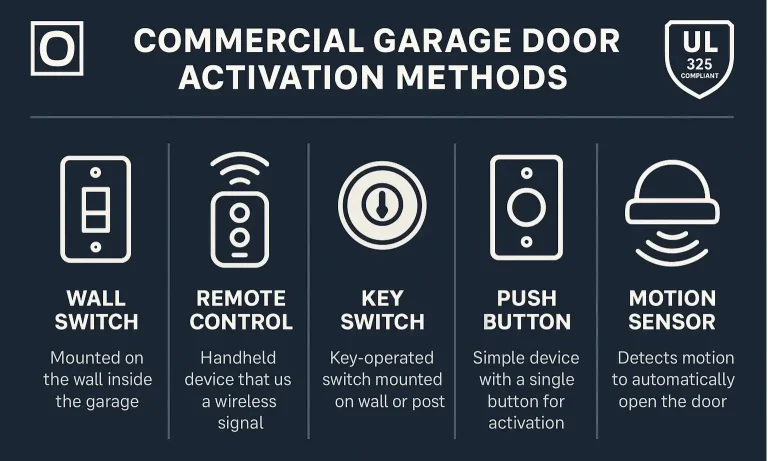
At its core, activating a commercial garage door is about sending a signal to the operator—the motorized engine that does the heavy lifting. While there are many variations, most systems fall into one of four main categories.
1. Push-Button Stations
This is the classic, most straightforward method. A wall-mounted control station, typically with three buttons (Open, Close, Stop), is hardwired directly to the door operator.
Best for: Interior doors or situations where authorized personnel are always present, like a small workshop or a single-bay mechanic’s garage.
The “Aha” Moment: While simple and reliable, it’s the least efficient method for high-traffic areas, creating bottlenecks as drivers or employees must physically access the control.
2. Radio Frequency Remotes
Just like your home garage door remote, these handheld transmitters send a secure signal to a receiver connected to the operator. They offer a major step up in convenience over wall stations.
Best for: Businesses that issue access to a specific group of employees or drivers, such as a fleet of delivery vans or a gated employee parking garage.
The “Aha” Moment: Security is managed by controlling the remotes. If a remote is lost or an employee leaves, access can be revoked by clearing the codes from the receiver. If you’re managing multiple users, learning how to program a garage door remote is a key operational skill.
3. Motion Sensors
These systems use infrared or microwave technology to detect movement within a specific zone, triggering the door to open automatically. Think of the automatic doors at a grocery store, but on an industrial scale.
Best for: High-traffic pedestrian areas or forklift routes where hands-free operation is essential for safety and speed. Often used in warehouses and manufacturing plants.
The “Aha” Moment: The key is placement. A poorly aimed sensor can be triggered by cross-traffic or even falling debris, causing the door to open unnecessarily. Understanding the nuances of garage door motion sensor security features is crucial to prevent false activations and security gaps.
4. Induction Loop Detectors
This is the invisible workhorse of industrial automation. A wire “loop” is installed in the pavement or floor. When a large metal object—like a vehicle—drives over it, the loop detects a change in the magnetic field and signals the door to open.
Best for: Vehicle-only entrances and exits with high traffic volume, like loading docks, car washes, and distribution centers.
The “Aha” Moment: Loop detectors are brilliant because they aren’t fooled by people, animals, or weather. They open only for vehicles, making them incredibly efficient and secure for managing truck and car flow without manual intervention.
Building: Matching the Activation Method to Your Business
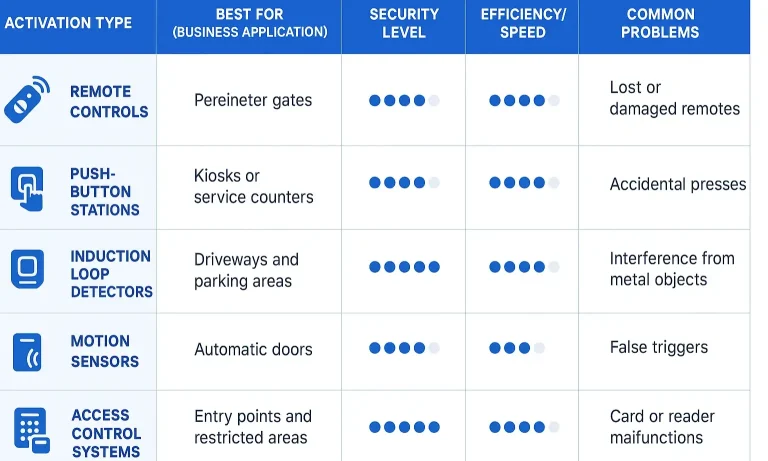
The “best” system doesn’t exist. The right system depends entirely on your daily operations. Choosing correctly means understanding the relationship between traffic flow, security needs, and the physical environment.
Let’s break it down by business type:
For the High-Traffic Warehouse or Distribution Center
- Your Challenge: Constant flow of trucks and forklifts. Every second of delay costs money. Security is paramount to prevent unauthorized entry.
- Your Best Bet: A dual system. An induction loop for exterior doors to manage truck traffic automatically, and motion sensors for interior doors to facilitate safe and efficient forklift movement between zones. This combination ensures vehicles move unimpeded while keeping the door closed at all other times. For doors cycling hundreds of times a day, you’ll need a powerful commercial high-cycle garage opener to handle the load.
For the Auto Dealership Service Bay or Car Wash
- Your Challenge: Customers and employees are constantly moving vehicles in and out. The system needs to be reliable, fast, and safe to prevent accidental closures on expensive vehicles.
- Your Best Bet: An induction loop is often the ideal solution. It ensures the door opens as a car approaches and stays open as long as the vehicle is in the doorway, preventing premature closing. A pull-cord or push-button station can serve as a manual override for staff.
- Your Challenge: Zero-fail reliability and maximum speed. When a call comes in, the doors need to open instantly and without question.
- Your Best Bet: Redundancy is key. A primary activation system using powerful radio frequency remotes from a central dispatch or inside the vehicle, backed up by a large, easily accessible push-button station as a failsafe. These systems require operators that can handle power and reliability needs under the most demanding circumstances.
For the Fire Station or Ambulance Bay
⚠️ Common Mistake: Installing infrared motion sensors in an environment with heavy steam (like a car wash) or dust (like a grain facility) can lead to constant false triggers. In these cases, an induction loop or a microwave-based motion sensor is a much more reliable choice.
Mastery: Advanced Considerations & Integration
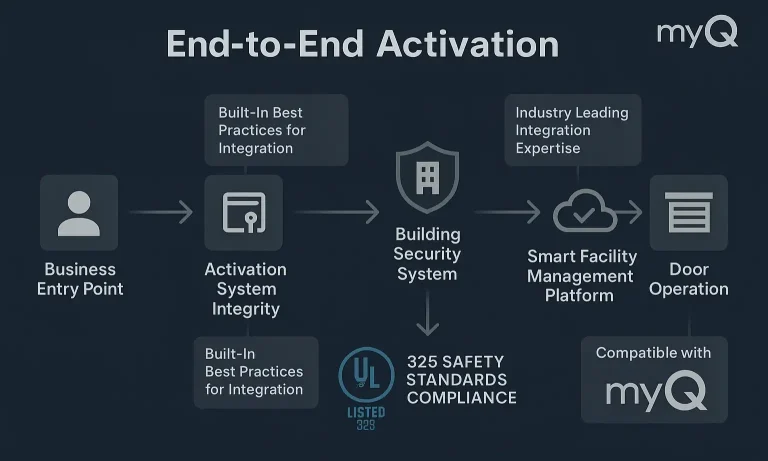
Modern commercial door systems are more than just openers; they are integrated components of your facility’s entire operational and security ecosystem.
Safety First: UL 325
Any professionally installed commercial door operator must comply with UL 325 safety standards. This requires a monitored safety device, such as photo-eye sensors or a sensing edge on the bottom of the door, to be active at all times. These devices prevent the door from closing if an obstruction is detected, which is non-negotiable for protecting people, products, and equipment.
Smart Facility Integration
Many modern operators, such as those from leading brands like LiftMaster, offer smart technology that allows for powerful integrations.
- Access Control: Integrate the door operator with your building’s access control system. This allows you to grant or revoke access via keycards or codes, and maintain a log of every time the door is used.
- Remote Management: With platforms like myQ, facility managers can monitor and control doors from a smartphone or computer, check their status, and receive alerts—no matter where they are. Exploring the top features and benefits of a LiftMaster commercial garage door opener can reveal new possibilities for operational control.
- Building Automation: Connect the door system to fire alarms to automatically open doors for emergency vehicle access, or to your HVAC system to minimize energy loss in climate-controlled environments.
Action: Your Activation Checklist & Troubleshooting Flowchart
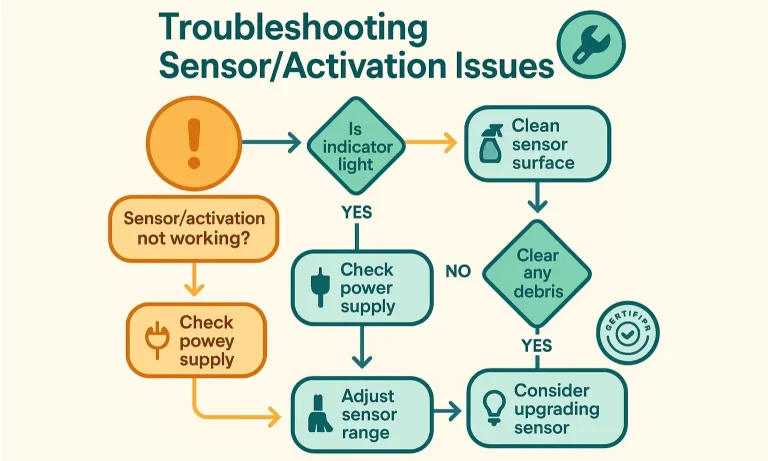
Choosing the right system is the first step. Keeping it running smoothly is the next. If you encounter issues, a logical diagnostic process can save you time and service call fees.
Before calling for service, run through these common checkpoints:
- Check for Power: Is the operator plugged in? Has a circuit breaker tripped? It sounds simple, but it’s the most common culprit.
- Inspect Safety Sensors: The small photo-eye sensors near the bottom of the door tracks must be perfectly aligned. If one of their indicator lights is off or blinking, they are the likely cause. Clean the lenses and adjust them until both lights are solid. If you find your garage door sensors not working, a quick realignment can often solve the problem.
- Look for Obstructions: Check the door’s path for anything that could be blocking the safety sensors or physically jamming the door.
- Test the Manual Controls: Try the wall-mounted push-button station. If it works, the problem lies with your remote, motion sensor, or loop detector, not the operator itself.
For persistent issues, it’s often best to consult a professional. Attempting complex electrical work or sensor bypasses can lead to safety hazards. If you need guidance, our guide on how to reset garage door sensors offers safe, DIY-friendly steps. And for more complex situations, our general garage door troubleshooting guide can help.
Frequently Asked Questions (FAQ)
Can I use multiple activation methods on one door?
Absolutely. In fact, it’s common. A warehouse might use an induction loop as the primary opener for trucks, but also have remotes for managers and a push-button station for manual overrides.
What’s the difference between a commercial and a residential motion sensor?
Commercial-grade sensors are built for durability, have a wider detection range, and offer more advanced settings to filter out interference and prevent false activations in busy industrial environments.
Is it possible to bypass my safety sensors if they malfunction?
While technicians have methods to temporarily bypass sensors for diagnostic purposes, permanently disabling them is a major safety violation under UL 325 and is strongly discouraged. It creates significant liability and risk of injury or damage. Our article on sensor removal for garage door openers explains the risks in more detail.
How often do my activation systems need maintenance?
It’s wise to include your activation systems in a regular maintenance schedule. Annually, you should have a professional check wiring, clean sensor lenses, test loop sensitivity, and ensure all components are functioning correctly as part of a commercial garage door maintenance plan.
By thoughtfully evaluating your business’s unique rhythm and needs, you can select an activation system that doesn’t just open a door, but opens up new potential for efficiency and security.
You May Also Like

Emergency Exterior Access for Commercial or Rolling Steel Garage Doors
The power is out. Your delivery truck is loaded and needs to leave, but the massive rolling steel door to your warehouse is sealed shut. Or maybe the motor made a grinding noise and now refuses to budge. Panic starts…
Published Date: May 27, 2026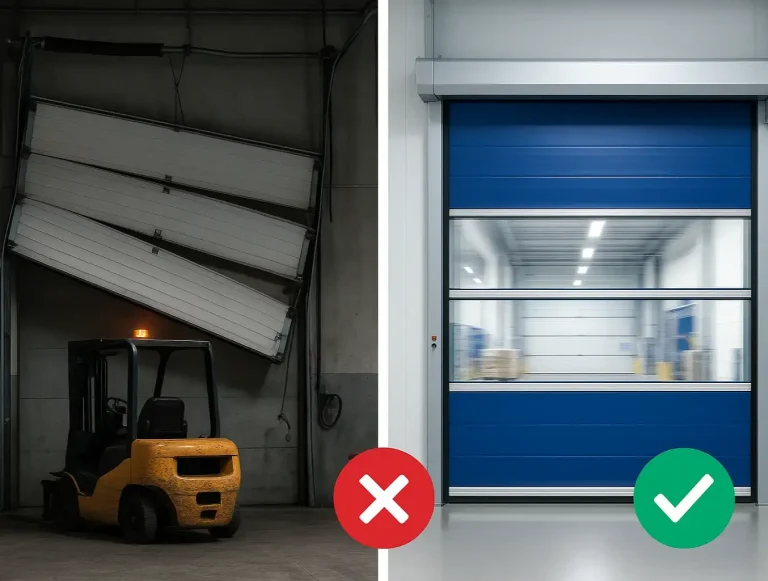
High-Cycle Commercial Garage Doors
It’s 10 a.m. on your busiest day. A forklift loaded with a critical shipment is waiting, but your warehouse’s standard sectional door has ground to a halt—again. A spring snapped, the motor is whining, and operations…
Published Date: May 21, 2026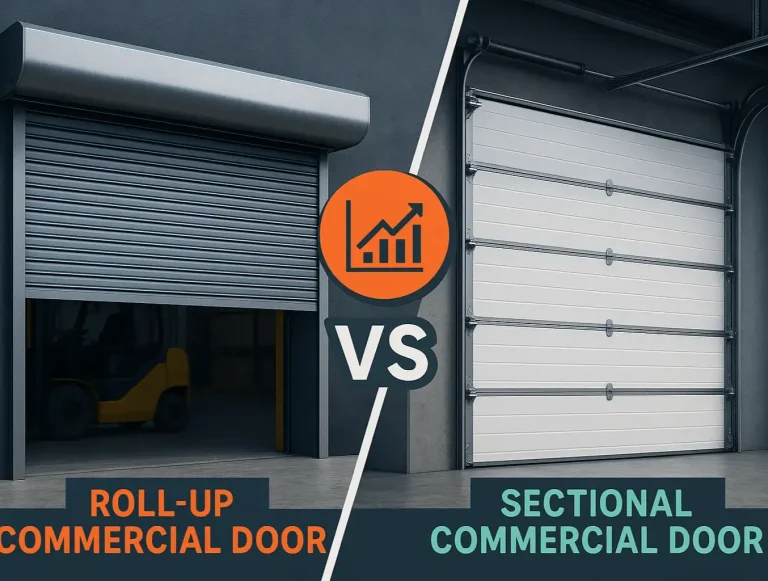
Roll-Up vs. Sectional Doors for High-Traffic Commercial Loading Docks
Choosing the wrong commercial door for your loading dock can cost you thousands of dollars a year in lost energy, unexpected repairs, and operational downtime. It’s a decision that goes far beyond the initial quote.…
Published Date: Apr 24, 2026