





High-Cycle Commercial Garage Doors
Published: May 21, 2026
It’s 10 a.m. on your busiest day. A forklift loaded with a critical shipment is waiting, but your warehouse’s standard sectional door has ground to a halt—again. A spring snapped, the motor is whining, and operations are at a standstill. Every minute of downtime costs you money, damages your reputation, and adds stress you don’t need.
This isn’t a freak accident; it’s an inevitability. It’s the moment you realize the “cost-effective” garage door you installed is actually one of your most expensive liabilities.
Many businesses treat a commercial garage door as a simple opening in a wall, but for high-traffic environments, it’s a core piece of operational machinery. Installing a standard, low-cycle door in a demanding setting is like using a family sedan to haul commercial freight. It will work for a little while, but failure is guaranteed.
This guide is for any business owner or facility manager who has felt that pain—or wants to avoid it. We’ll move beyond the basics to help you understand the world of high-cycle commercial doors and, more importantly, how to choose the right one for your specific operation.
Foundation: The High-Cycle Revolution
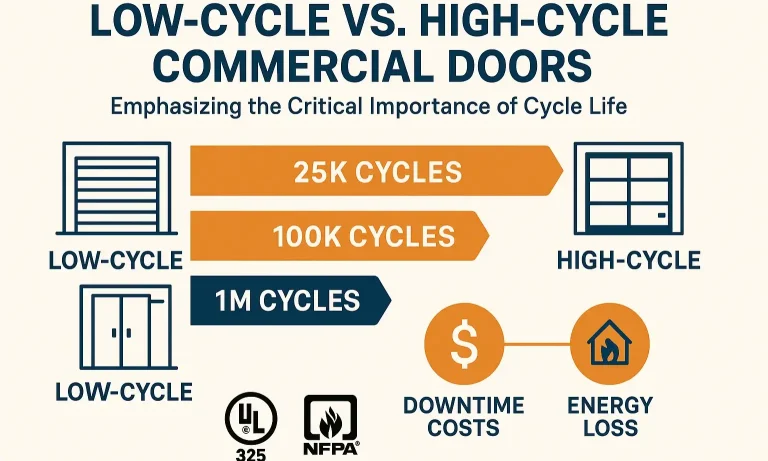
So, what exactly makes a door “high-cycle”? It comes down to one simple concept: the cycle. One cycle is one full opening and closing of the door.
A standard commercial door is built with springs and hardware rated for about 10,000 to 20,000 cycles. That sounds like a lot, but if your door opens just 25 times a day, you’ll burn through a 15,000-cycle rating in about two years. For many businesses, that number is far too low.
High-cycle doors, also known as high-performance doors, are engineered for a minimum of 100,000 cycles, with many models designed to exceed 1,000,000 cycles. They aren’t just beefed-up versions of standard doors; they are fundamentally different machines built for speed, durability, and relentless repetition.
Choosing low-cycle when you need high-cycle leads to:
- Constant Repairs: Frequent replacement of springs, cables, and operators.
- Operational Bottlenecks: Slow door speeds create delays for vehicles and personnel.
- Energy Waste: Gaps in seals and slow closing times lead to massive heating or cooling loss.
- Safety Hazards: Failing components pose a significant risk to your team.
The “aha moment” for most businesses is realizing that a high-cycle door isn’t a luxury—it’s an investment in operational uptime and long-term savings.
Building: The Ultimate Door Selection Guide (By Business Type)
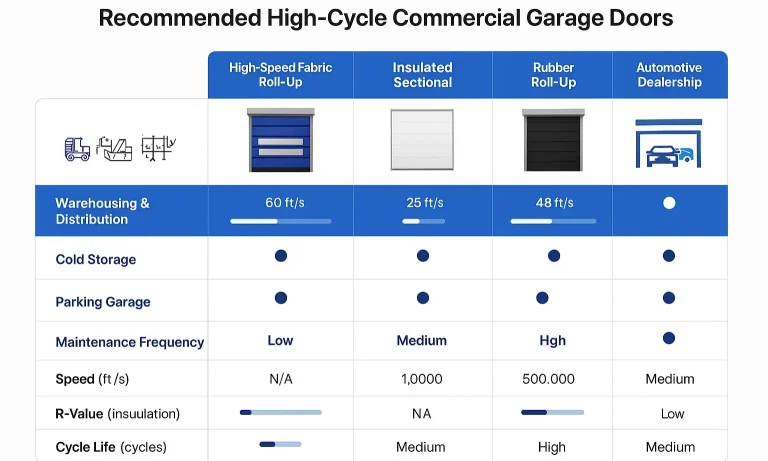
The biggest mistake in choosing a commercial door is focusing only on the product list. The right approach is to start with your environment. What are the unique demands of your facility? Below, we map common business types to their ideal high-cycle door solutions.
Warehousing & Distribution Centers
Primary Challenges: High volume of forklift and vehicle traffic, maintaining environmental control, and preventing costly impacts.
Ideal Door Types:
- High-Speed Fabric Roll-Up: The workhorse of the industry. These doors open at incredible speeds (up to 100 inches per second), minimizing the time the doorway is open. Many feature “breakaway” technology, where the door can absorb a forklift impact and automatically reset itself into the tracks, virtually eliminating downtime from collisions.
- High-Performance Rubber Roll-Up: For the most extreme environments. These doors are nearly indestructible, capable of shrugging off severe impacts from heavy machinery day after day.
Cold Storage & Food Processing
Primary Challenges: Strict temperature control, preventing moisture and pest infiltration, and meeting hygiene standards.
Ideal Door Types:
- Insulated High-Speed Doors: These doors combine the velocity of a fabric door with a high R-value (insulation rating). The rapid open/close cycle dramatically reduces air exchange between climate zones, a critical factor in energy savings. An insulated roll-up garage door is specifically designed to keep conditioned air in and outside temperatures out.
- High-Seal Doors: Look for models with tight perimeter seals and high wind resistance to create an effective barrier against air leakage and contaminants.
Parking Garages (Public & Private)
Primary Challenges: Extremely high cycle counts, maintaining traffic flow, security, and low-noise operation.
Ideal Door Types:
High-Speed Rigid Roll-Up: These doors offer the speed needed for fast-moving traffic with the security of rigid aluminum slats. Their direct-drive motors and springless designs are perfect for environments demanding over 500 cycles per day with minimal maintenance. The benefits of high-speed garage door systems are most apparent in these settings, ensuring vehicles move in and out without delay.
Automotive Dealerships & Service Bays
Primary Challenges: Balancing aesthetics with durability, providing visibility, and withstanding a moderate to high number of cycles.
Ideal Door Types:
High-Performance Sectional Doors: These offer the look of a traditional sectional door but are built on a high-cycle chassis. Full-view glass panels can be incorporated to showcase vehicles in showrooms while providing the durability needed for service bays. The debate between roll-up vs. sectional doors often comes down to the specific needs for ceiling clearance and aesthetics.
Mastery: Understanding the Engineering
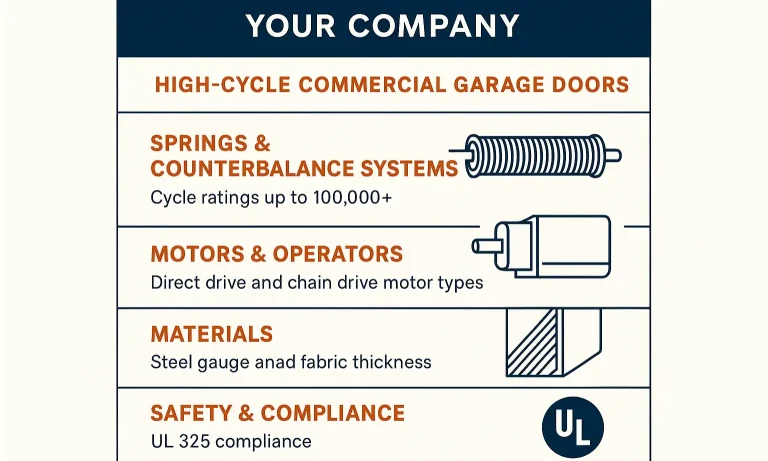
What gives a high-cycle door its superhuman endurance? It’s not one single thing, but a system of engineered components designed to work in harmony.
- Springs & Counterbalance Systems: This is the heart of the cycle life. While standard doors use torsion springs rated for 10k-20k cycles, high-cycle doors use specially treated, larger garage door springs rated for 100,000, 500,000, or even millions of cycles. Some advanced models eliminate springs entirely, using a direct-drive motor system.
- Motors & Operators: You won’t find a residential-style opener here. A high-cycle commercial garage door opener is a heavy-duty machine. Look for direct-drive motors that connect directly to the door shaft, eliminating chains and belts that wear out. Variable Frequency Drives (VFDs) allow the door to soft-start and soft-stop, reducing wear on all components. A top-tier LiftMaster commercial garage door opener is a prime example of this advanced technology.
- Materials & Durability: From heavy-gauge steel tracks to tear-resistant PVC vinyl and impact-proof rubber, every material is chosen for longevity in harsh conditions.
- Safety Features: High-performance doors must meet stringent safety standards like UL 325. They incorporate advanced safety features, including light curtains that create an invisible wall of protection in the opening, and reversing sensor edges that stop and reverse the door on contact.
Action: Making the Right Investment
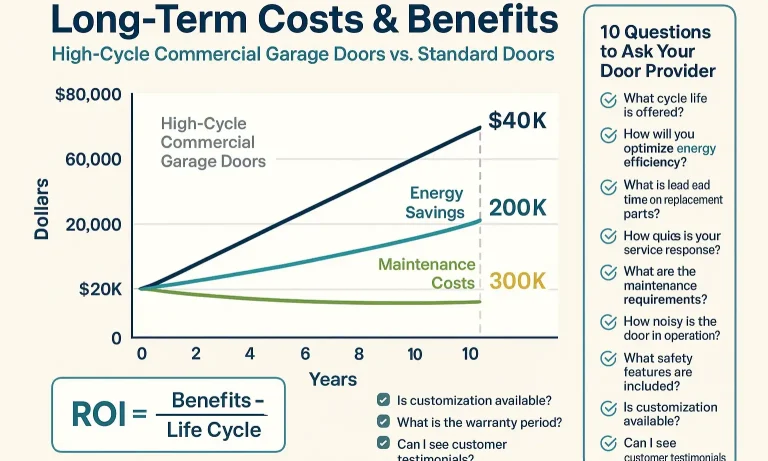
Shifting your mindset from “buying a door” to “investing in infrastructure” is the first step. A high-cycle door costs more upfront, but the return on investment (ROI) is realized quickly through reduced downtime, lower repair bills, and energy savings.
5 Questions to Ask Before You Buy:
- How many cycles do I realistically need per day? Be honest about your peak usage. This is the single most important factor.
- What is the biggest risk in my environment? Is it vehicle impact, temperature loss, or security?
- What is my true cost of downtime? Calculate what one hour of a non-operational doorway costs your business.
- What are the long-term maintenance needs? High-cycle doors are low-maintenance, not zero-maintenance. A plan for commercial door preventative maintenance is essential.
- What safety features are included? Ensure the door has modern safety sensors like photo-eyes or light curtains.
Understanding the subtle garage door maintenance differences between commercial models can help you budget for long-term care and extend the life of your investment even further.
Frequently Asked Questions (FAQ)
What is a high-cycle commercial garage door?
A high-cycle door is an industrial-grade door engineered to perform a minimum of 100,000 open-and-close cycles. It is designed for speed, durability, and reliability in high-traffic commercial environments like warehouses, parking garages, and manufacturing plants.
How do I know if I need a high-cycle door?
A simple rule of thumb: if your door opens more than 20-30 times per day, you should strongly consider a high-cycle solution. Other triggers include frequent repairs on your current door, high energy bills from a slow-moving door, or operational bottlenecks caused by door speed.
Are high-cycle doors more expensive?
Yes, the initial purchase price is higher than a standard commercial door. However, the total cost of ownership is significantly lower due to drastically reduced repair costs, fewer replacements, improved energy efficiency, and minimized operational downtime.
How long do high-cycle doors last?
Their lifespan is measured in cycles, not years. A door rated for 1,000,000 cycles in an environment where it runs 300 times a day will last for over nine years before its core components are expected to wear out. A standard door in the same environment might fail in less than a year.
What kind of maintenance do they require?
While robust, they still benefit from regular professional maintenance. This typically includes inspecting seals, checking safety sensors, ensuring track alignment, and verifying motor function. Because many have fewer moving parts (like springs), their maintenance needs are often simpler than those of a standard door.
The Smartest Opening for Your Business
Choosing the right commercial garage door is a strategic decision that directly impacts your productivity, safety, and bottom line. By moving past the upfront price tag and focusing on the long-term value of uptime and reliability, you can equip your facility with a solution that works for you, not against you.
When you’re ready to explore the right high-cycle solution for your business, consulting with an expert can help you navigate the options and make an investment that pays dividends for years to come.
You May Also Like
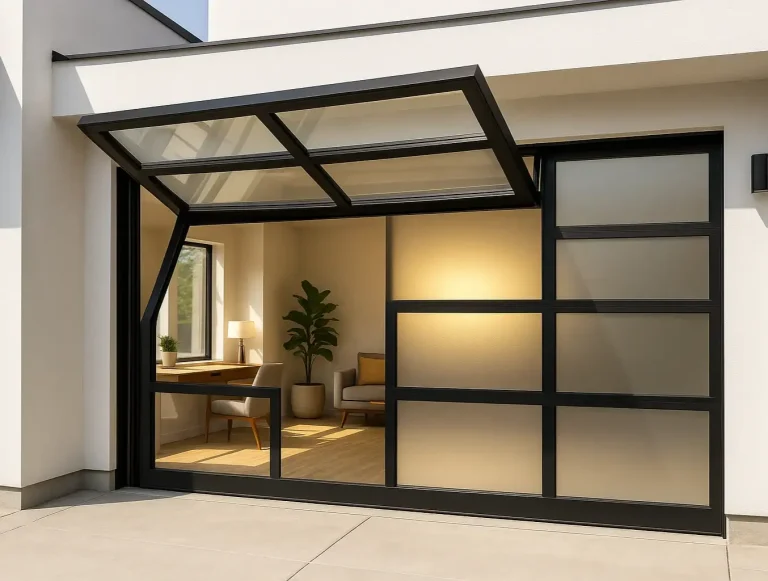
Full-View Aluminum & Glass Garage Doors: Modern Design
Ever drive past a home and do a double-take? Not because of the landscaping or the paint color, but because the garage door was a stunning wall of glass that seemed to blend the indoors with the out. You're not just…
Published Date: May 20, 2026
Explore Different Types of Garage Doors
Choosing the right garage door is about making your home more secure and looking better. Finding the one that meets your needs and your home’s style can be overwhelming with so many options. Whether you’re looking…
Published Date: Sep 25, 2024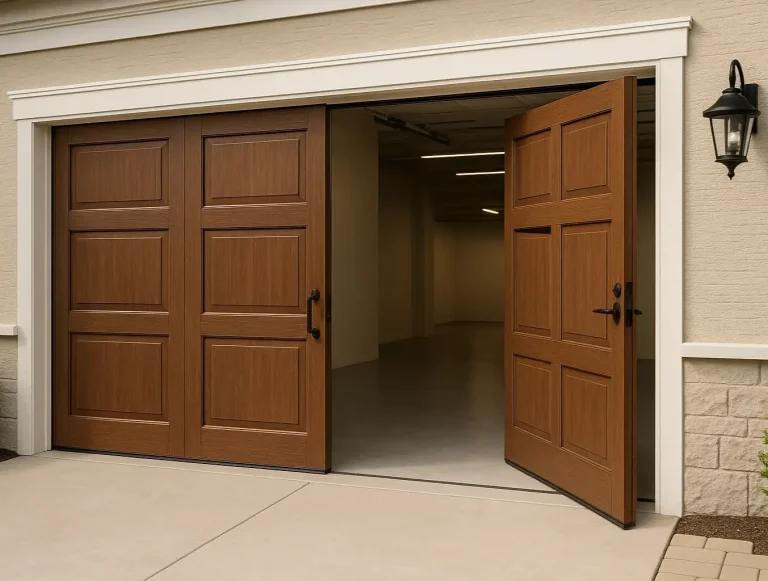
A Modern Look at a Classic Style for Functionality and Aesthetics
Your garage is more than just a place to park your car. It's a workshop, a home gym, a storage hub, or even the band's practice space. But if you have to open the entire heavy door every time you want to grab a tool…
Published Date: May 14, 2026