





How Garage Doors Detect Obstructions When Photo-Eyes Fail
Published: May 12, 2026
We all know the little electronic “eyes” at the bottom of our garage door tracks. They project an invisible beam, and if anything breaks that beam while the door is closing, the door instantly reverses. They are the frontline heroes of garage door safety, preventing countless accidents.
But what happens when they fail? What if they get bumped out of alignment, a wire gets frayed, or the lenses get too dirty? Is there a backup plan?
Absolutely. Meet the silent protectors: the secondary safety mechanisms built directly into your garage door opener. These systems are your last line of defense, designed to detect an obstruction even when the photo-eyes can’t. Understanding how they work isn’t just a matter of curiosity—it’s a critical part of ensuring your home’s safety. While you should always know how to align garage door sensors to keep them working, knowing the backup system is just as important.
Foundation: How Your Garage Door 'Feels' an Obstruction
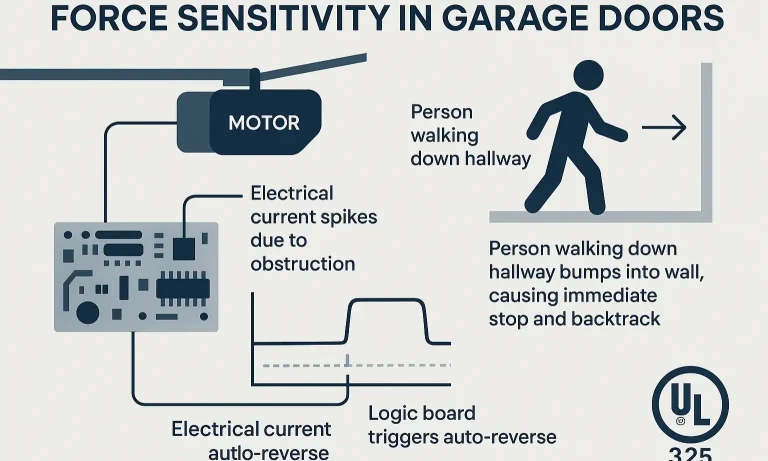
Ever wonder how a “machine” can “feel” something in its way? It’s not magic; it’s clever engineering. Modern garage door openers don’t have hands, but they have a highly sensitive “brain”—a logic board that constantly monitors the motor.
Think of it like this: Imagine you’re walking down a dark hallway. You have a normal, easy pace. If you suddenly bump into a wall, you immediately stop and back up. Your brain didn’t see the wall, but it felt the sudden resistance.
Your garage door opener does the same thing.
The logic board monitors the amount of electricity the motor is using to lower the door. On a normal trip down, the electrical draw is low and steady. If the door hits an object—a bike, a trash can, or anything else—the motor has to work harder to push through it. This causes a sudden spike in the electrical current. The logic board instantly detects this “spike” as an obstruction and sends a command: “Reverse!”
This entire process is governed by two interconnected features: Force Sensitivity and Auto-Reverse.
Building: The Two Key Systems in Action
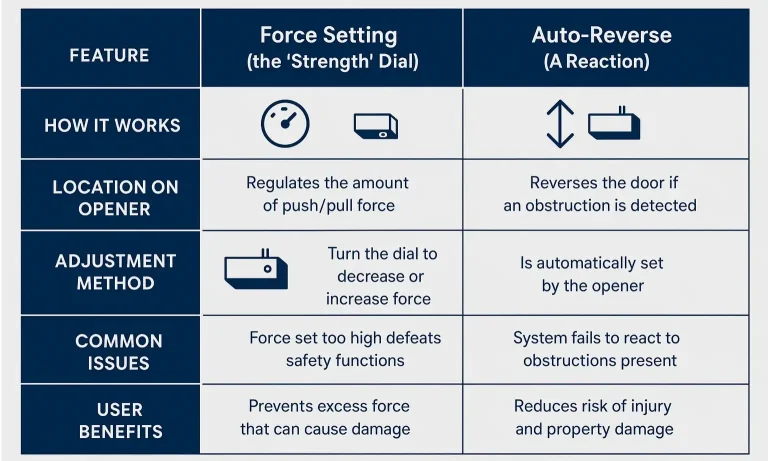
Force Sensitivity and Auto-Reverse work as a team. One sets the rules, and the other takes action. Understanding both is key to maintaining a safe garage door.
Force Setting: The ‘Strength’ Dial
The force setting, or sensitivity adjustment, is essentially the “strength dial” for your opener. It tells the logic board how much resistance is considered “normal” before it should trigger a reversal. The goal is to set the force to the minimum amount necessary to close the door smoothly.
- Too Little Force: The door might reverse on its own if it encounters minor friction from dirty tracks or cold, stiff grease.
- Too Much Force: The door could exert a dangerous amount of pressure on an object before the logic board registers the obstruction and reverses.
This is why you should never increase the force to compensate for a door that’s struggling to close. That struggle is often a symptom of another problem, like an unbalanced door or worn-out rollers. A proper garage door force adjustment is about finding the sweet spot, not overpowering a problem.
Auto-Reverse: The ‘Reaction’ Command
Auto-reverse is the action itself. It’s the pre-programmed command that tells the door to immediately stop and move back up when the force sensor detects an obstruction. This isn’t just a feature; it’s a federally mandated safety standard (UL 325) for all garage door openers manufactured since 1993.
When the force setting is calibrated correctly, the auto-reverse mechanism can detect an object and change direction in a fraction of a second, preventing serious injury or damage.
Mastery: How to Test and Calibrate Your System
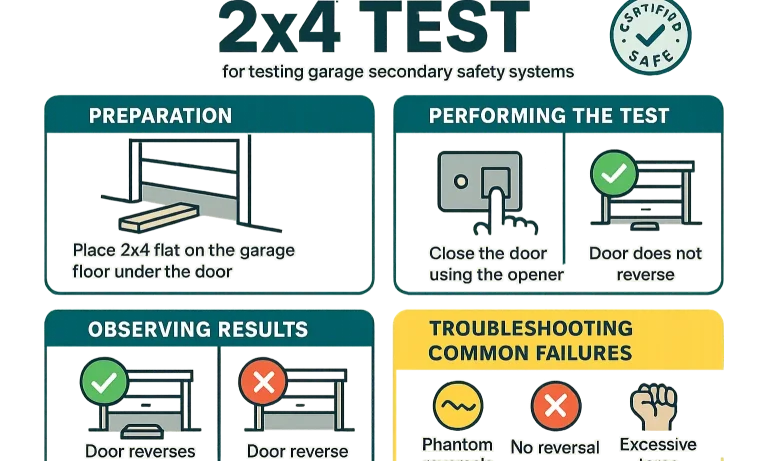
Knowing these systems exist is the first step. The second, and most important, is making sure they work. The industry-standard method for this is the “2×4 Test.” It’s simple, takes less than a minute, and should be done monthly.
How to Perform the 2×4 Test:
- Find a Prop: Get a standard 2×4 piece of wood. A full roll of paper towels can also work in a pinch.
- Position the Object: Lay the 2×4 flat on the ground in the center of the garage door’s path.
- Close the Door: From a safe distance, use your remote or wall button to close the door.
- Observe the Reaction: As soon as the door makes contact with the 2×4, it should immediately stop and reverse.
If the door pushes hard on the wood, strains, or doesn’t reverse, your force setting is too high and needs immediate adjustment. If it reverses successfully, your secondary safety system is working perfectly.
Action: Maintaining Safety
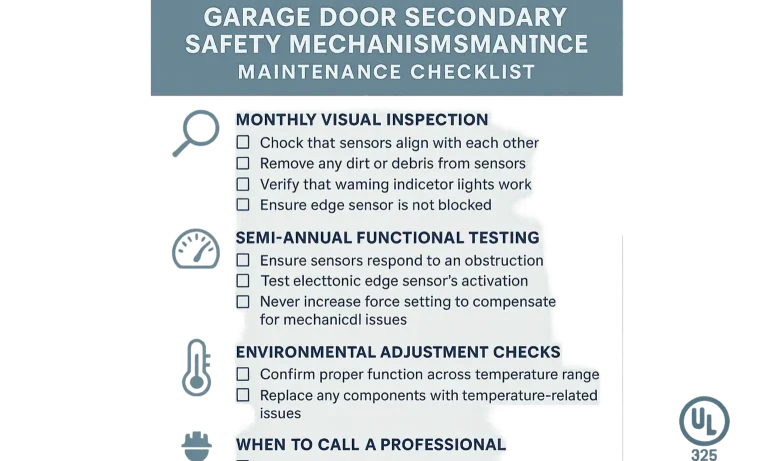
Your garage door is the largest moving object in your home. Keeping its safety features in top condition is a non-negotiable part of home maintenance. Beyond the monthly 2×4 test, a few simple checks can ensure everything runs smoothly.
When to Call a Professional
While testing is simple, adjusting these systems can sometimes be complex, and certain symptoms indicate a deeper problem. It’s time to call a professional technician if:
- Your door fails the 2×4 test, and you’re not comfortable adjusting the force settings yourself.
- You’ve adjusted the force, but the door still reverses for no reason or won’t close properly.
- The door moves unevenly, makes grinding noises, or seems excessively heavy to lift manually. These are signs of mechanical issues that force adjustments can’t fix.
Attempting to fix a garage door on your own can be dangerous if you’re not familiar with the mechanics. When in doubt, let an expert handle it.
Frequently Asked Questions (FAQ)
Why does my garage door start closing and then reverse for no reason?
This is the most common sign that your closing force is set too low. The opener is detecting minor resistance from dirty tracks, stiff rollers, or even cold weather and misinterpreting it as an obstruction. A slight adjustment may be needed, but always perform the 2×4 test afterward.
Can cold weather really affect my garage door?
Yes. In winter, the lubricants on the tracks and rollers can thicken, and the door’s components can contract slightly. This creates extra friction, which can be enough to trigger the auto-reverse if the force is set too sensitively. A seasonal adjustment is sometimes necessary.
What is UL 325 and why is it important?
UL 325 is a safety standard from Underwriters Laboratories that mandates all garage door openers sold in the U.S. must have both a primary (photo-eyes) and a secondary (contact-reverse) safety system. This regulation is the reason these life-saving features are standard on all modern openers.
Is it dangerous to just increase the force setting to make my door close?
Yes, extremely. The force setting should only be a reflection of a well-balanced, smoothly operating door. Using extra force to overcome a mechanical problem—like a frayed cable or worn-out spring—is like turning up the radio to ignore a rattling engine. It masks the real issue and creates a significant safety hazard. You could also damage the opener motor.
Since these backup systems exist, can I just disable my photo-eyes?
Never. It is incredibly dangerous and voids the UL safety certification of your opener. The photo-eyes are the primary, non-contact system designed to prevent the door from ever making contact with a person or object. The force-sensing system is a backup for when the primary system fails. Learning how to bypass safety sensors on a garage door is for emergency situations only, not for regular use.
Your Next Step to a Safer Home
Your garage door’s safety systems are a powerful, multi-layered defense. The photo-eye beams provide the first line of protection, while the force-sensing auto-reverse stands ready as the crucial backup.
Now that you understand how these silent protectors work, take the next step. Go out to your garage and perform the 2×4 test. It’s the simplest, most effective way to ensure your door is ready to protect what matters most. If you find any issues or are unsure about making adjustments, especially for specific models like Genie, our guide on how to adjust Genie garage door opener force adjustment may help, but don’t hesitate to contact a trusted professional. Safety is always the top priority.
You May Also Like
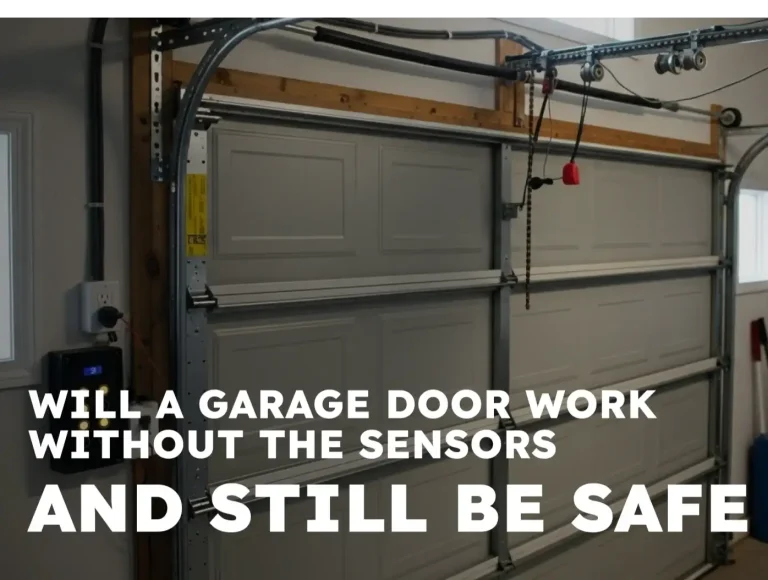
Will a Garage Door Work Without the Sensors And Still Be Safe
Many homeowners wonder if a garage door will work without the sensors, especially when the door won’t close and you need it down fast. While the opener can sometimes move without the garage door safety sensors, this…
Published Date: Nov 20, 2025
Deactivating Wi-Fi Enabled Openers and App Access
You’ve installed a smart garage door opener, and you love the convenience of opening it from your phone. But now you're facing a new situation. Maybe you’re selling your house, you just upgraded your Wi-Fi router, or…
Published Date: May 11, 2026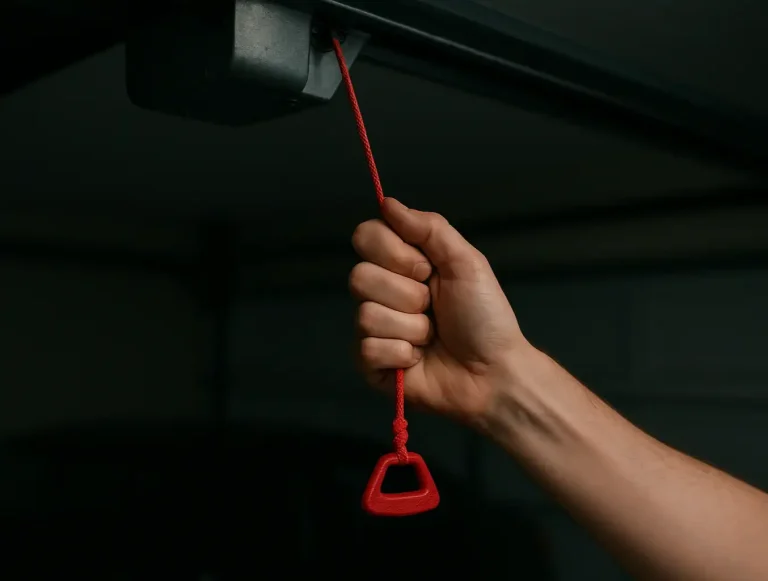
Deactivating Your Garage Door Opener During a Power Outage
The power goes out. The garage door opener is dead. Your car is trapped inside, and you need to get out. Or maybe the opener is making a grinding noise, and the door is stuck halfway open. It’s a stressful situation…
Published Date: May 8, 2026