




Garage Door Weight by Door Type: Why It Matters for Your Opener
Published: Nov 3, 2026
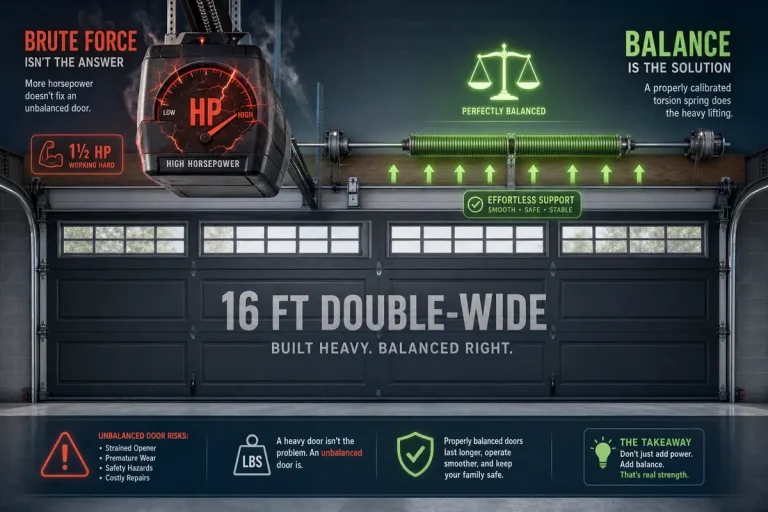
A common misconception among homeowners evaluating replacement options is that a garage door opener does the heavy lifting. In reality, your spring counterbalance system is designed to bear 90% to 95% of the static load. However, the opener motor must supply the initial dynamic torque needed to overcome static inertia, track friction, and breakaway resistance. If you have ever experienced your garage door motor running but door not opening, improper horsepower matching or spring decay is frequently the root cause.
The Physics of Door Mass and Opener Horsepower
When selecting an opener, understanding motor force dynamics is essential. Traditional AC motors operate on continuous mechanical horsepower (e.g., 1/2 HP, 3/4 HP) with constant speed and higher starting current draw. Modern DC motors utilize variable-speed electronics rated in “Horsepower Equivalent” (HPs or HPc). DC motors offer soft start and stop technology, drastically reducing mechanical shock on trolley gears and structural hinges when moving heavy doors.
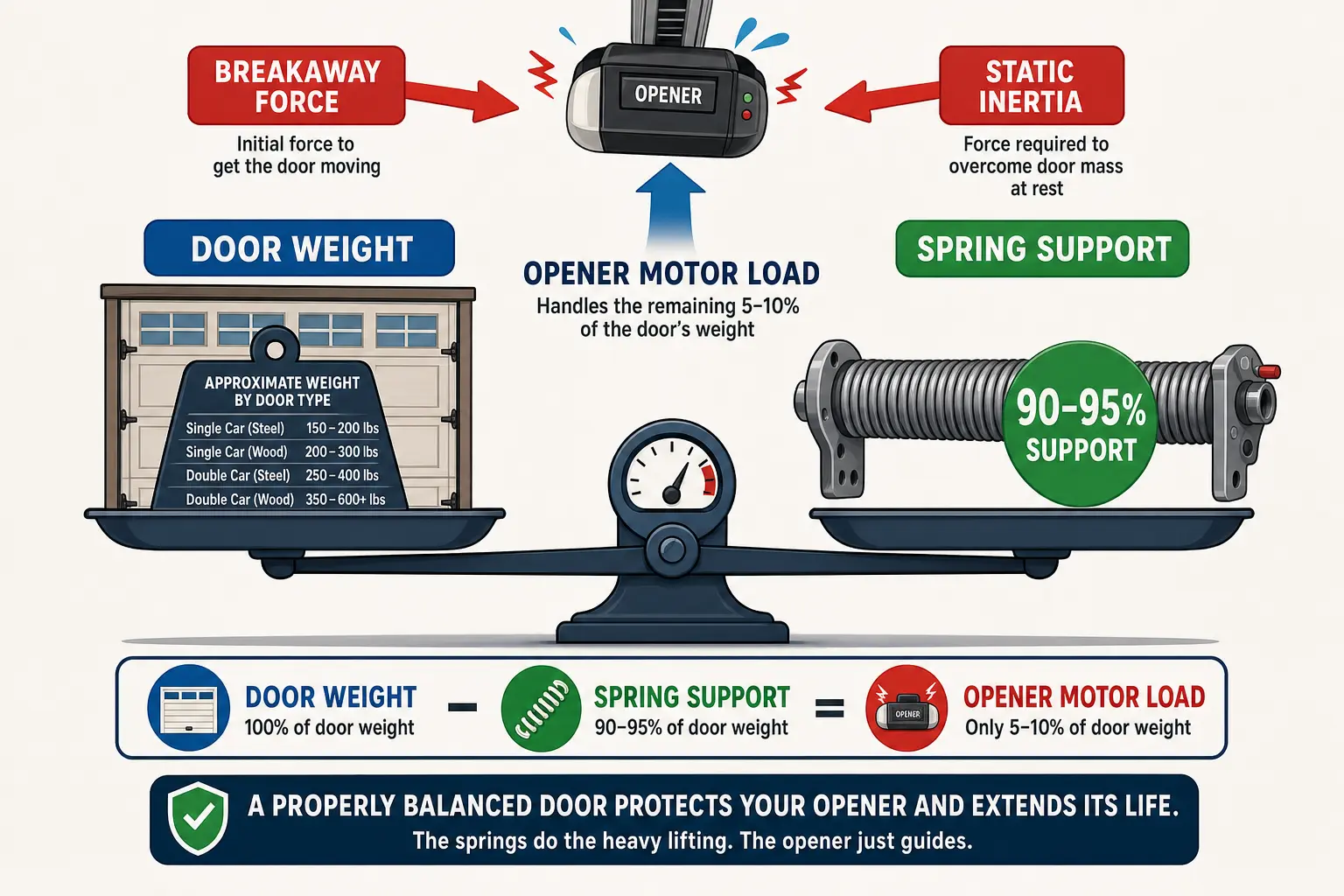
Underestimating motor force introduces severe safety risks. Under ANSI/UL 325 safety standards, an underpowered motor forced to operate near its maximum torque threshold may fail to trigger auto-reversal upon striking an obstacle, creating potential property damage or injury risks.
Garage Door Weight Reference Matrix
Determining your baseline garage door weight protects your system from premature motor burnout. Surface area density ratios vary considerably across materials—from single-layer uninsulated steel at 1.40 lbs/sq. ft. to 2-inch polyurethane steel-back sandwich panels at 1.97 lbs/sq. ft.
| Door Dimensions | Single-Layer Steel (25-Ga) | 2″ Steel Sandwich (Insulated) | Custom Wood / Overlay | Full-View Glass / Aluminum |
|---|---|---|---|---|
| 8′ x 7′ (Single) | 75 – 80 lbs | 115 lbs | 150 – 225 lbs | 175 – 225 lbs |
| 9′ x 7′ (Single) | 85 lbs | 129 lbs | 175 – 250 lbs | 200 – 250 lbs |
| 16′ x 7′ (Double) | 150 – 160 lbs | 220 – 225 lbs | 300 – 400 lbs | 350 – 450 lbs |
| 16′ x 8′ (Double) | 184 lbs | 253 lbs | 350 – 450 lbs | 400 – 500+ lbs |
While assessing steel garage door benefits, remember that structural gauge thickness and core density play a massive role in long-term opener requirements.
Accounting for Retrofits and Modifications
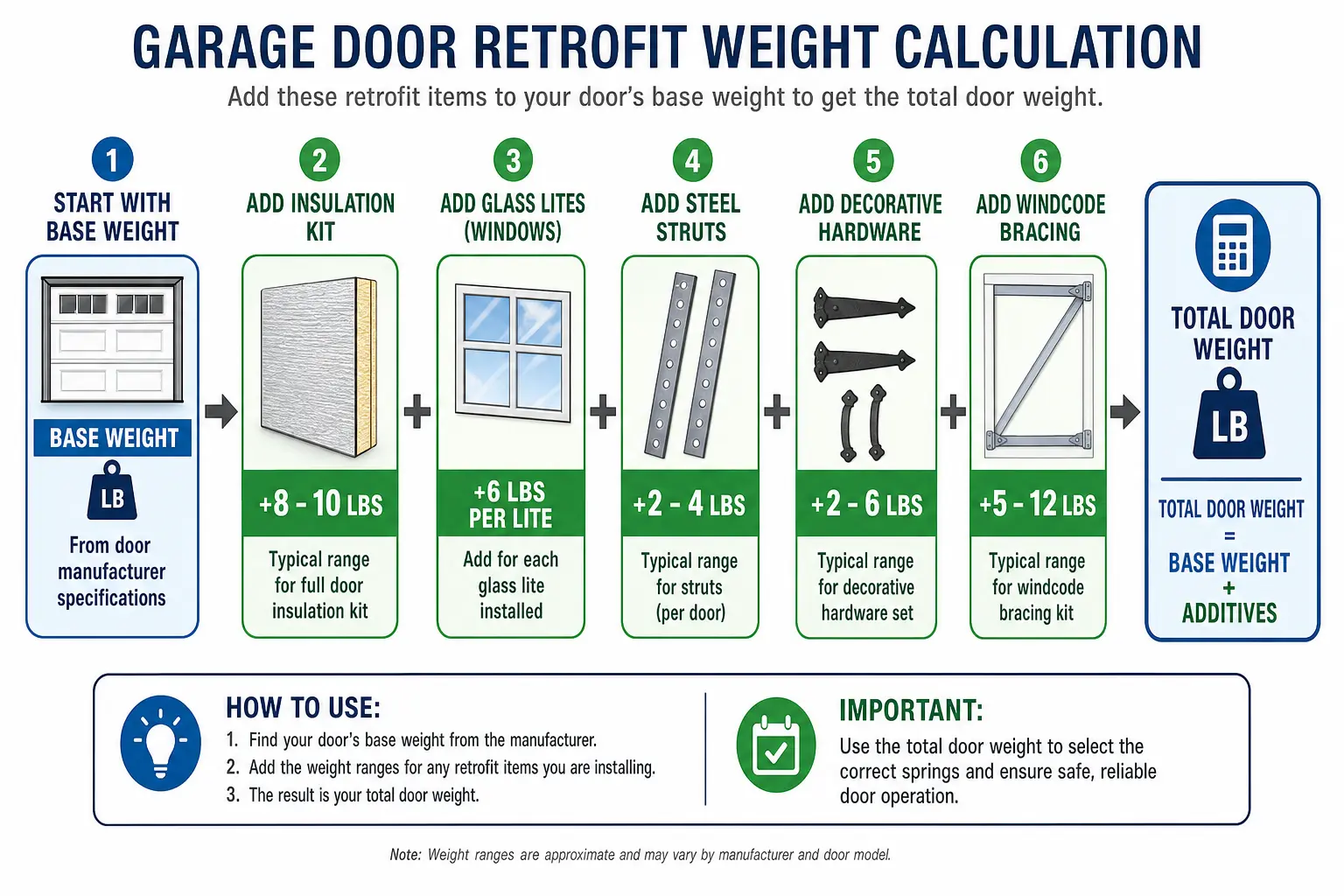
Homeowners frequently retrofit existing doors without accounting for mass accumulation. Learning how to insulate a garage door improves thermal efficiency, but standard DIY polystyrene insulation kits add 18 to 23 lbs to a double-car door, shifting the dynamic pull force required from the opener.
Key Additive Weight Variables:
- Polystyrene Panel Insulation: Adds +8 to +10 lbs (Single) / +18 to +23 lbs (Double).
- Insulated Glass Lites: Adds +6 lbs per short window / +10 to +12 lbs per long window.
- 22-Gauge Steel Reinforcement Struts: Adds +1.0 lb per linear foot (+16 lbs per 16-foot strut).
- Windcode & Hurricane Bracing: Adds +30 to +60 lbs total system mass.
Matching Door Mass to Opener Horsepower and Drive Selection
Evaluating what horsepower garage door opener do i need requires matching overall assembly mass to motor horsepower ratings and drive architecture.
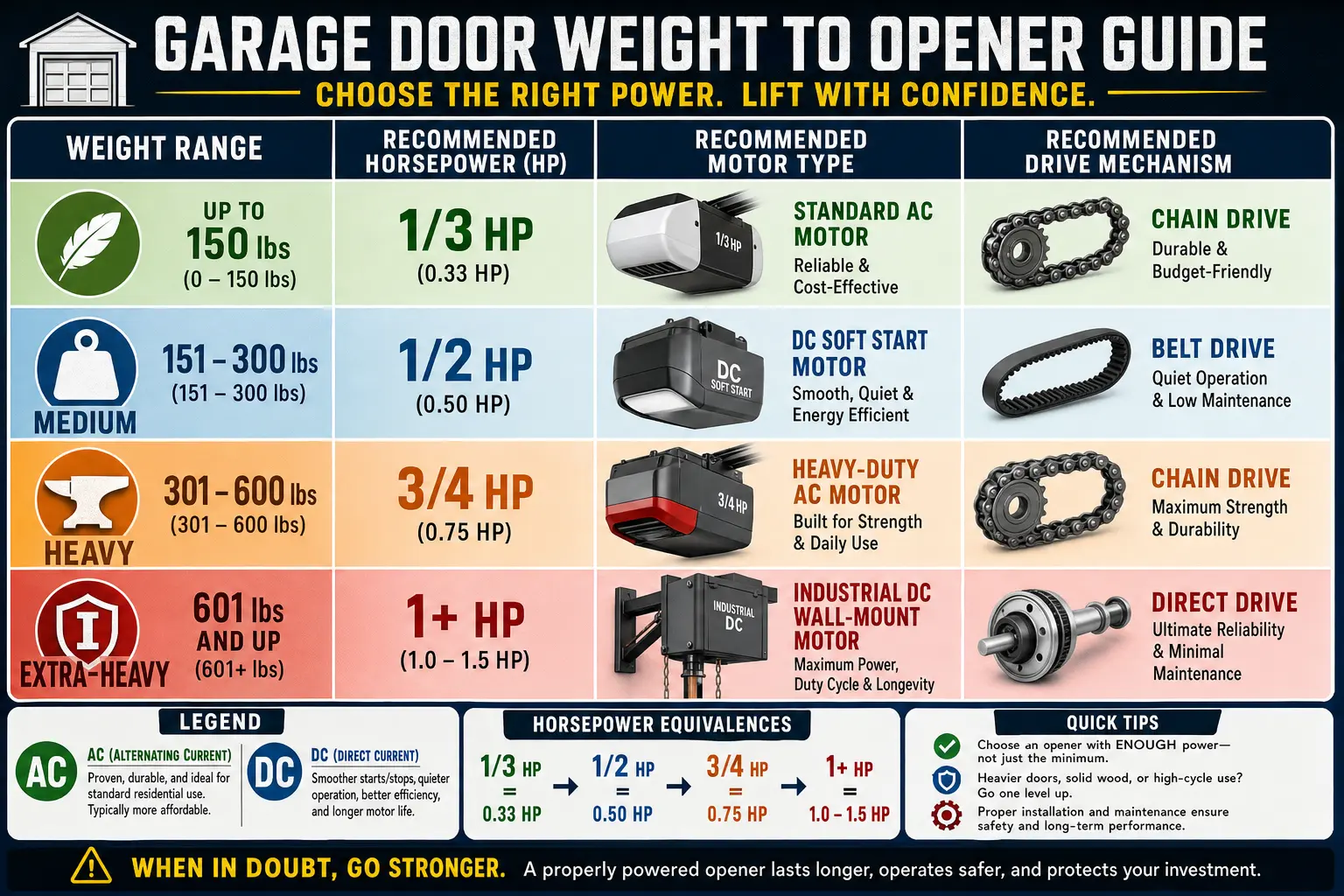
- Lightweight Doors (< 120 lbs): A 1/2 HP AC or 1/2 HPs DC motor handles single-car uninsulated steel or aluminum doors with low stress using standard chain or belt drives.
- Medium-Weight Doors (120 – 220 lbs): A 1/2 HP to 3/4 HP DC motor is optimal for standard double-car steel doors. Belt drives provide ultra-quiet performance and smooth acceleration.
- Heavyweight Doors (220 – 350 lbs): A 3/4 HP AC or 1 HPs DC motor is mandatory for 2-inch polyurethane insulated doors, wood overlays, and windcode-rated assemblies.
- Extra-Heavyweight Doors (350 – 500+ lbs): Solid hardwood carriage and heavy architectural glass doors demand 1.25 HPs DC motors. Installing a high-torque best wall mount garage door opener (jackshaft drive) transfers lift force directly to the torsion bar, eliminating overhead rail flexing.
Testing Spring Counterbalance Before Installation
Never attach a new opener to an unverified door assembly. A motor should never be used to compensate for worn or miscalibrated springs. Understanding how does a garage door spring work helps you perform a quick balance test:
- Close the door fully and disconnect the opener via the emergency release cord.
- Manually raise the door waist-high (3 to 4 feet off the ground) and let go.
- Observe movement: A properly balanced door should rest in place, held by spring tension.
- Diagnostics: If the door falls, spring tension is dangerously weak. If it snaps open, springs are over-wound.
If your test reveals imbalance, schedule a professional garage door spring tension adjustment near me before installing a new opener motor.
Frequently Asked Questions
Can a garage door opener be too powerful for a door?
No, an opener only delivers the force required to move the door’s physical weight. Installing a higher horsepower motor provides greater thermal efficiency, quieter operation, and reduced mechanical strain without damaging a lighter door.
How do I know if my existing opener motor is underpowered?
Signs of an underpowered opener include noticeable motor straining, slow travel speeds, stripped nylon drive gears, high-pitched mechanical noise, or sudden reversals caused by force limit thresholds being exceeded during start-up.
What is the difference between AC horsepower and DC HP-equivalent (HPs)?
AC motors use true mechanical horsepower ratings and run at fixed speeds. DC motors utilize electronic controls to offer variable speeds and soft start/stop routines, measured in “HP-equivalent” (HPs) to indicate lifting capacity with lower power consumption.
You May Also Like