




Cable Drum Slipping on the Shaft: Diagnosing and Fixing Set Screw Failures
Published: Oct 2, 2026
A sudden bang, a visibly crooked garage door, and a tangled mess of cables: these are the hallmark signs of a cable drum slipping on its torsion shaft. While it is easy to assume the cable itself broke, the root cause is frequently a mechanical breakdown at the connection point: a set screw failure.
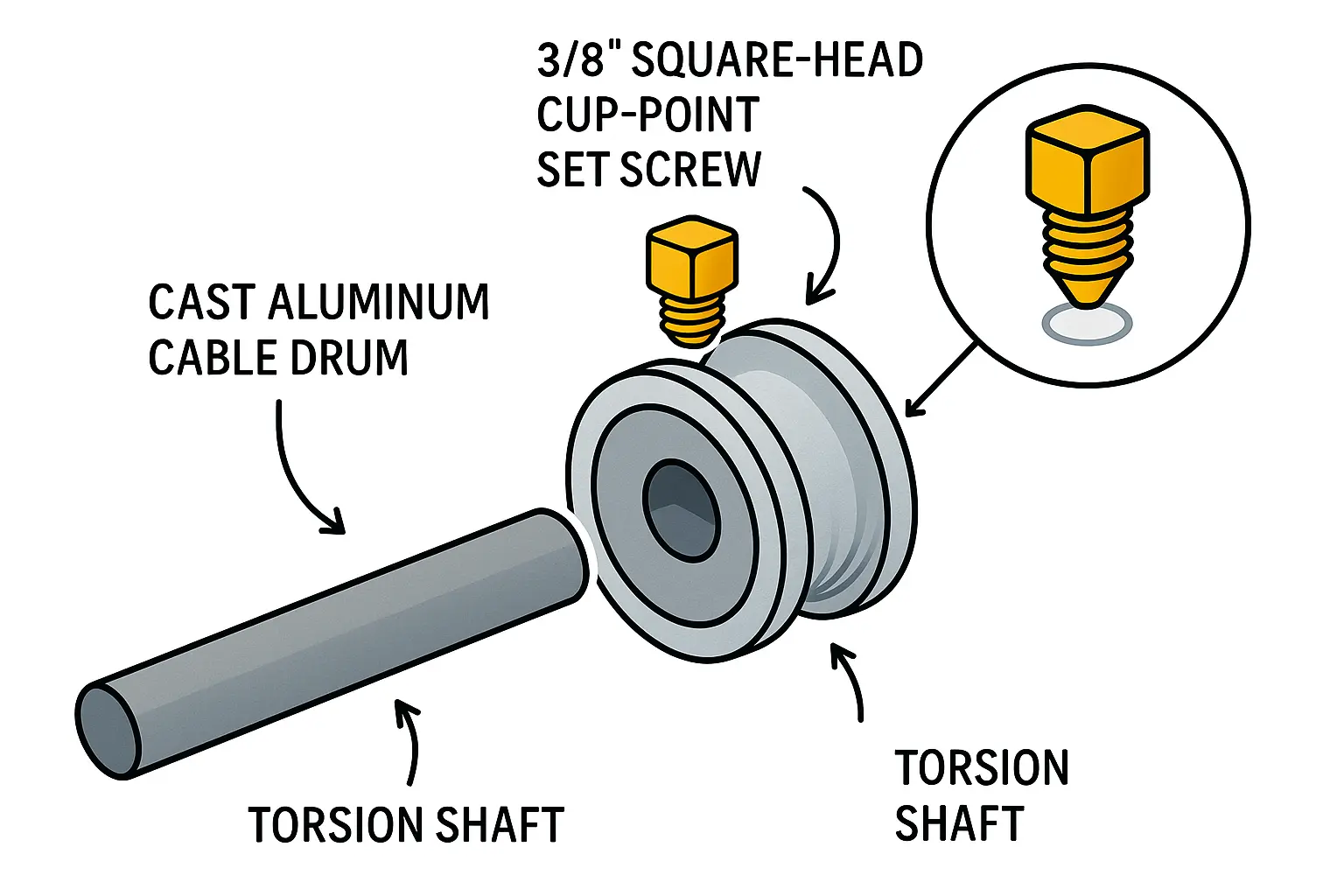
Set screws are designed to establish a critical friction-and-bite joint, locking the cast aluminum drum to the steel torsion shaft. When these fasteners lose their grip, the immense rotational force stored in the torsion springs instantly spins the shaft freely inside the drum, causing a complete system failure. If your garage door cable came off, diagnosing the set screw assembly is your critical first step.
The Metallurgy & Physics of Seasonal Slippage (Thermal Contraction)
Have you noticed these failures peak during autumn? It is not a coincidence; it is thermodynamic math.
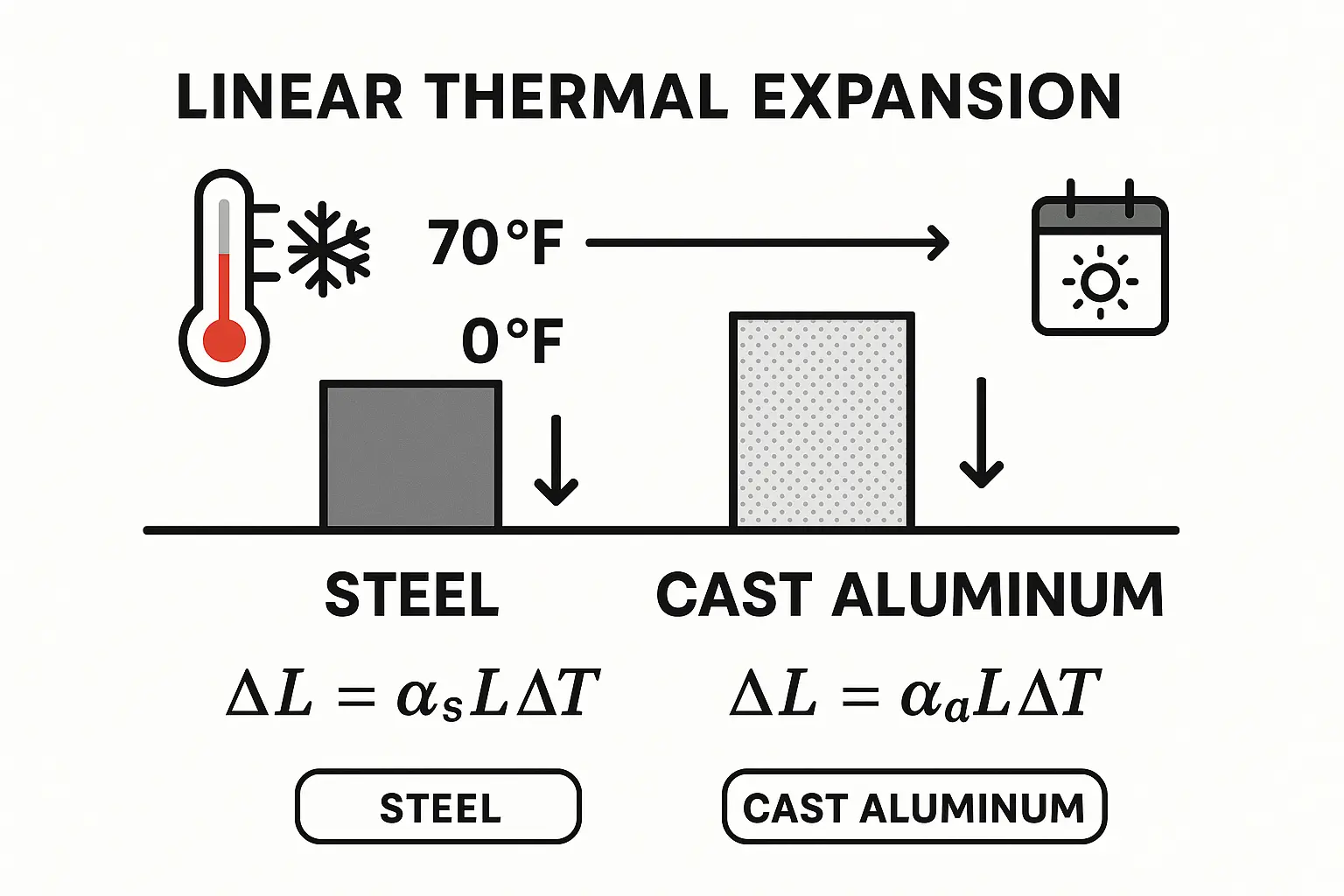
The steel torsion shaft and the cast aluminum cable drum expand and contract at radically different rates. Carbon steel has a thermal expansion coefficient ($alpha$) of approximately $11.5 times 10^{-6} text{ m/(m}cdottext{K)}$, whereas cast aluminum expands and contracts at roughly double that rate: $23.0 times 10^{-6} text{ m/(m}cdottext{K)}$.
When temperatures drop sharply, the aluminum drum hub contracts much faster than the steel shaft. If the set screws were slightly under-torqued during warm weather, this differential contraction alters the bolt preload, creating micro-gaps that allow the drum to slip. Understanding what are the different types of garage door drums and how they interact with temperature shifts is essential for preventing recurring winter failures.
Anatomical Breakdown of Set Screw Failures
Set screw failures generally present in three distinct modes:
- Under-Torquing and Shaft Scoring: Standard 3/8″-16 UNC square-head set screws feature a “cup point” designed to bite physically into the metal. If under-torqued, the screw fails to pierce the shaft, sliding under tension and cutting deep, structural scars around the steel shaft.
- Over-Torquing and Tube Collapse: On residential systems using hollow 14-gauge or 16-gauge steel torsion tubes, applying excessive torque collapses the wall of the tube. This permanently ruins the shaft’s concentricity and destroys the friction hold.
- Thread Strip-out in Cast Aluminum: Grade 5 steel set screws boast a yield strength of ~85,000 psi, while the cast aluminum drum hub (Alloy 380) has a yield strength of only ~23,000 psi. Over-tightening easily strips out the soft internal aluminum threads of the drum hub, requiring complete replacement of the drum.
To safely execute a garage door cable adjustment, technicians adhere to exact torque guidelines:
| Shaft Type | Recommended Torque | Turns Past Finger Tight | Failure Point |
|---|---|---|---|
| Hollow Tube (14/16-ga) | 15–20 ft-lbs (180–240 in-lbs) | 1/2 to 3/4 turn | >25 ft-lbs (Tube collapses) |
| Solid Steel Shaft (1″) | 20–25 ft-lbs (240–300 in-lbs) | 1 to 1-1/4 turns | >35 ft-lbs (Threads strip) |
Diagnostic & Rehabilitation Protocol: Fixing a Scarred Shaft
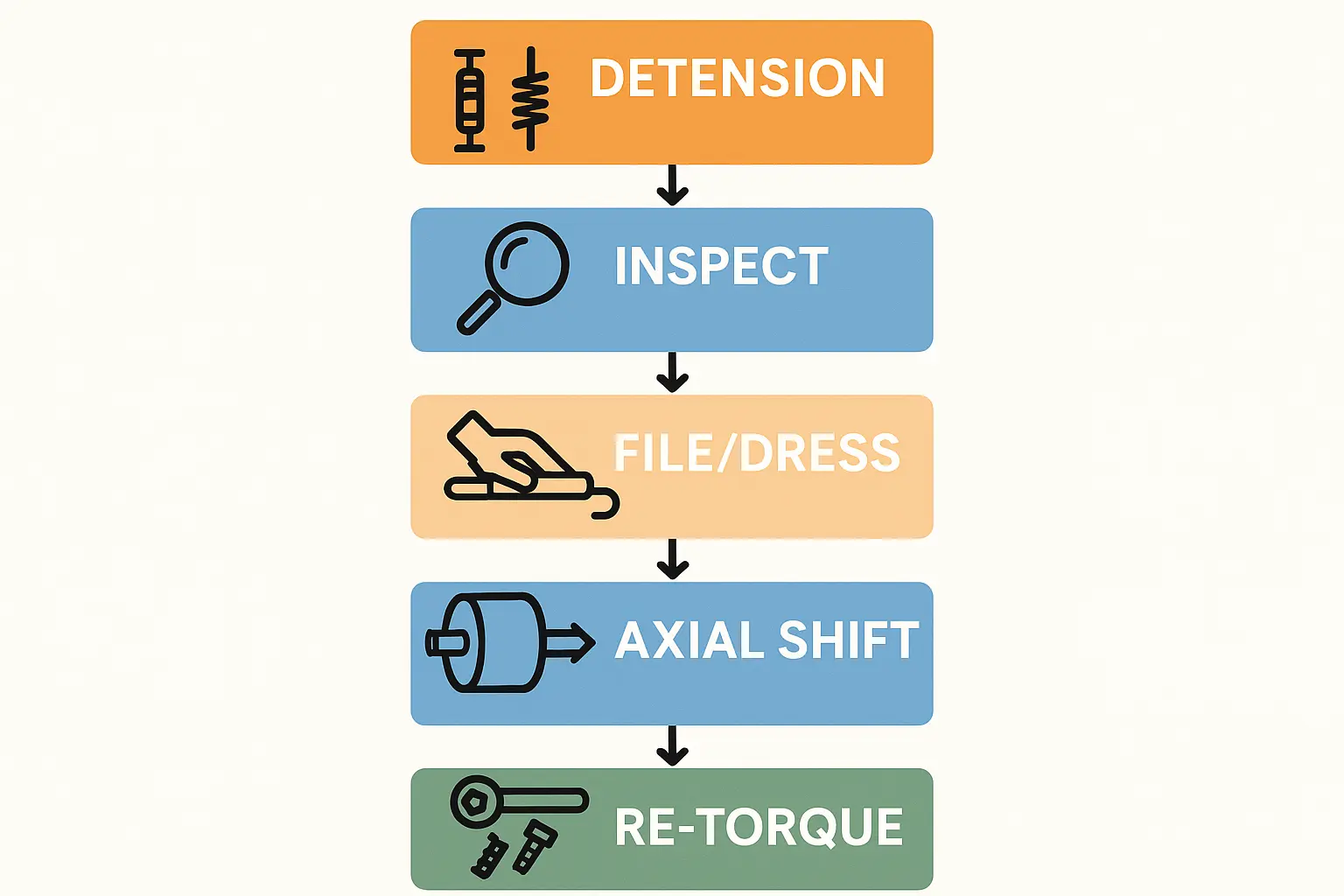
When a drum slips, it often leaves a scarred ring on the steel shaft. Simply tightening a new set screw into this groove will fail, as the fastener will slide back into the pre-existing rut. Instead, use the “Dress and Shift” protocol:
- De-tension: Safely unwind the torsion springs using rated winding bars. Never attempt this step without tools for garage door repair designed specifically for spring tension.
- Inspect: Examine the shaft for raised burrs and deep gouges.
- File and Dress: Use a fine-tooth metal file to grind down any raised metal burrs. The shaft surface must be completely flush to ensure the drum can slide and sit perfectly square.
- Axial Shift: Slide the cable drum slightly inward or outward by 1/8″ to 1/4″ (ensuring track alignments and clearances allow). This positions the set screws over clean, unmarred steel.
- Re-torque: Tighten the screws to exact torque specifications using a reliable wrench. Once secure, follow proper procedures on how to adjust garage door cables.
Keyways vs. Set Screws: Commercial and Industrial Systems
Industrial applications cannot rely solely on friction-grip set screws. High-cycle industrial commercial garage doors demand a mechanical interlock. These systems utilize solid steel shafts with machined keyways and square steel keys. The key acts as a physical barrier preventing rotational slippage, while set screws are used strictly to prevent axial (side-to-side) movement.
Safety Warning & DIY vs. Professional Evaluation
Working near torsion systems is inherently hazardous. Torsion springs store enough kinetic energy to cause catastrophic injury or property damage. If you do not possess rated winding bars, a calibrated torque wrench, and experience handling high-torque mechanical assemblies, adjusting these systems DIY is not worth the risk.
If you are facing a slipped drum, broken cable, or need a garage door spring tension adjustment near me, our family-owned team at Up & Down Garage Doors is standing by. We bring over 15 years of field experience, certified expertise, and upfront, transparent pricing.
For immediate help, contact our 24/7 dispatcher for emergency garage door repair across our service regions in Connecticut, Texas, New York, Illinois, and Arizona.
Frequently Asked Questions
Why did my garage door cable drum slip during the first cold week of winter?
This happens due to thermal contraction. Cast aluminum cable drums contract at twice the rate of the steel shaft. When temperatures drop, the aluminum drum hub shrinks slightly, reducing the tension and bolt preload of under-torqued set screws, allowing the drum to slip under load.
Can I reuse a cable drum if the threads are stripped?
No. Because steel set screws are much harder than the cast aluminum hub, over-tightening permanently shears the internal threads of the drum. Attempting to tap larger threads or reuse the stripped hub will result in another immediate, dangerous mechanical slip. The drum must be replaced.
How many turns past hand-tight should a set screw be tightened?
For residential hollow shafts, tighten the set screw 1/2 to 3/4 turn past finger-tight (15–20 ft-lbs). For solid commercial steel shafts, tighten 1 to 1-1/4 turns past finger-tight (20–25 ft-lbs) to ensure the cup-point bites deeply into the steel.
You May Also Like