





Specifier’s Guide: Types of Commercial And Industrial Garage Door Systems
Published: Jul 14, 2026
For any warehouse, logistics hub, or retail facility, the garage door is the single largest structural opening in the building envelope. This entry point directly influences energy expenses, logistical workflow, and safety. Yet, choosing the wrong system can lead to systemic thermal loss, regulatory penalties, or operational downtime.
When planning a facility design or a commercial garage door replacement, navigating the structural, thermal, and cycle-life specifications is essential. This guide decodes the complexities of commercial systems to help you select a solution tailored to your operational constraints.
The Master Commercial Door Comparison Matrix
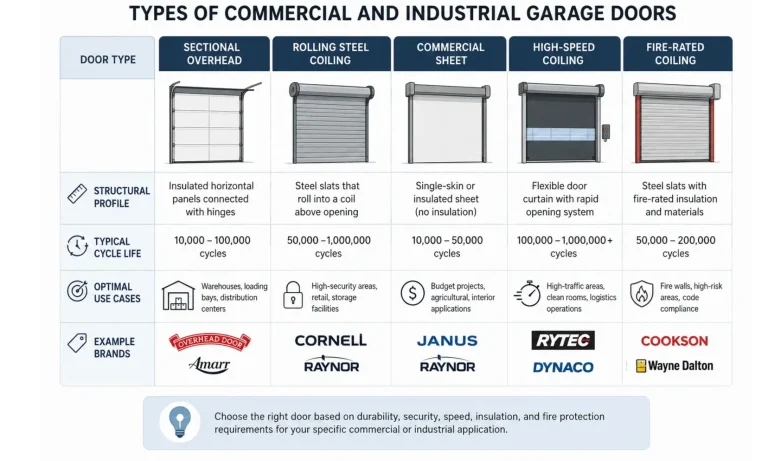
Before analyzing engineering details, look at how the primary commercial door classes compare across core operational metrics.
- 1. Sectional Overhead Doors: Track-guided, horizontal or vertical ceiling storage
- Typical Cycle Life: 10,000 to 50,000 cycles
- Optimal Use Case: Attached warehouse loading bays and service garages
- 2. Rolling Steel / Coiling Doors: Vertical coil, structural guides, interlocking slats
- Typical Cycle Life: 50,000 to 100,000 cycles
- Optimal Use Case: High-security facilities and heavy manufacturing plants
- 3. Commercial Sheet Doors: Light-gauge continuous steel sheet
- Typical Cycle Life: 10,000 to 20,000 cycles
- Optimal Use Case: Self-storage units and light commercial sheds
- 4. High-Speed Coiling Doors: Rapid vertical coiling, automated sensors
- Typical Cycle Life: 300,000 to 1,000,000+ cycles
- Optimal Use Case: Automated logistics and cold storage centers
- 5. Fire-Rated Coiling Doors: Gravity drop-activation, heat and smoke sensors
- Typical Cycle Life: Up to 20,000 cycles
- Optimal Use Case: Interior fire walls, pharmacy counters, and schools
Sectional Overhead vs. Rolling Steel: Headroom & Durability
The core architectural choice comes down to a choosing between sectional and rolling steel doors.
Sectional overhead doors utilize individual panels connected by hinges that retract along tracks parallel to the ceiling. This design provides high insulation capability at a lower initial cost. However, they require significant overhead headroom and track space, leaving tracks and springs vulnerable to forklift damage.
Rolling steel coiling doors consist of interlocking steel slats that roll into a compact coil above the header. This eliminates the need for horizontal track configurations, protecting structural ceiling space for lighting, HVAC, or cranes. Engineered to meet strict DASMA/ANSI structural wind load requirements, rolling steel doors offer high security and structural integrity.
The Thermal Engineering Breakdown - R-Value vs U-Factor & Polyurethane vs Polystyrene
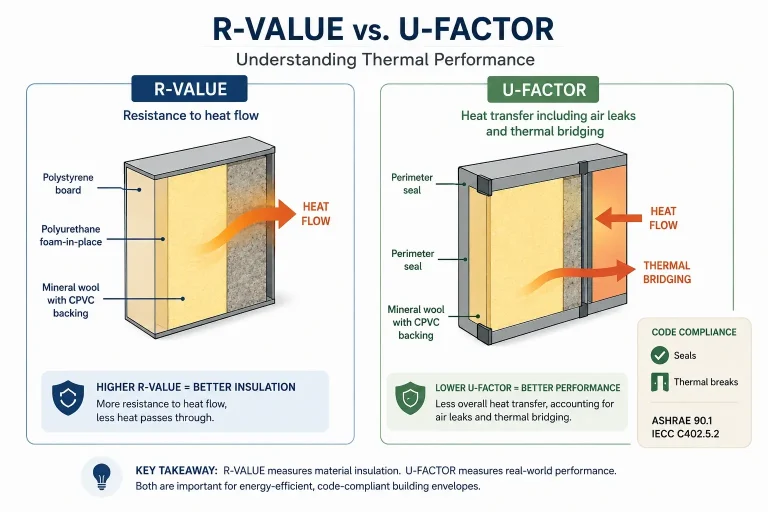
For climate-controlled spaces, thermal efficiency is highly critical. However, marketing materials often obscure true performance metrics.
- R-Value vs. U-Factor: A door’s R-value rating measures only the thermal resistance at the center of a panel. It ignores metal-on-metal tracking and joints, which act as thermal bridges. To comply with ASHRAE 90.1 and IECC C402.5.2, you must verify the entire assembly’s overall U-factor performance. A standard insulated door sits around a 0.90 U-factor, while an elite thermal-break coiling door can achieve a highly efficient 0.53 U-factor.
- Polyurethane vs. Polystyrene: Choosing polystyrene garage door insulation means utilizing pre-cut foam boards (delivering R-4 to R-9) that leave minor air gaps. In contrast, co-injected polyurethane foam expands within the steel panels, yielding a seamless structural bond (delivering R-12 to R-18) that eliminates internal convection currents.
Specialized Industrial Applications
Industrial environments demand highly specialized doors to protect productivity, life safety, and capital equipment.
Warehouse Loading Docks
Modern logistics hubs benefit from optimized roll-up vs sectional loading docks layouts. Sectional dock doors configured with breakaway bottom tracks easily pop back into place if struck by a forklift, preventing costly downtime. Integrating dock levelers and compression dock seals creates an airtight barrier to prevent energy loss during trailer loading.
High-Speed & Cold Storage Operations
For high-traffic clean rooms and refrigerated facilities, open-air time is the primary source of energy loss. Operating at up to 80 inches per second, high speed garage doors systems minimize open-air duration, protect environmental controls, and easily reset automatically if impacted.
Fire-Rated Coiling Doors
To meet building code fire-separation mandates, facilities require a certified fire rated garage door. These automated barriers are engineered to close via gravity when a local alarm triggers or a fusible link melts at 165°F, containing smoke and flames for up to four hours.
Corrosive Industrial Environments
In chemical plants or food-processing facilities, standard steel doors quickly degrade. These demanding environments require specialized configurations featuring zinc-coated bearings, ZRG powder-coated barrels, stainless steel hardware, and NEMA 4X motor operator enclosures to prevent moisture and chemical corrosion.
Total Cost of Ownership (TCO) & Cycle Life Calculation
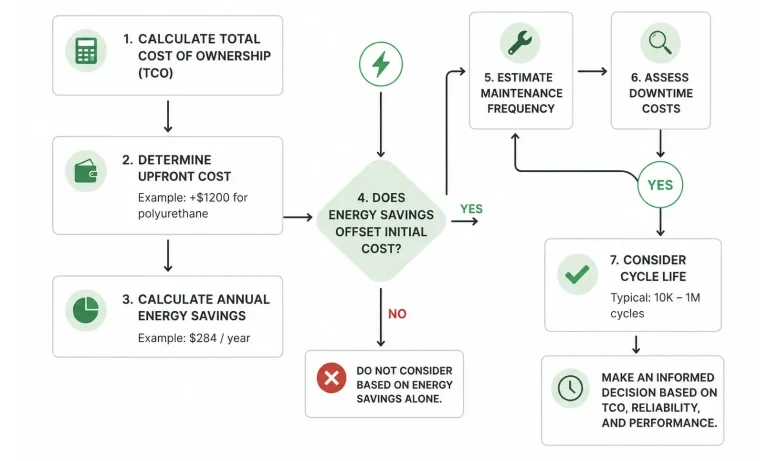
Selecting a door based solely on initial capital expense often leads to higher lifetime costs. Upfront savings are quickly wiped out by emergency repair fees, premature spring failures, and energy waste.
Total Cost of Ownership = Upfront Capital + (Annual Energy Loss x Years) + (Maintenance Costs x Cycles)
Investing in high cycle rolling doors paired with a matching commercial high cycle garage opener extends service intervals from the standard 10,000 cycles to over 100,000 maintenance-free runs. This makes high-performance systems highly cost-effective for high-traffic environments.
Frequently Asked Questions
Why does my high R-value door still feel drafty?
Your door likely suffers from thermal bridging or perimeter air leakage. Air infiltration along the track joints and perimeter seals can completely bypass the center-panel insulation. Ensure you verify the assembly’s overall U-factor.
Do commercial garage doors have to be fire-rated?
Only if they are installed in rated fire walls or partition barriers designed to separate different building occupancies. Standard exterior loading dock openings typically do not require fire ratings, but interior separation paths do.
What is the advantage of polyurethane over polystyrene?
Polyurethane is co-injected as a liquid that expands to fill every internal void. This bonds the steel skins together to create a rigid, highly insulated composite panel. Polystyrene relies on pre-cut sheets that leave air gaps and provide lower thermal resistance.
Strategic Next Steps
Selecting the right commercial door system requires balancing upfront budget constraints, operational traffic patterns, and strict thermal compliance. At Up & Down Garage Doors, our family-driven commitment to honest pricing and professional service ensures your facility remains secure and efficient. Contact our technical team today to configure a code-compliant, high-performance solution for your facility.
You May Also Like

Explore Different Types of Garage Doors
Choosing the right garage door is about making your home more secure and looking better. Finding the one that meets your needs and your home’s style can be overwhelming with so many options. Whether you’re looking…
Published Date: Sep 25, 2024
High-Cycle Commercial Doors for Distribution Centers and Warehouses
That sound you hear isn’t just a truck backing up to the dock. It’s the rhythm of your entire operation. Every time a loading dock door groans open and slowly closes, it’s a beat in that rhythm. But what if that beat…
Published Date: Jun 8, 2026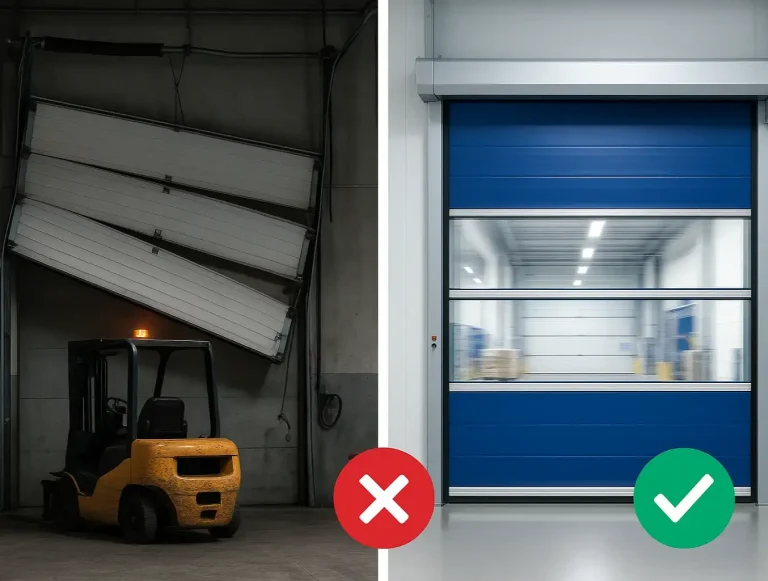
High-Cycle Commercial Garage Doors
It’s 10 a.m. on your busiest day. A forklift loaded with a critical shipment is waiting, but your warehouse’s standard sectional door has ground to a halt—again. A spring snapped, the motor is whining, and operations…
Published Date: May 21, 2026