





Engineering the Threshold: Guide to Emergency Service Garage Door Applications
Published: Jul 14, 2026
For station chiefs, municipal architects, and facility managers, specifying a commercial door is not merely an aesthetic choice. It is a critical operational decision balancing rapid emergency response, facility security, and strict life-safety code compliance.
When emergency vehicles must deploy in seconds, standard door configurations often introduce high-stress failure points. Navigating the complex engineering trade-offs of modern commercial door applications requires analyzing the structural and operational factors involved.
Emergency Service Egress – Horizontal Bifold vs. Overhead Sectional
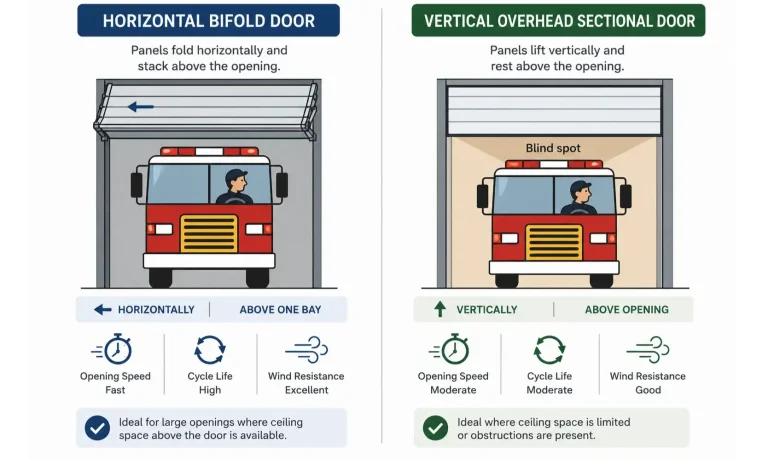
High-frequency, emergency-response environments place extraordinary physical demands on bay doors. Traditional overhead sectional doors average over $3,500 annually per door in maintenance costs due to broken springs, frayed cables, and tracking misalignments. Transitioning to commercial high cycle doors engineered for over 1,000,000 cycles practically eliminates these recurring maintenance expenditures.
Beyond cycle life, opening speed directly impacts response metrics. Standard overhead doors open vertically at 10 to 14 inches per second, meaning the door remains out of the driver’s peripheral sight-line until it is nearly fully retracted. This vertical path increases the risk of “clipping” accidents when trucks exit during high-stress dispatch calls.
In contrast, horizontal bifold doors operate at 24 inches per second—cutting critical egress dispatch times by 50%. Because they fold horizontally, they remain in the driver’s peripheral field of view throughout their entire operation, minimizing collision risks. They also eliminate the “wind-lock” binding risk that can trap traditional rolling steel doors in their tracks during high-wind events.
Overcoming the Retrofit Dilemma
While horizontal bifold doors offer outstanding speed, they are not a universal solution. Retrofitting bifold doors into an existing bay requires significant side-room clearance—typically a minimum of 18 inches on each side. If a facility lacks this lateral space, retrofitting becomes structurally impractical and financially restrictive. Additionally, a minor apparatus collision that deforms a bifold’s structural arm can lock down the entire bay.
For facilities with limited clearances, high-speed rolling steel doors are an excellent alternative. Deciding between a sectional door vs roll-up architecture involves evaluating headroom, side-room, and emergency repairability. If a rolling door is damaged, individual interlocking steel slats can often be field-replaced or manually bypassed quickly, keeping the station operational.
Smart Firehouse Automation & Dispatch Integration
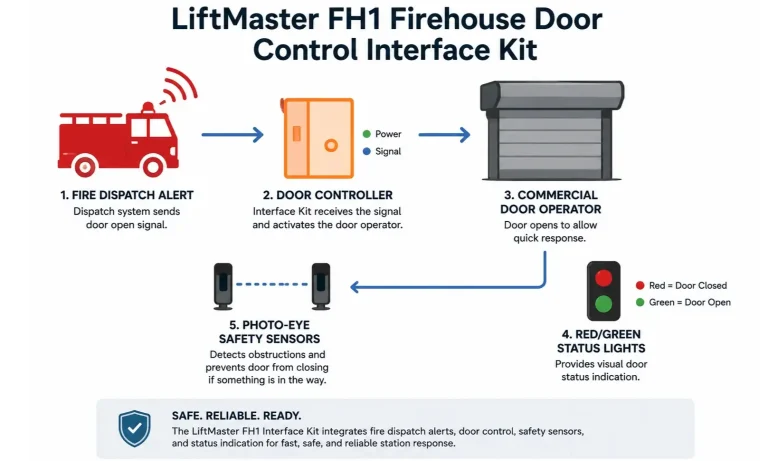
Modern emergency response facilities rely on smart automation to streamline egress. Advanced control systems like the LiftMaster FH1 Firehouse Door Control Interface Kit link the station’s 911 dispatch alerts directly to commercial door operators.
When an alarm triggers, the system automatically opens the bay doors, activates red/green warning lights, and monitors safety sensors. Implementing this requires a highly reliable liftmaster garage door opener remote receiver or hardwired interface compliant with UL 325. This integration ensures that emergency apparatus can deploy instantly without waiting for manual activation.
Hardware Code Compliance & Integrating Institutional Security
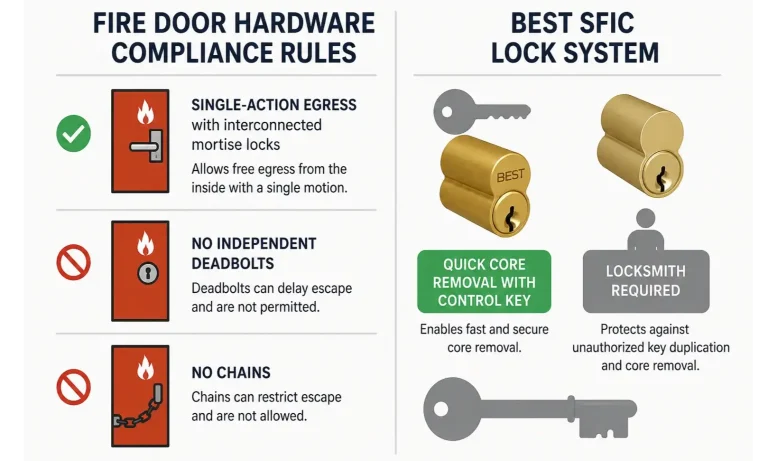
Commercial doors serving fire containment boundaries must comply with rigorous legal frameworks. When evaluating facility designs, architects often ask: do garage doors need to be fire rated? If the door is part of a building’s fire-rated compartment or emergency exit path, the answer is yes.
Under NFPA 101 and IBC Section 1010.2, any door along a means of egress must follow the Single-Action Egress Rule. Occupants must be able to unlock and open the door in a single, continuous motion. This makes independent, non-connected deadbolts illegal on fire doors. For international or UK-based projects, BS 9999 mandates strict six-month inspection intervals and certified self-closing/self-latching devices to maintain active fire containment.
To resolve security and egress compliance simultaneously, commercial entry doors with integrated pass-through wicket doors must support institutional keying. Our doors pre-integrate Small Format Interchangeable Core (SFIC) lock preps, fully compatible with BEST Access Systems mechanical master keys (standard A, B, or C keyways). If security is compromised, a facility manager can swap the core in seconds using a control key, preserving municipal security hierarchies without violating NFPA fire listings.
Tactical Access & Building Resilience
While heavy-duty steel doors keep facilities secure, they must not hinder emergency crews needing rapid entry. Standard commercial doors often force firefighters to use destructive “four-cut” or “box-cut” rescue saw methods, destroying the door panel.
To prevent this, our high-performance doors feature clearly marked external manual-override ports integrated with secure Knox Box systems. This provides non-destructive emergency exterior access commercial doors capabilities, allowing tactical entry without structural destruction. Partnering with a professional commercial door service provider guarantees your heavy-duty doors are installed to meet local life safety, wind-load, and tactical access regulations.
Frequently Asked Questions
Can bifold doors be retrofitted into standard overhead sectional tracks?
No. Bifold doors fold horizontally and require robust side-room structural framing (at least 18 inches) and unique motor configurations, making them incompatible with standard vertical sectional tracks.
Do high-speed doors improve energy efficiency?
Yes. Operating at 24 inches per second minimizes the time a bay remains open, significantly reducing thermal exchange and lowering HVAC costs in conditioned commercial spaces.
How do BEST SFIC cylinders enhance municipal security?
Small Format Interchangeable Cores allow facility managers to rekey an entire building in seconds using a specialized control key, eliminating the need to disassemble lock hardware or hire outside locksmiths.
You May Also Like
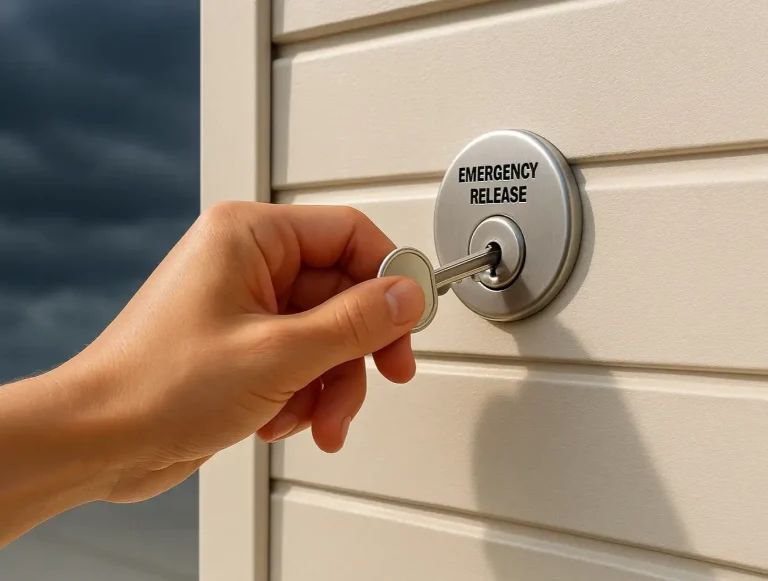
Installing an Exterior Emergency Release Kit for Stuck Garage Door
It’s a scenario we all dread: the power goes out, and your car is trapped inside the garage. The remote is useless, the wall button is dead, and you have no other way in. That feeling of being stuck is frustrating,…
Published Date: May 29, 2026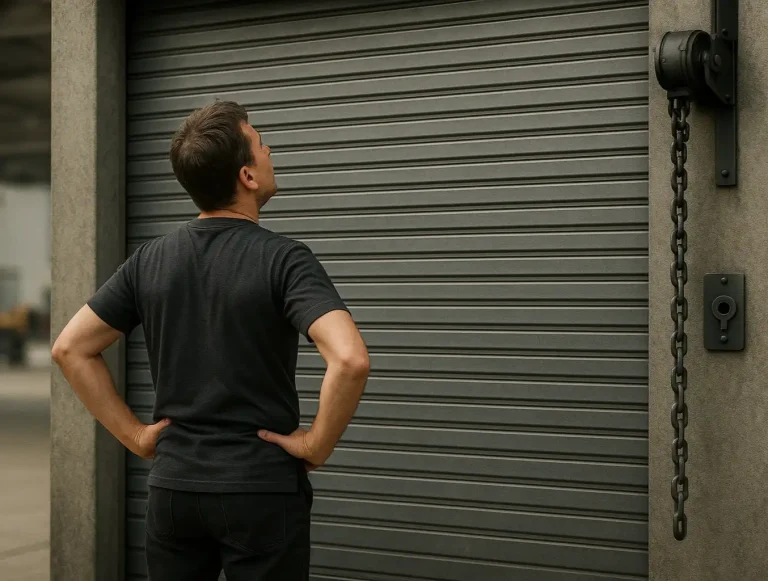
Emergency Exterior Access for Commercial or Rolling Steel Garage Doors
The power is out. Your delivery truck is loaded and needs to leave, but the massive rolling steel door to your warehouse is sealed shut. Or maybe the motor made a grinding noise and now refuses to budge. Panic starts…
Published Date: May 27, 2026
How To Open a Garage Door Without a Remote: Step-by-Step in an Emergency
If you’ve ever been stuck outside your garage during a power outage or lost your remote at the worst possible time, you’re not alone. Knowing how to open a garage door without a remote is a handy skill for any…
Published Date: Oct 24, 2025