





Shelter Integration with Overhead Loading Dock Doors
Published: Jun 4, 2026
That gap between the truck and your loading dock wall? It might look small, but it’s a massive drain on your resources. Every day, it’s leaking heated or cooled air, inviting in rain and pests, and creating potential safety hazards. It’s a hidden problem that quietly costs companies thousands in energy bills, damaged goods, and lost productivity.
Think about it: how much are you paying to heat and cool your entire warehouse, only to have that conditioned air escape through an unsealed dock? It’s like leaving a window wide open all winter.
Before you read on, take 60 seconds for a quick audit of your own loading dock:
Can you see daylight around the edges of a truck when it’s at the dock?
Do employees complain about it being too hot or cold near the loading doors?
Have you ever had products damaged by rain or snow during loading or unloading?
Are there wet, slippery spots on the dock floor after it rains?
If you answered “yes” to any of these, this guide is for you. We’re going to break down how to create a perfect seal at your loading dock, transforming it from a liability into a highly efficient, safe, and secure part of your operation.
Foundation: Seal vs. Shelter — Making the Right First Choice
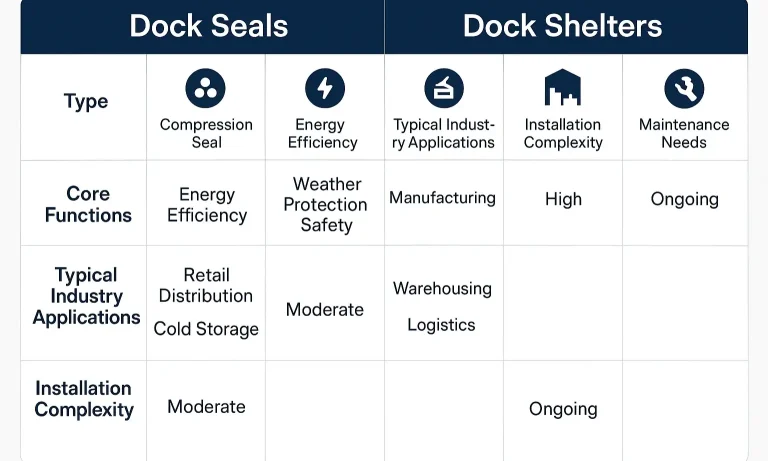
The first step is understanding the two fundamental pieces of equipment designed to bridge that gap: dock seals and dock shelters. People often use the terms interchangeably, but they serve different needs and function in distinct ways.
A dock seal is like a gasket. It’s typically made of foam pads covered in durable fabric that the trailer compresses against when it backs in, creating a tight seal around three sides of the trailer.
A dock shelter, on the other hand, is more like a canopy. It has a rigid or flexible frame that extends out from the building, with curtains that surround the top and sides of the trailer without being fully compressed.
Choosing between them depends entirely on your specific operational needs.
- Choose a SEAL if: You have standardized truck sizes, a high need for climate control, and a level approach to your dock. They offer the tightest seal possible.
- Choose a SHELTER if: You service a wide variety of truck and trailer sizes, require full, unobstructed access to the back of the trailer, or have a sloped driveway.
Building: The 5 Critical Factors for a Perfect Seal
Making the right choice goes deeper than just “seal vs. shelter.” A perfect integration requires a careful look at five critical factors that define your loading dock environment.
Door & Dock Dimensions
Start with the basics. You need precise measurements of your door opening (width and height) and your dock height (from the ground to the dock floor). This determines the fundamental size of the unit you’ll need. Many facilities are equipped with sectional garage doors which have specific clearance requirements.
Truck & Trailer Variety
Do you only service your own fleet of identical 53-foot trailers? Or do you get everything from small delivery vans to oversized rigs? A standard compression seal works great for a uniform fleet but will get destroyed by varied truck heights. A shelter offers the flexibility to accommodate a wider range of vehicles.
Traffic Volume
A high-traffic dock with dozens of trucks a day needs more durable equipment than a dock that sees one truck a week. Look for features like high-strength vinyl (40oz vs. standard 22oz), wear-pleats on the side pads, and heavy-duty framing to ensure a long service life.
Climate & Environment
Is your facility in Arizona or Upstate New York? The answer drastically changes your needs. In cold, wet climates, you’ll want features like snow-load support, rain-guarding headers, and durable fabrics that won’t crack in the cold. A well-sealed and insulated dock is essential for facilities with garage doors that can withstand extreme weather.
The Dock Approach Angle: The #1 Most Overlooked Factor
This is, without a doubt, the most critical and most frequently ignored factor in dock seal specification—and it’s the primary reason for premature equipment failure.
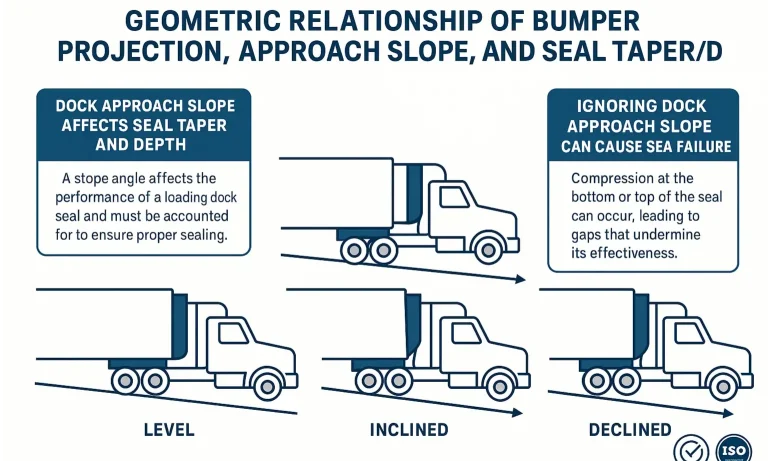
The “dock approach” is the slope of the driveway leading up to your loading dock. If the driveway declines (slopes away from the building), the top of the trailer will lean in and crush the head pad of a standard seal. If it inclines (slopes toward the building), the bottom of the trailer will hit the wall before the top makes contact, leaving a huge gap.
Ignoring a sloped approach is a recipe for disaster. A standard 10-inch projection foam seal on a 2% decline will be destroyed in a matter of weeks. The solution involves specifying seals with tapered side pads, extended bumper projections, or choosing a shelter-style unit that isn’t subject to the same compression forces. Always measure your approach angle before ordering equipment.
Mastery: A Deep Dive into Seal & Shelter Technology
Once you’ve assessed your five critical factors, you can dive into the specific types of equipment available. Each is engineered to solve a different set of problems.
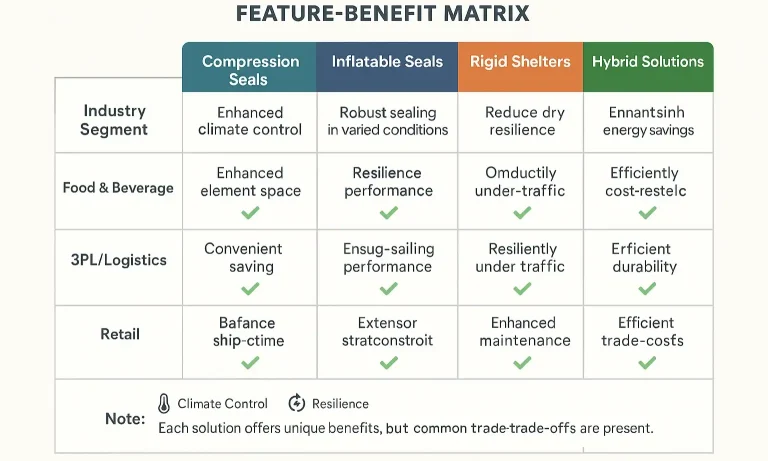
Compression Seals: The classic foam pads.
Pros: Excellent seal, cost-effective, great for climate control.
Cons: Prone to wear and tear, not suitable for varied truck sizes or sloped approaches.
Inflatable Shelters: An airbag-like system that inflates around the trailer after it docks.
Pros: The most complete and versatile seal, accommodates a huge range of truck sizes, retracts when not in use to avoid damage.
Cons: Higher initial cost, requires a power source and more maintenance.
Rigid Shelters: A rigid-sided frame (wood or steel) with fabric curtains.
Pros: Very durable, allows full trailer access, long-lasting.
Cons: Can be damaged by off-center trucks, doesn’t provide as tight a seal as foam or inflatables.
Hybrid Designs: These combine elements, like a shelter with foam side pads, to offer a balance of sealing, access, and durability.
The right technology is often dictated by your industry’s specific demands.
For example, a food-grade cold storage facility must prioritize climate control to maintain the cold chain, making an inflatable shelter the superior investment. A high-volume distribution center, however, may prioritize the durability of a rigid shelter to withstand constant use.
Action: Your Implementation & Maintenance Toolkit
Selecting the right equipment is only half the battle. Proper installation and ongoing maintenance are crucial for maximizing its lifespan and effectiveness. A well-maintained dock system, including the overhead door, is key to operational success. Incorporating a routine of commercial door preventative maintenance ensures all components work together seamlessly.
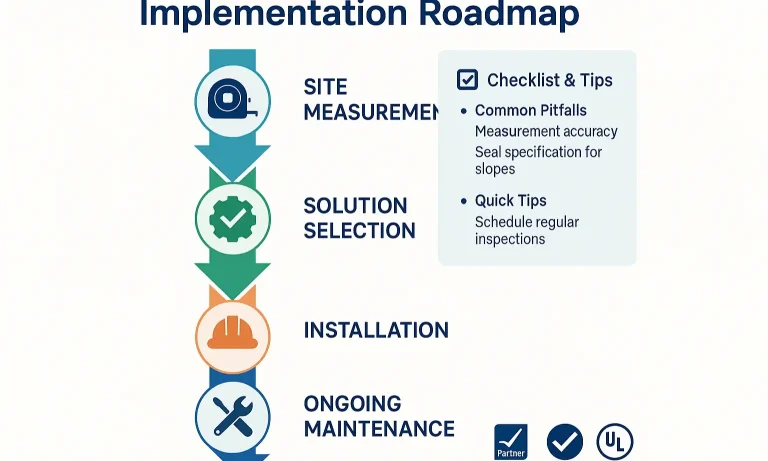
Here’s a simple roadmap to follow:
- Measure Twice, Order Once: Use a detailed worksheet to record your door size, dock height, bumper projection, and—most importantly—the approach angle. Inaccuracy here is a costly mistake.
- Ensure Professional Installation: Proper installation is not a DIY job. An installer will ensure the unit is mounted securely, sealed to the building wall, and positioned correctly relative to the dock bumpers.
- Train Your Staff: Educate both your dock crew and truck drivers on how to properly approach the dock to avoid damaging the equipment. Simple things like backing in slowly and squarely make a huge difference.
- Schedule Regular Inspections: At least twice a year, inspect your seals or shelters for tears, worn fabric, and loose hardware. Catching small issues early prevents them from becoming major problems.
Frequently Asked Questions (FAQ)
What is the main difference between a dock seal and a dock shelter?
A dock seal uses compression pads that the truck presses against to create a tight, gasket-like seal. A dock shelter is a larger, non-compressive frame with curtains that surrounds the trailer opening. Seals offer a tighter seal, while shelters offer more flexibility for different truck sizes.
Why is the head pad on my dock seal getting damaged?
This is almost always caused by a declined driveway approach. As the truck backs in, the top of the trailer pitches forward and over-compresses the top pad, causing it to tear or shear off. You likely need a seal designed for a decline, such as one with a tapered design or a drop-head curtain.
What vinyl weight should I choose? 22oz, 40oz, or higher?
It depends on your traffic volume. For a low-traffic dock (1-5 trucks/day), standard 22oz vinyl is often sufficient. For a medium-to-high traffic dock, upgrading to 40oz vinyl provides significantly more abrasion and tear resistance, extending the life of the unit. Some manufacturers offer even higher-strength materials for extreme-use environments.
Can I install a dock seal on an insulated metal building?
Yes, but it requires special consideration. You cannot simply anchor the unit to the sheet metal. Proper installation requires adding structural support tubes or brackets that tie back to the building’s steel frame to handle the compression forces from the trailer.
Your Dock Is Your Gateway
Your loading dock isn’t just a door—it’s the critical intersection of your building and your supply chain. By properly integrating your overhead doors with the right seals and shelters, you do more than just stop the rain. You protect your products, reduce your energy consumption, and create a safer, more productive environment for your team.
Start by taking a fresh look at your dock today. That small gap holds a big opportunity for improvement.
You May Also Like
Activating Commercial Garage Doors
Imagine a busy warehouse. Every day, dozens of trucks arrive and depart. Each time, the driver has to stop, get out, walk to a wall-mounted button, wait for the massive door to open, get back in the truck, and drive…
Published Date: Jun 3, 2026
Emergency Exterior Access for Commercial or Rolling Steel Garage Doors
The power is out. Your delivery truck is loaded and needs to leave, but the massive rolling steel door to your warehouse is sealed shut. Or maybe the motor made a grinding noise and now refuses to budge. Panic starts…
Published Date: May 27, 2026
High-Cycle Commercial Garage Doors
It’s 10 a.m. on your busiest day. A forklift loaded with a critical shipment is waiting, but your warehouse’s standard sectional door has ground to a halt—again. A spring snapped, the motor is whining, and operations…
Published Date: May 21, 2026