





The Surprising Science: Why Garage Springs Break in Texas Heat vs. Connecticut Winters
Published: Jul 17, 2026
You’ve probably heard it before—that loud, startling bang from the garage that sounds like a firecracker went off. It’s the classic sign of a broken garage door spring, and for decades, the common wisdom has been that frigid winter weather is the main culprit.
If you live in Connecticut, you nod along, chalking it up to another casualty of a harsh New England winter. But what if you’re in Texas, where the blistering summer sun is the real enemy? It feels counter-intuitive, but that sweltering heat may be just as punishing—if not more so—to the very same steel components.
The truth is, both extreme cold and extreme heat attack your garage door springs, but they do it in remarkably different ways. This isn’t just a homeowner’s headache; it’s a fascinating tale of physics, metal fatigue, and climate. Let’s break down the science behind why springs fail, whether you’re in Dallas or Danbury.
The Unsung Hero of Your Garage: A Quick Look at the Torsion Spring
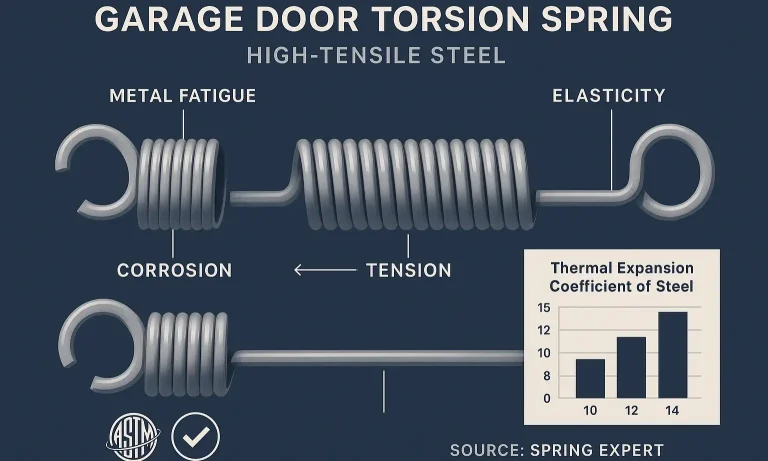
Before we dive into the climate wars, let’s get acquainted with the component at the center of it all: the torsion spring. This tightly wound coil of high-tensile steel sits above your garage door, and its job is simple but crucial: it acts as a counterbalance, making your several-hundred-pound garage door feel light enough to lift with one hand (or with the help of a small motor).
Think of it as a battery that stores mechanical energy. When the door closes, the spring winds up, storing tension. When the door opens, it unwinds, releasing that energy to do the heavy lifting. This elegant system, however, has two primary enemies that work tirelessly to bring it down:
- Stress Cycles: The simple act of opening and closing your door, day after day.
- Corrosion: The slow, creeping decay caused by moisture.
Understanding how does a garage door spring work is the first step in protecting it. Climate supercharges both of these enemies, dramatically shortening a spring’s lifespan.
A Tale of Two Climates: How Your Location Wages War on Steel
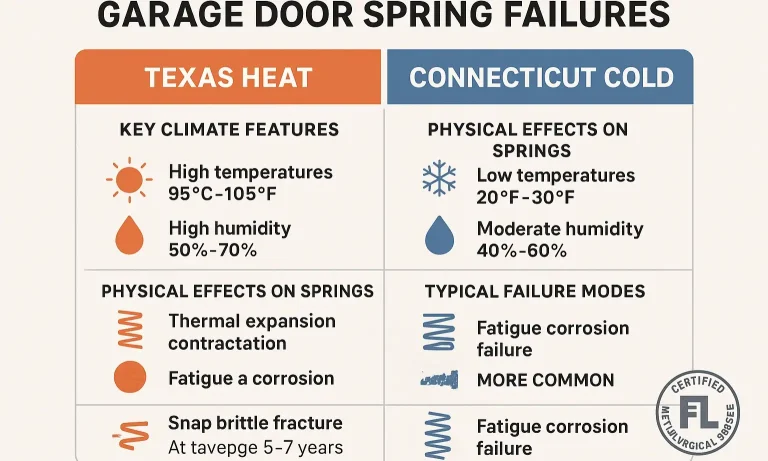
Your local weather report is also a forecast for your garage door springs. Here’s how the two extremes—a Connecticut winter and a Texas summer—launch their unique attacks.
Case #1: The Connecticut Winter – The Brittle Snap
This is the scenario most people are familiar with. As temperatures plummet, the steel molecules in your torsion spring contract, tightening the coil and increasing its overall tension.
But something else is happening on a microscopic level. The extreme cold makes the high-tensile steel less ductile—in other words, more brittle. It loses its ability to flex and absorb stress.
Imagine a frozen rubber band. Instead of stretching, it’s more likely to snap. Your torsion spring faces a similar fate. It’s now under higher tension and more fragile than ever. The immense force required to lift a heavy, possibly frozen-shut garage door is often the final straw, causing a sudden, explosive failure. This is why a broken garage door spring is such a common call during the first deep freeze of the year.
Case #2: The Texas Summer – The Slow Burn of Fatigue
In Texas, the enemy isn’t a single, brutal cold snap; it’s a relentless cycle of expansion and contraction, accelerated by a secret accomplice: humidity.
Here’s the real “aha moment”: it’s not just the peak 100°F heat that does the damage. It’s the daily temperature swing.
- Thermal Cycling: During a hot Texas day, the spring expands as the metal heats up. At night, as temperatures drop into the 70s, it contracts again. This daily expansion-contraction cycle is a classic case of metal fatigue. Think of bending a paperclip back and forth. It doesn’t break on the first or second bend, but repeat the cycle enough times, and it will eventually snap. Your spring is enduring a low-grade version of this every single day of a long, hot summer.
- Humidity as the X-Factor: A hot Texas garage is often a humid one. This moisture is an engraved invitation for rust to form on the spring’s surface. Rust isn’t just a cosmetic issue; it creates microscopic pits in the steel. These tiny pits become stress concentrators—weak points where fractures are most likely to begin. As the spring flexes through its daily thermal cycle, these tiny cracks slowly grow, until the metal can no longer handle the load.
Unlike the sudden snap of winter, a summer failure is a slow burn—a death by a thousand cuts from heat, cycling, and corrosion. And if you don’t know how to remove rust from a garage door and its components, you might be overlooking a major warning sign.
The Unifying Theory of Spring Failure
So, who wins the battle of the climates? Neither. They both lead to the same result through different paths. The key is to understand the specific threat your climate poses.
| Climate Factor | The Connecticut Winter | The Texas Summer |
|---|---|---|
| Primary Attacker | Extreme Cold | Heat & Humidity |
| Mechanism of Failure | Metal Contraction & Brittleness | Thermal Cycling & Corrosion |
| Type of Break | Sudden, Catastrophic Snap | Gradual Fatigue Failure |
| Key Analogy | A frozen rubber band snapping | A paperclip bent until it breaks |
| Warning Signs | Few; failure is often sudden | Visible rust, groaning sounds during operation |
Climate-Specific Prevention for Your Garage Door
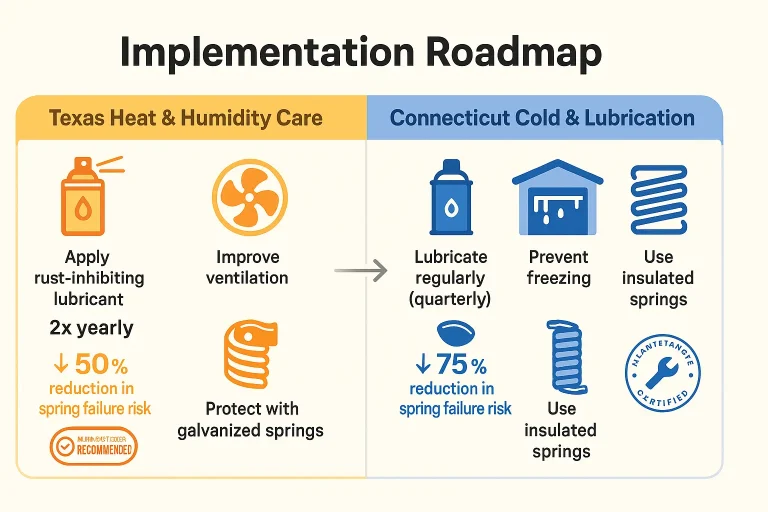
You can’t change the weather, but you can absolutely change how you prepare for it. Proper garage door spring maintenance isn’t one-size-fits-all; it should be tailored to your environment.
For the Connecticut Homeowner (Fighting the Freeze)
Your goal is to combat brittleness and prevent moisture from causing problems.
- Lubricate Before Winter: Apply a high-quality, silicone-based garage door lubricant to the springs before the first freeze. This repels moisture that could otherwise freeze between the coils, causing them to bind and adding stress.
- Listen Closely: Pay attention to any new groaning or creaking sounds during cold weather. These can indicate that the spring is under extreme strain.
- Check the Balance: If you disconnect the opener, can you lift the door easily? If it feels heavy, the springs are losing their power and are at higher risk of failure.
For the Texas Homeowner (Beating the Heat & Humidity)
Your focus should be on fighting rust and mitigating the effects of humidity.
- Use a Rust-Inhibiting Lubricant: Choose a lubricant specifically designed to prevent corrosion. Regular lubrication is one of the most important aspects of garage door maintenance, and in a humid climate, it’s non-negotiable.
- Improve Garage Ventilation: Reducing the humidity inside your garage can significantly slow down the rate of corrosion. Consider adding a dehumidifier or improving passive ventilation.
- Upgrade Your Springs: When it’s time for a replacement, ask a professional about galvanized or powder-coated torsion springs. These are designed to offer superior resistance to rust and are an excellent investment in hot, humid climates.
No matter your climate, skipping routine maintenance can lead to severe mechanical wear, making it critical to understand the connection between proper garage door lubrication and home security.
Frequently Asked Questions About Garage Door Springs & Climate
What’s the average lifespan of a garage door spring?
Most standard torsion springs are rated for about 10,000 cycles (one cycle is one full opening and closing). For the average family, this translates to about 7-10 years. However, as we’ve seen, extreme climates can significantly shorten this lifespan.
Can I replace a broken garage door spring myself?
This is strongly discouraged for homeowners. Torsion springs are under extreme tension, and attempting to replace one without the proper tools and training can result in severe injury. This is a job best left to trained professionals.
Why do the springs on my garage door keep breaking?
If you’re replacing springs every few years, it could be due to several factors: an improperly balanced or heavy door, low-quality springs, or the intense climate-related stress discussed in this article.
Does summer heat affect springs as much as winter cold?
Yes, absolutely. While a winter snap causes a dramatic, sudden failure, the slow, grinding fatigue from summer’s thermal cycling and humidity is just as effective at destroying a spring over time.
Your Next Step to a Healthier Garage Door
Your garage door is more than just a moving wall; it’s a complex system that’s constantly interacting with its environment. By understanding whether your biggest enemy is a brittle snap or a slow burn, you can move from reacting to a broken spring to proactively extending its life.
The first step is awareness. The next is taking small, consistent maintenance steps that are right for your climate. Your garage door will thank you for it.
You May Also Like
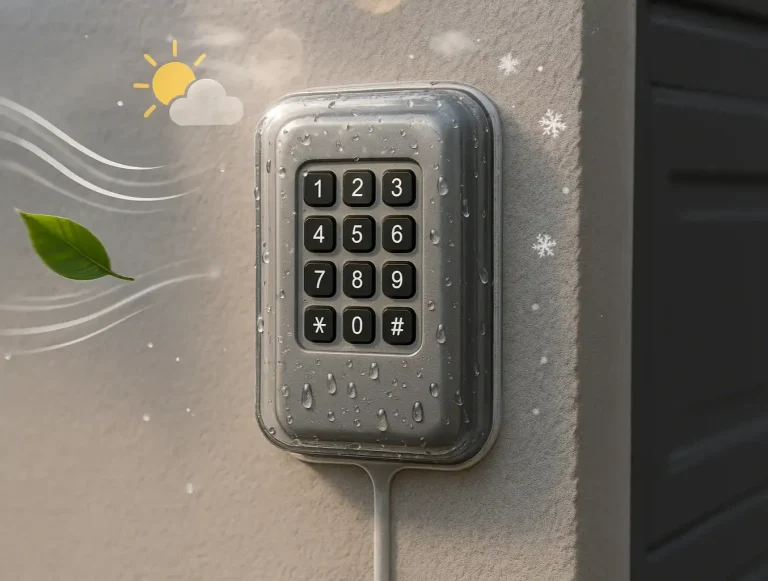
Weatherproofing Your Outdoor Garage Door Keypad
It’s one of those moments that can ruin a morning. You’re rushing out the door, coffee in hand, tapping your code into the garage door keypad… and nothing happens. You try again. Still nothing. The rain starts to…
Published Date: Jun 24, 2026
Why Your Garage Door Remote Range Decreases in Cold Weather
It’s one of the most frustrating moments of winter: you pull up to your home, shivering, and press the garage door remote. Nothing happens. You press it again, holding it closer to the windshield. Still nothing.…
Published Date: Apr 24, 2026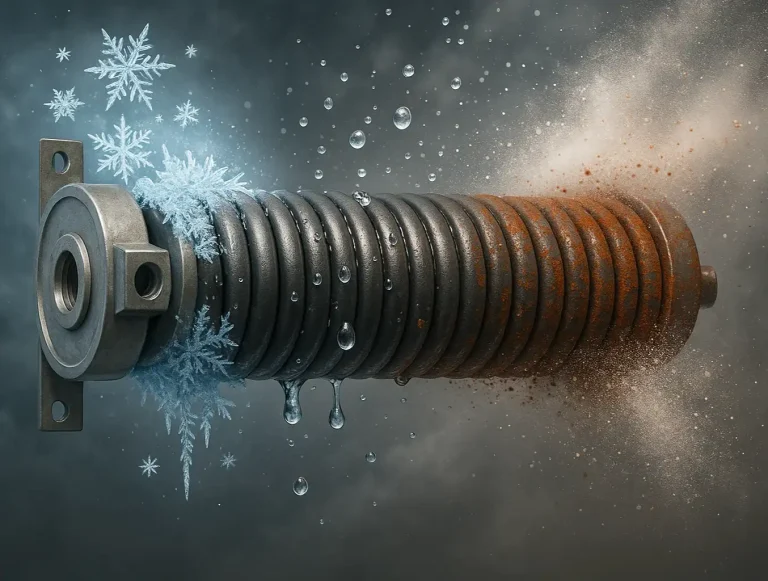
Garage Door Spring Maintenance in Extreme Weather
Think of your garage door springs as a ticking clock. With every cycle, they wind and unwind under immense tension, lifting hundreds of pounds of weight. But here’s something most homeowners don’t realize: the…
Published Date: Apr 9, 2026