





Space-Saving Insulation Solutions for Garage Doors in Compact
Published: Jun 26, 2026
You’ve meticulously designed your compact, energy-efficient home. Every square foot is optimized, every window is triple-paned, and your walls have the perfect thermal envelope. But there’s a giant, uninsulated hole in your design that’s silently sabotaging your efforts: your garage door.
In a smaller home—be it a modern townhouse, an ADU, or a tiny house—the garage isn’t just a place for cars. It’s often a workshop, a gym, or a storage area directly adjacent to your living space. An uninsulated door can make these areas unusable in extreme weather and bleed energy from your home.
The problem? Most insulation advice you’ll find is for large, spacious garages where adding a two-inch thick foam panel is no big deal. For you, every inch of clearance matters, and every added pound puts strain on your system. This guide is different. It’s for those who need maximum thermal performance with minimal bulk.
Foundation: More Than Just R-Value - Understanding the Garage Door "System"
Before we talk about materials, let’s have a quick coffee-chat about the science. Most guides throw around the term “R-value,” which is simply a measure of how well a material resists heat flow. Think of it like the TOG rating on a duvet—a higher number means better insulation.
But in a compact space, focusing only on R-value is a mistake. We need to consider the entire garage door “system,” which involves three key elements:
- Insulation (R-Value): The material that does the heavy lifting of blocking heat transfer.
- Air Sealing: The process of eliminating drafts and gaps around the door panels and perimeter. A high R-value is useless if cold air is just blowing in around the edges.
- Thermal Bridging: Preventing heat from traveling through the metal parts of the door itself.
The goal is to find a solution that balances high R-value with low thickness and weight, all while ensuring the system is completely sealed.
Building: Choosing Your Materials - A Guide for Low-Profile Performance
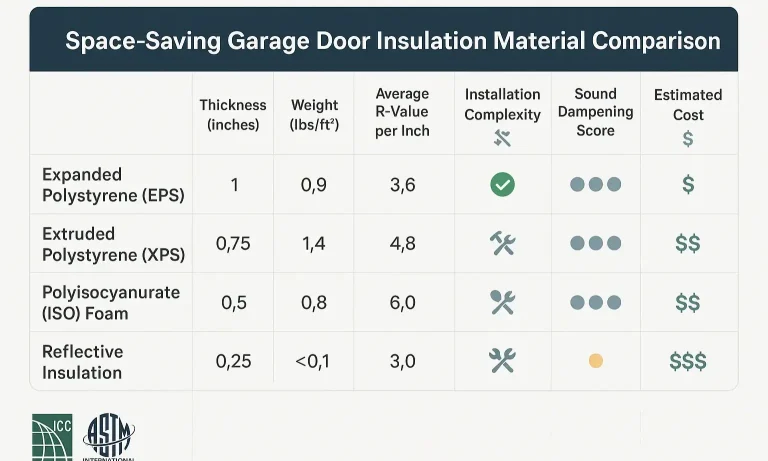
Standard insulation kits are often bulky. For compact homes, we need to be more strategic. Here’s a breakdown of the best low-profile options, rated on the factors that matter most to you.
1. Expanded Polystyrene (EPS) Foam Panels
This is the lightweight, white foam you often see in packaging. It’s an affordable and effective choice for many DIYers.
- Thickness & Weight: Typically 1 to 2 inches thick. Very lightweight, adding minimal stress to your door opener.
- R-Value: Around R-3.8 per inch. A 1.5-inch panel will give you about an R-6.
- Sound Dampening: Good. It significantly reduces noise from wind, rain, and street traffic.
- Best For: Budget-conscious homeowners who need a solid thermal and acoustic upgrade without much complexity. For a deeper dive, explore the pros and cons of polystyrene garage door insulation.
2. Extruded Polystyrene (XPS) Foam Panels
XPS is denser and more rigid than EPS, often colored pink, blue, or green. It offers better performance in a slightly thinner profile.
- Thickness & Weight: Can achieve higher R-values at 1 to 1.5-inch thicknesses. Slightly heavier than EPS but still very manageable.
- R-Value: Around R-5 per inch. A 1.5-inch panel delivers a respectable R-7.5.
- Sound Dampening: Very good, due to its denser structure.
- Best For: Those who can spare about 1.5 inches of clearance and want a step up in thermal performance and durability.
- Thickness & Weight: The thinnest option for a given R-value, often around 1 inch. It remains lightweight.
- R-Value: Excellent, ranging from R-6.5 to R-7 per inch. The foil facing also acts as a radiant barrier, reflecting heat.
- Sound Dampening: Excellent.
- Best For: Homeowners with minimal clearance who demand the highest thermal performance. It’s the premium space-saving choice.
3. Polyisocyanurate (ISO) Rigid Foam
Often foil-faced, “Polyiso” is a high-performance foam that packs the most insulating power into the slimmest profile.
4. Reflective (Radiant Barrier) Insulation
This looks like a roll of metallic bubble wrap. It doesn’t work by resisting heat flow (R-value) but by reflecting radiant heat. This is a critical distinction.
Thickness & Weight: The thinnest and lightest option by far (less than half an inch).
R-Value: Its effectiveness depends entirely on a proper air gap (see next section). Without it, the value is minimal. With it, it can perform like an R-4 to R-8 material.
Sound Dampening: Minimal.
Best For: Hot, sunny climates where the primary goal is to reflect solar heat out. It’s less effective at keeping heat in during cold winters compared to foam.
Mastery: The "Good, Better, Best" Solutions for Compact Garages
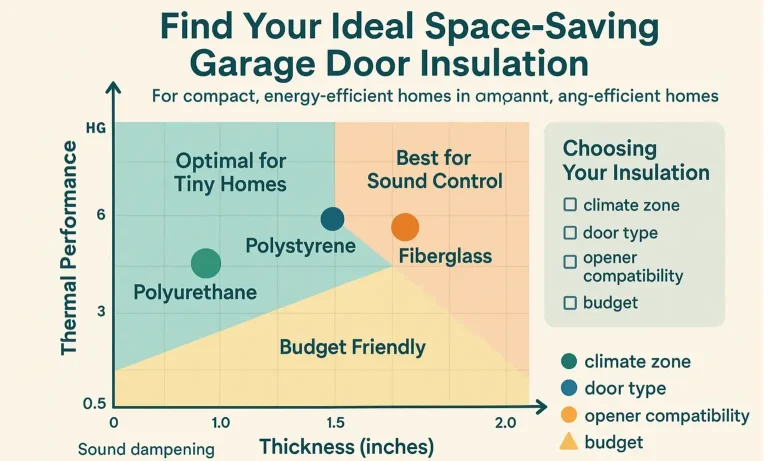
Choosing the right material is only half the battle. Creating a truly effective system requires a thoughtful approach.
Good: A Basic DIY Kit
A pre-cut garage door insulation kit using EPS or reflective insulation is a great starting point.
- Process: Cut panels to size, secure them in the door’s channel, and you’re done.
- The Catch: This method leaves small gaps between the panels and the door’s metal frame, allowing air to leak and reducing overall effectiveness.
Better: Foam Panels + Air Sealing
This approach combines a rigid foam (EPS or XPS) with meticulous air sealing.
- Process: After installing the foam panels, use weather-resistant foil tape to seal all four edges of each panel to the metal frame.
- The “Aha!” Moment: This simple step stops air movement behind the panels, dramatically boosting the insulation’s real-world performance. It addresses thermal bridging and makes the entire system more robust.
- Process: Use foil-faced Polyiso panels, carefully taped at the seams. Then, upgrade the door’s perimeter seals. The importance of garage door weather stripping cannot be overstated; it ensures a tight seal when the door is closed.
- The Result: You get the highest R-value in the slimmest profile, a radiant barrier, and a virtually airtight seal. This approach transforms your garage door from a liability into a high-performance component of your home’s thermal envelope.
Best: ISO Panels + Total Weatherization
This is the ultimate solution for an energy-efficient compact home.
A Critical Note on Reflective Insulation and the Air Gap:
For reflective insulation to work, it needs an air gap of about 3/4 inch between the foil surface and the garage door panel. This gap allows heat to radiate and be reflected. Without it, the heat simply conducts through the material, and its insulating properties plummet.
Action: Installation & Safety - From DIY Kit to Custom Fit
Before you start any project, safety and functionality come first. Adding insulation adds weight to your garage door, and if you’re not careful, it can cause serious problems.
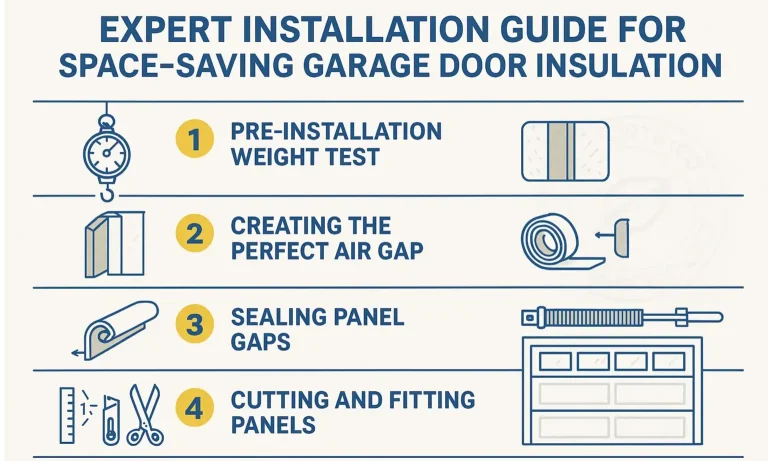
The Pre-Installation Weight Test
This simple check can save you a huge headache.
- Disconnect the Opener: Pull the red emergency release cord on your garage door opener to disengage it from the door.
- Manually Lift the Door: Lift the door by hand to about waist height.
- Let Go (Carefully): A well-balanced door should stay in place or move very slowly up or down.
- Observe: If the door slams down or shoots up, your springs are already out of balance and should be adjusted by a professional before you add any weight.
- If the door now drifts downward or feels significantly heavier to lift, the added weight has unbalanced the system.
- WARNING: Do NOT attempt to adjust garage door springs yourself. They are under extreme tension and can cause severe injury. This is a job for a qualified technician who can re-tension the springs to account for the new weight.
The Post-Installation Balance Check
After you’ve installed your insulation, repeat the weight test.
Frequently Asked Questions
Does garage door insulation actually work?
Absolutely. A properly insulated and sealed garage door stabilizes the temperature of the garage, reduces energy bills (especially if you have a room above it), and provides significant sound dampening. The many garage door insulation benefits make it one of the most cost-effective home upgrades.
How can I tell if my garage door is already insulated?
Look at the interior of your door. If you see the backside of the exterior metal shell, it’s not insulated. Insulated doors have a backing—often made of vinyl or steel—that encloses the insulation material, creating a clean, finished look.
What is the best R-value for my climate zone?
- Hot Climates: An R-value of 6 to 9 is often sufficient, and radiant barriers are highly effective.
- Mixed Climates: Aim for an R-value between 9 and 13.
- Cold Climates: The higher, the better. An R-value of 13+ will provide the best defense against heat loss.
Your Next Step to a More Efficient Home
Insulating your garage door is more than just a DIY project; it’s a crucial step in completing the energy-efficient ecosystem of your compact home. By choosing a low-profile material and focusing on a complete “system” of insulation and air sealing, you can gain comfort and efficiency without sacrificing precious space.
If you’re exploring other ways to optimize your garage, consider investigating different types of space saving garage doors that are designed from the ground up for compact living. And if you’re not sure how to seal a garage door or feel unsure about checking your door’s balance, our team of professionals is always here to help ensure your project is done safely and effectively.
You May Also Like
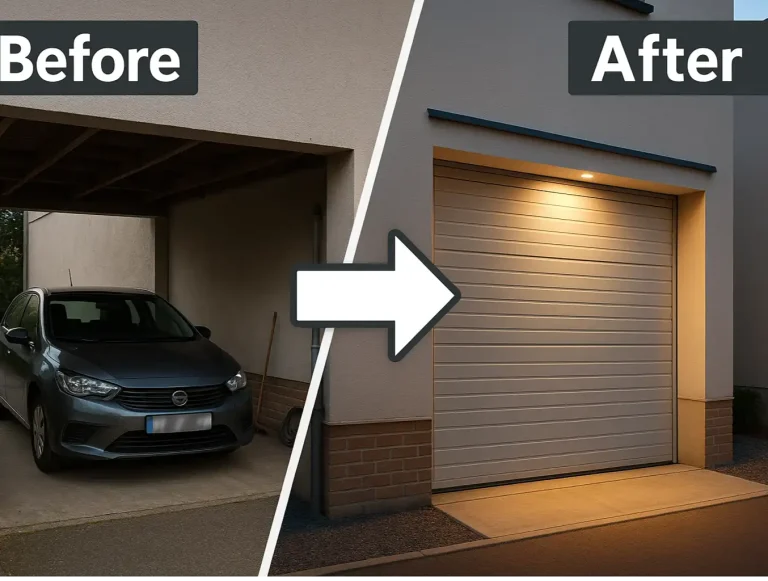
Converting Carports to Garages in Small Footprint Properties
You look at that carport every day. It does a decent job of keeping frost off the windshield and the worst of the rain off your car, but you can't help but dream of what it could be. A secure, fully-enclosed garage.…
Published Date: Jun 25, 2026
The Best Garage Door Solutions for Small Spaces and Compact Homes
The trend towards smaller homes is becoming increasingly common, but that doesn’t mean you have to sacrifice function or style. With thoughtful planning and the right garage door installation choices, you can have an…
Published Date: Jun 6, 2025
Securing Narrow or Street-Facing Garage Doors
Living in the city has its perks—the energy, the convenience, the walkability. But when your garage door opens directly onto a busy sidewalk or a narrow alley, that convenience can feel like a vulnerability. You've…
Published Date: Jun 24, 2026