




Optimizing Commercial Door Operator Maintenance: Keeping Heavy Doors Cycling
Published: Oct 2, 2026
For facility managers and operations directors, a stalled overhead door is more than an inconvenience—it is a bottleneck that halts logistics, compromises climate control, and creates immediate safety liabilities. When heavy industrial doors stop cycling, the primary suspect is often the motor. However, keeping these high-use systems running reliably requires understanding how the mechanical door, electrical control systems, and operator interface under immense structural loads.
By taking a systematic, preventive approach to your operator systems, you can avoid costly emergency dispatch fees and protect your facility from unexpected operational downtime.
Decoupling the Operator from the Door: The Balance Test
To ensure the long-term reliability of your commercial garage door openers, you must first understand a fundamental mechanical truth: the operator is designed to guide and control movement, not bear the dead weight of the door. The counterbalance springs are engineered to do the heavy lifting.
When a door becomes a garage door unbalanced, the operator motor is forced to pull against excessive, unintended resistance. For instance, a single seized roller in a heavy sectional door track adds 30 to 50 lbs of rotational drag to the system. Across a standard 10-roller industrial door, this drag creates an extra 150 to 250 lbs of resistance. This instantly overloads standard-duty motors and can shorten winding life by up to 70%.
To determine where the problem lies, perform a manual Balance Test: pull the operator emergency release cord and manually cycle the door halfway. If the door drifts downward or flies upward, the springs require immediate, certified tensioning.
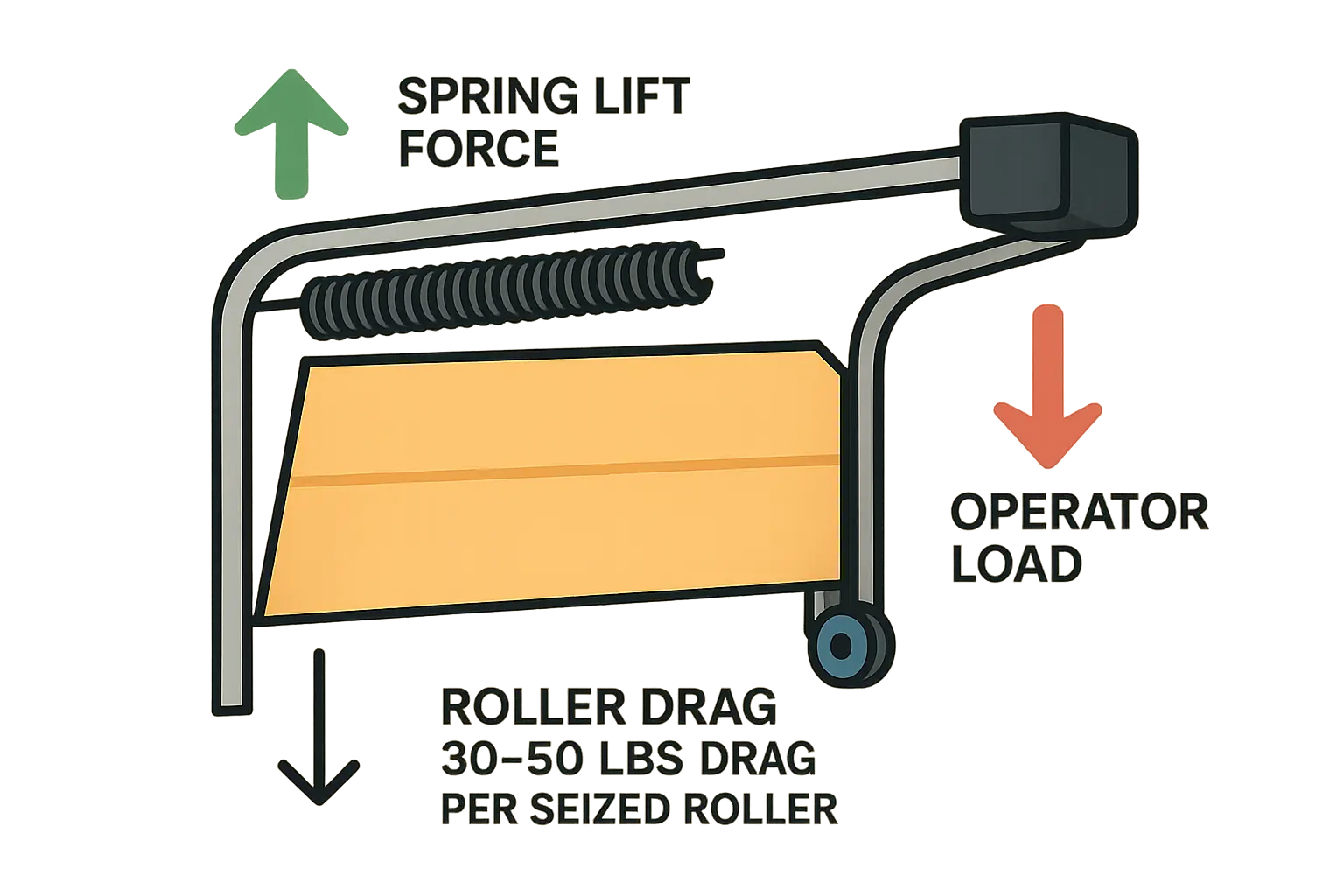 This diagram clarifies the critical concept that the door’s springs bear the lifting load, not the operator motor, explaining why seized rollers adding 30-50 lbs of drag dramatically overload operators and shorten their lifespan.
The 9-Point Commercial Operator PM Protocol
To prevent unexpected garage door opener has power but not working issues, facility teams should implement a comprehensive commercial garage door maintenance strategy built around precise mechanical tolerances:
- Limits and Travel Calibration: Calibrate and monitor limit limits on advanced logic boards (such as LiftMaster Logic 5.0 or Manaras ECB 070) to prevent the door from slamming into structural stops.
- Entrapment Protection & Reversing Speeds: Test photo-eyes and bottom safety edges. They must trigger a complete reverse action within 2 inches of making contact with an obstruction.
- Torque Clutch Calibration: Ensure the operator’s mechanical clutch is calibrated to a breakaway torque of 15 to 25 ft-lbs using a torque wrench. Clutches that are set too tight will burn out motor windings during an obstruction.
- Brake Solenoid Air Gap Alignment: Solenoid brakes require a precise friction disc air gap of 0.3 to 0.5 mm (0.012 to 0.020 inches) to prevent drag, which overheats motors.
- Electrical Under-Load Voltage Test: Measure voltage at the operator disconnect while running. A voltage drop exceeding 5% indicates weak supply wiring or failing control relays.
- Relay Control Circuits: Confirm the transformer consistently delivers stable 24 VAC power. Low voltage causes relay chatter and intermittent faults.
- Cycle Counter Forensic Analysis: Read the digital cycle counters on your operator logic boards. Sudden spikes can point to looping errors or stuck exit loop sensors.
- Lubrication Boundaries: Lubricate drive chains and trolley tracks. Never allow grease or oil to contact clutch friction discs or solenoid brake cores.
- Safety Signage & Compliance Audit: Confirm that safety warnings and emergency manual release instructions are clearly visible, meeting UL 325 and ADA Section 404 requirements.
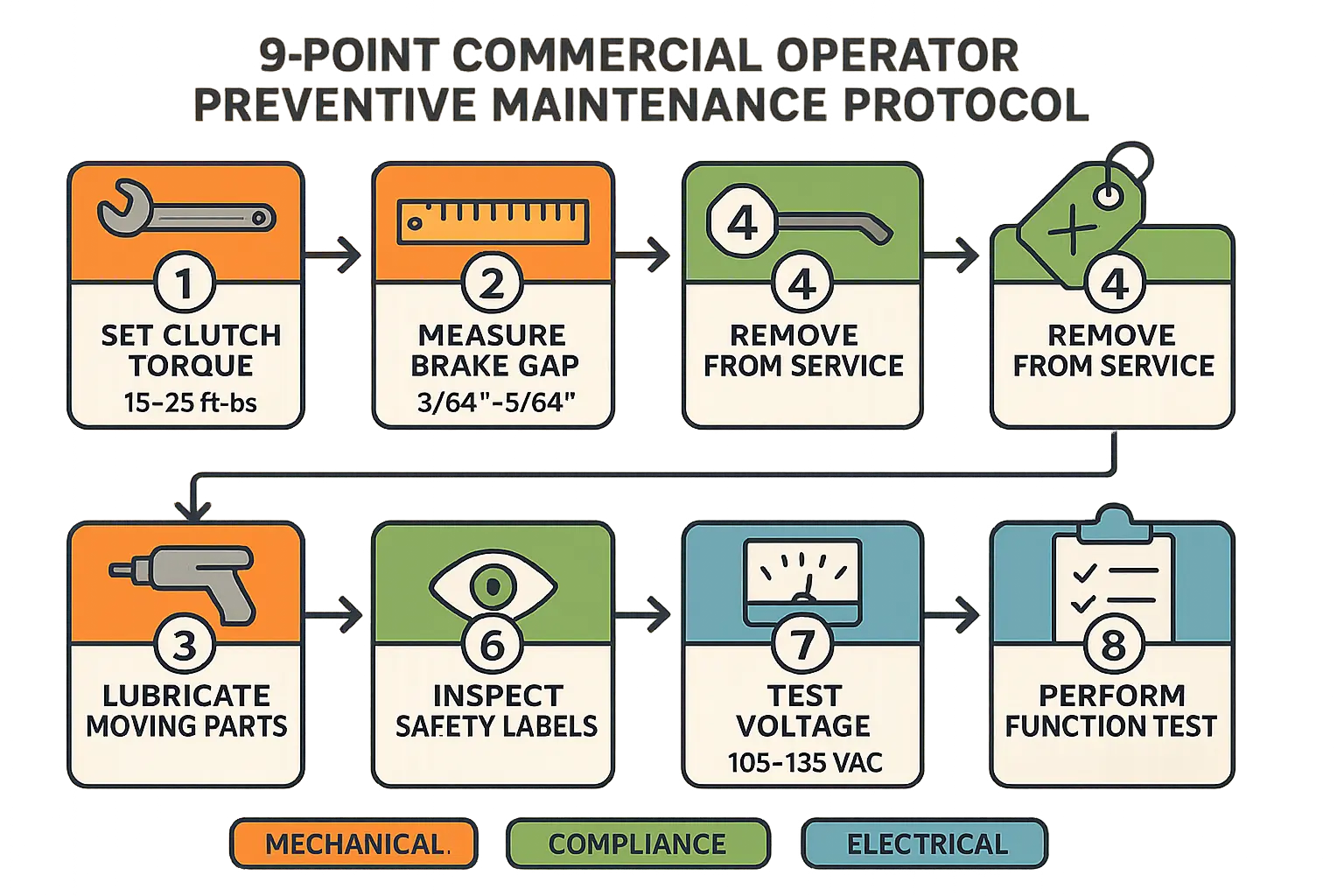 This flowchart breaks down the complex commercial door operator maintenance procedure into nine manageable, color-coded steps, empowering facility staff to understand and communicate critical preventive tasks clearly.
Facility Responsibility Matrix: In-House vs. Certified Technicians
To shield your business from safety liabilities while maintaining high operational efficiency, clearly define which maintenance tasks can be handled in-house and which require certified, expert intervention.
| Task Category | In-House Facility Staff | Certified Technician (AAADM/NFPA) |
|---|---|---|
| Basic Inspection & Cleaning | Cleaning photo-eye lenses, clearing track debris, and visually checking hinges. | Replacing high-tension cables, tracking structural wear patterns. |
| Mechanical Alignments | Lubricating drive chains and trolley rails. | Adjusting torsion springs, calibrating breakaway torque, adjusting solenoid air gaps. |
| Electrical & Diagnostic | Recording logic board LED blink codes and resetting soft faults. | Under-load voltage testing, replacing control boards, wiring safety edges. |
Maintaining this clear boundary protects your equipment warranties and ensures your team stays safe.
Standardizing Your PM Schedule by Cycle Demand
Standard-duty operators are designed for about 90 cycles per day. In a busy logistics park or multi-family parkade cycling 200 times daily, that system will reach 73,000 cycles in a single year. It will hit its physical lifetime wear limit in less than 17 months.
To prevent early mechanical failure, it is critical to upgrade to heavy-duty commercial high cycle doors and adapt your maintenance schedule to actual usage:
- Low-Traffic (Under 20 cycles/day): Annual professional service.
- Medium-Traffic (20–100 cycles/day): Semi-annual maintenance checks.
- High-Traffic (100–300+ cycles/day): Quarterly technical inspections.
- Critical Openings (24/7 high-use hubs): Monthly preventive care.
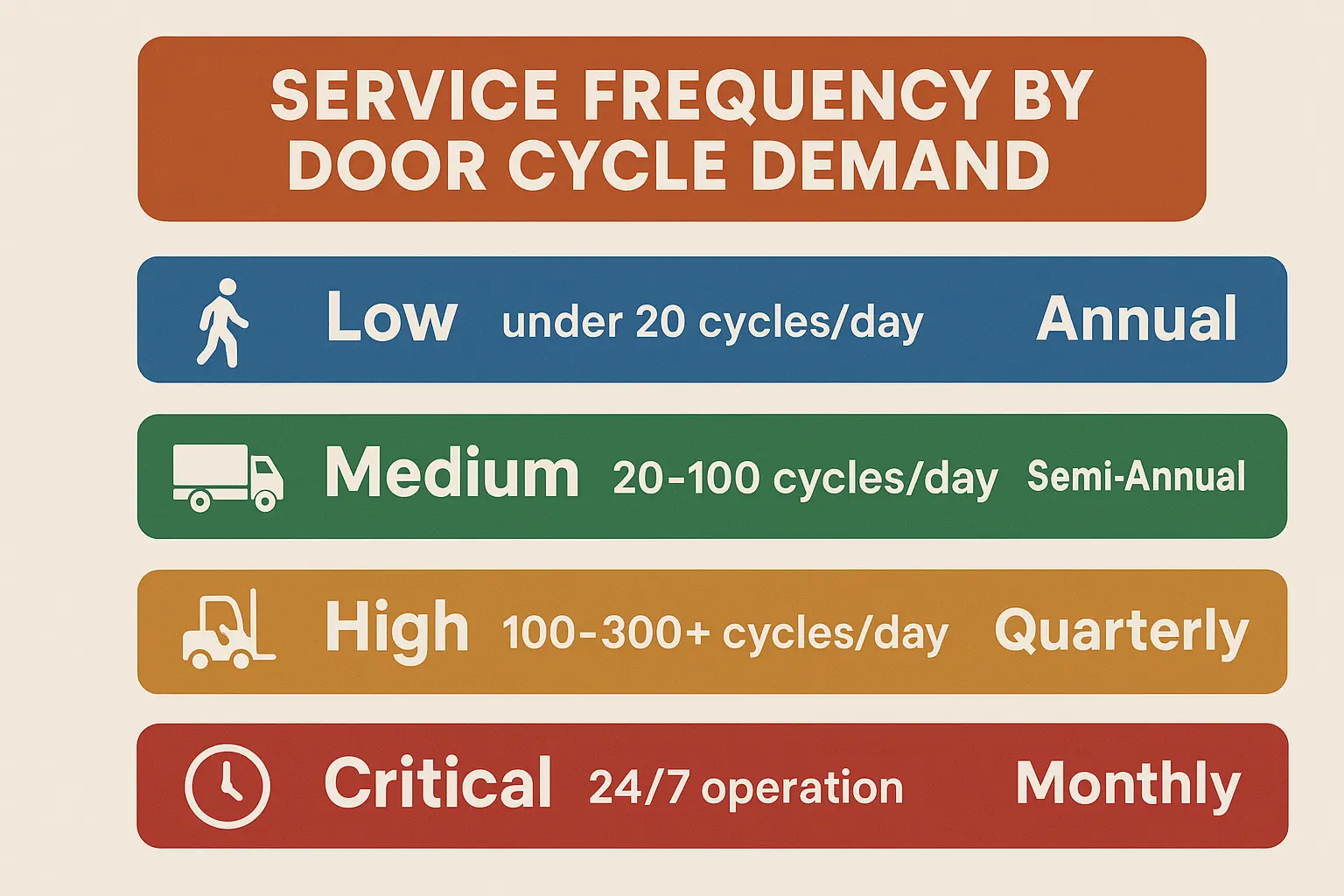 This chart helps facility managers quickly recall and apply the correct preventive maintenance schedule based on door cycle frequency, anchoring maintenance planning to measurable operational demand.
By matching your service schedule to real-world operational demand, you ensure your heavy doors keep cycling smoothly year-round.
Frequently Asked Questions
How often do commercial doors need servicing?
For low-traffic commercial environments, annual professional service is sufficient. However, for high-volume facilities like distribution centers, multi-family parkades, or emergency services stations cycling over 100 times daily, safety and operational regulations mandate quarterly or monthly technical inspections.
Why does my commercial garage door opener stop mid-way?
This is typically caused by limit drift on the circuit board, an activated Maximum Run Timer (MRT) fault, or a physical door imbalance. If a damaged track or seized roller adds more than 30 to 50 lbs of rotational drag, the operator’s safety clutch will slip or the motor overload protector will trip, stopping the cycle to prevent motor burnout.
How do I adjust a commercial door operator clutch?
Adjusting the clutch requires measuring the breakaway torque with a torque wrench to ensure it is set between 15 and 25 ft-lbs. Tightening the clutch too far eliminates the slip protection and will burn out the motor during an obstruction, while setting it too loose will cause the clutch to slip and prevent the door from opening.
You May Also Like