





Why Your Garage Door Jerks at the Top: The Loose Top Fixture Dilemma
Published: Oct 6, 2026
If your garage door operates smoothly through most of its travel but suddenly violently pops, bangs, or shudders as it reaches the ceiling, you are likely dealing with a loose top fixture roller bracket. When a garage door sticks when opening or transitionally jerks at the top, it is rarely a mystery. Instead, it is a predictable mechanical failure caused by concentrated pulling forces on thin sheet metal.
For homeowners evaluating whether to tackle this repair themselves or hire a professional, understanding the physics behind this common issue is key to making a safe, long-lasting decision.
Anatomy of the Top-of-Track Jerk (The Physics Explained)
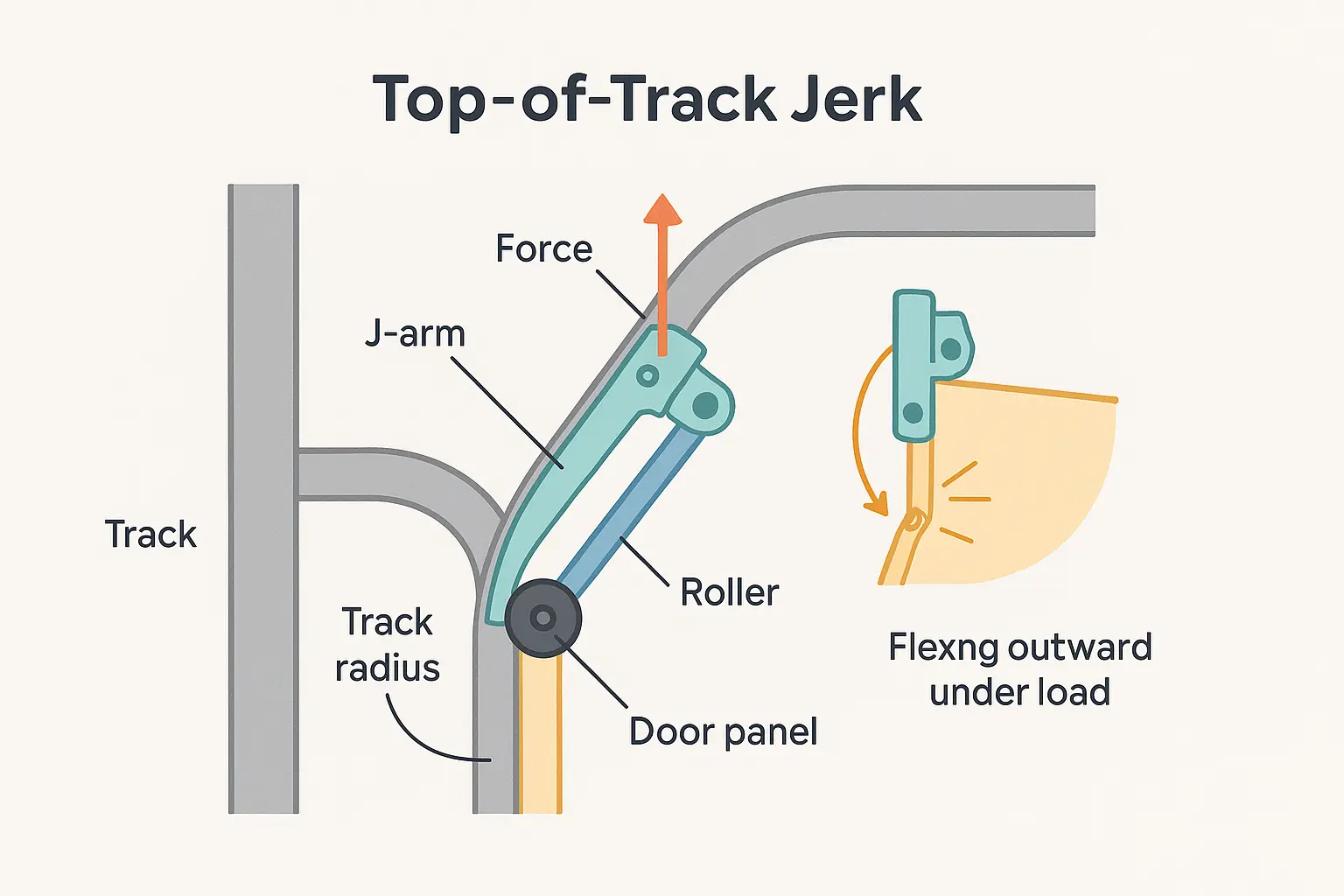
When your garage door is fully closed, the automatic opener’s drawbar (often called the J-arm) sits at its steepest angle. As the motor starts, it exerts between 300 to 600 Newtons of force to pull the top door panel upward and backward. On a standard residential door constructed of thin 25- or 26-gauge steel, this massive force is concentrated entirely on the top panel’s structural attachment points.
If the adjustable top fixture bracket has loose or stripped mounting screws, the bracket flexes outward under load rather than transferring that pulling force smoothly to the roller. This structural deflection causes the roller to bind in the vertical-to-horizontal curve of the track. As the motor continues to pull, mechanical tension builds. Once the J-arm’s angle flattens out, the built-up tension releases all at once. The roller violently “pops” through the track radius, resulting in a loud bang and a physical jerk of the door panel.
Diagnostics: Is Your Top Fixture Actually Pulling Loose?
To properly diagnose the issue, you must look at the specific metal hardware on your door panel. Generic online guides often confuse different types of garage door brackets, which can lead to purchasing the wrong replacement parts.
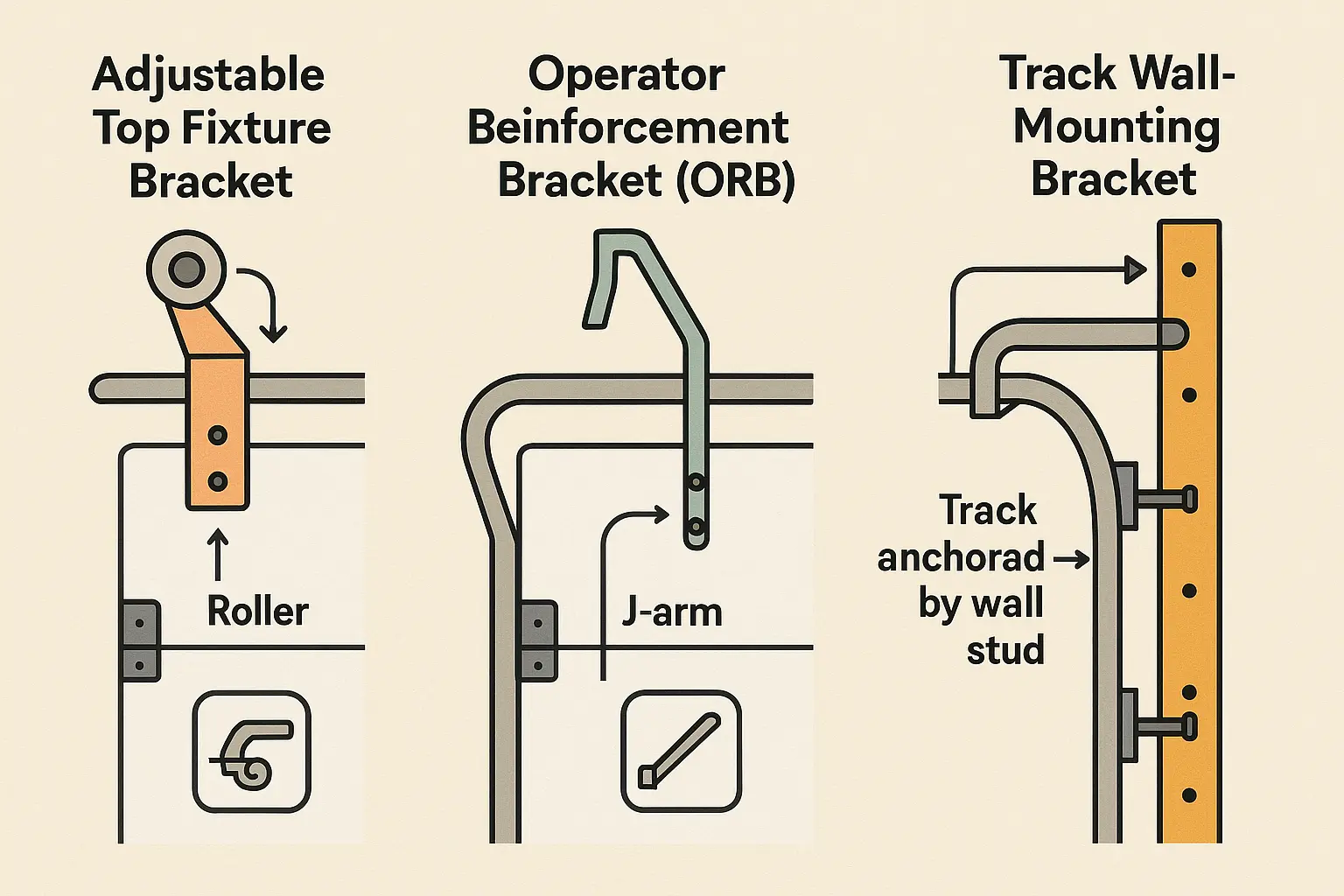
Keep these three components structurally distinct:
- Adjustable Top Fixtures: Located at the top-left and top-right corners of the top panel. These hold the top rollers and feature a slide mechanism to adjust how tightly the top section seals against the header.
- Operator / Drawbar Reinforcement Brackets (ORB): Located in the absolute center of your top panel. This is where the opener’s J-arm physically connects to lift the door.
- Track Wall-Mounting Brackets: These are the stationary garage door track brackets that anchor the steel tracks to your garage wall studs.
To verify a failing top fixture, unplug your opener and manually lift the door. Watch the corner brackets closely as they enter the curve of the track. If you see the bracket body pulling away from the steel door skin, screws backing out, or visible metal fatigue around the screw holes, your top fixture is loose and binding.
The 3 DIY Repair Methods: A Comparative Matrix
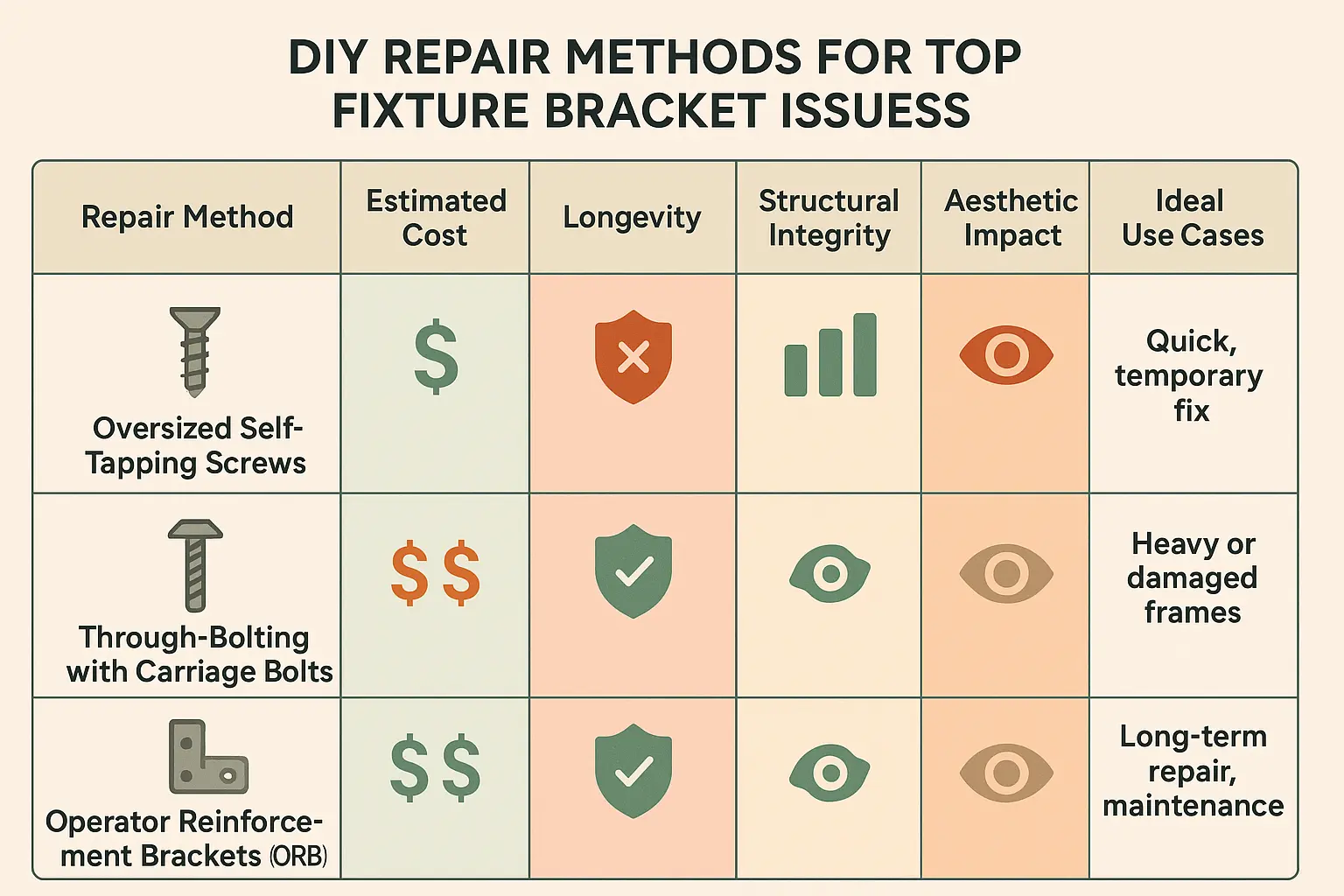
Depending on the weight of your door—ranging from an 80-pound single-layer steel model to a heavy wood overlay door exceeding 350 pounds—you have a few primary ways to fix a loose bracket.
- Oversized Self-Tapping Screws: If the original screw holes are only slightly stripped, replacing the standard fasteners with wider 5/16-inch or 3/8-inch self-tapping screws can temporarily secure the bracket back to the panel skin.
- Through-Bolting: For shredded screw holes, drilling completely through the door panel and securing the fixture with carriage bolts and a backing plate provides an exceptionally strong, permanent clamp. However, the bolt heads will be visible on the exterior of your door.
- Operator Reinforcement Brackets & Struts: The professional-grade solution is to install a comprehensive garage door panel reinforcement kit or a horizontal strut. This distributes the physical load across the entire top section of the door. Reviewing instructions on garage door reinforcement bracket installation can help you determine if you have the specialized tools required for this method.
The Critical Safety Check: What is Safe to Touch?
Many homeowners avoid garage door repairs out of a healthy fear of the high-tension torsion springs. However, there are clear safety boundaries you can rely on.
While bottom roller brackets are under lethal spring tension and should only be serviced by certified professionals, top fixture brackets are under no spring tension when the door is fully closed. This makes top-of-door adjustments safe for handy homeowners to attempt.
If you decide to tighten the hardware or learn how to replace garage door rollers at the top of the door, always unplug your automatic opener first. Close the door completely and place a locking clamp on the track directly below the second roller to ensure the door cannot physically move while you work.
When to Call a Pro & Cost Expectations
A DIY repair using oversized screws or a retail reinforcement plate typically costs between $15 and $40. However, if the sheet metal of your door panel is completely torn, the vertical stiles are cracked, or you suspect a broader garage door track alignment issue, it is time to call in a professional.
A professional service call to reinforce a damaged top section or realign binding tracks generally ranges from $150 to $300, which includes a comprehensive safety inspection and a structural tune-up. If you need trusted, honest garage door technicians, our family-owned team at Up & Down Garage Doors offers transparent pricing and prompt garage door repair services across our multi-state service areas.
Frequently Asked Questions
Why does my garage door jerk and pop only at the very top of its travel?
This jerking motion is usually caused by a loose top fixture roller bracket. When the door is closed, the opener pulls at a steep, high-stress angle. If the bracket is loose or stripped, it flexes outward instead of transferring the force to the roller, causing the roller to bind in the track curve. Once the opener arm flattens out, the built-up tension releases suddenly, resulting in a loud pop and a physical jerk.
Is it safe to tighten or replace a top garage door bracket myself?
Yes, the top fixture brackets are generally safe to adjust or replace because, unlike the bottom brackets, they are not connected to the high-tension garage door springs. Before starting any work, always unplug the automatic opener, make sure the door is fully closed, and clamp the tracks to secure the door panel from moving.
Should I use carriage bolts or self-tapping screws to fix a stripped bracket?
Self-tapping screws are a quick, low-cost fix for lightweight, single-layer steel doors with minor thread stripping, but they may pull out again under heavy use. Through-bolting with carriage bolts offers a permanent, structural repair for double-layer insulated or heavy wood overlay doors, though the bolt heads will be visible on the exterior of the door panel.
You May Also Like
Optimizing Commercial Door Operator Maintenance: Keeping Heavy Doors Cycling
Published Date: Oct 2, 2026
Decoding LiftMaster Diagnostic Codes: Your Complete Troubleshooting Guide
Published Date: Sep 30, 2026
Forklift Damage to Dock Doors: Repair Options for Sectional and Rolling Steel
Published Date: Sep 30, 2026