




Opener Rail Bent or Sagging: Repair Options and Diagnostic Guide
Published: Oct 20, 2026
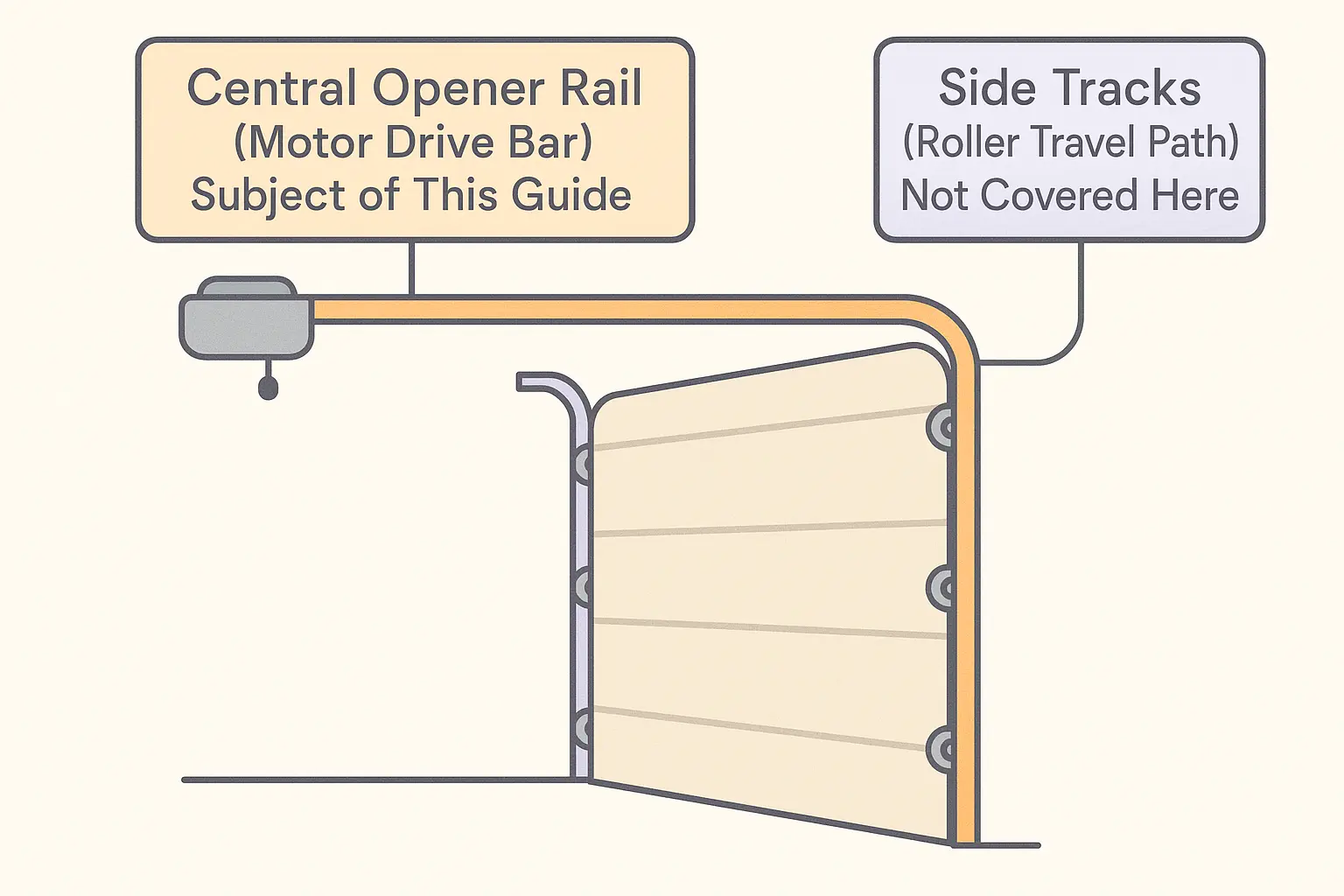
When your garage door opener rail sags downward or bows violently during operation, evaluating your repair choices requires immediate clarity. Over 75% of online guides mistakenly confuse the central motor drive rail with the side roller tracks. If your issue involves the perimeter channels where rollers travel, you are dealing with a bent garage door track. However, if the long metal bar extending from your motor housing to the wall above your door is flexing, snapping, or sagging, this guide provides the exact mechanical diagnostic and financial evaluation framework you need.
Diagnostic Flowchart Section: Identifying Rail Failure Modes
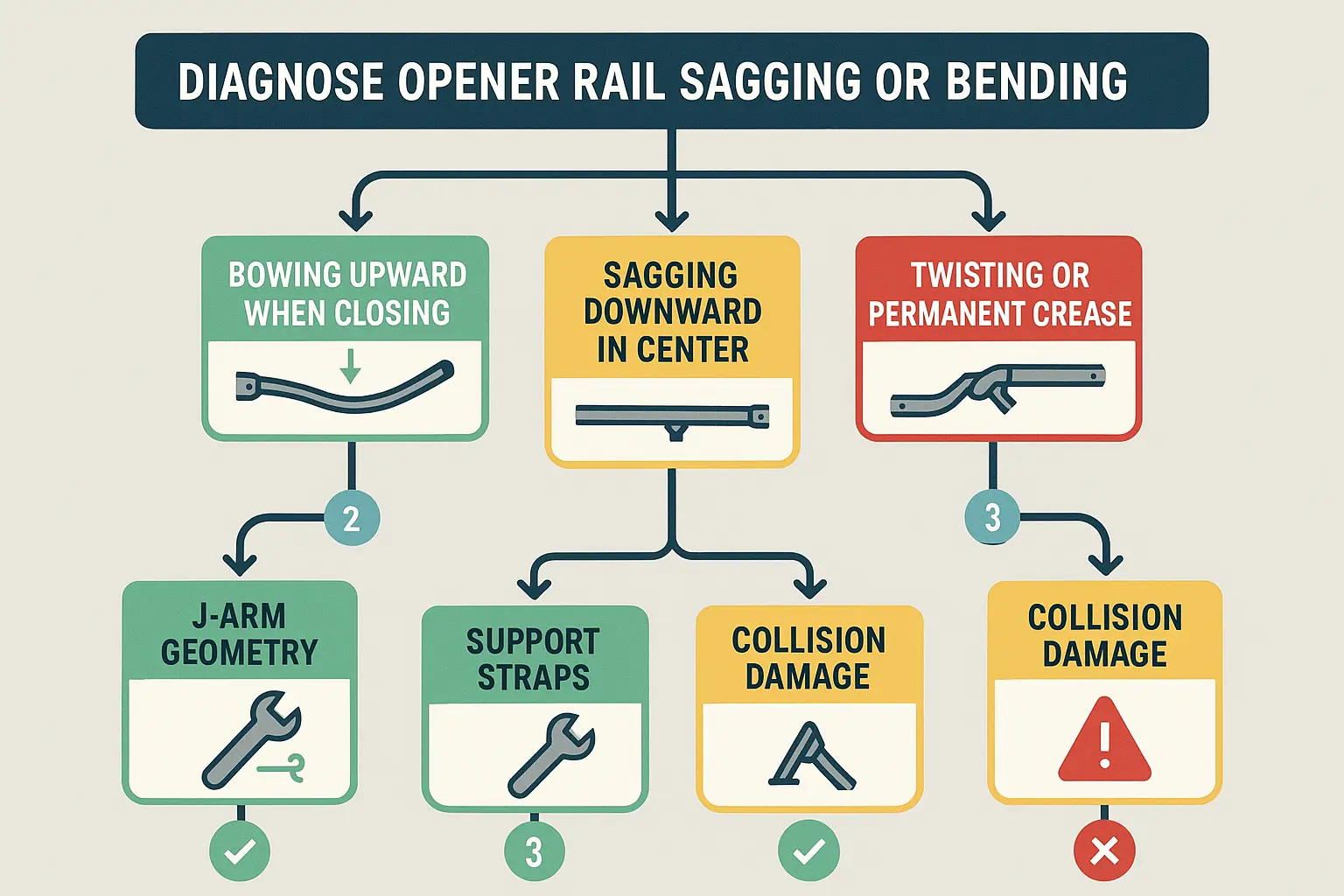
Before spending money on replacement parts, you must isolate how and when the deformation occurs. Rail failure generally falls into three distinct mechanical patterns:
- Bowing Upward When Closing: The rail flexes upward toward the ceiling as the door nears the floor. This points directly to improper J-arm angle geometry or excessive down-travel force.
- Sagging Downward in the Middle: The rail dips persistently, even when idle. This indicates improper overhead support strapping, multi-piece rail joint fatigue, or extreme deadweight from an unbalanced door.
- Twisting or Permanent Creasing: The rail channel is visibly kinked or spiraled. This stems from trolley jams, severe door collisions, or operating the motor against a broken spring.
Root Cause Mechanics: Why Motor Rails Buckle
Understanding the mechanical forces at play prevents repeated rail failures:
- Vector Thrust Forces: The curved J-arm connecting the trolley to the door should slope back toward the opener at a 45° to 60° angle when closed. If installed vertically (90°), closing force transforms into up to 180 lbs of vertical upward thrust, flexing multi-piece steel rails by 2.5 to 4 inches.
- Spring Imbalance Load: A healthy garage door requires only 10 to 15 lbs of motor force to move. If a torsion spring snaps or loses calibration, dead weight jumps to 150–250+ lbs. Understanding how does a garage door spring work clarifies why unassisted door weight instantly buckles thin-gauge rails.
- Multi-Piece vs. Solid T-Rails: Retail DIY openers utilize 3-piece bolt-together or snap-fit C-channel rails. These multi-piece assemblies exhibit a 3.4x higher mid-span failure rate compared to professional 1-piece solid steel T-rails under identical stress conditions.
The MOFU Repair Options & Decision Matrix Section
Evaluating your options comes down to structural integrity, safety, and long-term cost efficiency. Use this comparison matrix to determine your best course of action:
When weighing a simple patch against a full system refresh, reviewing a complete guide on garage door repair vs replacement helps align budget expectations with home safety goals.
Step-by-Step DIY Solutions vs. Professional Intervention
Option 1: Adjusting Geometry and Travel Limits ($0 DIY)
If your rail flexes upward during the final inches of closing, decrease the opener’s down-travel setting. Re-mount the J-arm bracket so the arm slants backward toward the motor head. Reviewing how to adjust garage door travel or learning how to adjust garage door opener limits ensures the motor stops precisely as the bottom seal touches the ground.
Option 2: The 14-Gauge Structural Spine Reinforcement ($15–$35 DIY)
For minor mid-span sagging on 3-piece C-channel rails, install a piece of 14-gauge slotted angle iron directly along the top spine of the rail. Fasten it securely with hex bolts, ensuring clearance for the trolley traveler. This field-proven reinforcement stiffens multi-piece rails and eliminates flex without forcing a total system tear-down.
Option 3: Professional Rail or Motor Replacement
If metal cracking, heavy creasing, or severe twisting has occurred, straightening the metal compromises structural safety. A compromised rail can cause trolley derailment, leaving your door immobilized or running into issues like a garage door not opening but motor running. If spring tension has failed alongside rail collapse, seek professional garage door spring tension adjustment near me. For older units, opting for a complete garage door motor replacement featuring a solid 1-piece I-beam or T-rail offers maximum durability and smooth performance. When in doubt, consulting a technician to repair garage door opener mechanics protects your door system against systemic failure.
Frequently Asked Questions
Why does my garage door opener rail bow only during closing?
Upward bowing during closing occurs when force limits are set too high or the J-arm is installed vertically at a 90° angle. As the door hits the floor, the motor continues pushing, creating upward vector thrust that flexes the center rail. Adjusting down-travel limits and angling the J-arm back toward the motor head resolves this issue.
Can I attach a solid 1-piece rail to a retail Chamberlain or Genie opener?
Most retail DIY opener powerheads (Chamberlain, Genie, Craftsman) are engineered specifically for multi-piece assembly rails. While professional single-piece T-rails fit commercial-grade models, retrofitting them onto retail powerheads usually requires proprietary mounting adapters. In most cases, upgrading to a professional-grade motor kit equipped with a factory 1-piece rail is the most reliable solution.
Does a sagging opener rail mean my motor is dying?
Not necessarily. A sagging rail is primarily a structural or mechanical alignment issue rather than motor failure. However, operating an opener with a severe rail sag forces the motor gear to work against extra drag, accelerating internal gear wear over time. Correcting the rail flex early protects your motor head from premature failure.
You May Also Like