




Residential vs. Commercial Opener Duty Cycles: Matching the Operator to the Door
Published: Oct 20, 2026
Installing a heavy-duty residential operator on a light commercial bay door often seems like a practical cost-saving shortcut during initial procurement. However, facility managers and building operators quickly discover that this mismatch leads to premature motor burnout, costly operational downtime, and severe code compliance risks. Selecting the right opener requires looking past superficial horsepower numbers to evaluate duty cycles, motor thermal limits, and electrical power phases.
Decoding Duty Cycles: CPH vs. CPD (The Physics of Thermal Overload)
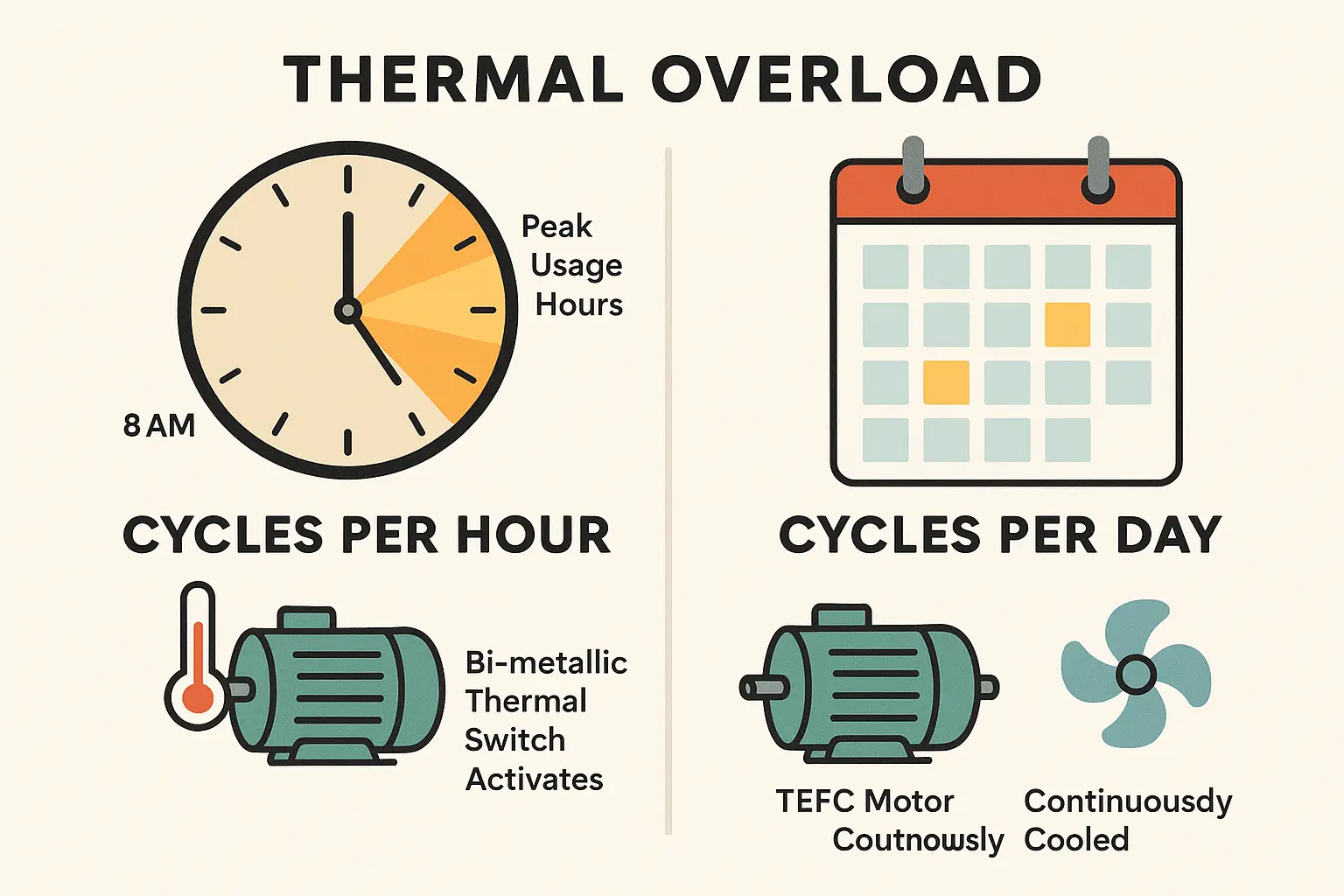
Understanding operator survival comes down to distinguishing between total daily volume—Cycles Per Day (CPD)—and peak usage frequency, defined as Cycles Per Hour (CPH). Per DASMA TDS-350 technical standards, residential garage door openers are designed for intermittent duty (2 to 5 CPH maximum). They utilize open-frame AC motors with internal bi-metallic thermal switches that trip at approximately 135°C (275°F). Running four consecutive cycles under heavy load triggers this thermal protection cutoff, leaving the door non-operational for a 15 to 30-minute cooling period.
In contrast, commercial operators are engineered to handle repetitive thermal stress. These units employ Totally Enclosed Fan-Cooled (TEFC) or Totally Enclosed Non-Ventilated (TENV) motor enclosures featuring Class F insulation and external cooling fins, allowing continuous operational cycling without thermal shutdown.
Master Duty Cycle Classification Framework
To accurately match an operator to your operational demand profile, evaluate your facility against the six standard duty cycle classifications:
| Classification | Max Cycles/Hour (CPH) | Max Cycles/Day (CPD) | Motor Type & Rating | Common Applications |
|---|---|---|---|---|
| Residential | 2 – 5 CPH | 2 – 6 CPD | 1/3 – 1/2 HP Intermittent | Single-family private residences |
| Light-Duty Comm. | 10 – 12 CPH | Up to 25 CPD | 1/3 – 1/2 HP Intermittent | Auto detail bays, agricultural pole barns |
| Medium-Duty Comm. | 12 – 15 CPH | Up to 50 CPD | 1/2 HP Intermittent | Retail loading bays, repair shops |
| Standard-Duty Comm. | 20 – 30 CPH | 75 – 90 CPD | 1/2 – 3/4 HP Continuous | Warehouses, light distribution docks |
| Industrial / Heavy | 30 – 60+ CPH | 300+ CPD | 3/4 – 1+ HP Continuous | Freight terminals, transit facilities |
| Continuous Duty | Unrestricted | 24/7 Continuous | TEFC / Brushless DC | Parking structures, toll booths |
The Operator Sizing Formula: Step-by-Step Calculation Guide
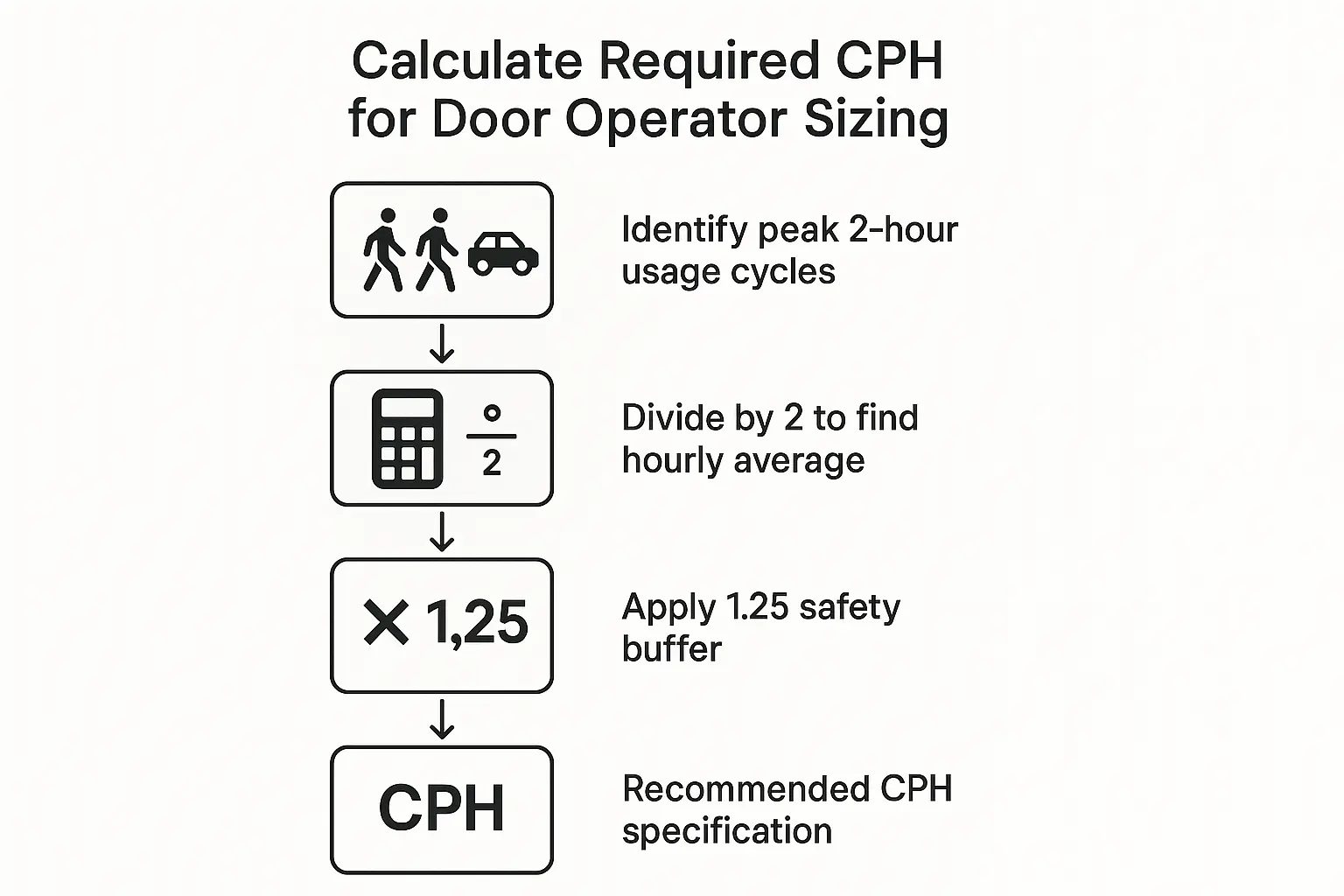
Never size a commercial operator using average daily traffic alone. Peak traffic bursts create the thermal buildup that destroys undersized motors. Calculate your required CPH capability using this standard technician calculation:
$$text{Required CPH} = left( frac{text{Peak 2-Hour Usage}}{2} right) times 1.25 text{ (Safety Buffer)}$$
For example, if a distribution facility experiences 40 door cycles during its peak shift change between 7:00 AM and 9:00 AM, the average hourly rate is 20 cycles per hour. Applying the 1.25 safety buffer yields a 25 CPH requirement, indicating that the facility needs a Standard-Duty or Heavy-Duty Commercial Operator rather than a medium-duty unit.
Electrical Power, Drive Types, and Thermal Dissipation
Selecting high-performance commercial garage door openers requires matching available site power to duty demands. While residential units run exclusively on 115V single-phase power, commercial facilities often utilize 208/230/460/575V 3-phase power. Three-phase systems distribute electrical load across three distinct currents, eliminating starting capacitors—a primary failure point in heavy usage—and drastically reducing operating heat buildup.
Advanced models, such as a continuous-rated liftmaster commercial garage door opener, integrate smart diagnostics alongside UL 325 monitored entrapment protection. Mechanical configuration must also align with door lift profiles: trolley (drawbar) operators suit standard lift sectional doors, while wall-mount jackshaft operators are required for high-lift, full-vertical lift, and rolling steel curtain doors.
System Synergy: Why Springs, Tracks, and Safety Gears Must Match the Operator
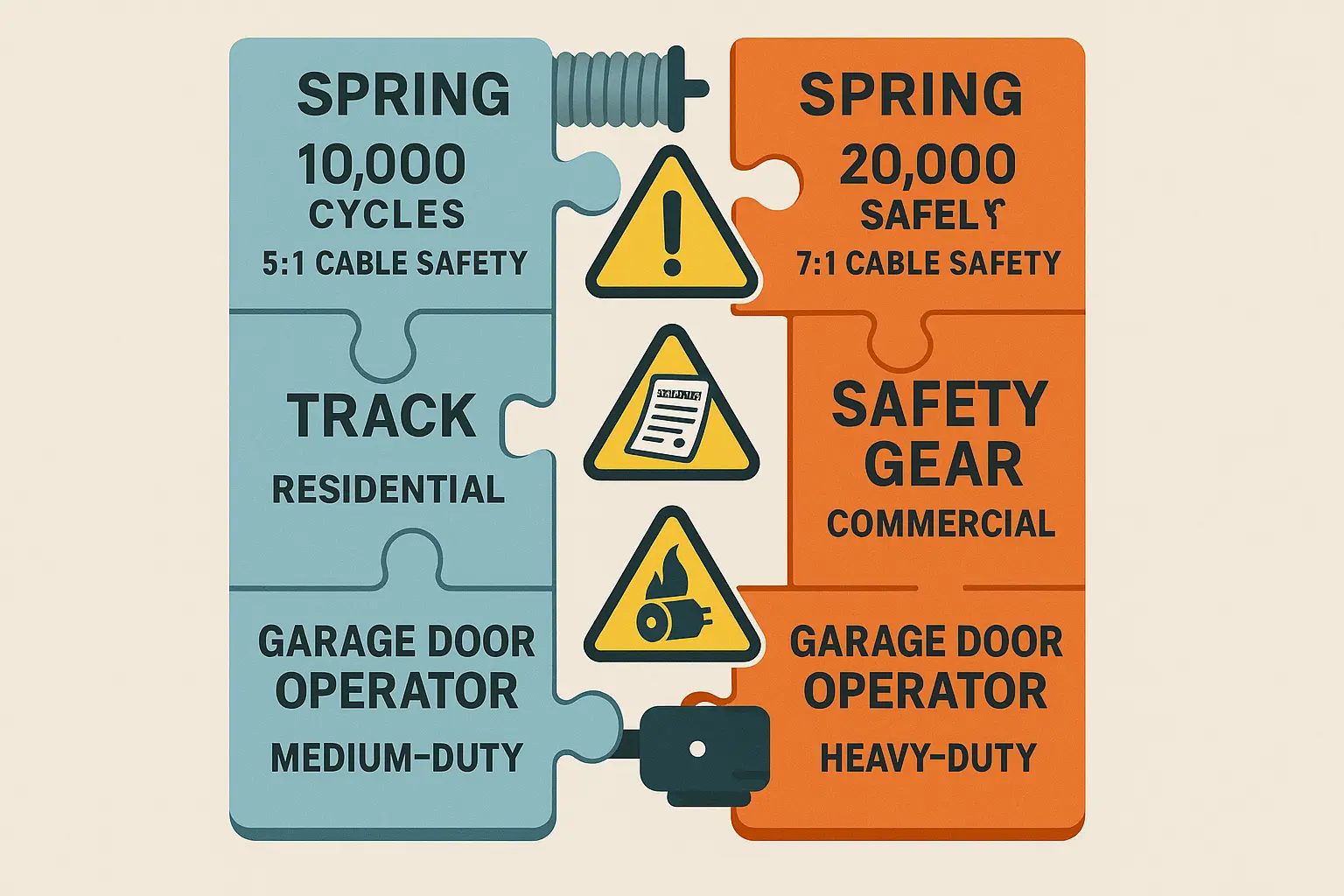
An operator does not work in isolation; it functions as part of a balanced mechanical ecosystem. Installing a heavy commercial continuous-duty operator on a door equipped with standard 10,000-cycle torsion springs creates severe failure points. High opener duty cycles will snap standard springs within months. Commercial installations demand commercial high cycle doors fitted with 25,000 to 100,000-cycle high-cycle springs, heavy 13-gauge or 14-gauge track steel, and 10-ball steel bearing rollers.
Furthermore, while residential hardware operates under a 5:1 cable safety factor, commercial standards mandate a 7:1 safety factor. Ensuring full component compatibility across your industrial commercial garage doors preserves motor longevity, prevents track buckling, and maintains NFPA 80 fire door release compliance.
Frequently Asked Questions
Can I install a residential garage door opener on a light commercial door?
No. Installing a residential opener in a commercial facility voids manufacturer warranties, breaches UL 325 safety codes, and risks premature motor failure. Residential openers lack the thermal cooling, 7:1 safety cable ratings, and structural duty capabilities required for commercial operational demands.
What happens when an operator exceeds its Cycles Per Hour (CPH) limit?
Exceeding CPH limits generates excessive internal heat within motor windings. On standard intermittent operators, internal thermal switches trip to prevent fire, rendering the door completely inoperable for 15 to 30 minutes. Repeated thermal overload degrades motor insulation, leading to short circuits and permanent burnout.
How does 3-phase power improve continuous operator performance?
Three-phase power (208/230/460/575V) supplies continuous power flow that eliminates high initial amperage spikes and avoids starting capacitor wear. This delivers smoother torque, lowers operating temperatures, and allows motors to run continuous cycles without thermal breakdown.
Making the Right Investment for Your Facility
Selecting the correct operator requires balancing operational frequency, door mechanics, and electrical configuration. Up & Down Garage Doors brings decades of family-owned experience to help facility managers make informed decisions backed by transparent pricing and technical expertise. Whether you require immediate garage door repair or 24/7 emergency garage door repair, our licensed technicians deliver reliable solutions tailored to your operational needs. Contact our team today to schedule an expert duty-cycle evaluation.
You May Also Like