




Garage Door Motor Installation, Replacement & Upgrades: The Ultimate Decision Guide
Published: Nov 4, 2026
When your garage door motor hums without moving, grinds loudly, or struggles to lift the door, you face an immediate crossroads: Should you repair a failing part, replace the head unit, or upgrade your entire system? Making the right choice requires balancing long-term reliability, hardware compatibility, safety compliance, and direct financial investment.
Executive Diagnostic Flowchart: Repair, Replace, or Upgrade?
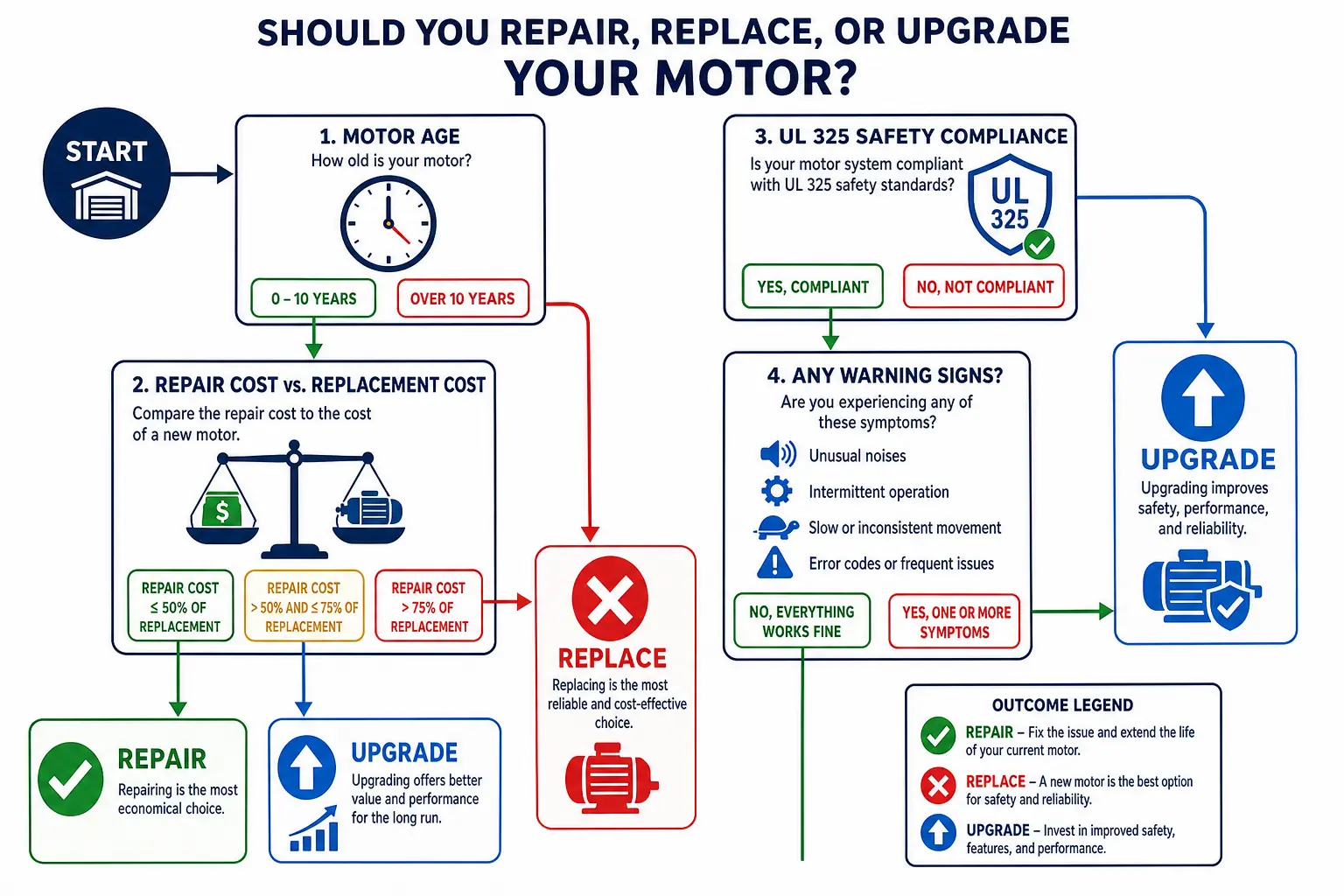
To determine whether to fix or swap your unit, evaluate your motor using three core industry standards:
- The 50% Financial Rule: Standard motor repairs average $65 to $385, while a complete installed system ranges from $250 to $650+. If a logic board or motor assembly repair quote exceeds 50% of a new unit’s cost, full replacement yields far higher return on investment.
- System Lifespan Benchmarks: Most residential garage door motors last 10 to 15 years. If your motor is over a decade old and requires a repair exceeding $150, internal gear wear makes complete replacement the smarter choice.
- Safety & Regulatory Mandates: Under federal law (UL 325), any garage door opener manufactured before January 1, 1993, lacks modern non-contact photo-eye safety sensors and cannot legally be repaired by a professional technician. Furthermore, state regulations like California’s SB 969 mandate functional battery backup systems on all new installations to ensure operational access during power outages.
When asking yourself should i fix or replace my garage door opener, also examine structural panel damage. If your opener failure stemmed from physical track binding, verifying if can a damaged garage door be repaired will prevent immediate mechanical overload on your new motor.
Motor Compatibility Matrix: Matching Horsepower, Door Weight & Drive Types
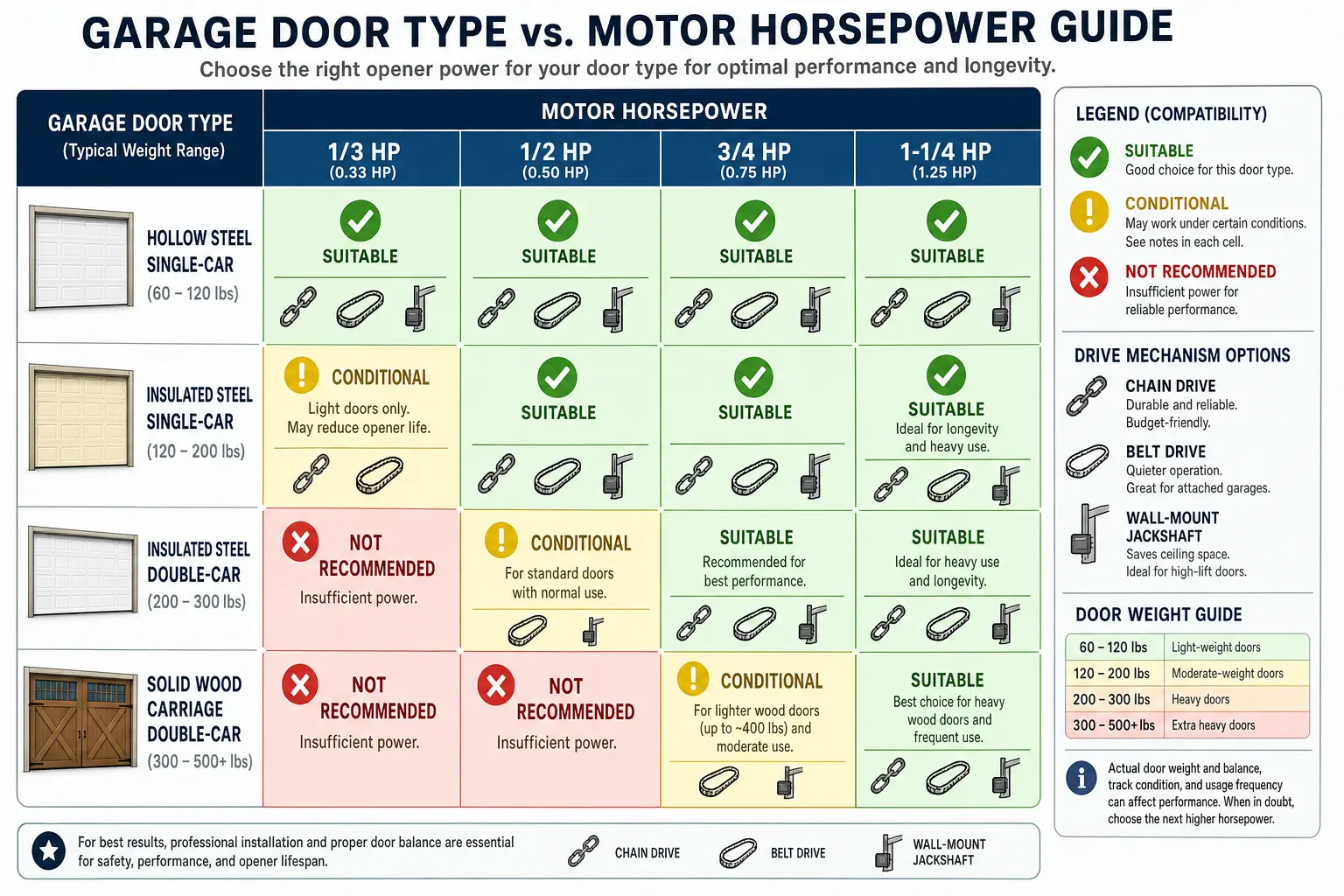
Installing an underpowered motor strains the internal drive gears, while selecting the wrong drive mechanism causes unnecessary structural noise across your home.
- 1/3 HP to 1/2 HP (AC/DC): Best suited for single-car, uninsulated steel or aluminum doors weighing under 150 lbs.
- 1/2 HP (Standard Baseline): Handles standard two-car double doors made of uninsulated steel (up to 300 lbs).
- 3/4 HP to 1-1/4 HP (Heavy-Duty DC): Essential for heavy insulated double doors, custom glass, or solid carriage house wood doors weighing 300 to 800+ lbs.
Drive System Selection
- Chain Drive (~70 dB): Highly durable and economical, but generates significant mechanical vibration. Ideal for detached garages.
- Belt Drive (~50 dB): Steel-reinforced rubber belts deliver whisper-quiet operation, making them perfect for garages beneath bedrooms.
- Wall-Mount / Jackshaft Drive (~40 dB): Mounted directly alongside the torsion spring bar on the wall. If you want to maximize ceiling storage or install high-lift tracks, reviewing the best wall mount garage door opener options will help free up overhead space while reducing noise transfer by up to 75%.
DIY vs. Professional Installation: Risk & Safety Assessment
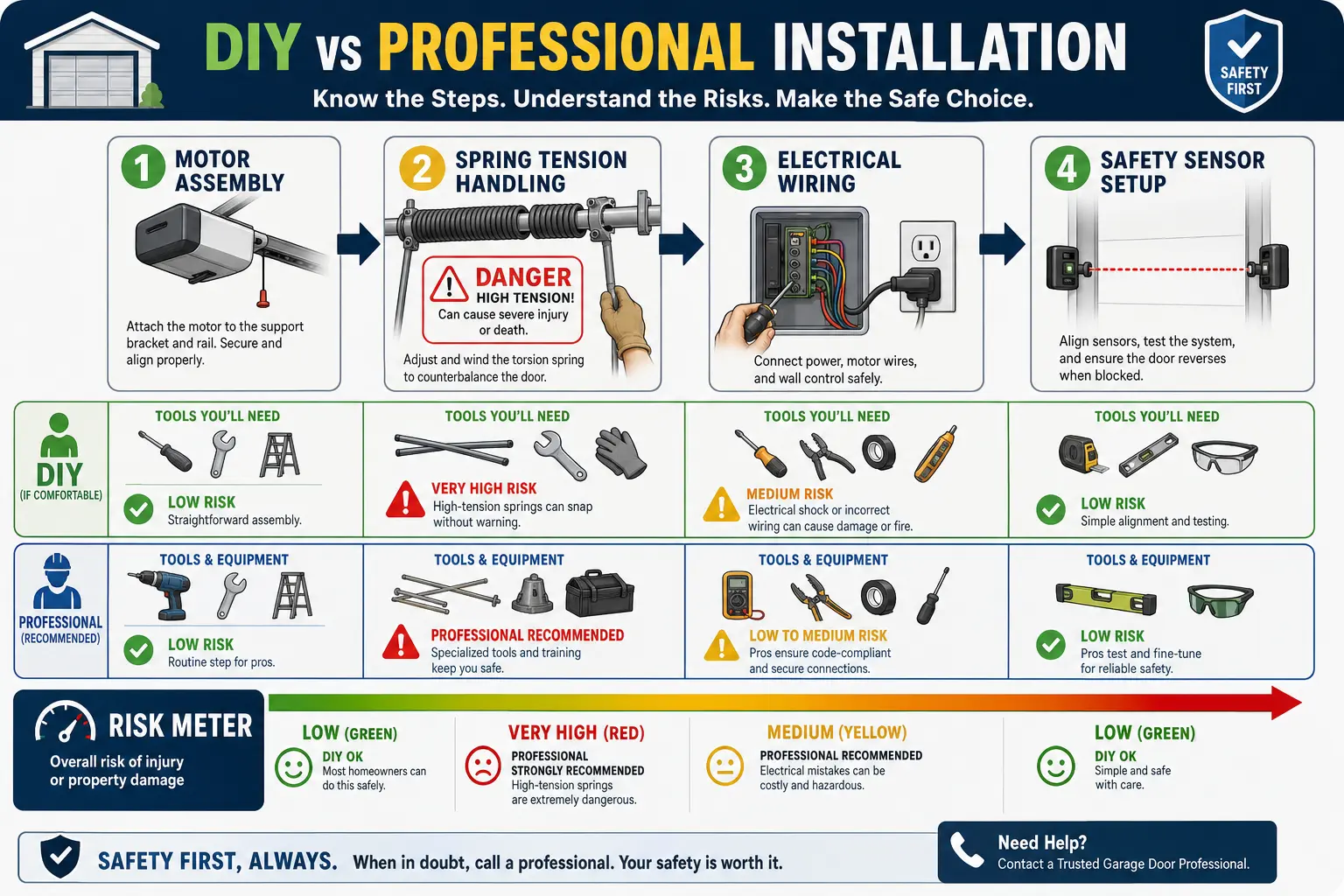
While assembling ceiling rail brackets and mounting a motor housing is straightforward, hooking an opener to an unbalanced system carries severe hidden hazards. Garage door torsion springs operate under 100 to 500 lbs of active torque tension. Unhooking an opener from an improperly balanced door can trigger a sudden door collapse or violent spring unwinding.
In fact, field statistics show that 68% of premature gear stripping failures are directly caused by underlying door weight imbalances rather than motor defects.
If you are undertaking total structural overhauls, understanding how to remove a garage door safely requires strictly securing spring tension before disturbing the opener arm. For basic mechanical disconnects, mastering how to reconnect garage door opener systems after emergency pull-cord release ensures your motor logic board preserves its limit setting calibrations.
Frequently Asked Questions
What should I do if my garage door opener has power but not working?
If the main housing unit light activates or hums but the door fails to move, check for tripped travel limit switches, disengaged emergency release trolleys, or stripped internal nylon drive gears. For a detailed step-by-step diagnostic breakdown, review our guide on resolving a garage door opener has power but not working to isolate control board issues from mechanical jams.
Can I install a new motor head on my existing ceiling rail?
In most cases, retrofitting a new motor head onto an old ceiling track is not recommended. Drive rails, trolley assemblies, and mounting brackets are engineered specifically for precise manufacturer drive types and shaft dimensions. Installing a modern motor onto worn, unaligned legacy rails voids manufacturer warranties and accelerates mechanical wear.
What maintenance ensures my new garage door motor lasts 15 years?
To maximize longevity, check door balance annually by disconnecting the opener and lifting the door manually; it should remain stationary at waist height. Lubricate drive chains or screw shafts twice yearly with silicone spray (never apply grease to belt drives), and conduct monthly UL 325 auto-reverse tests using a 2×4 block placed beneath the door path.
Make Your Next Step with Confidence
Upgrading or replacing your garage door motor protects your home’s security, accessibility, and family safety. Whether you need expert technical guidance or precise professional installation, trusted family-owned expertise ensures the job is done right. Contact the certified team at Up & Down Garage Doors today to schedule a comprehensive evaluation and secure long-term reliability for your home.
You May Also Like