




Wind-Load Struts Missing or Bent on a Commercial Sectional Door: The Technical Evaluation Guide
Published: Nov 18, 2026
In this article (7 sections)
- The Critical Function of Wind-Load Struts (U-Bars) on Commercial Doors
- Root Causes: Why Struts Crease, Buckle, or Disappear
- The Hidden Risks of Ignoring Bent or Missing Struts
- Commercial Decision Matrix: Repair vs. Replace vs. Upgrade
- Professional Recalibration and Spring Counterbalance Protocols
- Frequently Asked Questions
- Take Action: Secure Your Commercial Door Infrastructure
When a commercial sectional door develops a bent or missing wind-load strut, facility managers face an urgent operational decision. Unlike residential doors where minor cosmetic dents are manageable, a compromised horizontal U-bar strut on a 20-foot-wide commercial door severely degrades structural integrity, invalidates insurance coverage, and poses immediate safety risks to facility personnel.
Hammering out a creased steel strut or operating a door without its engineered stiffeners leads to catastrophic track derailment, motor failure, or building envelope breach during high-wind events. Evaluating your diagnostic and repair options based on engineering standards ensures long-term operational continuity.
The Critical Function of Wind-Load Struts (U-Bars) on Commercial Doors
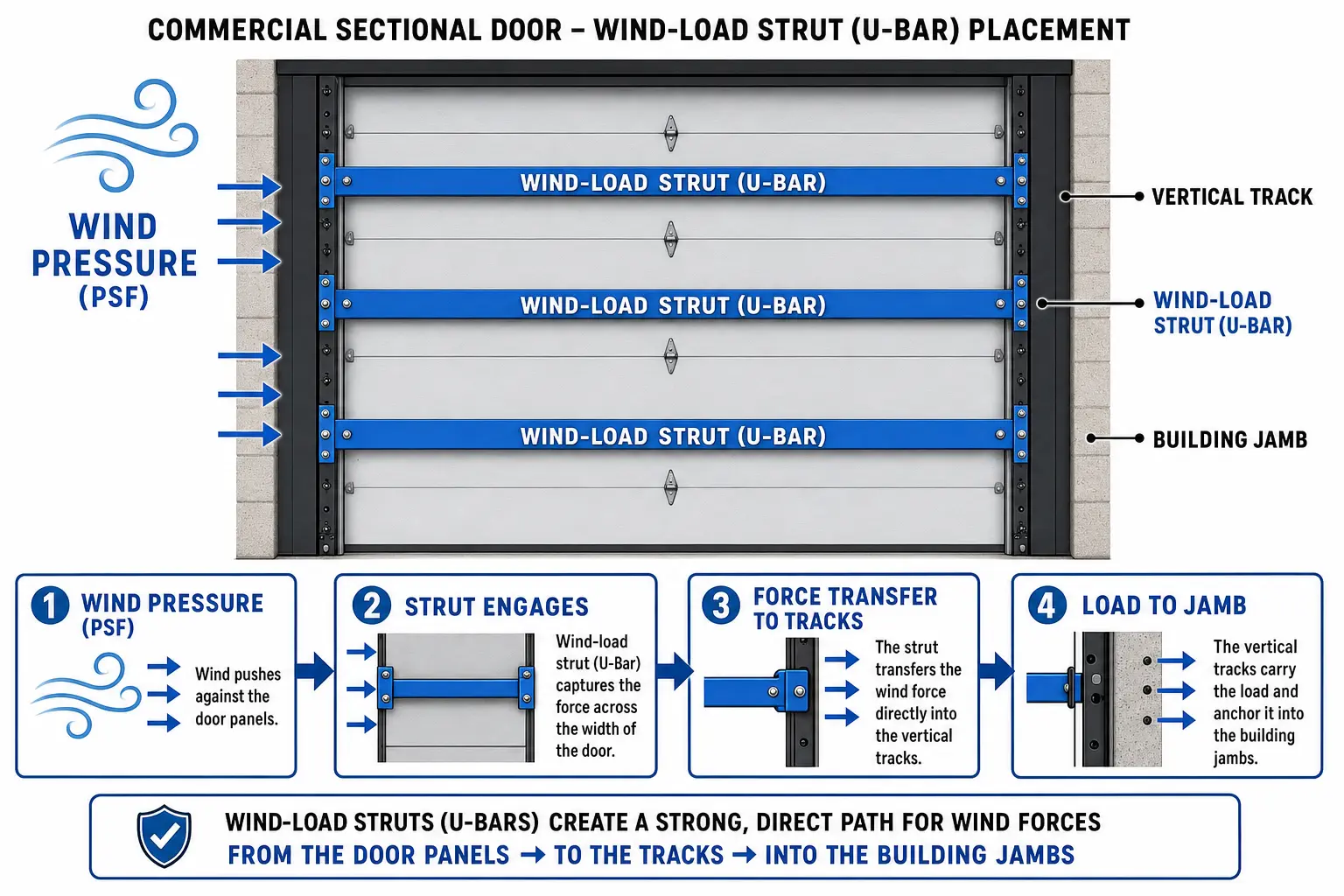
Horizontal wind struts (80-gauge to 20-gauge steel U-channels) act as primary structural beams across wide door sections. According to DASMA (Door & Access Systems Manufacturers Association) technical studies, these struts provide up to 90% of a sectional door’s flexural rigidity against lateral wind pressure (Pounds per Square Foot or PSF).
When dynamic wind pressure acts against the door, struts transfer these forces away from thin sheet metal skins into the end hinges, vertical rollers, steel tracks, and building structural jambs. Compliance under ANSI/DASMA 108 (static pressure testing) and ANSI/DASMA 115 (impact/cyclic testing) requires precise structural resistance based on local ASCE 7-22 wind velocity maps. If you operate in high-wind or coastal regions, maintaining a certified wind load door is essential to structural performance.
Root Causes: Why Struts Crease, Buckle, or Disappear
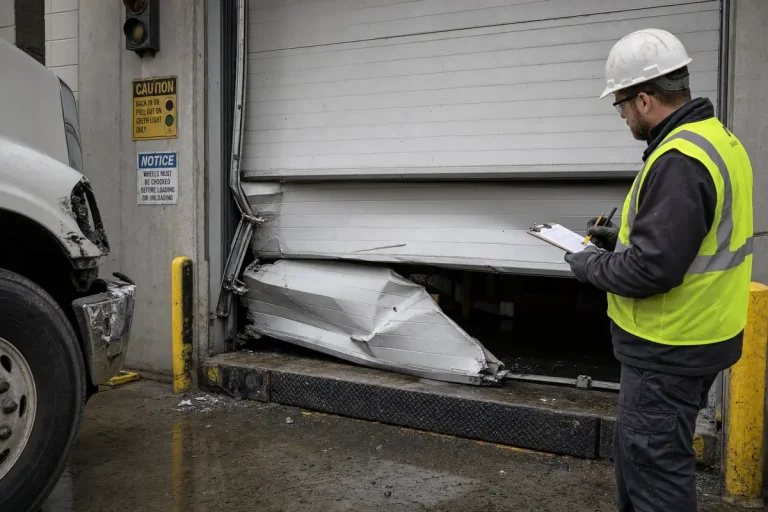
- Forklift and Equipment Collisions: In busy distribution hubs, material handling equipment frequently clips door panels during loading. Even a minor hit can buckle the strut profile. Reviewing your overall dock door repair cost strategy helps isolate localized structural damage from systemic vehicle impacts.
- Extreme Wind Deflection: High-wind events exceeding the door’s yield threshold cause central crimping. Once bent, the steel permanently loses its section modulus.
- Improper Unqualified Maintenance: Inexperienced technicians sometimes remove struts to “lighten” a door when springs weaken, severely unbalancing the mechanical assembly.
- Opener Arm Misalignment: Direct push-pull force from a commercial operator attached to an unreinforced top section causes severe central stress fractures over time.
The Hidden Risks of Ignoring Bent or Missing Struts
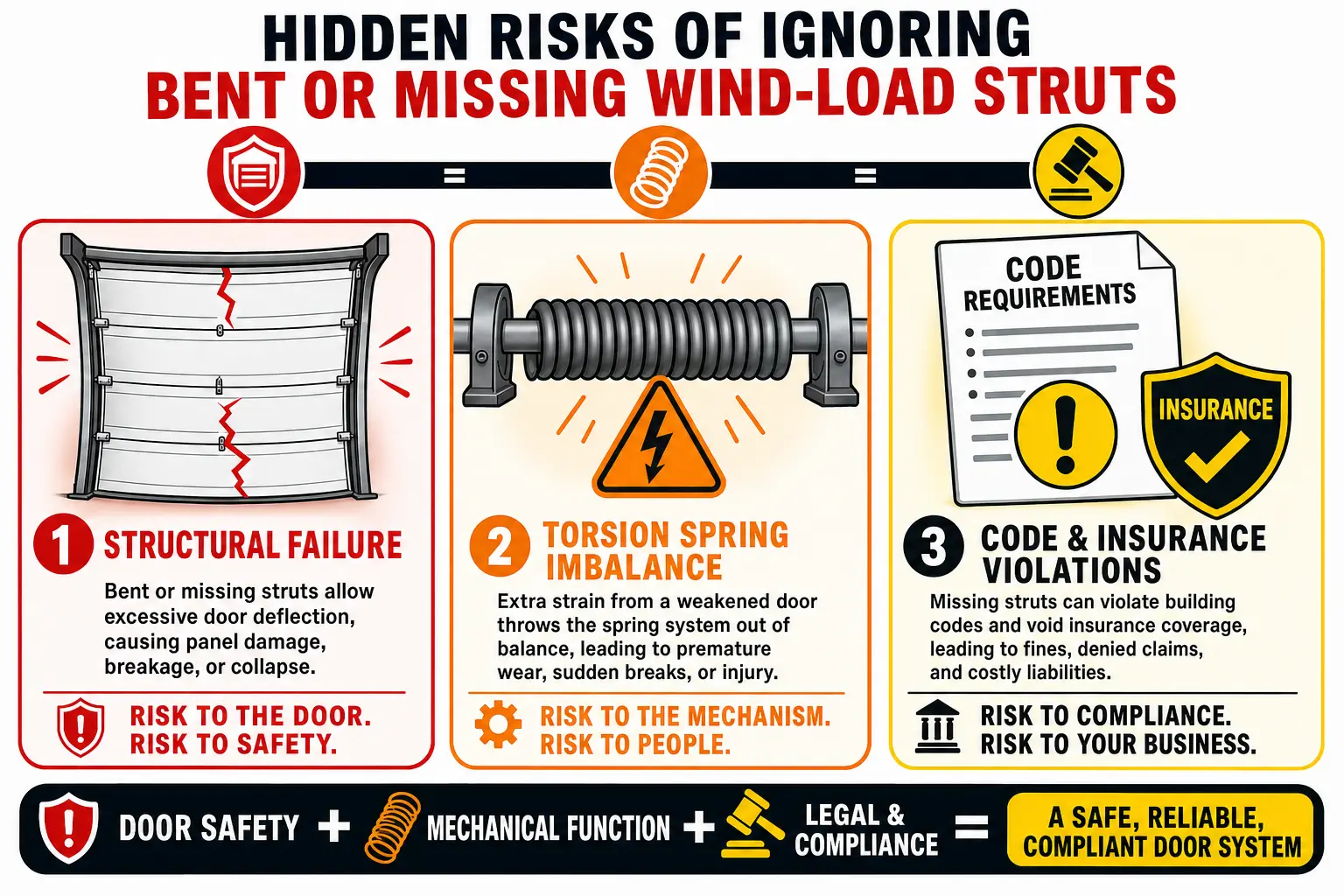
Ignoring strut damage exposes your commercial facility to severe compound risks:
- Catastrophic Wind Blow-In/Blow-Out: DASMA data confirms a creased strut loses 70% to 85% of its structural moment of inertia ($I_x$). FEMA mitigation reports reveal that over 80% of structural wind damage in commercial buildings originates from overhead door breaches.
- Torsion Spring & Counterbalance Imbalance: A 20-foot commercial steel wind strut weighs between 18 lbs and 35 lbs. Removing or compromising a strut alters counterbalance by 5% to 12%. This imbalance causes cable slippage, gear stripping, or motor thermal overload. Routine commercial facility door maintenance must evaluate both structural stiffness and spring balance.
- Insurance Claim Invalidation & Code Violations: Non-compliant assemblies violate strict safety standards. Severe windstorms that breach compromised doors often lead to insurance claim denials under strict garage door code compliance rules.
Commercial Decision Matrix: Repair vs. Replace vs. Upgrade
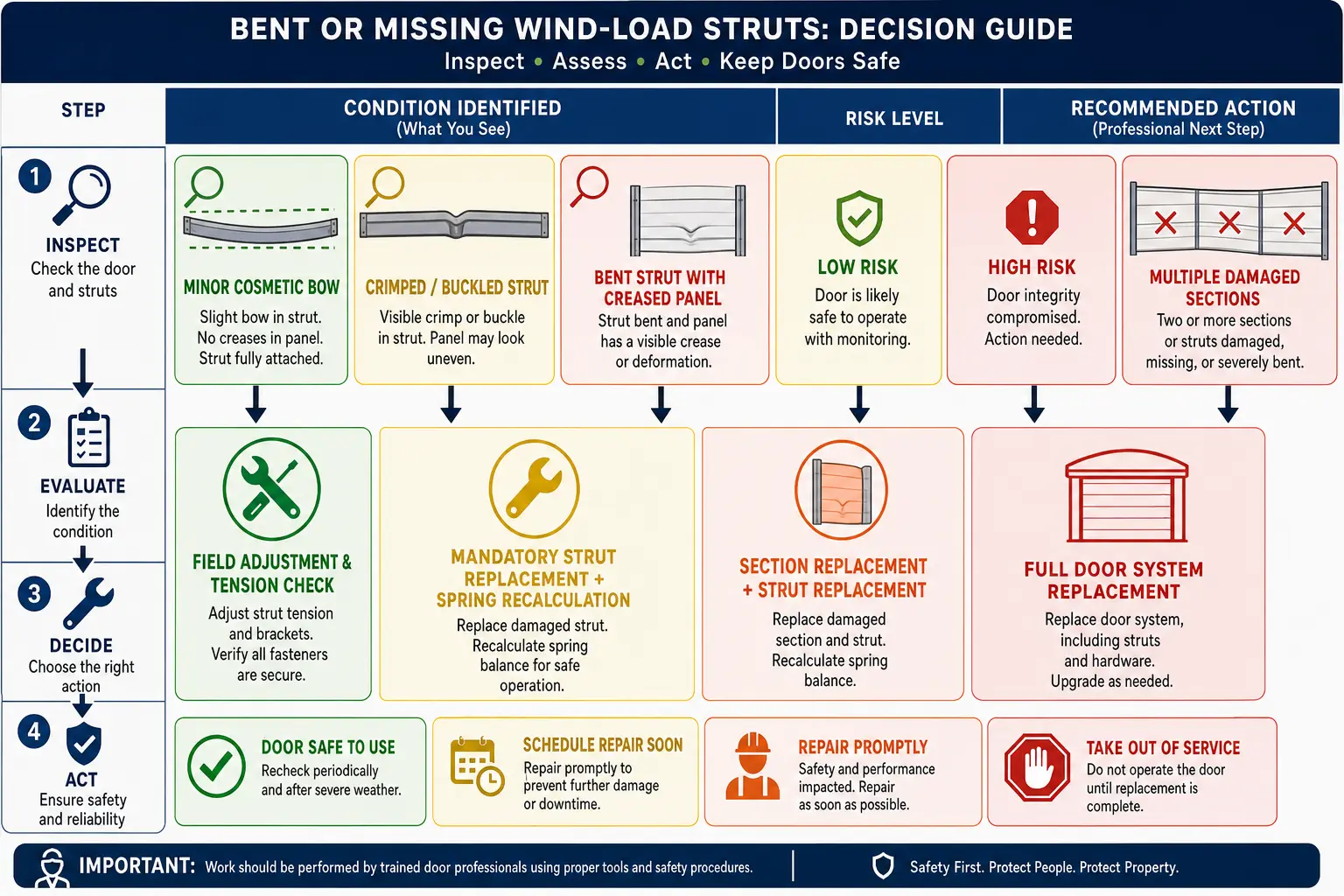
Evaluating vendor proposals requires clear baseline data. Use this technical decision framework to determine the proper scope:
| Damage Diagnostic | Structural Impact | Recommended Action | Estimated Cost (2026) |
|---|---|---|---|
| Minor Bowing (No Steel Crease) | < 15% reduction in moment of inertia | Fastener retightening, track alignment & tension check | $150 – $275 |
| Crimped or Buckled Strut Only | 70% – 85% loss of flexural stiffness | Strut replacement + spring IPPT recalibration | $175 – $420 |
| Bent Strut + Creased Door Panel | Severe panel skin fatigue & joint failure | Targeted commercial garage door panel replacement + new strut | $750 – $1,850 |
| Multiple Section Creases / Obsolete Profile | System-wide structural invalidation | Full assembly replacement via professional commercial garage door repair texas technicians | $3,200 – $9,500+ |
Professional Recalibration and Spring Counterbalance Protocols
Replacing a commercial wind strut is not merely a matter of driving Tek screws into steel. Because struts add significant weight across section spans, replacing or retrofitting a strut requires recalculating torsion spring IPPT (Inches Per Turn).
Attempting to force a heavier door open without re-tensioning springs stresses the operator drive assembly. Qualified technicians perform high-precision garage door torsion spring repair near me services, ensuring accurate calculation of how many turns on a garage door spring are necessary to balance the door safely. Scheduling a routine garage door tune up ensures ongoing alignment, fastener torque retention, and motor safety limit verification.
Frequently Asked Questions
Can you straighten a bent commercial garage door wind strut with a hammer?
No. Field-straightening a cold-formed steel U-bar strut creates work-hardening stress fractures and fails to restore the section modulus ($Z_x$). A hammered strut loses up to 85% of its structural wind-load capacity, failing ANSI/DASMA 108 standards.
How do missing struts affect commercial opener lifespan?
Missing struts cause sections to flex under cycle operation. This dynamic sagging binds end rollers inside vertical tracks, placing continuous thermal load on the motor and accelerating drive gear wear.
Will a missing wind strut cause my commercial property insurance to reject a storm claim?
Yes. Adjusters inspect door integrity after major weather events. If an overhead sectional door breaches because required structural stiffeners were missing or compromised, insurers may classify the damage as unaddressed maintenance and deny building failure claims.
Take Action: Secure Your Commercial Door Infrastructure
Don’t let a compromised wind strut jeopardize your operations or property compliance. Up & Down Garage Doors brings over 15 years of family-owned experience, 24/7 availability, and certified LiftMaster and Clopay expertise to commercial facilities across Connecticut, Texas, New York, Illinois, and Arizona. Contact our licensed technicians today for an authoritative structural inspection and transparent evaluation.
You May Also Like