





The Sourcing Trap: Risks of Replacing Discontinued Garage Door Panels
Published: Aug 3, 2026
It is a frustratingly common scenario: you back out of your driveway a bit too quickly, or a rogue storm flings a heavy branch, leaving a deep crease in a single garage door panel. Naturally, your first instinct is to look for a quick, localized fix. Sourcing a single replacement panel seems like the most practical and budget-friendly move.
However, if your garage door model has been discontinued by the manufacturer, this straightforward path quickly turns into a structural and financial dead end. While attempting to patch or piece together an older door is tempting, mixing incompatible parts introduces severe technical, safety, and legal risks.
Understanding the underlying physics and engineering of garage doors reveals why trying to patch a discontinued panel is often a dangerous and expensive mistake.
The 4 Fatal Pitfalls of Discontinued Panel Replacement
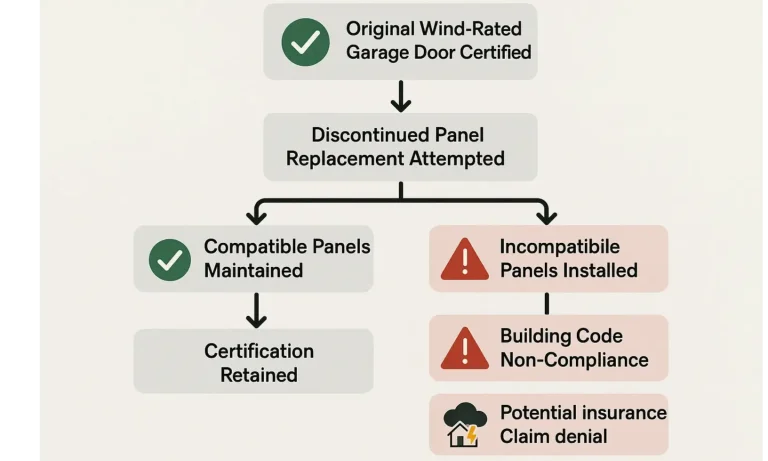
Pitfall A: The Tongue-and-Groove Joint Lockout
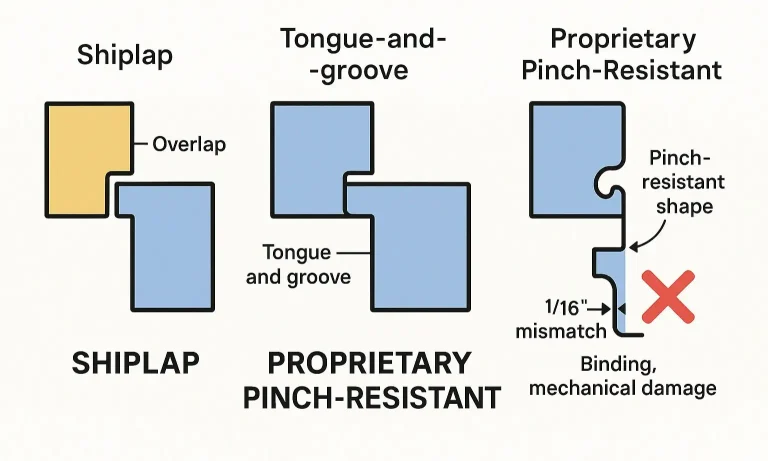
Garage door panels are not universal building blocks. Manufacturers design sections to interlock using highly engineered, proprietary joint profiles—most notably Shiplap, Tongue-and-Groove, and patented Pinch-Resistant designs.
When a door model is discontinued, finding a factory-matched panel becomes nearly impossible. Forcing a section from a newer product line or a different manufacturer into your existing assembly will fail. Even a tiny mismatch of 1/16th of an inch prevents the sections from articulating smoothly as the door rolls around the track radius. This leads to track binding, panel creasing, and severe strain on your opener. If you are dealing with a damaged section, attempting a mismatched garage door panel replacement will compromise the entire system rather than resolve the issue.
To understand your options before committing to a patch job, consult a professional evaluation on garage door panels repair to assess compatibility.
Pitfall B: The Torsion Spring Weight Equation
A residential garage door is a finely balanced mechanical system. The torsion or extension springs are engineered to counterbalance the exact, ounce-for-ounce weight of your specific door.
If you attempt to substitute a discontinued hollow steel panel with a newer insulated panel, you alter the overall weight distribution. A variance of just 2 to 5 pounds can leave the system completely unbalanced [3]. An unbalanced door forces your automatic opener to work harder, causing the motor gears to strip or the safety reverse mechanism to fail. It also places immense strain on the springs. Correcting this weight discrepancy requires recalculating the physics of the system and performing a complete garage door spring replacement to handle the new load, significantly driving up repair costs.
To see how these forces interact safely, you can learn more about how does a garage door spring work before attempting any modifications.
Pitfall C: The Wind-Load Code and Insurance Liability Trap
In many states—particularly coastal areas or storm-prone zones—garage doors must meet strict wind-load and building code regulations. Manufacturers test and certify the door as a single, unified structure.
According to DASMA Technical Datasheet #152, garage door failures account for up to 80% of residential structural damage during high-wind events due to rapid home pressurization once the door integrity is breached. If you modify a wind-rated door with a non-matching, unrated aftermarket panel, you void its Wind Load Certification. If a storm hits and the door fails, insurance adjusters can deny your structural damage claims because the pressure-rated opening was modified with unapproved parts.
If you live in a high-wind territory, maintaining a fully certified system with dedicated wind resistant garage doors is crucial for protecting your property and preserving your insurance coverage.
Pitfall D: Aesthetic Degradation & Legacy System Complications
Even if you manage to find a panel that physically fits, you will face an obvious aesthetic mismatch. Years of UV exposure cause “chalking” and paint fading on older steel doors. A factory-fresh panel will stand out dramatically against the weathered sections, hurting your home’s curb appeal.
Furthermore, legacy systems like Wayne Dalton’s discontinued Torquemaster One counterbalance system present unique challenges. Because these older components are no longer manufactured, attempting to repair a single panel often forces an expensive conversion to a modern standard torsion spring system, compounding your repair bills.
Evaluating the "Rule of 50"
When deciding whether to move forward with a repair or opt for a full replacement, industry experts recommend applying the 50% Rule:
The 50% Rule: If the cost to repair your door is 50% or more of the price of a brand-new door, it is a smarter financial investment to choose a full replacement.
If the combined cost of tracking down a rare, discontinued panel, paying premium labor, adjusting or replacing the springs, and repainting the door exceeds half the price of a modern system, a full replacement is the economically superior choice.
Additionally, consider the age of your system. According to InterNACHI, a standard residential garage door has a lifespan of 15 to 20 years, while an automatic opener lasts 10 to 15 years. Spending hundreds of dollars to patch a 12-year-old door means you are investing premium capital into a system that is already near the end of its operational life. Deciding whether can a damaged garage door be repaired requires analyzing these long-term financial realities.
Frequently Asked Questions
Can I use a different brand’s panel if the dimensions match?
No. Even if the height and width are identical, the interlocking joints (shiplap or tongue-and-groove) will not line up perfectly. Forcing different brands together prevents smooth articulation and will damage your tracks and opener.
How do I find out if my garage door is discontinued?
Look for the manufacturer’s data sticker, typically located on the inside edge of the bottom panel or on the side of individual sections. This label contains the model number, serial number, and manufacture date. You can use these details to check availability with a certified dealer.
Will mixing panels void my garage door warranty?
Yes. Manufacturers specifically state that installing non-OEM (Original Equipment Manufacturer) parts or mixing different model lines immediately voids any remaining warranty on the structural integrity of the door.
Making the Smart Investment
When dealing with a damaged, discontinued garage door panel, attempting a temporary patch is a high-risk gamble. Between mechanical alignment failures, unbalanced spring physics, and building code violations, the short-term savings of a quick fix can easily turn into expensive structural repairs.
Opting for a complete, modern door system ensures safety, code compliance, and reliable operation. Modern systems offer superior energy efficiency, quiet belt-drive openers, and a fresh manufacturer warranty—giving you long-term peace of mind.
You May Also Like

Legacy Fixed Code Garage Openers and Modern Security Risks
You pull into your driveway, press a button, and like magic, your garage door glides open. It’s a moment of convenience we take for granted. But what if that simple remote in your car is broadcasting an open…
Published Date: Jul 22, 2026
Safety Risks of Operating a Bent Garage Door
That new dent in your garage door is glaring. Maybe a car bumped it, or a stray basketball found its mark. Your first thought might be about the cosmetic damage, but the real issue isn't what you see—it's what you…
Published Date: Jun 19, 2026
When NOT to Reengage Your Garage Door Opener: Identifying Safety Risks
You’re heading out, you press the button on your garage door remote, and… nothing. Or worse, a horrible grinding sound fills the air, and the door stops halfway, hanging at a crooked angle. Your first instinct is…
Published Date: Apr 6, 2026