




Choosing and Maintaining a Secure Garage Door Opener
Published: Sep 8, 2026
Many homeowners invest heavily in smart locks and security cameras for their front doors while leaving their largest physical entry point vulnerable. According to the U.S. Department of Justice, approximately 9% of residential burglars gain entry through the garage, and 28% of these break-ins occur while residents are inside the home. Securing this critical barrier requires understanding both the physical physics of forced entry and the digital mechanics of modern signal hacking.
The Anatomy of a Secure Garage Door Opener
When evaluating a new opener, the drive configuration you choose fundamentally dictates its physical security profile.
- Wall-Mounted Jackshaft Openers: These units mount directly to the wall beside the garage door torsion shaft. Because they eliminate the central overhead rail, they completely prevent “trolley-fishing”—the common physical break-in method where an intruder slips a wire hanger through the top panel to pull the manual release.
- Overhead Belt and Chain Drives: Traditional overhead systems remain highly popular. If you are experiencing a garage door not opening but motor running scenario, it often means the emergency release has been disconnected, which is also a primary physical security risk if triggered by an intruder from the outside.
- Automatic Track Deadbolts: Modern high-security openers integrate an automatic deadbolt that physically locks into the track when the door closes, communicating directly with the motor head to prevent manual prying.
Cryptographic Security: Decoupling Rolling Codes and RF Attacks
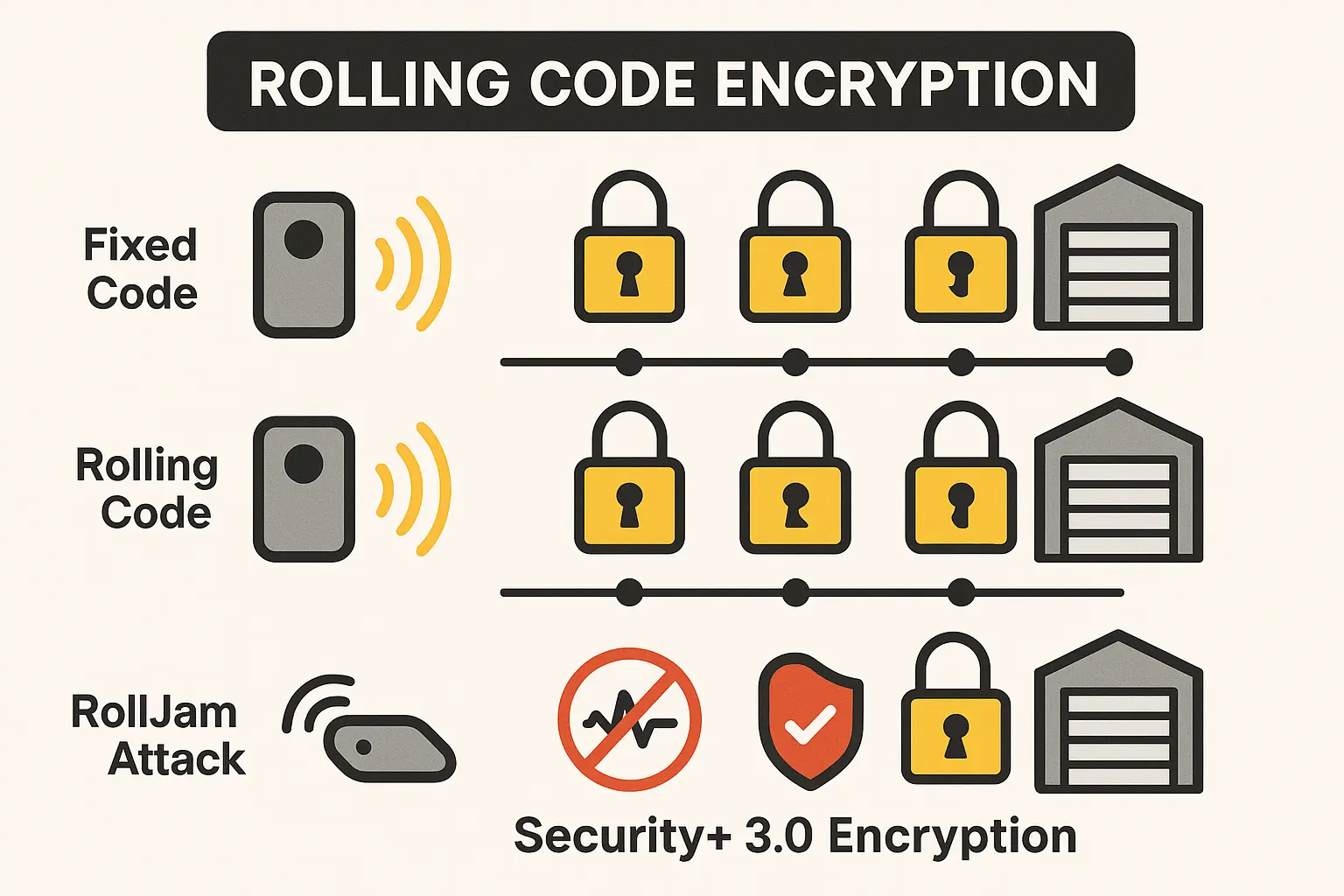
Historically, RF garage remotes relied on fixed-code DIP switches. In 2015, security researcher Samy Kamkar demonstrated the “OpenSesame” exploit, brute-forcing fixed-code systems in under 10 seconds using a modified toy pager. While standard rolling codes solved this by changing the code after every press, sophisticated thieves now use “RollJam” devices. These devices jam the receiver at 315/390 MHz while capturing the first transmission, leaving the homeowner to press the button a second time while the attacker saves an active, unused code for future entry.
To mitigate this, industry leaders transitioned to dual-frequency, advanced rolling code systems like LiftMaster’s Security+ 3.0. This standard uses sophisticated encryption and dynamic frequency switching to block code-grabbing hardware. For smart-home enthusiasts, the shift to closed ecosystems has sparked a movement toward local-only hardware interfaces like RatGDO, which bypasses cloud vulnerabilities by letting you run encrypted automation locally within Home Assistant.
The 15-Point Physical Security and Maintenance Checklist
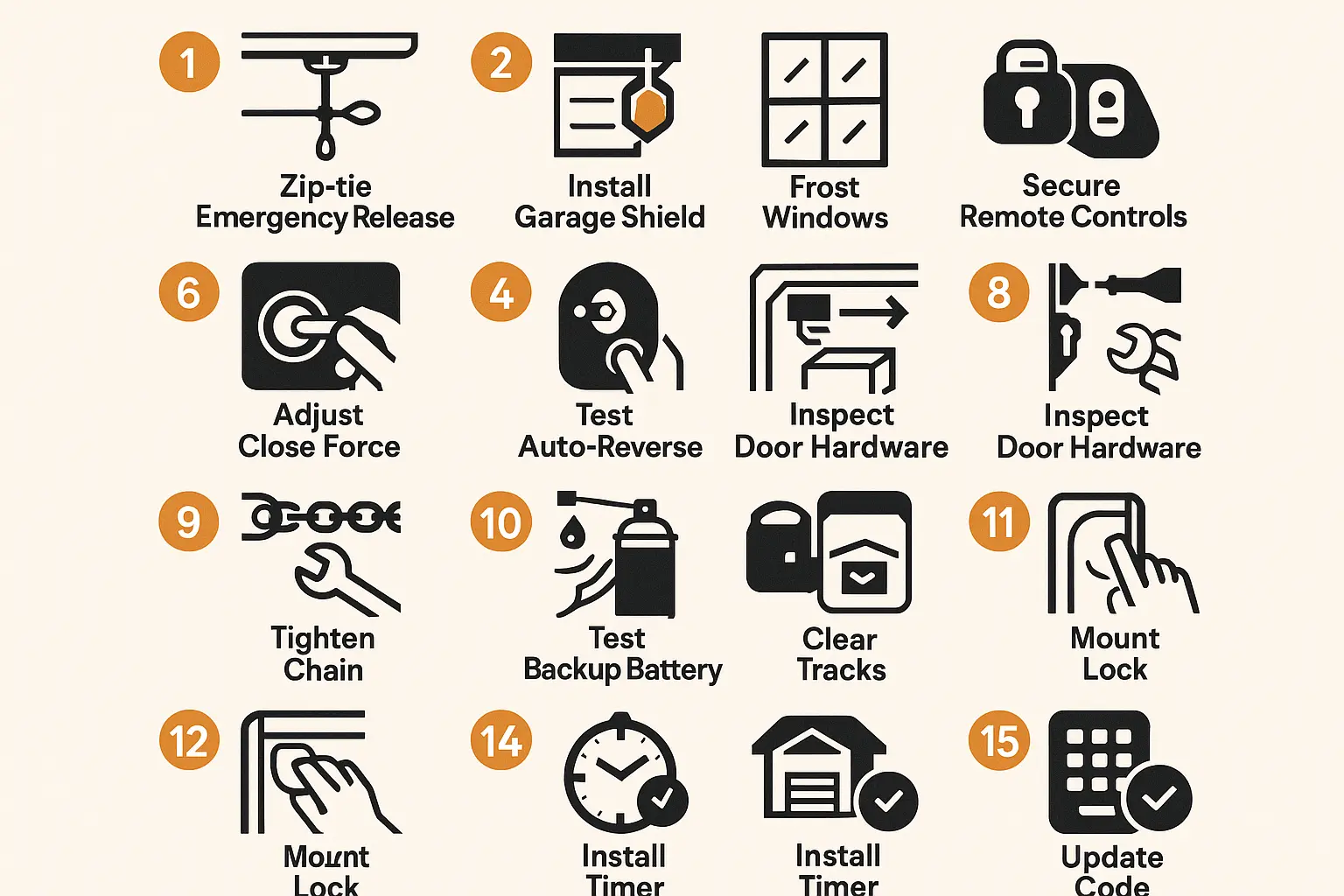
A secure digital system is useless if the physical door can be bypassed. Security testing shows a standard overhead garage door can be breached from the outside in under six seconds using a simple coat hanger. Use this checklist to reinforce your perimeter:
- Shield the Emergency Release: Install an affordable plastic shield over the trolley mechanism to block coat-hanger access.
- Secure the Pull-Cord: Secure the manual release handle with a breakaway zip-tie that can still be broken with strong downward force in an emergency.
- Frost Your Windows: Use frosted privacy film to block views of your car, belongings, and trolley mechanism.
- Ditch the Visor Remote: Replace visor-mounted remotes with small keychain fobs or vehicle-integrated transponders to prevent thieves from stealing the remote out of a driveway-parked car.
- Audit Smart Features: Secure your connected app (such as myQ or Aladdin Connect) by enabling biometric multi-factor authentication (MFA). Disable any “Auto-Open on Geofencing” features to avoid accidental door openings.
Professional Installation vs. DIY: The True Security Tradeoffs
Many homeowners overlook the security implications of installation quality. A poorly DIY-installed opener can leave loose header brackets, incorrect traveler adjustments, or out-of-balance torsion springs. If the door isn’t balanced correctly, intruders can use a pry bar to warp the top door panel and slip a wire hook inside.
Additionally, professional installers ensure proper structural support, including professional garage door framing service to keep your door aligned. If you suspect structural warping or alignment problems, contacting a professional for an emergency garage door repair near me can prevent a vulnerability from becoming an open invitation. In areas like Texas, combining security upgrades with specialized garage door insulation dallas services also ensures the physical panels remain dense, rigid, and resistant to prying attacks.
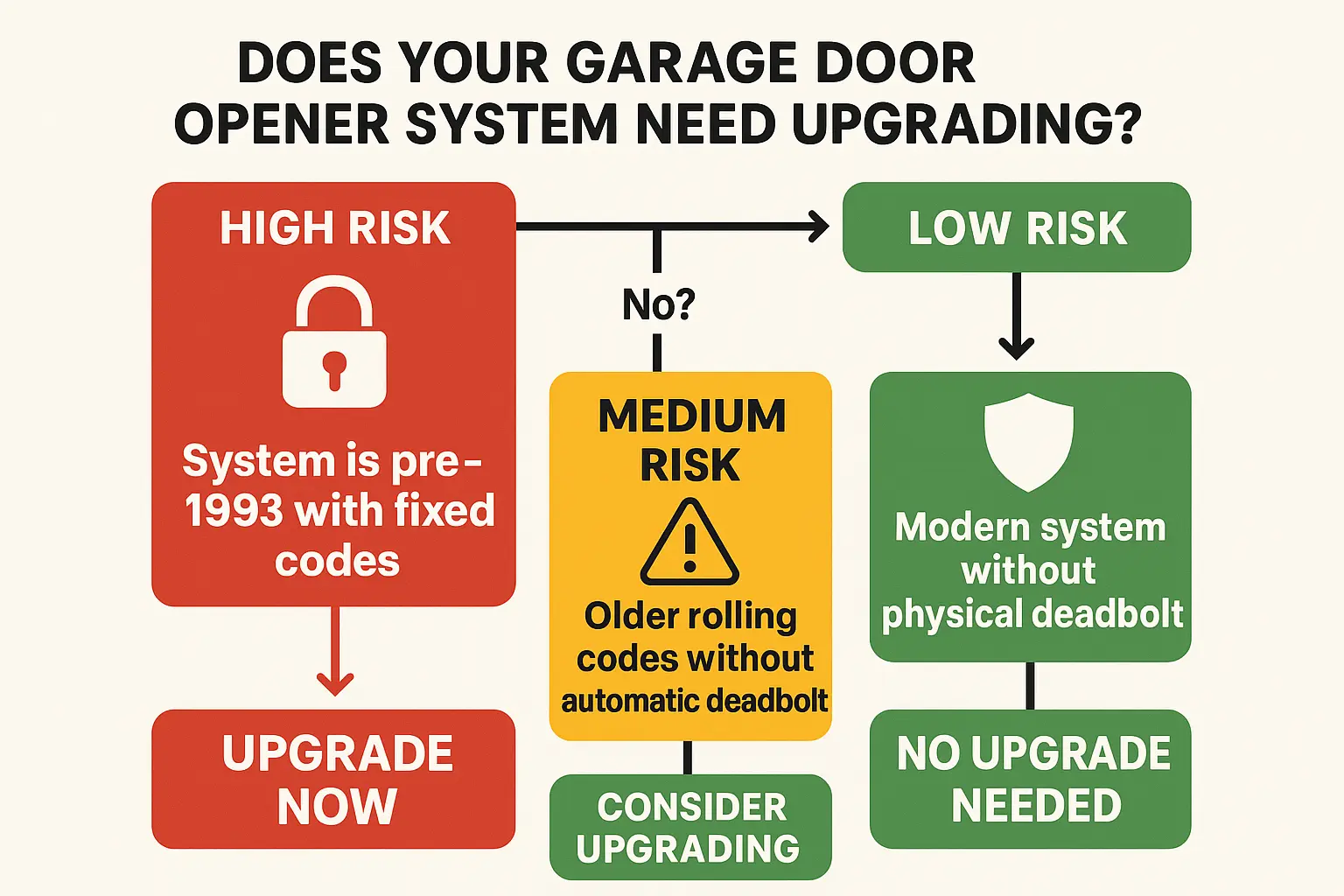
The "When to Upgrade" Diagnostic Matrix
Evaluating your existing setup determines if you need an immediate replacement or a simple retrofit:
| Manufacture Date | Primary Security Risk | Recommendation |
|---|---|---|
| Pre-1993 | Lack of safety eyes; fixed-code DIP switch vulnerabilities. | Immediate replacement mandatory. |
| 1993–2010 | Standard rolling codes; vulnerable to RollJam; lack of smart integration. | Upgrade recommended for modern encryption. |
| 2011–Present | Smart cloud systems; vulnerable to app sharing or lack of physical track locks. | Low-risk; retrofitting physical locks and configuring MFA is recommended. |
Frequently Asked Questions
Can someone hack my garage door opener using a Flipper Zero?
A Flipper Zero can capture older, fixed-code signals (pre-1993) and instantly replay them to open the door. However, it cannot easily bypass modern rolling code systems like Security+ 2.0 or 3.0 because those systems require a synchronized, cryptographic handshake that changes with every button press.
What is the “six-second” garage door break-in, and how do I prevent it?
This exploit occurs when an intruder slips a coat hanger wire through the top gap of the garage door, hooks the red emergency release cord, and pulls it to manually open the door. You can prevent this by installing a plastic console shield over your trolley or securing the release lever with a breakaway zip-tie.
How does an automatic deadbolt protect my garage?
An automatic deadbolt physical lock mounts directly to your garage track. When the door closes completely, the motor head sends a signal to throw a heavy steel bolt through the track rail, physically preventing intruders from prying the door up from the bottom.
You May Also Like