



Torsion Spring Color Codes: Identifying Your Spring Size
Published: Oct 13, 2026
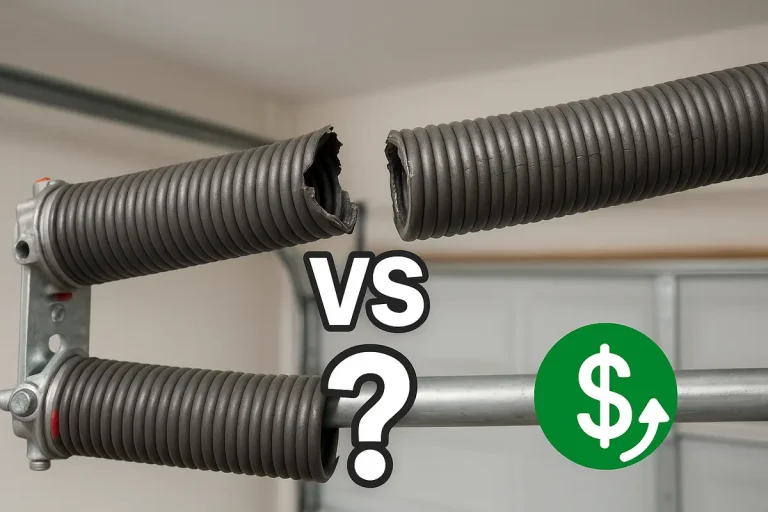
If you are staring at a broken torsion spring above your garage door and trying to figure out what replacement part to order, you are likely looking at a small stripe of paint on the coil. While the Door & Access Systems Manufacturers Association (DASMA) standard TDS-171 assigns specific colors to wire sizes, relying solely on paint can lead to costly ordering mistakes. DASMA color codes repeat roughly every 10 wire sizes, and years of friction, grease, and surface rust can fade these stripes beyond recognition.
Understanding the full diagnostic framework—from end cone colors to physical measurements—ensures you identify the exact match for a balanced, safe garage door system.
DASMA Color Decoder & Wire Gauge Standards
DASMA establishes standardized color coding across North American manufacturers. However, because color palettes cycle across more than 34 standardized wire diameters ranging from .177″ up to .625″, seeing a yellow or gold stripe is only your first clue.
| DASMA Color | Wire Diameter (in.) | 20-Coil Length (in.) |
|---|---|---|
| Yellow | .207 | 4 1/8″ (4.125″) |
| White | .218 | 4 3/8″ (4.375″) |
| Green | .225 | 4 1/2″ (4.500″) |
| Gold | .234 / .250 | 4 11/16″ / 5.00″ |
| Blue | .242 / .262 | 4 13/16″ / 5 1/4″ |
| Red | .255 / .273 | 5 1/8″ / 5 7/16″ |
Because color sequences repeat across size tiers, verifying physical coil dimensions is essential before ordering replacement parts.
The Dual-Color Rule: Winding Cone vs. Wire Gauge
One of the most common identification errors occurs when homeowner evaluators confuse cone colors with wire gauge paint. Torsion springs feature paint in two distinct places, each communicating completely different technical specs:
- Winding & Stationary Cone Color: Identifies Wind Direction.
- RED Cone: Designates Right-Hand Wind (installed on the left side of the center anchor bracket in standard dual-spring setups).
- BLACK Cone: Designates Left-Hand Wind (installed on the right side of the center anchor bracket).
- Coil Body Stripe: Identifies the Wire Gauge diameter.
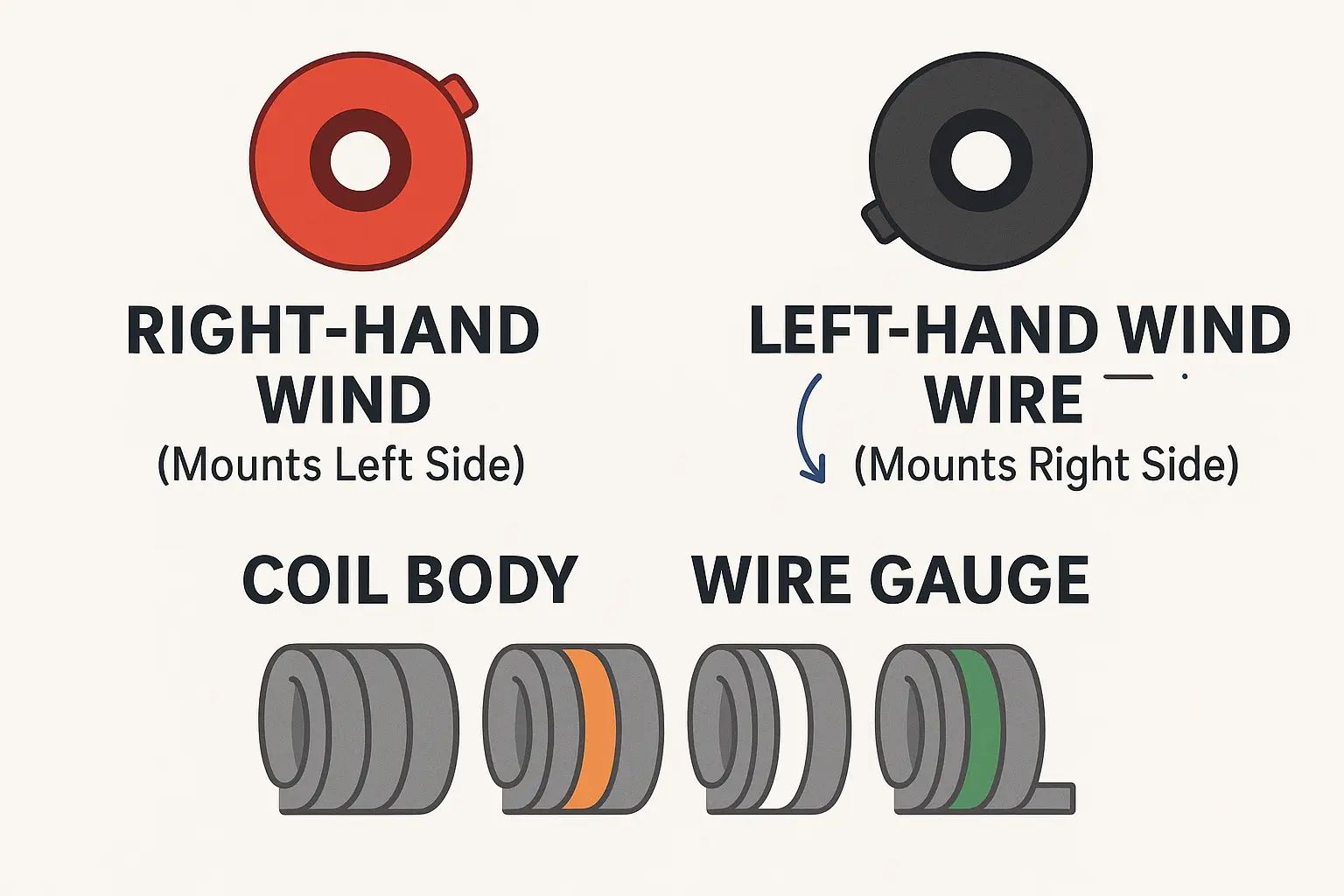
Never mistake a red stationary winding cone for a red wire gauge stripe. End cones designate wind orientation, while coil stripes specify wire thickness.
How to Identify Wire Size When Paint is Faded, Rusted, or Missing (The 10/20-Coil Protocol)
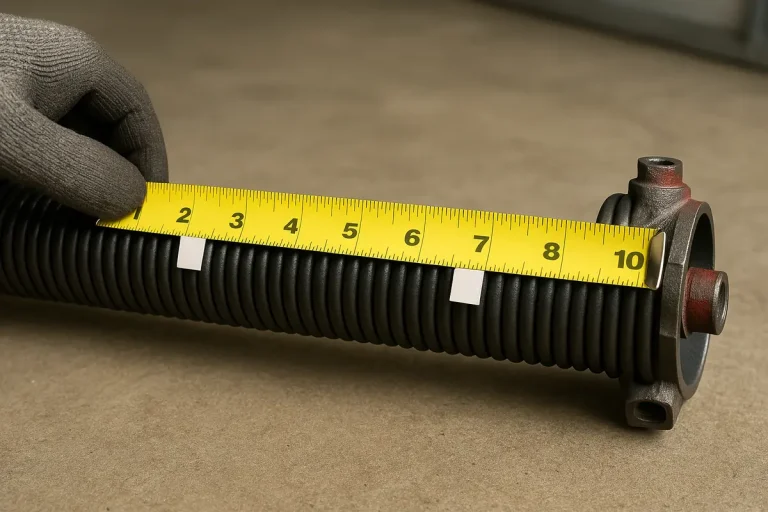
When friction or surface rust renders paint unreadable, use the 20-coil physical measurement method to calculate wire diameter with exact accuracy.
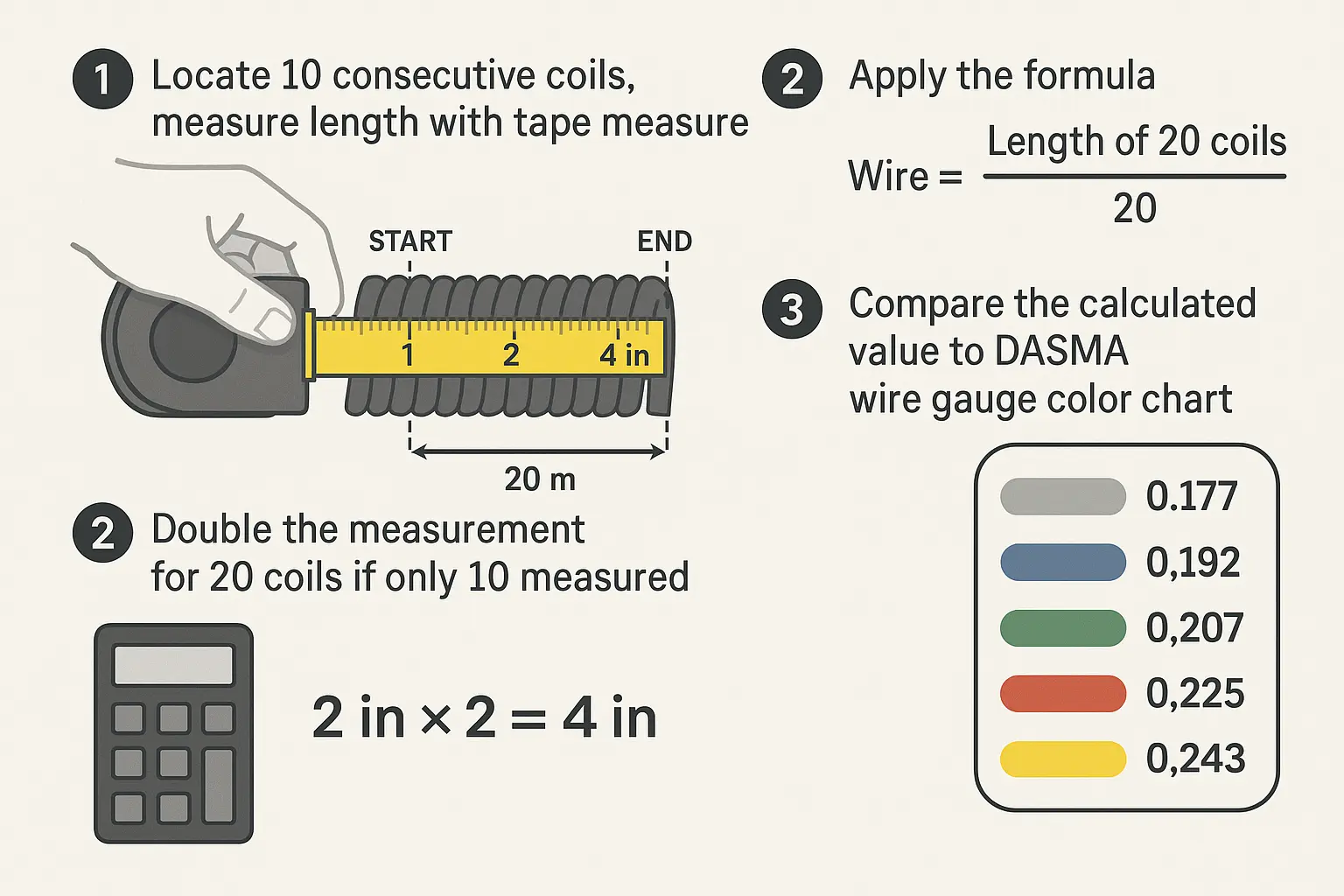
If you suspect spring degradation or balance issues, knowing how to check garage door springs helps confirm whether simple physical measuring or a full replacement is required. Routine garage door spring maintenance also helps prevent coil paint from flaking off prematurely.
Critical Warning: Why Color Code Alone Is NOT Enough to Buy a Replacement
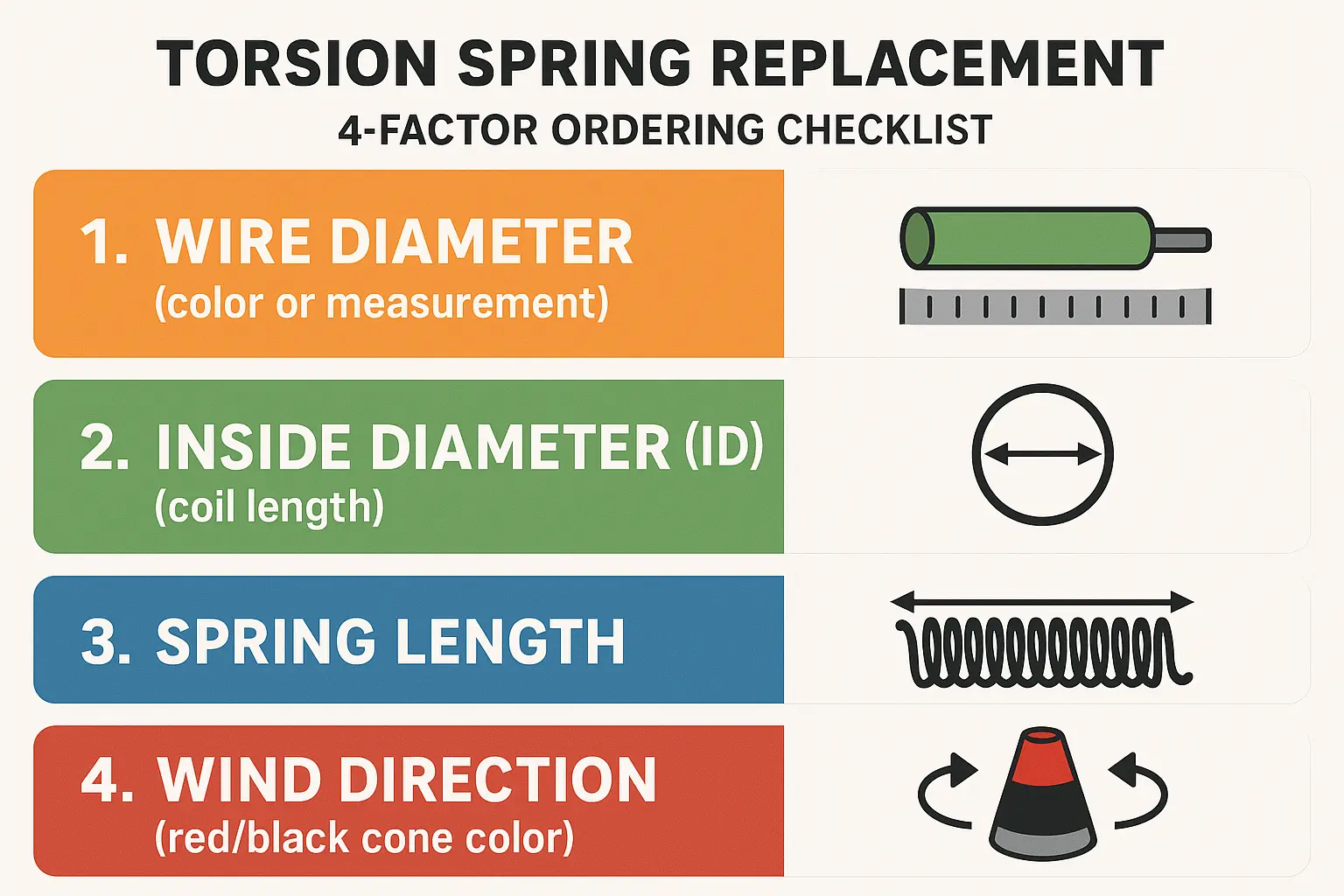
Ordering replacement parts based strictly on wire color codes frequently leads to door imbalance or garage door opener motor burnout. To ensure safe operation, verify the complete 4-Factor Torsion Spring Specification Equation:
- Wire Gauge: Verified through DASMA color coding combined with the 20-coil measurement protocol.
- Inside Diameter (ID): Standard residential sizes are 1-3/4″ or 2″ (frequently stamped on the cast aluminum cone).
- Overall Unwound Length: Measure the unwound coil length in inches from end to end.
- Wind Direction: Left-Hand Wind or Right-Hand Wind based on cone color and coil spiral direction.
Attempting installation with incorrect specs risks serious injury under high kinetic tension. If you are dealing with a broken garage door spring, professional service ensures accurate calibration. To find trusted support in your area, search to replace garage door spring near me.
Torsion Spring vs. Extension Spring Color Codes
It is critical not to confuse torsion spring ratings with extension spring standards. When evaluating a torsion spring vs extension spring, keep in mind that extension spring colors indicate door weight capacity (e.g., Gold = 80 lbs, Red = 110 lbs). Torsion spring colors, by contrast, denote wire diameter thickness. Mixing up these categories will result in buying incorrect, incompatible hardware.
Before making adjustments or handling tensioned components, review technical guidelines on how to adjust garage door springs to maintain proper safety protocols.
Frequently Asked Questions
Why do DASMA torsion spring color codes repeat across wire sizes?
DASMA cycles through a standard 10-color palette across more than 30 wire sizes to simplify manufacturing processes. Because a color like Gold can designate .177″, .250″, or .331″ wire, you must perform a 20-coil physical measurement to verify the exact decimal gauge.
How do I know if my garage door torsion spring is right-wind or left-wind?
Check the color of the cast winding or stationary end cone. A red cone indicates a right-hand wind spring, typically installed on the left side of the center bracket. A black cone indicates a left-hand wind spring, usually mounted on the right side.
Can I replace a single broken torsion spring with a high-cycle dual spring setup?
Yes. Converting from a single-spring configuration to a dual-spring setup distributes structural weight evenly, doubles system cycle life, and prevents your garage door from crashing down if one spring snaps in the future.
You May Also Like