




Sectional Garage Doors: How Sections, Hinges, and Rollers Work Together
Published: Oct 21, 2026
When evaluating a malfunctioning or noisy garage door, homeowners often look at individual components in isolation. However, according to DASMA standards—which govern over 95% of North American residential and commercial doors—a sectional garage door functions as a single kinetic assembly.
The interaction between door sections, graduated hinges, and stem rollers dictates performance, balance, and longevity. Understanding this “Kinematic Triad” allows you to evaluate replacement specs, eliminate operational binding, and make informed choices when upgrading your hardware.
The Physics of Motion: How the Triad Travels
A sectional garage door does not travel up and down a perfectly plumb vertical line. Vertical tracks are pitched slightly away from the jamb—typically 1/8 inch of backward slant per section height. This pitch allows the door to press tight against perimeter weather stripping when closed, preventing draft intrusion without scraping the jamb seal during travel.
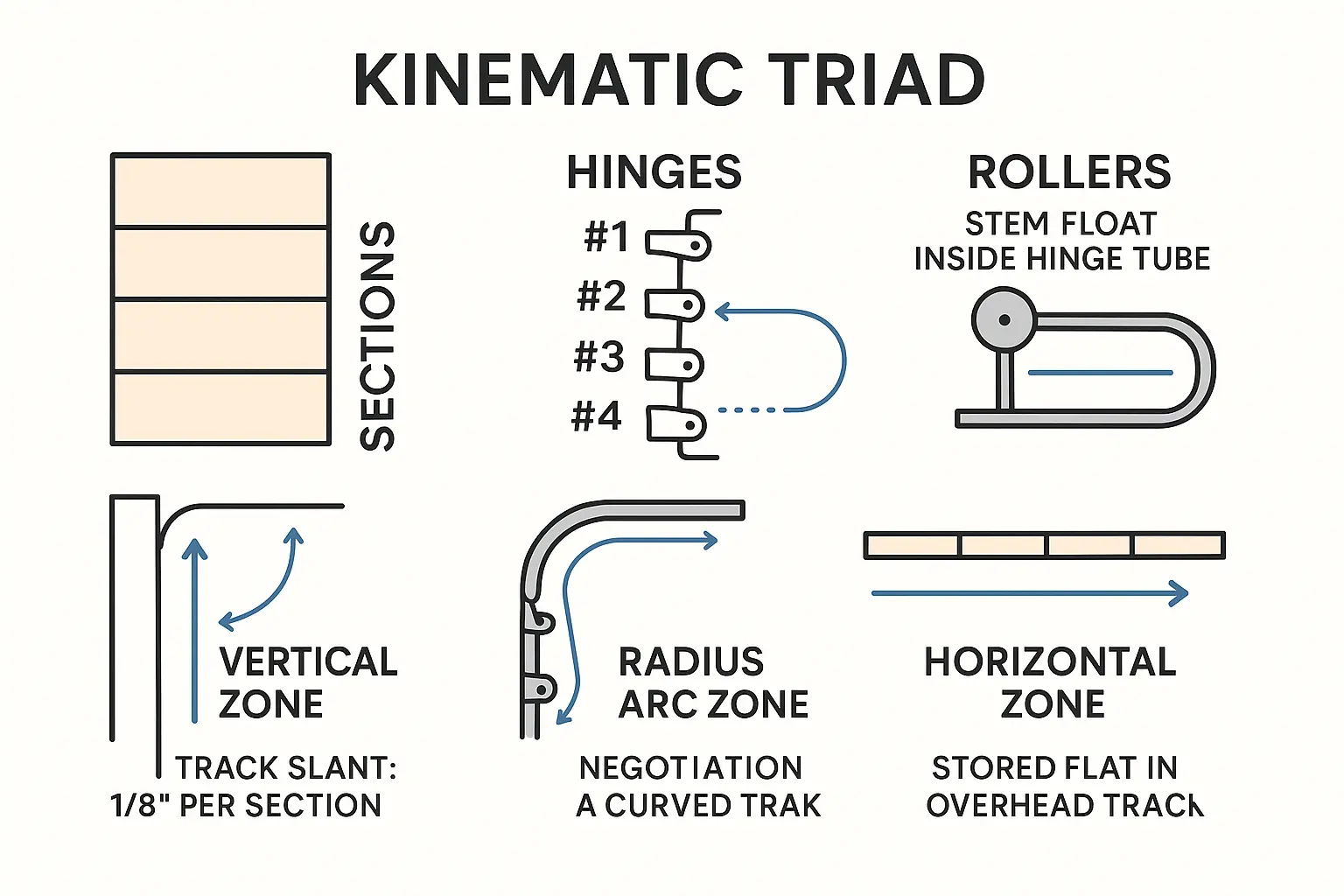
The door travels across three distinct mechanical zones:
- Vertical Zone: The closed state where section weight rests squarely on the floor or bottom brackets, compressed tightly against the jamb.
- Radius Arc Zone: The curved track section where hinges knuckle panel joints while rollers navigate a short radius turn.
- Horizontal Zone: The overhead storage position where section weight shifts entirely to horizontal track sets, supported by tension cables and spring assemblies. Understanding how does a garage door spring work explains how counterbalance neutralizes this overhead weight.
Panel Engineering and Joint Mechanics
Door panels form the structural skin of the triad, connected by precision joint profiles. Standard builder-grade panels use tongue-and-groove joints that interlock for weather resistance. Modern residential designs feature flush, pinch-resistant contoured joints, which prevent finger-trapping during articulation around track curves. Internal steel end stiles reinforce panel edges, providing anchor points for hinges and preventing horizontal panel sag (“oil-canning”).
The Graduated Hinge System (#1 through #5 Explained)
Because vertical tracks are pitched away from the frame, standard flat hinges cannot keep rollers centered in the track. Sectional systems rely on a graduated hinge system numbered #1 through #5:
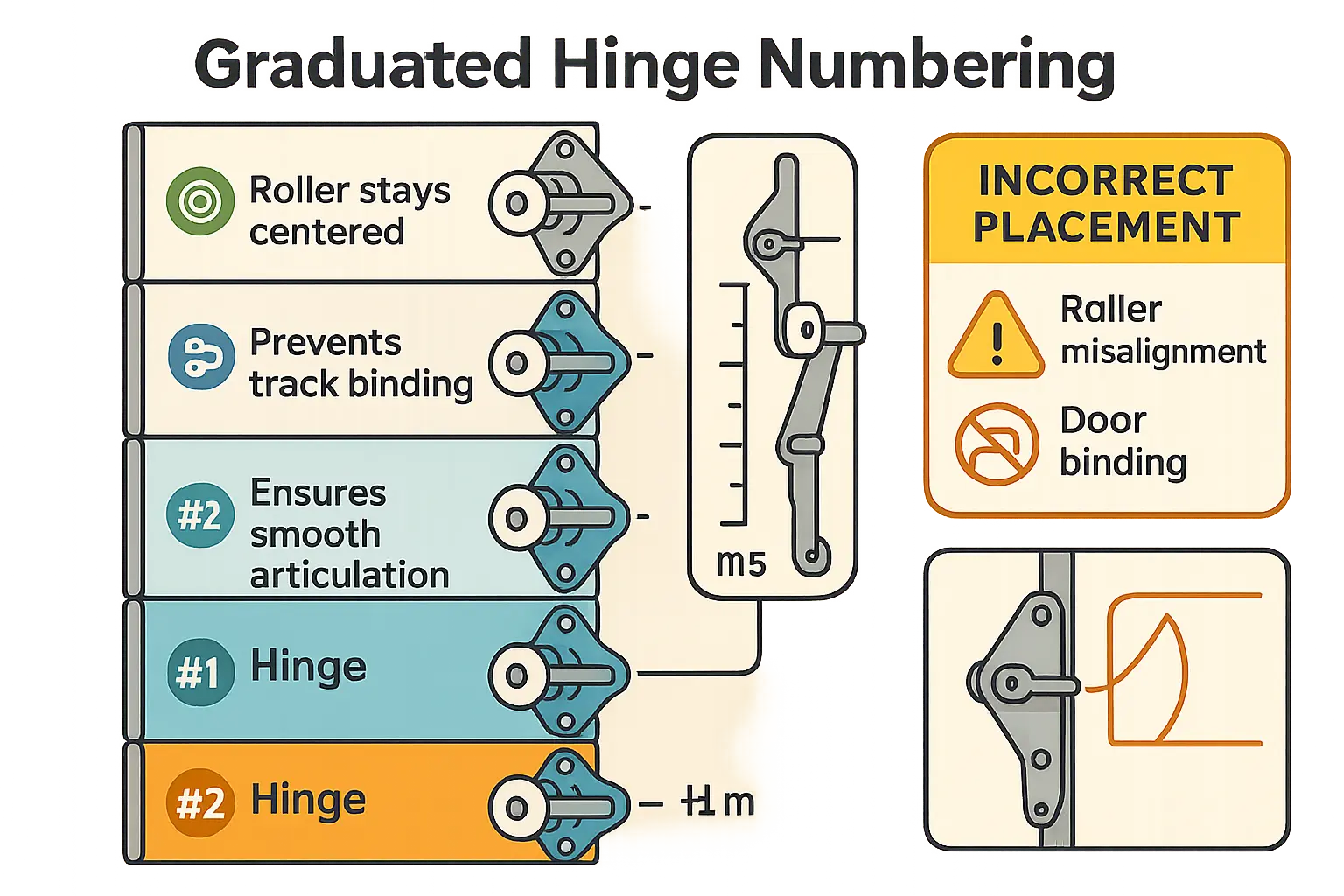
- #1 Hinges: Positioned along the center stiles and between sections 1 and 2 at the outer edges. They feature the shortest stem sleeve offset.
- #2 Hinges: Installed between sections 2 and 3 at outer edges, featuring a deeper offset to project the roller stem further out.
- #3, #4, and #5 Hinges: Installed progressively higher on 4-panel and 5-panel doors. Each step increases offset depth, compensating for the track’s backward slant.
Installing the wrong hinge number forces the roller off-center, leading to binding, panel popping, or track jump.
Steel Gauge Evaluation
- 18-Gauge (0.0478 in): Builder-grade. Prone to flexing under wind load or heavy insulated panels.
- 14-Gauge (0.0747 in): Standard residential benchmark offering long-term durability and rigid alignment.
- 11-Gauge (0.1196 in): Heavy-duty commercial standard for high-cycle doors or doors wider than 14 feet.
Rollers and Floating Stem Dynamics
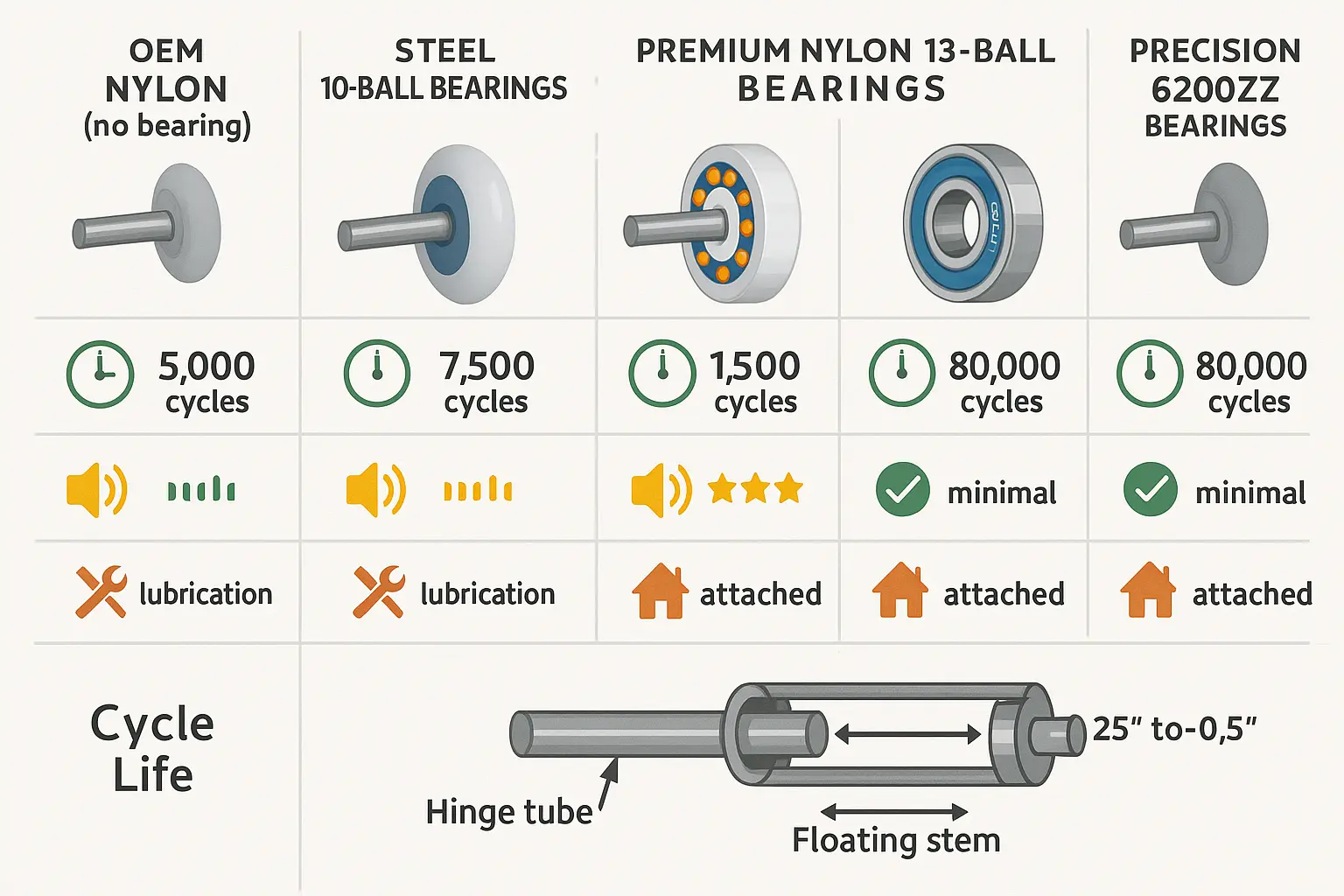
Rollers act as the dynamic bridge between moving panels and stationary track channels. Crucially, roller stems are never clamped rigid inside hinge barrels; they require 0.25 to 0.5 inches of free lateral float. This float accommodates building settling, track width variations, and thermal expansion.
Hardware Selection Matrix
- OEM Plastic (Unshielded): Rated for 1,000–2,500 cycles (1–2 years). High failure rate.
- 10-Ball Steel: Rated for 5,000–10,000 cycles. Durable, but prone to metallic noise and rust without frequent lubrication.
- 13-Ball Sealed Nylon: Rated for 15,000–20,000 cycles. Delivers up to 75% noise reduction compared to steel. A popular option when selecting quiet garage doors.
- Precision 6200ZZ Nylon: Rated for 100,000+ cycles. Commercial neoprene-sealed bearings designed for maintenance-free operation.
Routine service involves knowing how to proper lubricate garage door parts—focusing on stem sleeves and roller bearings rather than inside track channels.
System Diagnostics: Hardware Fault Mapping
When issues arise, mechanical symptoms trace back to specific components:
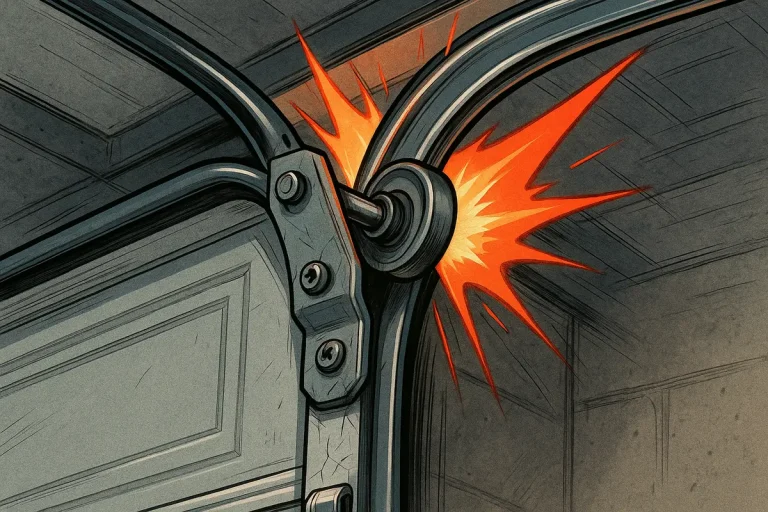
- Loud Popping at Curve: Dry hinge knuckles or cracked leaf plates. Reviewing comprehensive garage door noise vibration troubleshooting helps pinpoint worn pivot joints.
- Shaking During Travel: Worn or flat-spotted rollers sliding rather than rolling across the track flange.
- Top Section Gap: Misaligned top fixture brackets or worn upper hinges preventing weather seal compression.
For structural hardware upgrades or a complete garage door installation, matching hinge gauges and roller cycle ratings ensures decades of smooth operation. Consistent garage door maintenance keeps every part moving smoothly.
Frequently Asked Questions
Can I replace an individual hinge or roller without releasing spring tension?
Yes, intermediate panel hinges and standard edge rollers can be safely replaced while the door is closed. However, bottom roller brackets are directly anchored to live counterbalance cables under high tension and should never be unbolted without professional spring isolation.
How do I know which hinge number to buy for a replacement?
Look at the stamped number on the outer leaf of your existing hinge (#1, #2, #3, etc.). Hinges mounted along center stiles are always #1, while side hinges increase in number from bottom to top to maintain proper track clearance.
Why are my newly installed rollers binding against the track flange?
Binding typically occurs when an incorrect hinge number was installed, altering the roller stem offset, or when roller stems are jammed too tightly into hinge sleeves without allowing mandatory lateral float.
You May Also Like