





Composite vs Cedar Overlay Boards on Steel Carriage Doors: Engineering, Aesthetic, and TCO Guide
Published: Nov 23, 2026
In this article (6 sections)
Selecting the right material for architectural custom garage doors comes down to evaluating authentic natural beauty against long-term structural durability. Homeowners seeking high-end curb appeal often compare authentic Western Red Cedar overlay boards against moulded composite or cellular PVC overlays bonded to insulated steel cores.
While both options elevate exterior design far beyond standard stamped-steel panels, their structural engineering, mechanical strain, thermal resilience, and total cost of ownership differ substantially. This guide breaks down the core technical, aesthetic, and financial parameters to help you determine which overlay material best aligns with your home’s architecture, climate exposure, and maintenance expectations.
Executive Comparison & Interactive Decision Flowchart
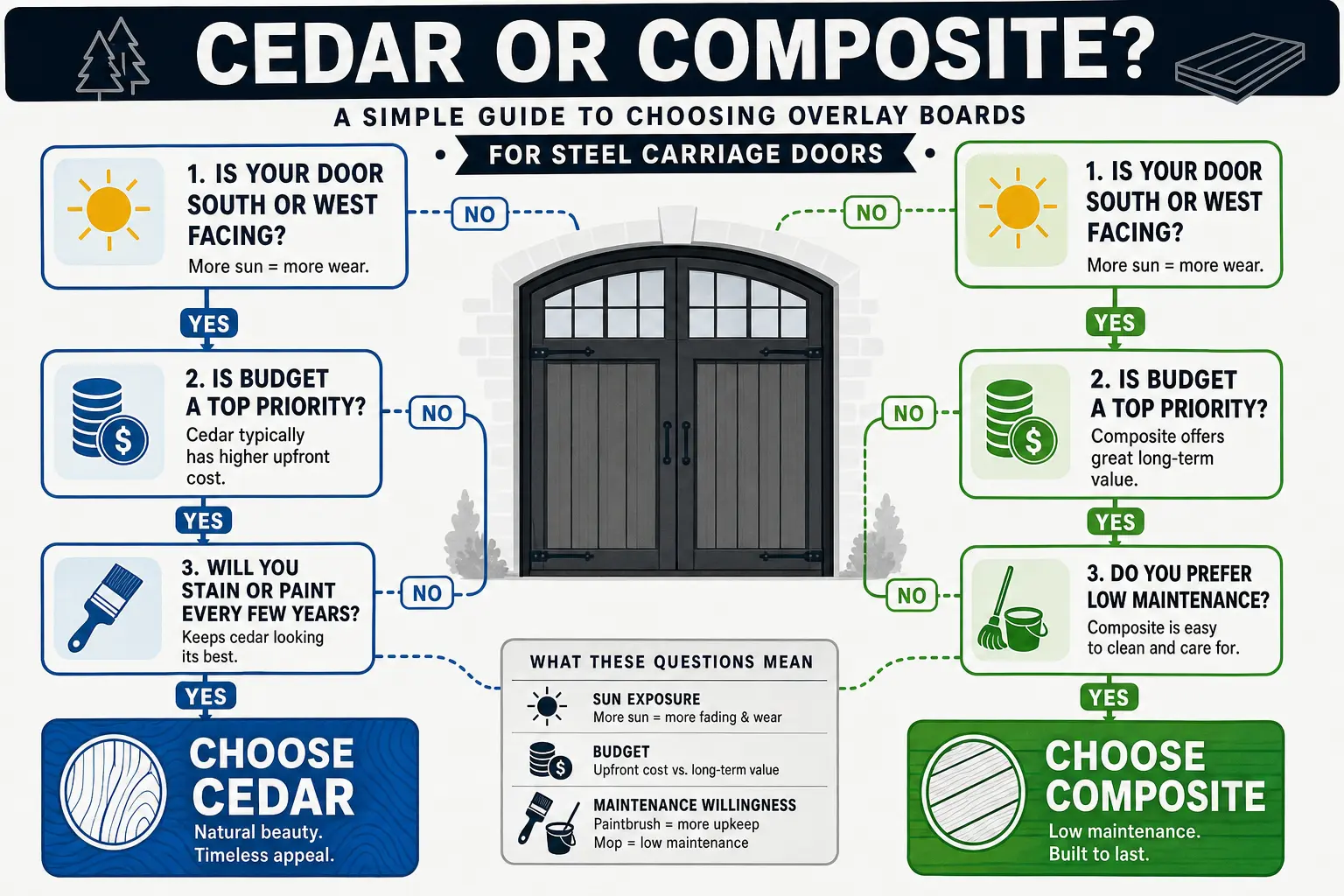
When evaluating wood composite garage doors alongside natural timber, key trade-offs define each material:
- Choose Western Red Cedar Overlays If: You require authentic wood grain depth, custom stain matching to timber-frame elements, natural aroma, and live in a moderate UV climate where routine refinishing every 2 to 3 years fits your home management plan.
- Choose Composite/PVC Overlays If: You prefer a zero-maintenance exterior, live in high-humidity or extreme sun environments, require high rot and insect resistance, and want lower long-term life-cycle expenses.
Anatomy of an Overlay Steel Carriage Door: How They Are Built
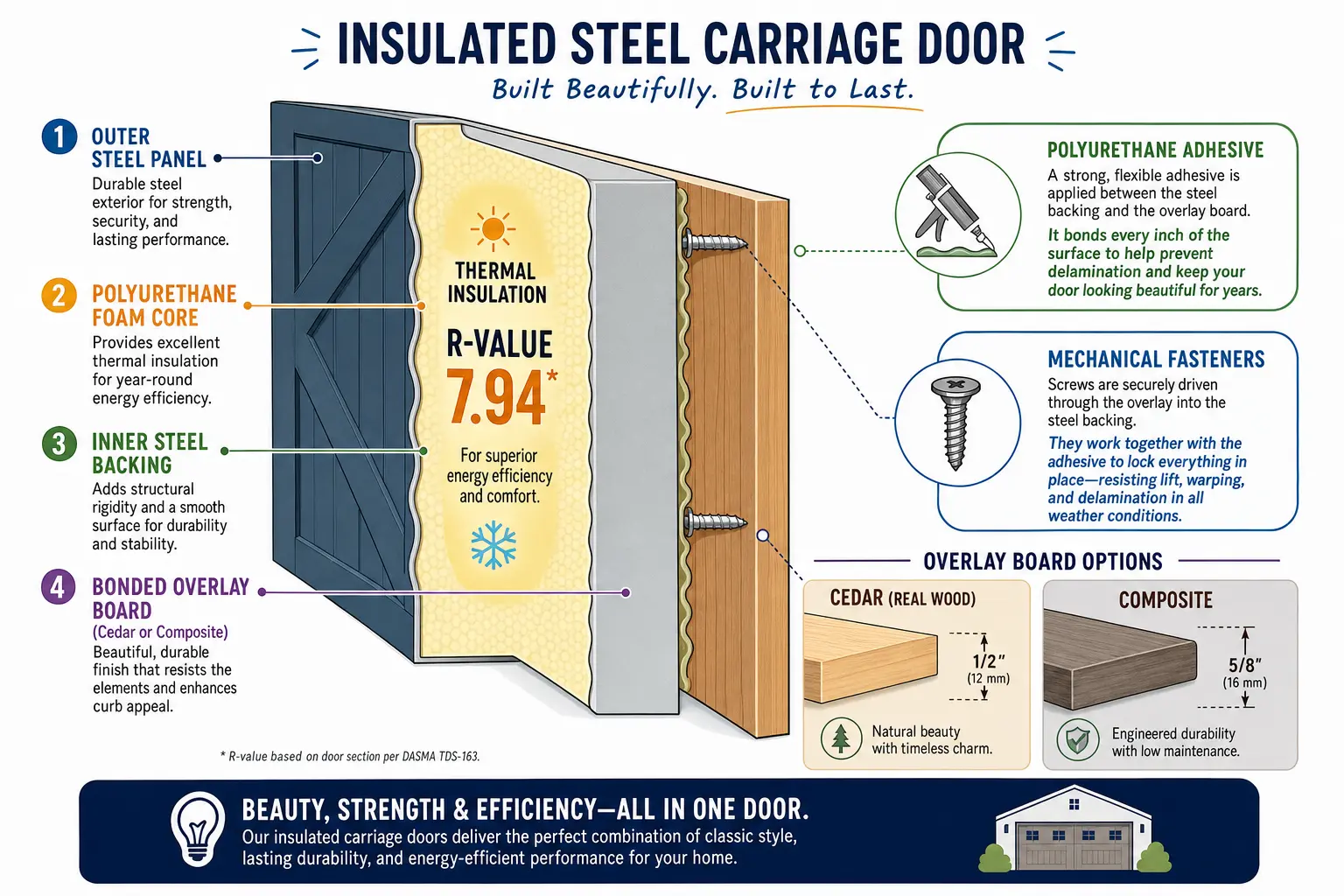
Carriage house doors utilizing overlay technology consist of a multi-layer composite system. The foundation is a 3-layer steel section comprising heavy-gauge steel skins injected with dense polyurethane foam. Overlay trim boards are then bonded directly to the outer face.
Modern overlay manufacturing relies on flexible, commercial-grade polyurethane structural adhesives supported by concealed mechanical fasteners. This construction resolves legacy fears regarding adhesive delamination. Steel skins and overlay materials expand and contract at different rates—a thermal expansion differential near. High-performance structural adhesives absorb these micro-movements, ensuring trim boards remain permanently bonded across severe freeze-thaw cycles.
From an energy perspective, overall thermal efficiency is driven by the polyurethane steel base rather than the facing material. A standard core provides an overall garage door r value ranging from R-12 to R-18.4. Western Red Cedar overlays add roughly R-0.6 to R-0.9, while composite trim contributes R-0.4 to R-0.7.
Solar Exposure and Aesthetic Realism
Aesthetic evaluation often follows the “Driveway Inspection Distance” rule. Beyond 6 to 10 feet, modern high-moulded polymer composite overlays (cast from real timber masters) are visually indistinguishable from natural stained wood. At close inspection range (under 5 feet), authentic Western Red Cedar reveals organic grain depth, tactile variation, and unique natural wood character.
Solar orientation dictates material survival:
- West-Facing Driveways: Direct sunlight can drive internal skin temperatures above 160F. Dark-painted polymer overlays absorb high thermal energy, risking heat distortion if thermal limits are exceeded. Cedar handles heat without warping, but UV exposure breaks down clear coats quickly.
- Shaded or North-Facing Driveways: Cedar maintains finish longevity much longer in shade, while composite panels hold dimensional stability indefinitely regardless of shade exposure.
For homeowners considering dark finishes or black carriage style garage doors, heat-reflective paints or engineered composites rated for high solar heat absorption are essential.
10-Year Total Cost of Ownership (TCO) Financial Model
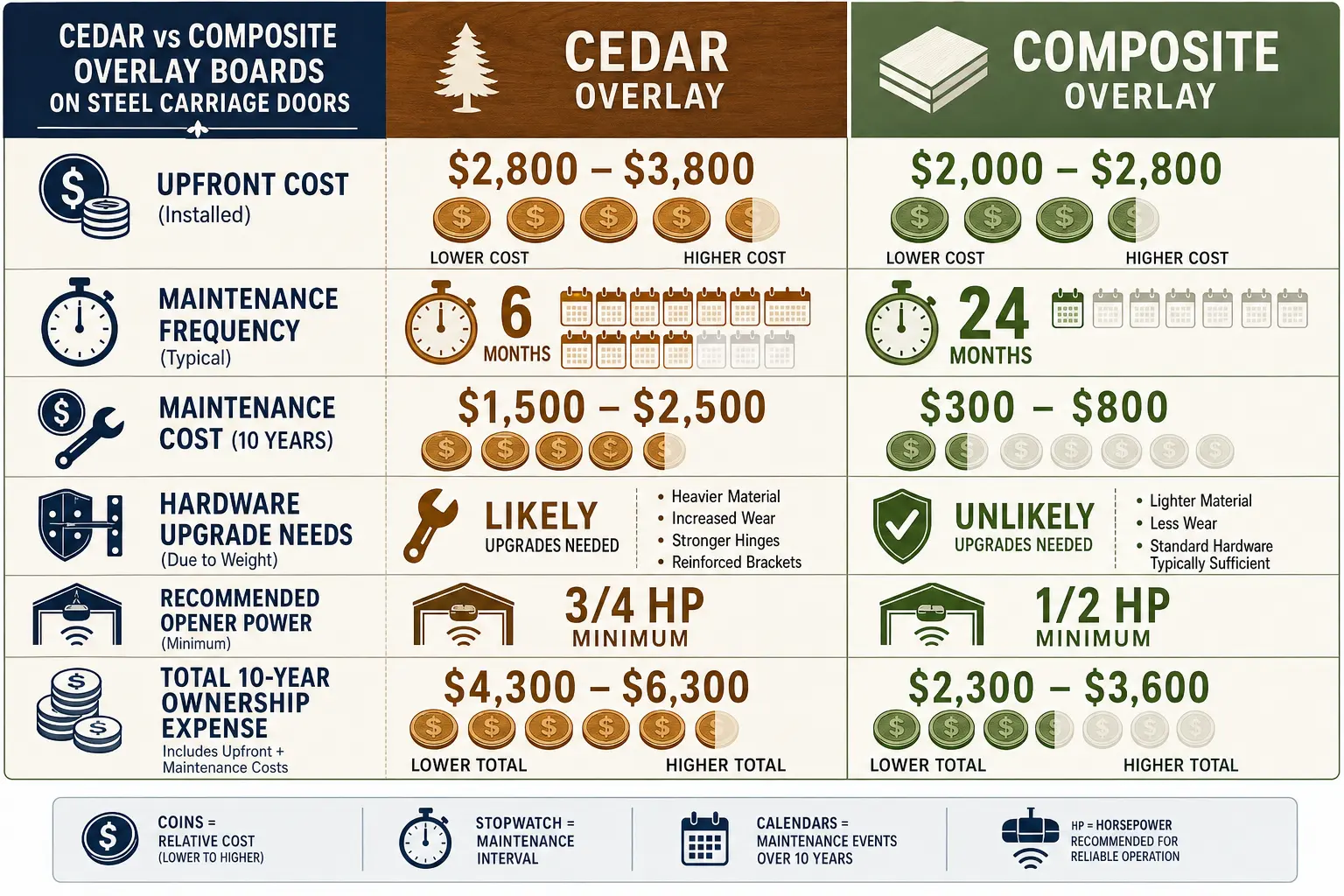
Evaluating carriage style garage doors requires analyzing both upfront purchase price and ongoing refinishing expenses over a 10-year horizon.
According to home remodeling financial reports, high-end garage door upgrades consistently yield 102% to 194% ROI upon home resale, with zero-maintenance composite doors leading buyer preference in climate zones prone to extreme weather.
Frequently Asked Questions
Will composite overlay boards peel off the steel door over time?
No, modern structural carriage doors do not rely on standard glues. Premium manufacturers utilize commercial polyurethane adhesives combined with concealed mechanical fasteners. This design accommodates the differing thermal expansion rates between steel and polymer skins without delaminating.
How does board weight affect garage door springs and openers?
Overlay boards add substantial weight—up to 360 lbs total for a double door. Operating this mass with standard 1/2 HP openers or light-duty springs leads to motor burnout and premature spring breakage. Professional installation requires high-torque 3/4 HP to 1.25 HP openers and heavy-duty 25,000+ cycle torsion springs.
Can composite carriage doors be painted or stained if they fade?
Yes. Unlike vinyl, engineered cellular PVC and moulded composite overlays accept exterior-grade acrylic latex paint. If you decide to change your exterior color scheme down the road, composite surfaces can be repainted following proper surface preparation and primer application.
Professional Guidance for Your Door Evaluation
Choosing between natural Western Red Cedar and high-performance composite overlay boards depends on your aesthetic priorities, elevation exposure, and willingness to maintain real wood finishes. Up & Down Garage Doors offers comprehensive consultations, engineering checks, and precision installations to ensure your door operates flawlessly for decades. Contact our team today to schedule an on-site consultation and design evaluation.
You May Also Like
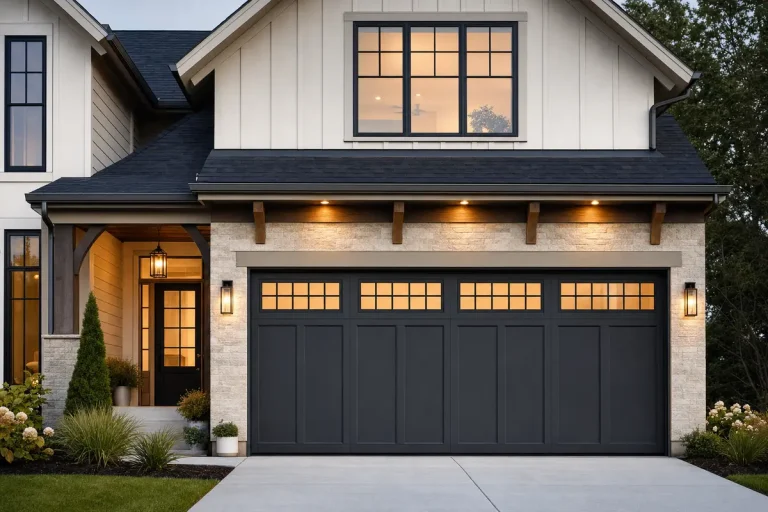
Garage Door Window Placement Rules for Balanced Curb Appeal
Published Date: Nov 20, 2026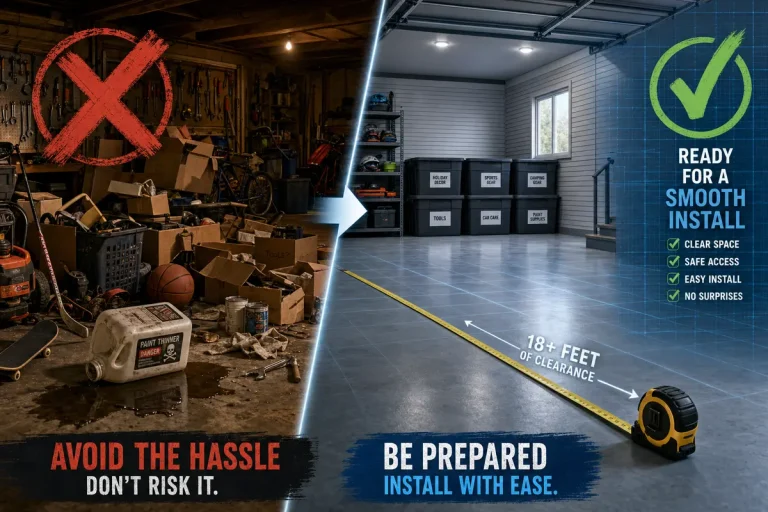
Essential Blueprint: What to Clear From the Garage Before Installation Day
Published Date: Nov 17, 2026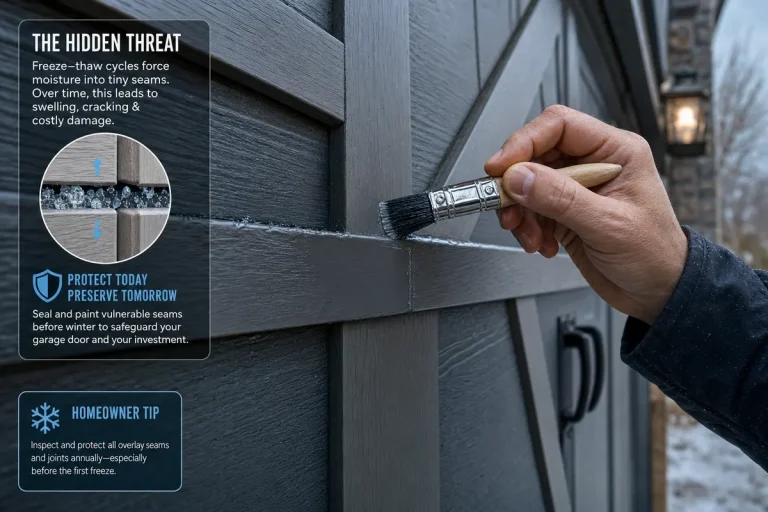
Sealing & Repainting Carriage Door Overlays Before Winter: The Complete Substrate & Freeze-Thaw Defense Guide
Published Date: Nov 16, 2026