





Garage Door Fire Safety and Home Protection Guide
Published: Aug 20, 2026
Each year, the National Fire Protection Association (NFPA) reports an estimated 6,600 residential garage fires in the U.S. These incidents result in an average of 30 deaths, 400 injuries, and $450 million in direct property damage. When assessing your home’s defenses, navigating local building codes and technical safety standards can be difficult.
Many homeowners struggle to distinguish between the distinct safety roles played by the main overhead vehicle door, the pedestrian entry door, and the ceiling attic hatch. True residential protection requires understanding how these three structural barriers operate together to contain flames, block toxic gases, and safeguard your escape routes.
The Pedestrian Entry Door (The House-to-Garage Barrier)
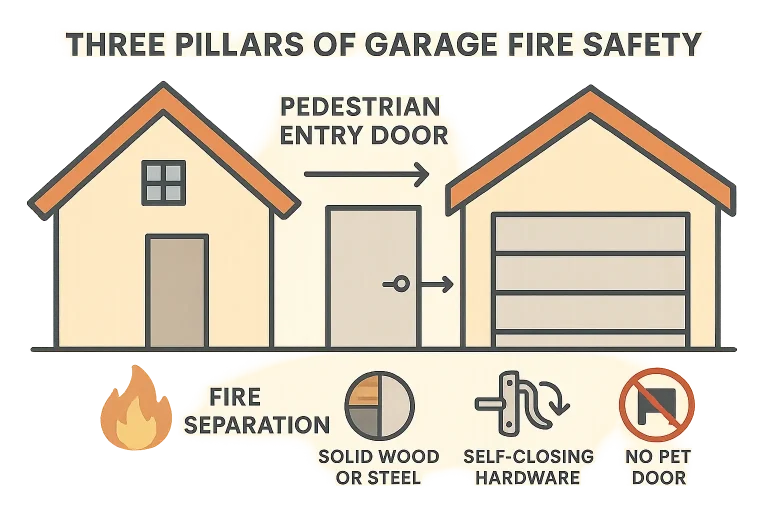
The primary defense line between your living space and your garage is the pedestrian entry door. According to the International Residential Code (IRC) Section R302.5.1, this opening must be structurally fortified to prevent rapid fire spread. The code mandates the use of either a 20-minute UL-rated fire door, a minimum 1-3/8 inch solid wood door, or a honeycomb/solid-core steel door.
Additionally, this door must be equipped with self-closing hinges or a hydraulic closer to ensure it is never accidentally left open—which would allow carbon monoxide or flash fires to breach the living areas. A common and costly inspection failure is cutting a pet flap into this barrier; doing so immediately voids its fire-rating compliance. When upgrading your home, selecting the proper fire rated residential garage doors and matching entry assemblies is your first line of defense.
The Garage Attic Access Hatch
Your garage ceiling functions as a vital horizontal fire barrier. If your ceiling is breached by a cheap, unrated plywood crawlspace cover, flames can access the attic space in minutes, bypassing your wall defenses and destroying the home’s roof structure.
To maintain structural integrity, building codes require replacing standard plywood covers with 5/8-inch Type X gypsum board or certified, upward-opening insulated steel access doors. Furthermore, any pull-down attic ladders should feature ASTM E119-compliant fire-rated aluminum or wooden construction designed to withstand intense heat and flame exposure for up to 60 minutes.
The Overhead Garage Door itself (Up & Down Garage Doors' Core Business)
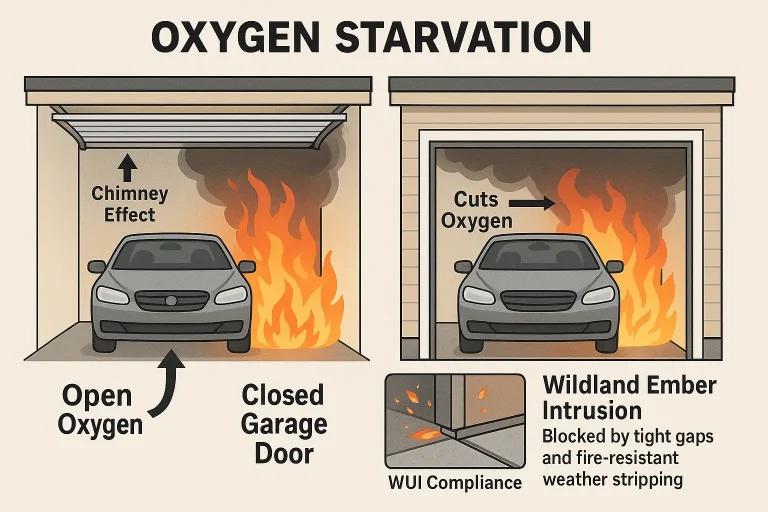
While the main overhead vehicle door does not carry a standard hourly fire-resistance rating like a commercial door, it plays a critical structural role in residential fire containment. Keeping a heavy-duty, double-skin overhead door closed starves an internal garage fire of oxygen, preventing the dangerous “chimney draft effect” from feeding and spreading the flames.
In Wildland-Urban Interface (WUI) zones, California Chapter 7A (SFM 12-7A-6) standards mandate ignition-resistant overhead doors to protect properties from exterior threats. According to CAL FIRE, wind-blown embers cause up to 90% of home ignitions during wildfires, traveling over a mile and penetrating structural gaps larger than 1/8 inch.
To harden your home against this threat, high-quality garage door insulation must be paired with heavy-duty astragal bottom seals and perimeter vinyl stop molding to eliminate gaps. When analyzing the pros and cons of garage door materials, double-skin insulated steel remains the premier choice for heat deflection. Working with a certified professional for your garage door installation near me ensures that your door is perfectly hung to eliminate vulnerable air gaps.
Emergency Operation & Openers During a Fire
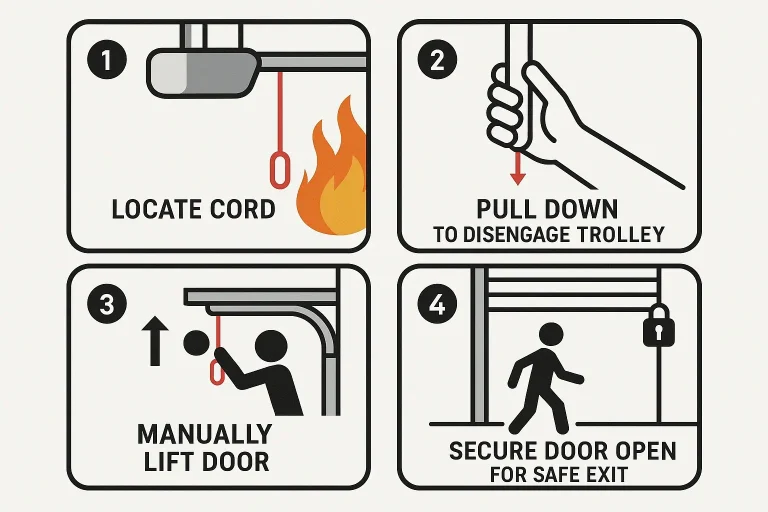
During a major fire emergency, municipal electrical power grids frequently fail. Knowing how to open a garage door without power is an essential life-safety skill. Homeowners must know how to quickly locate and pull the red emergency release cord to disengage the automated opener’s trolley, allowing them to lift a heavy door manually.
To mitigate this risk, upgrading to modern garage door openers with battery backup ensures that your system remains fully operational at the push of a button, even when power lines are cut.
Commercial & Industrial Overhead Fire Doors (NFPA 80)
Commercial and industrial spaces face even stricter fire containment requirements. Commercial rolling fire doors rely on fusible links designed to melt at 165°F, which triggers a gravity-driven auto-close mechanism to seal off entire zones.
NFPA 80 standards dictate strict regular audits for these systems. Alarmingly, 60% of commercial fire door failures during audits are caused by improper clearances—such as gaps exceeding 3/4 inch at the floor or 1/8 inch at the head and jambs. Routine annual garage door maintenance is mandatory to identify and correct these alignment issues. Partnering with a licensed specialist to service your commercial garage doors guarantees absolute mechanical compliance and safety.
Frequently Asked Questions
Do residential overhead garage doors need to be fire-rated?
No, standard residential vehicle overhead doors do not require an hourly fire-resistance rating. However, they must seal tightly to block wildfire embers, and the pedestrian door connecting the garage directly to your home’s interior must be fire-rated under IRC R302.5.1.
Why did my home inspection fail at the garage entry door?
The most common reasons for inspection failure include missing or broken self-closing hinges, having a non-compliant hollow-core door, or installing a pet flap, which completely voids the door’s fire-containment capability.
How often should I test my garage fire safety components?
You should test your pedestrian door’s self-closing hinges monthly to ensure they latch completely. Additionally, professional annual maintenance is recommended to verify that weatherstripping, clearances, and emergency release systems are in perfect working order.
Secure Your Home with the Trusted Experts
With over 15 years of industry experience, Up & Down Garage Doors is a family-owned business founded by four brothers dedicated to honesty, fair pricing, and professional excellence. Operating across Connecticut, Texas, New York, Illinois, and Arizona, we provide 24/7 service to ensure your home or business remains safe and compliant. Contact our team today to schedule an inspection, maintenance, or a certified safety upgrade.
You May Also Like
Top Benefits of Fire-Rated Garage Doors: Why They’re Worth It
A fire-rated garage door is more than just a safety upgrade — it’s a smart investment in protecting your home, business, or property. Whether you’re a homeowner or commercial builder, these doors offer real fire…
Published Date: Jan 21, 2026
Top Reasons to Choose a Steel Garage Door
Thinking about upgrading your garage door? A steel garage door offers a great mix of strength, style, and minimal upkeep. Whether you’re building new or replacing an old door, steel models provide long-lasting…
Published Date: Dec 11, 2025
Faux Wood Garage Doors: A Smart Choice for Homeowners
Are you a homeowner, property manager, or business owner who loves the classic look of a wooden garage door but worries about the upkeep? The natural beauty of wood is appealing, but the maintenance, cost, and…
Published Date: Sep 16, 2025