





My Garage Door Opens and Closes By Itself: An Emergency Guide
Published: Jul 21, 2026
It’s a feeling that can send a shiver down your spine. You’re sure you closed the garage door when you left, but you come home to find it wide open. Or worse, you hear it creaking open on its own in the middle of the night. It’s more than just an inconvenience; a garage door that operates unpredictably is a significant safety and security risk for your home and family.
You’re not alone in feeling a bit of panic. This is one of the most common and unnerving issues homeowners face. But before you start troubleshooting, the most important thing is to secure your home.
Secure Your Garage First
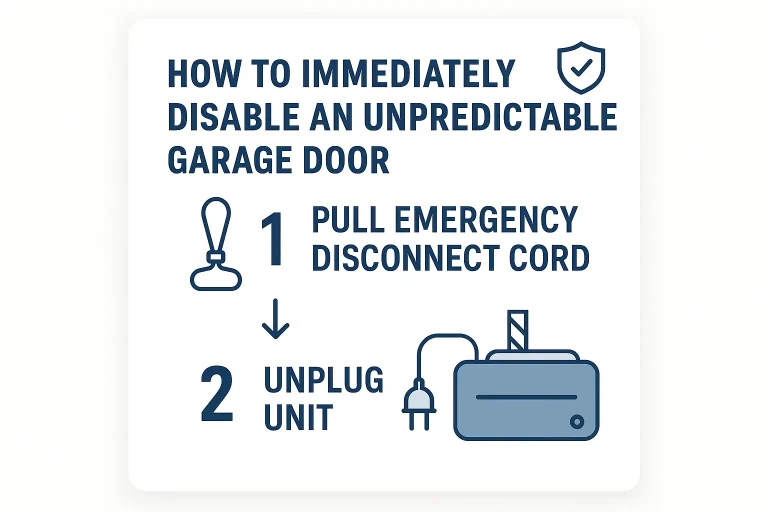
When your garage door is acting erratically, you can’t trust it. Before we figure out why it’s happening, let’s make sure it doesn’t happen again while you’re not looking. Your immediate priority is to disable the automatic opener.
Here are the two simplest ways to do it:
- Pull the Red Cord: Look for a red cord with a handle hanging from the opener’s motor unit. This is the emergency release. Pulling this cord disengages the door from the opener, allowing you to operate it manually.
- Unplug the Opener: The most surefire way to prevent the motor from activating is to cut its power. Unplug the opener from the ceiling outlet. This completely removes the risk of any electronic “phantom” openings.
With your home secure, you can now investigate the cause with a clear head.
Is It a Phantom or a Reversal?
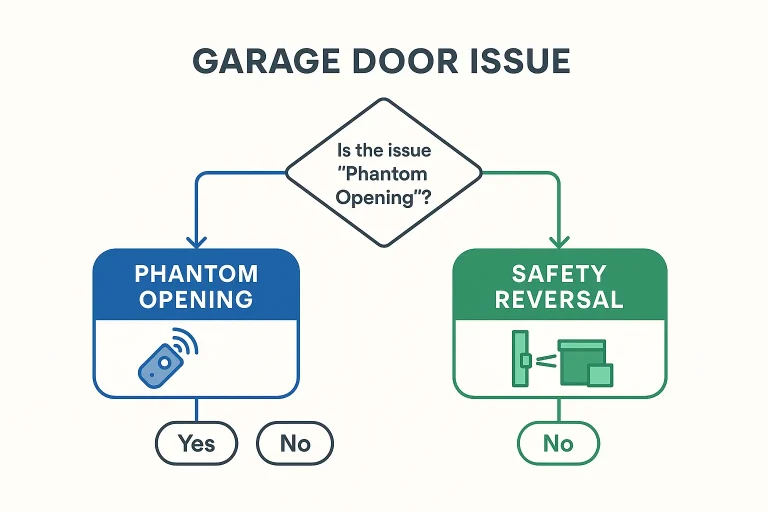
Nearly every case of a garage door operating unpredictably falls into one of two categories. Figuring out which one you’re experiencing is the key to a fast and effective solution.
- The Phantom Opening: This is when the door opens or closes completely at random times, even when no one has touched the remote. It feels like a ghost is in the machine. This is almost always caused by an unintended signal.
- The Safety Reversal: This is when you try to close the door, and it goes down part-way (or all the way), then immediately reverses and opens back up. This is not a random event; it’s your garage door’s safety system kicking in.
Let’s walk through the diagnostic steps for each path.
Building (Path A): Solving the “Safety Reversal”
If your door closes and then opens again, it’s easy to get frustrated. But here’s the “aha moment”: your door is doing exactly what it’s supposed to do. It thinks something—a child, a pet, a box—is in its path, and it’s reversing to prevent an accident. Our job is to figure out why it’s getting a false alarm.
Step 1: Check for Physical Obstructions
This seems obvious, but it’s the most common culprit. Look for anything on the floor that could be breaking the sensor beam, even small items like a stray leaf, a broom, or a buildup of snow or ice.
Step 2: Inspect and Clean the Safety Sensors
At the bottom of your garage door tracks are two small “photo-eye” sensors. They face each other and send an invisible beam across the opening. If that beam is broken, the door won’t close.
- Check the Lights: Each sensor has a small LED light. One is typically green (sending) and the other amber or red (receiving). If the receiving sensor’s light is blinking or off, the beam is misaligned or blocked.
- Clean the Lenses: Wipe the lenses with a soft, clean cloth. Dust, cobwebs, or dirt can easily obstruct the beam.
- Check for Misalignment: The sensors can get bumped out of alignment. If the lights are still blinking after cleaning, gently adjust them until they are pointing directly at each other and both LEDs are solid. For a more detailed walkthrough, our guide explains how to align garage door sensors in detail.
Step 3: Check the Close-Limit Settings
Your opener is programmed to know how far the door should travel to be fully closed. If this setting is off, the door might hit the floor and interpret the resistance as an obstruction, causing it to reverse. The adjustment process usually involves turning small screws on the motor unit, but it varies by model.
Building (Path B): Chasing Down the “Phantom Opening”
A door that opens on its own is a serious security issue. This problem is caused by an unwanted signal telling your opener to activate. Let’s find the source.
Step 1: Check Your Remotes and Wall Button
The simplest explanation is often the right one.
- Stuck Button: Check all your remotes (including the one in your car) and the main wall-mounted button to ensure one isn’t stuck or jammed.
- Low Batteries: Dying batteries in a remote can sometimes cause it to send out strange, erratic signals. Try replacing the batteries in all your remotes. If you’re having garage door remote programming issues, this is a good place to start.
Step 2: The “Phantom Signal” – Understanding Radio Frequency (RF) Interference
This is the most mysterious cause, but it’s surprisingly common. Think of your garage opener as a radio receiver waiting for a secret code from your remote. Usually, only your remote knows the code. But sometimes, other electronics are “shouting” out random radio signals, and if your opener hears one that’s close enough to its code, it might open.
Common sources of RF interference include:
- A neighbor’s new garage door remote, especially on older models with similar frequencies.
- New LED light bulbs in or near your garage. Some low-quality LEDs emit significant RF noise.
- Faulty electronics, nearby radio towers, or even military base communications.
- The reduced garage door opener range is often the first symptom of RF interference before phantom openings begin.
Step 3: Perform a System Reset
The most effective way to eliminate a phantom signal is to erase your opener’s memory and start fresh. This forces it to forget any stray signals it may have learned and ensures it only listens to your remotes.
The process involves pressing the “Learn” button on your motor unit until the light goes out, which clears all paired remotes. You will then need to reprogram each remote one by one. Our guide provides easy-to-follow instructions on how to reset a garage door opener for most major brands.
When to Call a Pro
You can solve many of these issues yourself with a little patience. However, there are times when it’s safer and smarter to call in a professional. If you’ve tried the steps above and the problem persists, it could be a more complex issue.
- Faulty Logic Board: The logic board is the opener’s “brain.” If it’s damaged by a power surge or has failed due to age, it can send random signals to the motor. Replacing a logic board is a job for a trained technician.
- Frayed or Shorted Wiring: Wires leading from the wall button or safety sensors can become damaged over time, causing a short that mimics a button press.
- You’re Unsure or Uncomfortable: Your safety is the top priority. If you’re not comfortable with any of these steps, it’s always best to let an expert handle it. There’s no shame in wanting to know how to fix a garage door safely.
A Checklist for a Healthy Door
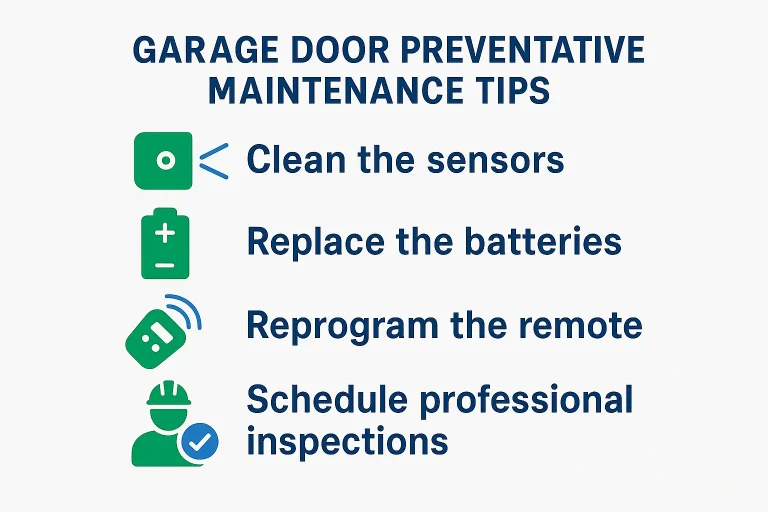
The best way to deal with a phantom garage door is to prevent it from happening in the first place. Taking fifteen minutes twice a year to perform a few quick routine checks can save you from major security headaches down the road. Inspecting your wiring, clearing remote memory banks, and checking sensor alignment during seasonal maintenance ensures your door stays closed when it is supposed to.
Frequently Asked Questions
Why did my garage door suddenly start doing this?
Sudden issues are often linked to a recent event. Did you have a power surge or thunderstorm? This can damage the logic board. Did you recently install new electronics or LED bulbs in your garage? This could be the source of new RF interference.
Can my neighbor’s remote really open my garage door?
It’s rare with modern openers that use “rolling code” technology, which changes the code every time you use the remote. However, on much older models that use a fixed “dip switch” code, it is possible for a neighbor to have the same code by coincidence.
I have an old opener. Should I just replace it?
If your opener was manufactured before 1993, it lacks modern safety features like photo-eye sensors. In this case, upgrading is highly recommended not just for reliability, but for the safety of your family. Modern openers also have better security and are less susceptible to RF interference.
Is it safe to just leave the opener unplugged and operate the door manually?
While this stops the phantom opening, it’s not a secure long-term solution. When the door is disengaged from the opener, it can sometimes be forced open from the outside. The best solution is to diagnose and fix the root cause.
You May Also Like
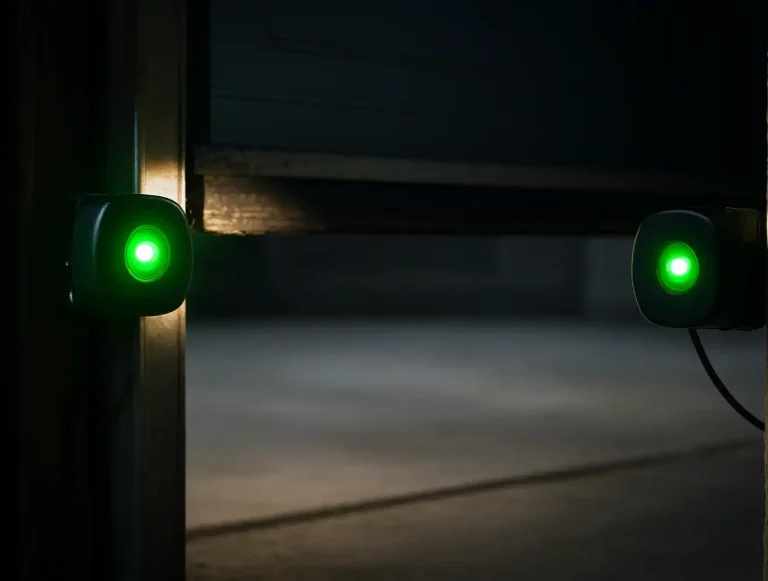
My Garage Door Sensors Are Green, But the Door Still Won’t Close
It’s one of the most confusing and frustrating garage door problems you can face. You’ve done your homework: you checked for obstructions, wiped the sensor lenses, and made sure they’re pointing at each other. Both…
Published Date: Jun 26, 2026
5 Reasons Your Garage Door Won’t Close and How to Fix Them
It’s frustrating when your garage door won’t close, especially if you’re in a hurry. You press the remote and the door drops a few feet, then suddenly reverses. That’s often a safety feature at work. The most common…
Published Date: Nov 4, 2025
How to Close a Garage Door Without Power: Simple Manual Steps
Garage door won’t budge during a power outage? You’re not the only one. Whether it’s from a storm or a blown fuse, there’s a simple and safe way to close and lock it by hand — no tools required. Below are four quick…
Published Date: Jun 13, 2025