





Understanding Dip Switch Technology in Garage Door Openers
Published: Sep 10, 2026
If you own a home built or updated during the late 20th century, you might still use a garage door opener configured with physical rows of tiny sliding toggle switches. These micro-switches, known as DIP (Dual In-line Package) switches, were the primary industry standard from the mid-1980s until 1993, when federal safety regulations changed how radio signals communicate with residential openers.
While legacy systems are durable, they often leave homeowners guessing when attempting to program replacement remotes. If you are trying to restore access to your garage, understanding how this technology functions is essential to evaluating whether you need a simple configuration adjustment or a complete garage door repair.
Visual Identification: Binary vs. Trinary Switches
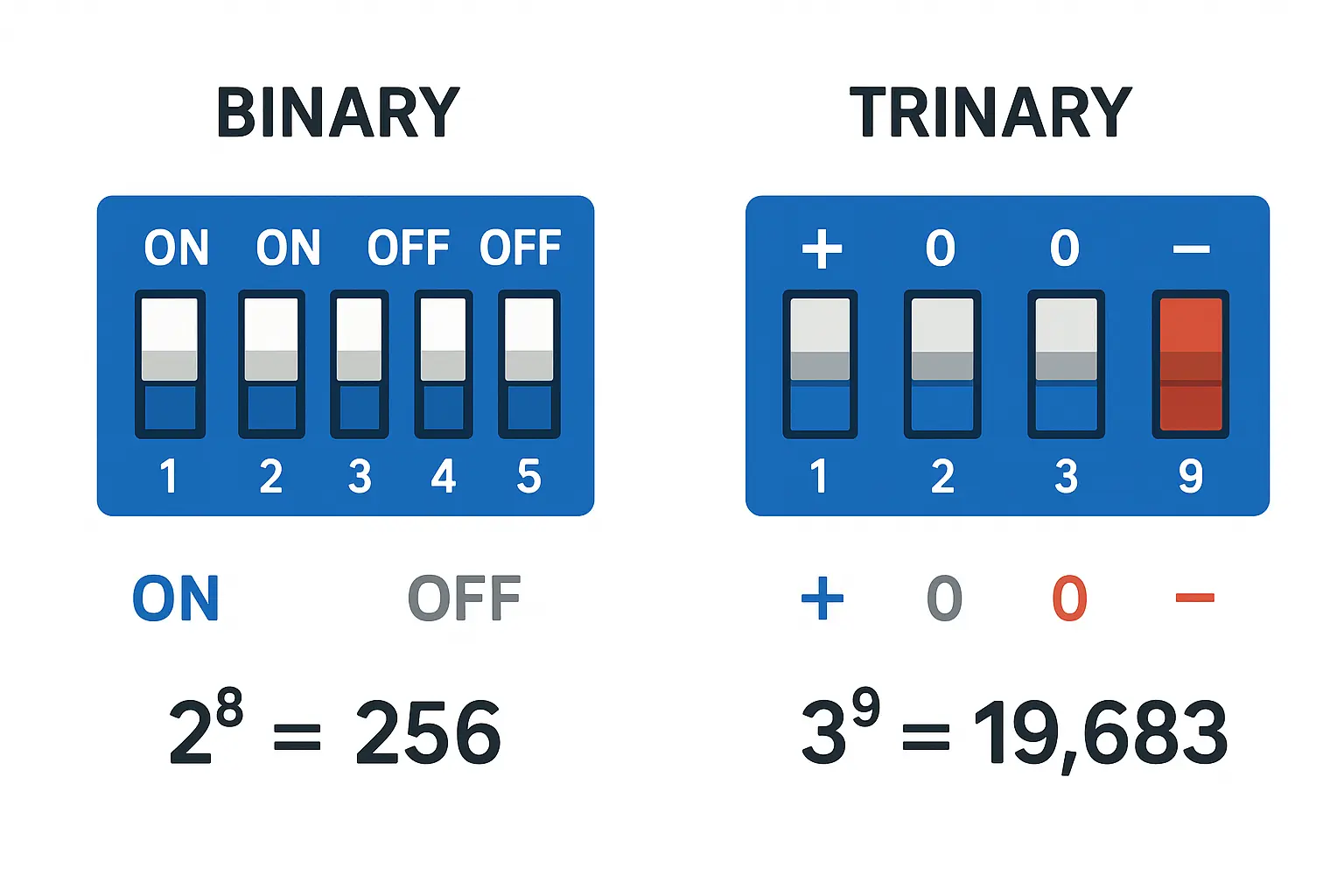
At the heart of any legacy system is a physical switch block containing 8 to 12 sliding keys. These keys are configured in one of two logical formats: binary or trinary.
Binary configurations feature two possible states for each switch: ON or OFF (often marked as + and -). This means an 8-switch system yields $2^8 = 256$ code combinations, while a 10-switch layout offers $2^{10} = 1,024$ unique codes.
Trinary systems, utilized heavily by Chamberlain-manufactured units, offer three physical positions: Up (+), Middle (0), and Down (-). A 9-switch trinary block increases the mathematical permutations exponentially, offering $3^9 = 19,683$ unique combinations. Because of these distinct logical profiles, a binary remote cannot communicate with a trinary receiver block.
Brand Compatibility and the Translation Key
Different manufacturers historically used proprietary switch layouts and radio frequencies. For instance, over 90% of legacy Sears Craftsman hardware was manufactured by Chamberlain, meaning they share identical programming logic and the 390 MHz frequency.
| Brand | Switch Count | Frequencies Used | Switch Logic | Hardware Family Notes |
|---|---|---|---|---|
| Sears Craftsman | 9-Position | 390 MHz (pre-2005) | Trinary (+, 0, -) | Manufactured by Chamberlain. Identical programming steps. |
| Chamberlain / LiftMaster | 9 or 12-Position | 390 MHz / 315 MHz | Trinary (+, 0, -) | Color-coded antenna wire indicates the frequency. |
| Genie (Blue Max) | 9 or 12-Position | 390 MHz | Binary (ON/OFF) | Requires absolute matching with the receiver unit. |
| Linear / Multi-Code | 10-Position | 300 MHz | Binary (ON/OFF) | Highly common in gated communities. |
| Linear Delta-3 | 8-Position | 310 MHz | Binary (ON/OFF) | Uses a specific 310 MHz receiver block. |
Step-by-Step Programming Guide
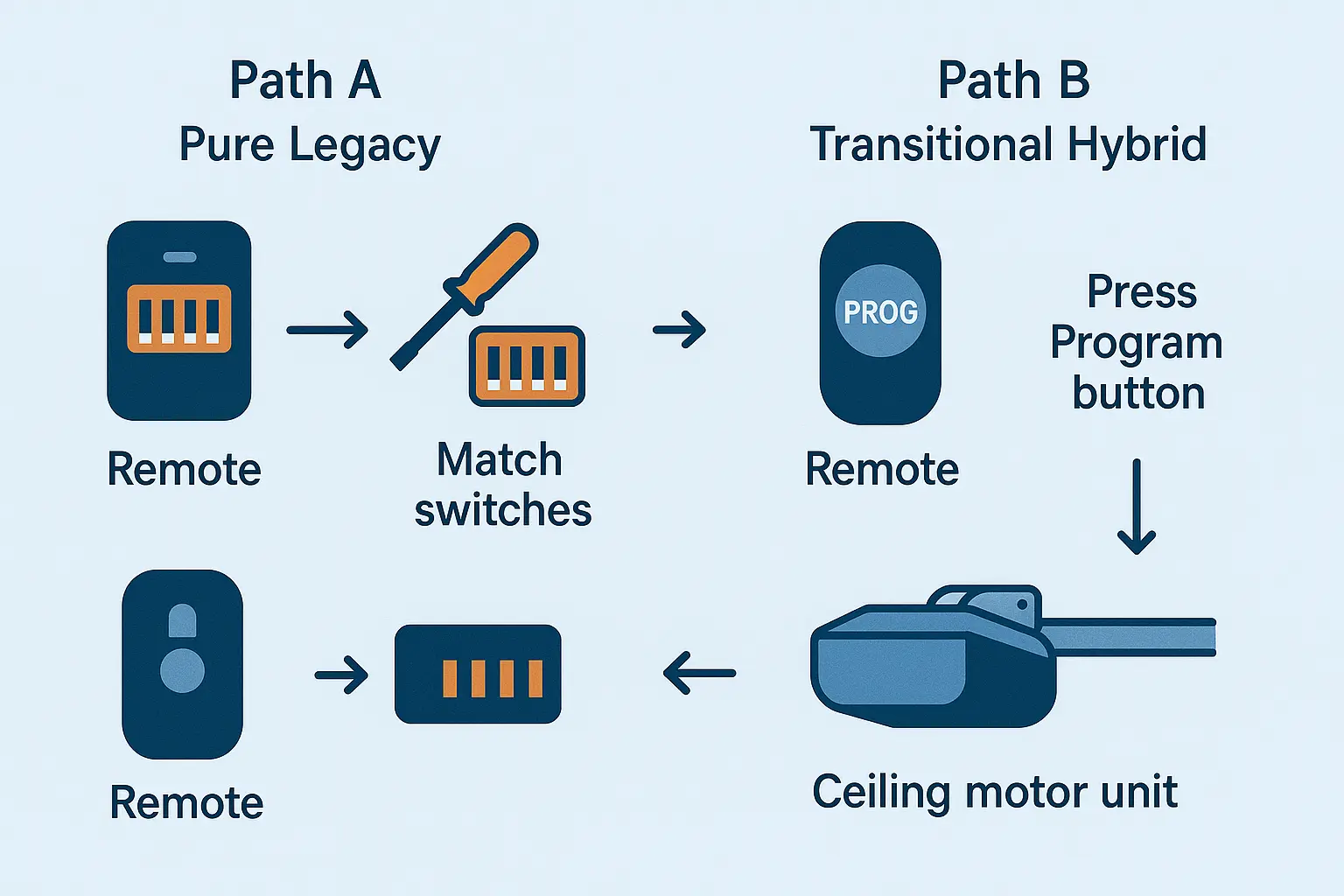
A common pitfall in online guides is instructing homeowners to look for a “Learn” button on a pure legacy system. In models built before 1993, there is no learn button. These units rely 100% on matching physical configurations. However, transitional “hybrid” systems, built during the late 1990s, feature both physical DIP switches and transitional learn button setups.
For Pure Legacy Systems:
- Locate the switch block on your motor unit (usually on the back panel under the light cover) and write down the sequence (e.g., +, -, 0, +, 0, -, -, +, 0).
- Open the battery compartment of your replacement remote.
- Use a precision screwdriver or pen tip to slide the internal keys to match the sequence on your ceiling unit exactly.
For Transitional Hybrid Systems:
If your system uses a universal remote, you may need to cycle through programming modes using an onboard button on the remote, allowing the transmitter to scan for your motor’s matching frequency.
Troubleshooting Physical and Signal Degradation
If your configurations match but the door fails to open, three issues are usually at play:
- RF Interference: Many modern LED bulbs emit electromagnetic noise that jams weak 300–390 MHz signals. Try removing the LED bulbs from your motor unit to test.
- Physical Switch Slippage: With age, the tiny plastic toggles can wear out and float between positions (e.g., getting stuck between 0 and +).
- Contact Corrosion: Humidity and battery leaks corrode copper contacts over decades.
If your physical hardware is reaching its limits, planning strategic garage door upgrades can resolve persistent connectivity issues while adding reliable, modern functionality.
Security Analysis: Is Your Dip Switch Opener Vulnerable?
Fixed-code DIP switch systems broadcast the exact same signal every time. This introduces a vulnerability known as “code grabbing,” where unauthorized devices can record your radio frequency.
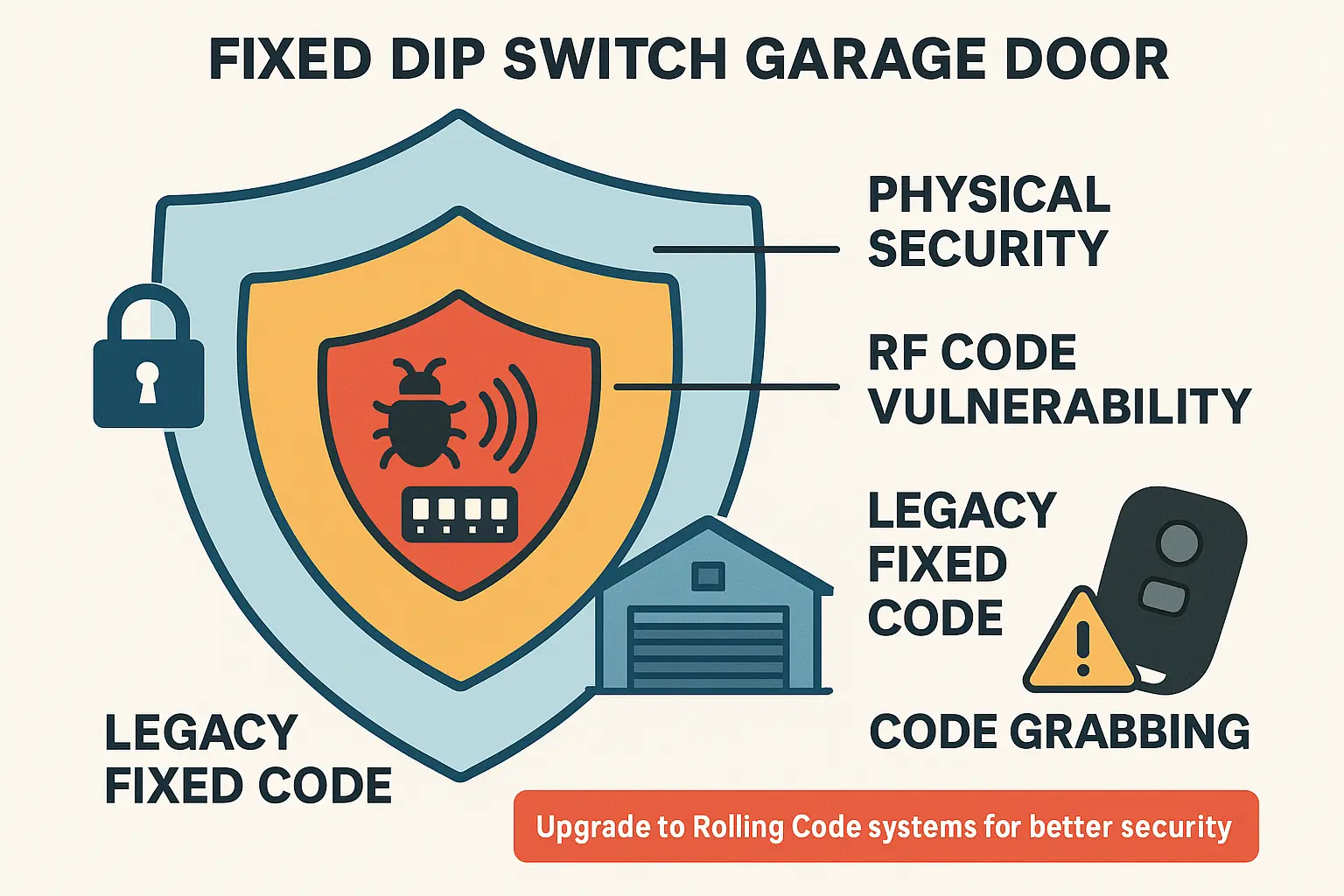
While you can increase your safety by periodically changing the internal key patterns, legacy openers also lack the advanced safety reverse garage door technology required by contemporary standards. Modern systems replace fixed signals with rolling codes that alter the encryption key after every use. For homeowners seeking convenience, pairing a modern rolling-code motor with a geofence garage door opener allows hands-free, high-security access.
Frequently Asked Questions
Can I use a modern universal remote with my old dip switch opener?
Yes, many multi-brand universal remotes support legacy frequencies. You must verify that the remote specifically lists compatibility with your motor’s frequency (such as 390 MHz or 300 MHz) and manual DIP switch settings.
Why does my garage remote work only when I am standing very close to the door?
This is usually caused by localized RF interference. Modern LED light bulbs installed inside the motor housing frequently block legacy frequencies. Other causes include a low remote battery or a degraded receiver antenna wire on the motor unit.
What should I do if I lost my original remote and don’t know the switch code?
You do not need the old remote. Simply locate the physical DIP switch panel directly on the ceiling-mounted motor unit, note the pattern of the switches, and copy that exact sequence into your new replacement remote.
Modernize Your Garage Door Access
While troubleshooting legacy systems can be rewarding, aging motors may present safety and performance risks. If you need help with a modernization plan or repair, contact an affordable garage door company at Up & Down Garage Doors to schedule an on-site evaluation with one of our highly trained, licensed technicians.
You May Also Like
Choosing and Maintaining a Secure Garage Door Opener
Published Date: Sep 8, 2026
Fix or Replace Your 20 Year Old Garage Door Opener
Your 20-year-old Craftsman, LiftMaster, or Chamberlain garage door opener has been a model of reliability. But lately, it is showing its age. Maybe it is making a strange humming sound, emitting a persistent beep, or…
Published Date: Aug 19, 2026
How to Diagnose and Fix Garage Door Opener Electrical Issues
When your automatic garage door refuses to budge, it is rarely just an inconvenience—it is a security vulnerability and a disruption to your day. Homeowners and facility managers often struggle to determine whether a…
Published Date: Aug 7, 2026