





One-Piece & Tilt-Up Garage Doors: Classic Style & Simple Operation
Published: Sep 17, 2026
If you own a Mid-Century Modern home, an Eichler-style property, or a classic Spanish Colonial, the seamless exterior facade of a flat, single-panel door is likely essential to your home’s historic charm. Unlike modern sectional doors that split into several horizontal panels, a one-piece or tilt-up door operates as a single, solid slab.
Yet, managing these historic installations poses unique challenges. Homeowners often struggle with modern opener compatibility, thermal insulation limits, and specialized hardware degradation. Whether you are seeking to preserve an architecturally significant facade or looking to troubleshoot old hardware, understanding the mechanics of a tilt up garage door is the first step toward making a confident, safe decision.
Trackless Jamb vs. Track-Guided Systems
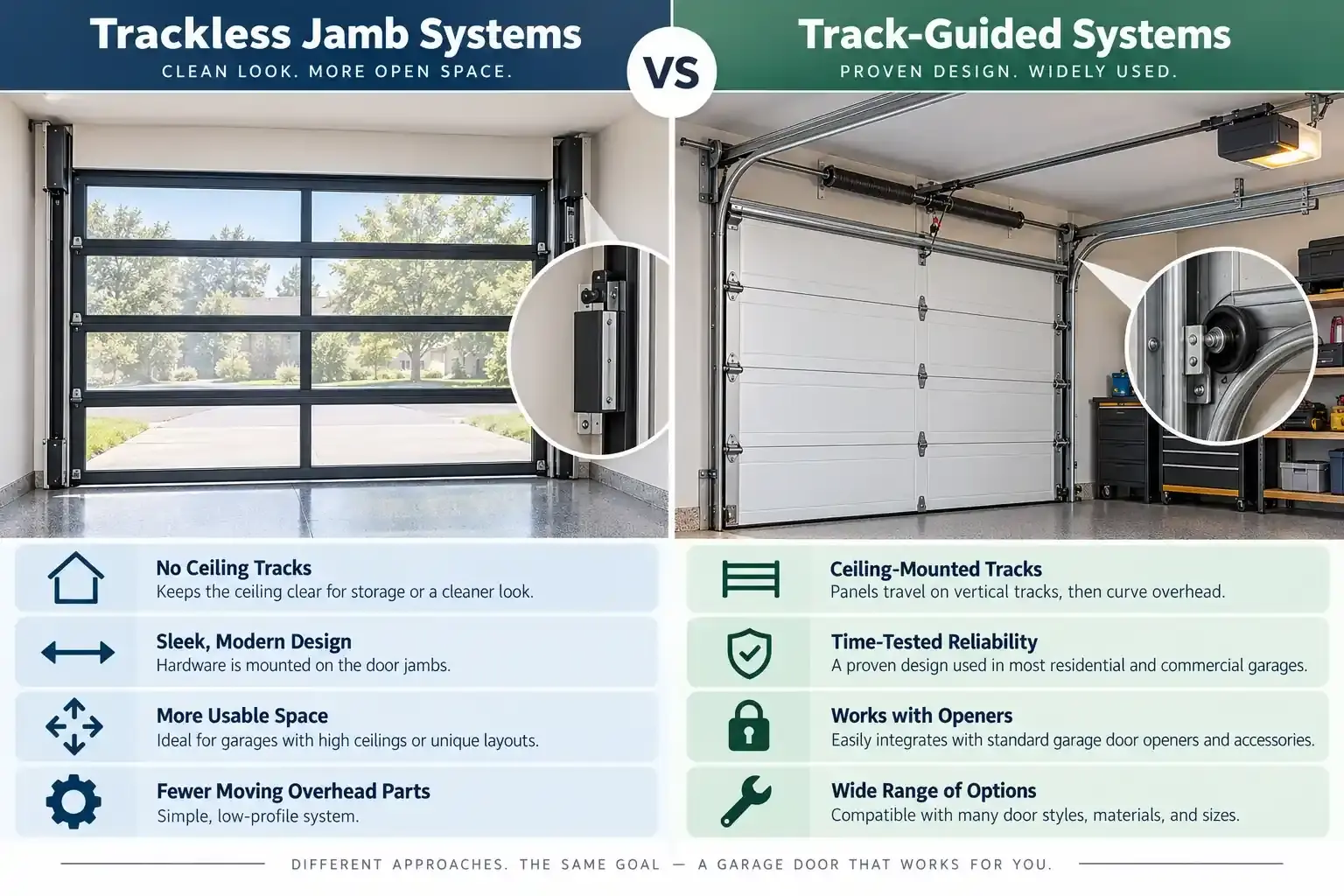
Single-panel doors generally fall into two architectural categories: canopy (trackless) and retractable (track-guided) systems.
Canopy systems use a trackless design, utilizing side-mounted jamb hardware and pivoting lever arms. When opened, the door swings outward like an awning, leaving about one-third of the panel protruding outside the garage. A major advantage of trackless jamb-type hardware is space efficiency; it requires only 1-1/2 inches of headroom, making it an exceptional option among space saving garage doors. By comparison, standard sectional systems demand 10 to 12 inches of clearance.
Retractable systems, conversely, use overhead tracks. The door swings outward and then rolls completely back into the garage, leaving no projection outside.
The Choice: Restoration vs. Sectional Conversion
When hardware fails or panels wear down, you face a critical decision: should you repair your existing setup or convert to a modern sectional door? To decide, you must weigh architectural preservation against practical safety:
- Aesthetics and Clearance: If maintaining historic integrity is your priority, or if your garage has extremely restricted ceiling clearance, preserving your jamb-type door is highly advantageous.
- Safety and Clearances: Because these single-panel slabs swing outward during operation, they are colloquially known as “shinbusters.” Anyone standing or parking too close to the garage face is at risk of being struck during operation.
- Weight Constraints: Old-school wood one-piece doors routinely weigh between 300 and 350 lbs. This immense weight requires heavy-duty mechanical leverage, making correct tilt-up garage door installation and balance adjustments absolutely vital.
If your structural frame is sound and you want to maintain your home’s vintage charm, restoring the existing hardware is often a highly cost-effective path when compared to a complete garage door repair vs replacement overhaul.
Decoding the Hardware: Springs, Tags, and the 10/20-Coil Rule
The counterbalancing system of a one-piece door relies on highly pressurized side extension springs. Because of the extreme kinetic energy stored in these systems, understanding why are garage door springs dangerous is crucial before undertaking any adjustments.
To safely manage or replace these systems, you must understand how does a garage door spring work. Unlike sectional doors that use overhead torsion shafts, tilt-up doors utilize dual-stretch extension springs mounted vertically on either side.
To identify replacement springs, do not rely on standard caliper measurements, which are prone to errors due to wire curvature. Instead, use the industry-standard 10/20-coil count rule: measure the physical length of 10 compressed coils, then 20 compressed coils, and compare those measurements to a standard wire-gauge chart. Additionally, look for stamped Holmes Tag codes (e.g., P728C or P928C). The “28” in these codes indicates the spring’s physical length of 28 inches, while the prefix denotes the weight capacity class.
Safety Warning: Always install containment safety chains inside these extension springs. If a high-tension spring snaps without a containment chain, it can fly off with lethal force.
Motorizing a Single-Panel Door
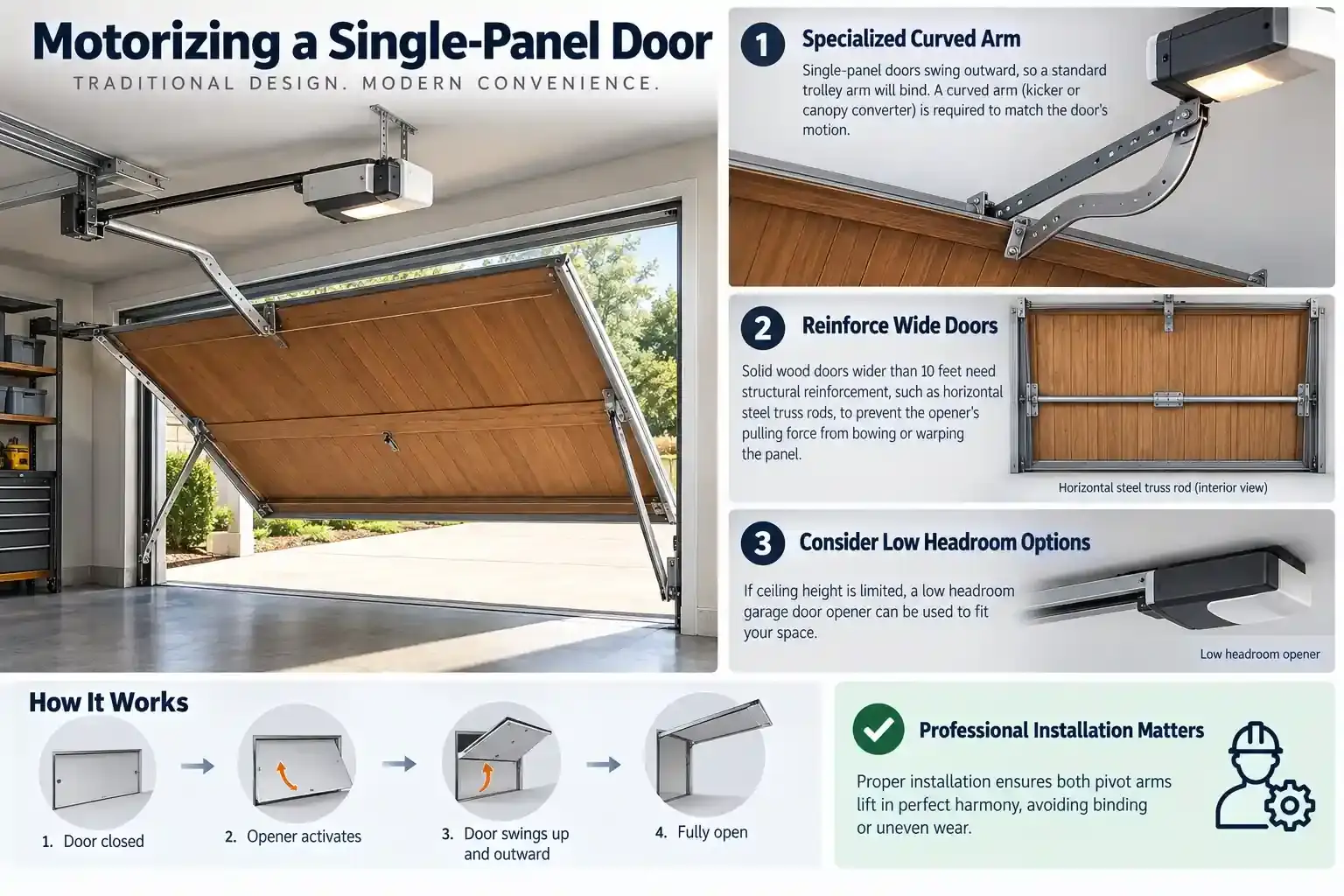
Can you pair a traditional swing-up door with a modern electric opener? Yes, but it requires specific mechanical modifications.
Because a single-panel door swings outward, standard trolley openers will bind unless fitted with a specialized curved door arm (often called a “kicker” or “canopy converter”). Furthermore, solid wood slabs wider than 10 feet require structural reinforcement, such as horizontal steel truss rods, to prevent the opener’s pulling force from bowing or warping the door panel over time.
If ceiling height is at an absolute premium, look into a specialized low headroom garage door opener configuration. Proper garage door opener installation ensures that both pivot arms lift in perfect harmony, avoiding binding or uneven physical wear.
Frequently Asked Questions
Can I automate an existing tilt-up garage door?
Yes, you can automate a tilt-up door, but it requires a specialized curved door arm attachment to handle the outward swinging arc without binding. Solid wood doors also require horizontal truss reinforcements to withstand the dynamic pulling forces of an electric opener.
How do I identify the replacement springs for my one-piece door?
Rather than using calipers, measure the length of 10 and 20 active coils to determine the wire size. Next, locate the stamped Holmes Tag code (such as P728C), where the number “28” specifies a 28-inch spring length, indicating the correct weight-rating class.
Are single-panel doors safe to use?
They are safe if maintained properly, but they pose higher risks than sectional doors. Because they swing outward, they can cause injury or vehicle damage if bystanders stand too close. Additionally, their heavy side springs require physical containment chains to prevent dangerous recoil if a spring breaks.
***
If you are ready to restore your classic mid-century door or explore a modern, insulated sectional replacement, let our experienced, licensed technicians guide you. Contact Up & Down Garage Doors today for a precise diagnostic inspection.
You May Also Like
The Five Strategic Types of Garage Doors: A Homeowner’s Selection Guide
Published Date: Sep 16, 2026
The Science of Steel Gauge: Understanding Thickness and Strength
Published Date: Sep 9, 2026
The Dark Carriage Door Revolution: Balancing Bold Aesthetics with Mechanical Reality
Published Date: Sep 8, 2026