




Garage Door Cable Frayed at the Bottom Bracket: Why It Happens
Published: Sep 23, 2026
If you notice a frayed garage door cable at the bottom bracket, you are looking at a serious mechanical failure in the making. The bottom bracket anchors the cable that bears the extreme weight of your door, making it one of the most high-tension areas in your entire garage door system. Ignoring a single frayed strand can lead to a sudden, dangerous door drop.
Before diving into the root causes, secure your garage immediately: disconnect the automatic opener, place locking pliers (vice grips) on the tracks just above the rollers to prevent the door from falling, and do not attempt to manually force the door open or closed.
The Physics of Bottom Bracket Wear
To understand why cables degrade specifically at the bottom corner, you have to look at the immense physical forces at play. On a standard residential 9×7 door, the bottom bracket anchors a cable holding up to 150 to 250 pounds of dead weight under instantaneous active tension.
While standard aircraft-grade cables are rated for 10,000 to 15,000 cycles (about 5 to 10 years of normal use), mechanical friction and environmental exposure can slash this lifespan to under 18 months.
Furthermore, because of shared environmental conditions and age, if you discover a frayed garage door cable on one side of your door, there is an 88% probability that the opposing cable is also near the point of failure.
The Four Root Causes of Bottom Corner Fraying
Cables rarely fail without a mechanical or chemical catalyst. When the wear is concentrated at the bottom bracket, it is almost always driven by one of four hidden root causes:
1. Galvanic Crevice Corrosion
During winter, vehicles carry road salt (sodium chloride and calcium chloride) into the garage. This saline runoff pools directly around the bottom corners of the door. The liquid gets trapped in the tight space between the steel cable loop and the zinc-coated bracket. This creates a localized “galvanic crevice corrosion cell,” accelerating the rate of steel degradation by up to 10 times compared to pure water exposure. The steel strands rust and weaken from the inside out, hidden from plain sight.
2. Fleet Angle and Roller Stem Misalignment
The “fleet angle” is the angle at which the cable travels from the top drum down to the bottom bracket. If the vertical track is out of alignment, or if a worn roller has too much play, the bracket shifts out of its vertical plane. This offset forces the high-tension cable to rub continuously against the steel flange of the garage door brackets or the edge of the track, cutting through the steel strands like a saw. Proper garage door track alignment is critical to maintaining a straight, friction-free cable travel path.
3. Milford Pin Pivot Restriction
The cable loop is held to the bottom bracket by a clevis pin, often called a Milford pin. This connection must pivot freely as the door transitions from vertical to horizontal. If rust or debris seizes this pin, the cable loop cannot rotate. Instead, it undergoes intense cyclic bending fatigue every time the door runs, causing the wire strands to snap right at the eyelet.
4. Track-to-Wall Gap Rubbing
Shifting foundation walls or loose fasteners can push the vertical tracks too close to the door frame. When this happens, the gap narrows, forcing the cable to scrape against the track wall during operation. Correcting this requires professional adjustments to align rollers quickly and restore safe structural clearances.
Diagnosing the Issue: Frayed Cable vs. Broken Spring
Homeowners often confuse cable wear with spring failure. However, diagnosing the exact problem is crucial to determining the safety of your system:
If you suspect spring damage, look for the signs your garage door spring is broken to avoid operating a highly unstable door.
The DIY vs. Professional Safety Matrix
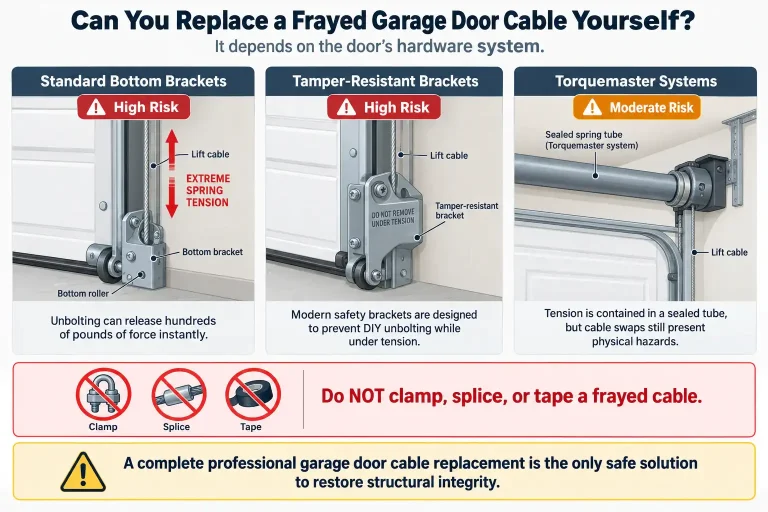
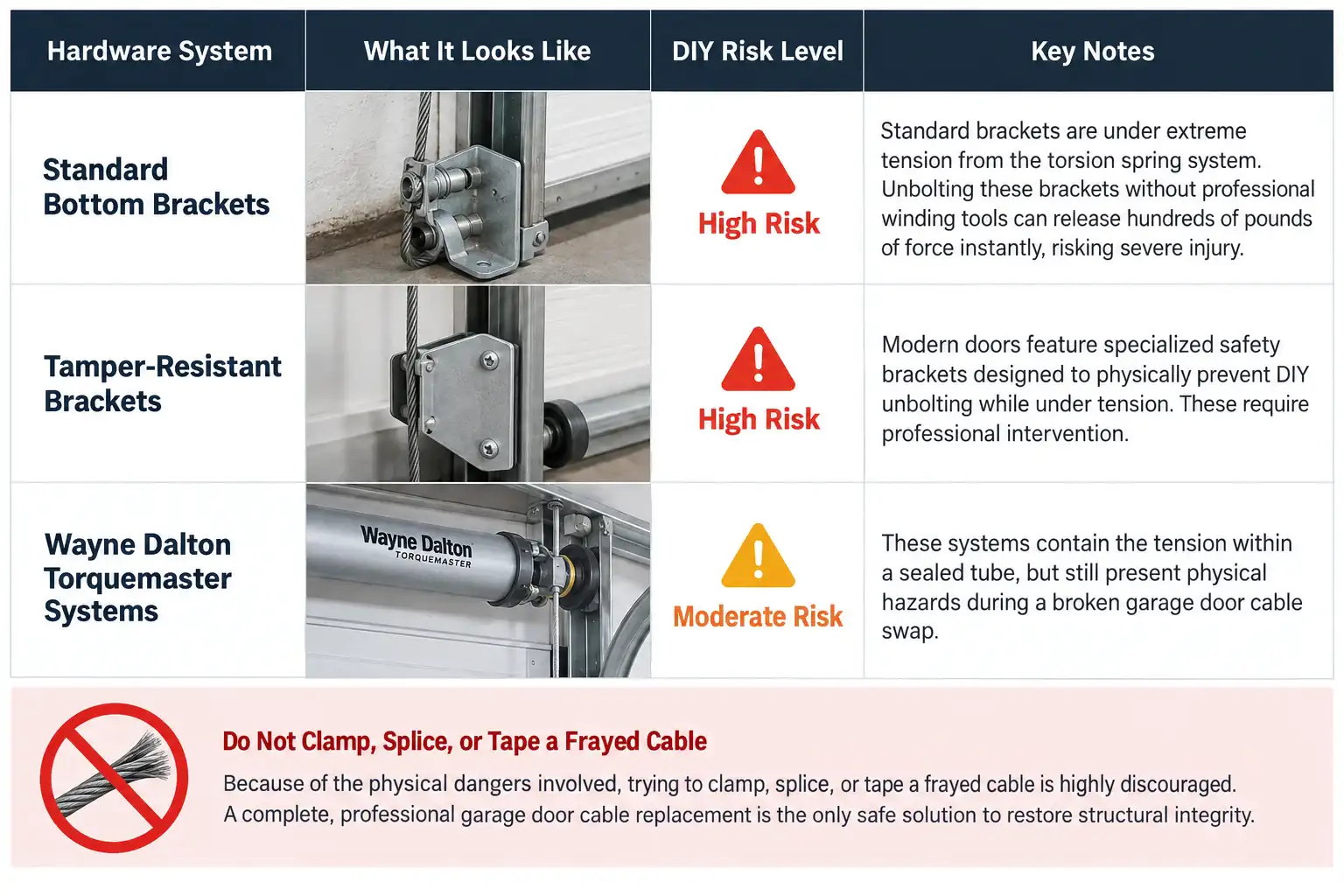
Can you replace a frayed cable yourself? The answer depends entirely on your door’s hardware system:
- Standard Bottom Brackets (High Risk): Standard brackets are under extreme tension from the torsion spring system. Unbolting these brackets without professional winding tools can release hundreds of pounds of force instantly, risking severe injury.
- Tamper-Resistant Brackets (High Risk): Modern doors feature specialized safety brackets designed to physically prevent DIY unbolting while under tension. These require professional intervention.
- Wayne Dalton Torquemaster Systems (Moderate Risk): These systems contain the tension within a sealed tube, but still present physical hazards during a broken garage door cable swap.
Because of the physical dangers involved, trying to clamp, splice, or tape a frayed cable is highly discouraged. A complete, professional garage door cable replacement is the only safe solution to restore structural integrity.
Prevention: Debunking the Cable Lubrication Myth
Many well-meaning homeowners spray heavy grease or thick oil directly onto their garage door cables. This actually accelerates cable failure.
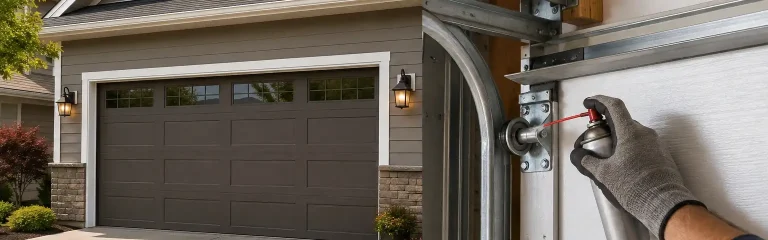
Heavy lubricants act like a magnet for airborne dust, grit, and road salt, forming an abrasive grinding paste that eats away at the steel strands. To extend the lifespan of your cables, keep the steel wire clean and dry. Instead, learn how to lubricate garage door assemblies properly: apply dry silicone spray or marine-grade rust inhibitors strictly to the moving pivot points—such as the roller bearings, hinges, and the bottom bracket pins—while leaving the cable itself completely free of grease.
Frequently Asked Questions
Can I open my garage door if only one cable is frayed?
No. Operating a door with a frayed cable puts double the stress on the remaining cable and the opener, which can lead to a sudden break and cause the door to crash down crookedly, damaging the tracks.
Why did my newly replaced garage door cable fray so quickly?
Accelerated wear on a new cable is almost always caused by an underlying alignment issue, such as a misaligned track, a seized roller, or a rusted bottom bracket pin that is keeping the cable from pivoting.
Is it necessary to replace both cables if only one is frayed?
Yes. Cables wear out at similar rates due to shared age and environment. Replacing both ensures even tension across the door and prevents the unreplaced cable from failing shortly after the repair.
You May Also Like