




Sealing & Repainting Carriage Door Overlays Before Winter: The Complete Substrate & Freeze-Thaw Defense Guide
Published: Nov 16, 2026
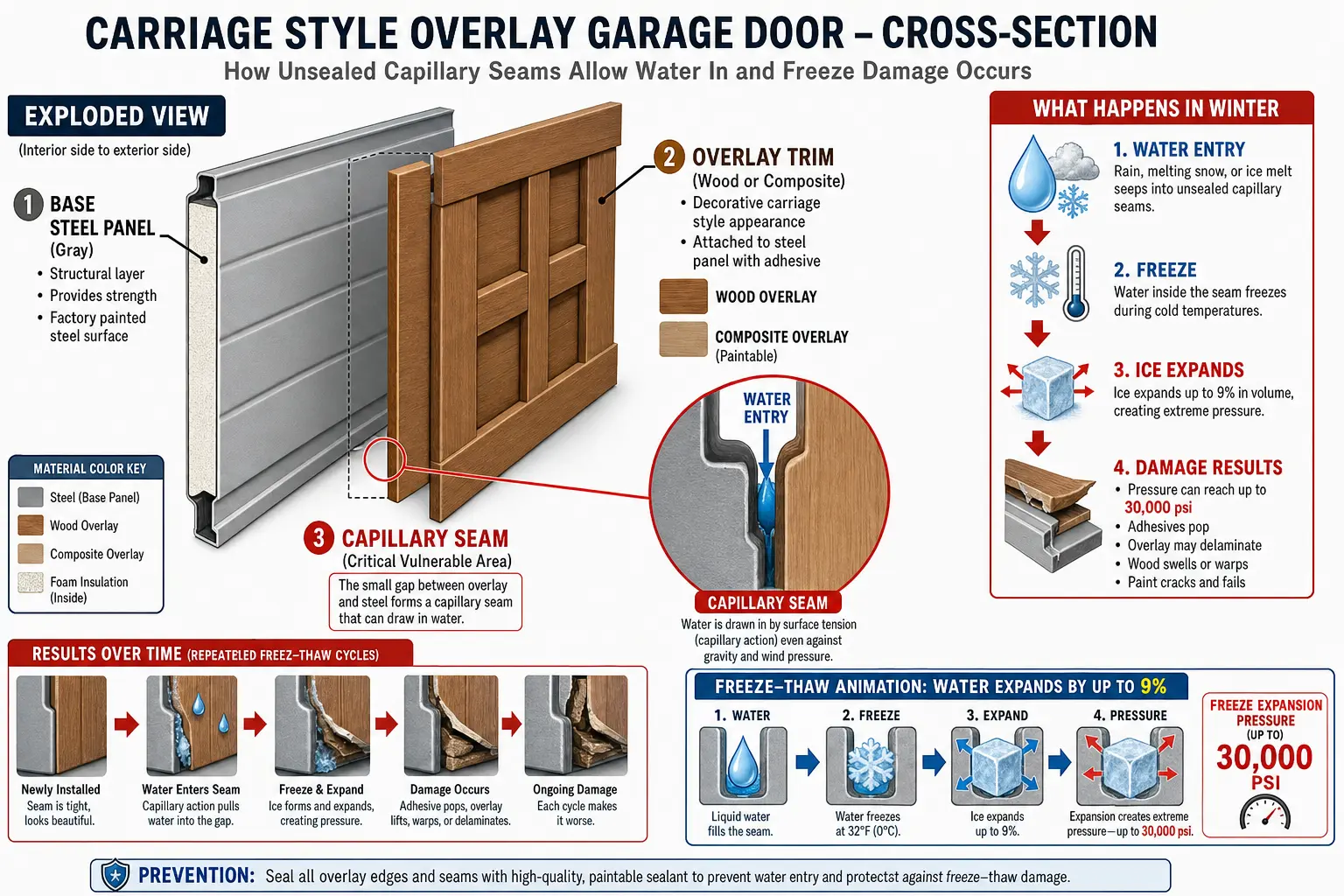
Carriage-style overlay garage doors represent a major architectural feature for high-end homes. Whether constructed with real wood, cellular PVC, or trim glued to steel backings, their aesthetic value depends entirely on structural integrity. However, these doors possess a vulnerability that generic painting guides ignore: the capillary seam between the decorative overlay trim and the backing panel.
When winter precipitation penetrates unsealed seams, moisture becomes trapped inside the core. As ambient temperatures drop, this trapped water freezes and expands by 9% in volume. This phase change generates up to 30,000 psi of hydraulic pressure against internal surfaces—easily shearing factory adhesives, rotting wood substrates, and delaminating composite panels.
Protecting your investment before freezing temperatures set in is critical. Investing $85 to $175 in a defensive pre-winter sealing kit preserves your door, avoiding professional refinishing fees ($600–$1,200) or complete replacement costs.
Substrate Diagnostics, LRV Limits, and Material Selection
Evaluating your door’s material composition dictates the exact primers, sealants, and coatings required. Real cedar or fir demands moisture-blocking alkyd primers, whereas wood composite garage doors and cellular PVC require 100% exterior acrylic latex formulations.
The Solar Thermal Safety Rule (LRV)
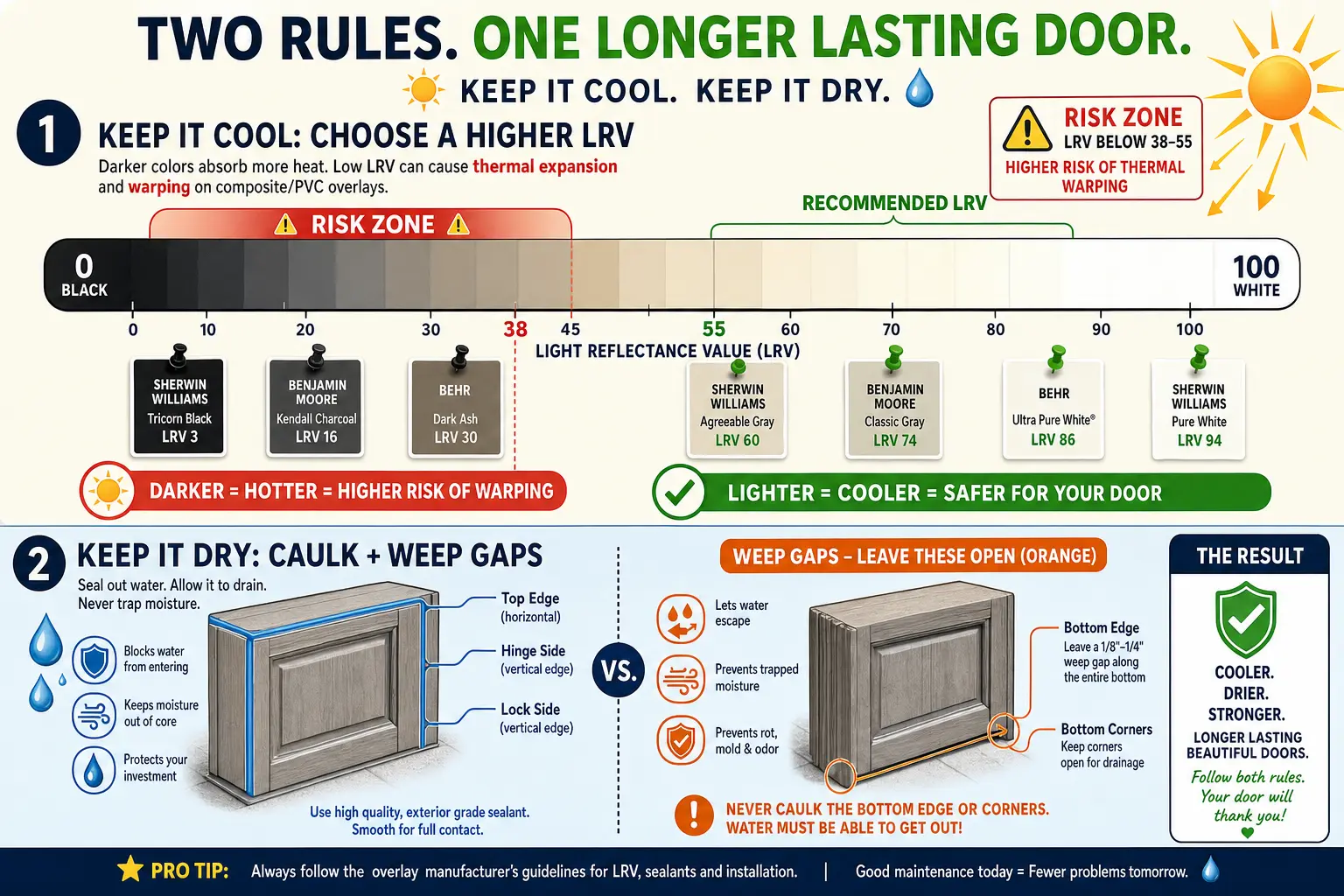
When updating trending colors like deep grays or black carriage style garage doors, you must account for Light Reflectance Value (LRV). Dark pigments absorb intense solar radiation, driving overlay surface temperatures up to 160°F–180°F on southern and western exposures. Leading manufacturers like Clopay mandate minimum LRV ratings between >38 and 55 for composite and vinyl overlays. Coating a PVC overlay with paint below these LRV limits induces differential thermal expansion, causing permanent warping and voiding manufacturer warranties.
Paintable Polyurethane vs. Silicone Seals
Never use pure silicone caulk on overlay seams. Silicone cannot accept paint, degrades under UV exposure, and seals indiscriminately without bonding dynamically to moving joints. Instead, select paintable polyurethane or high-grade elastomeric sealants (such as Quad Max or Dynaflex 230). These allow for continuous thermal movement between heterogeneous materials without cracking.
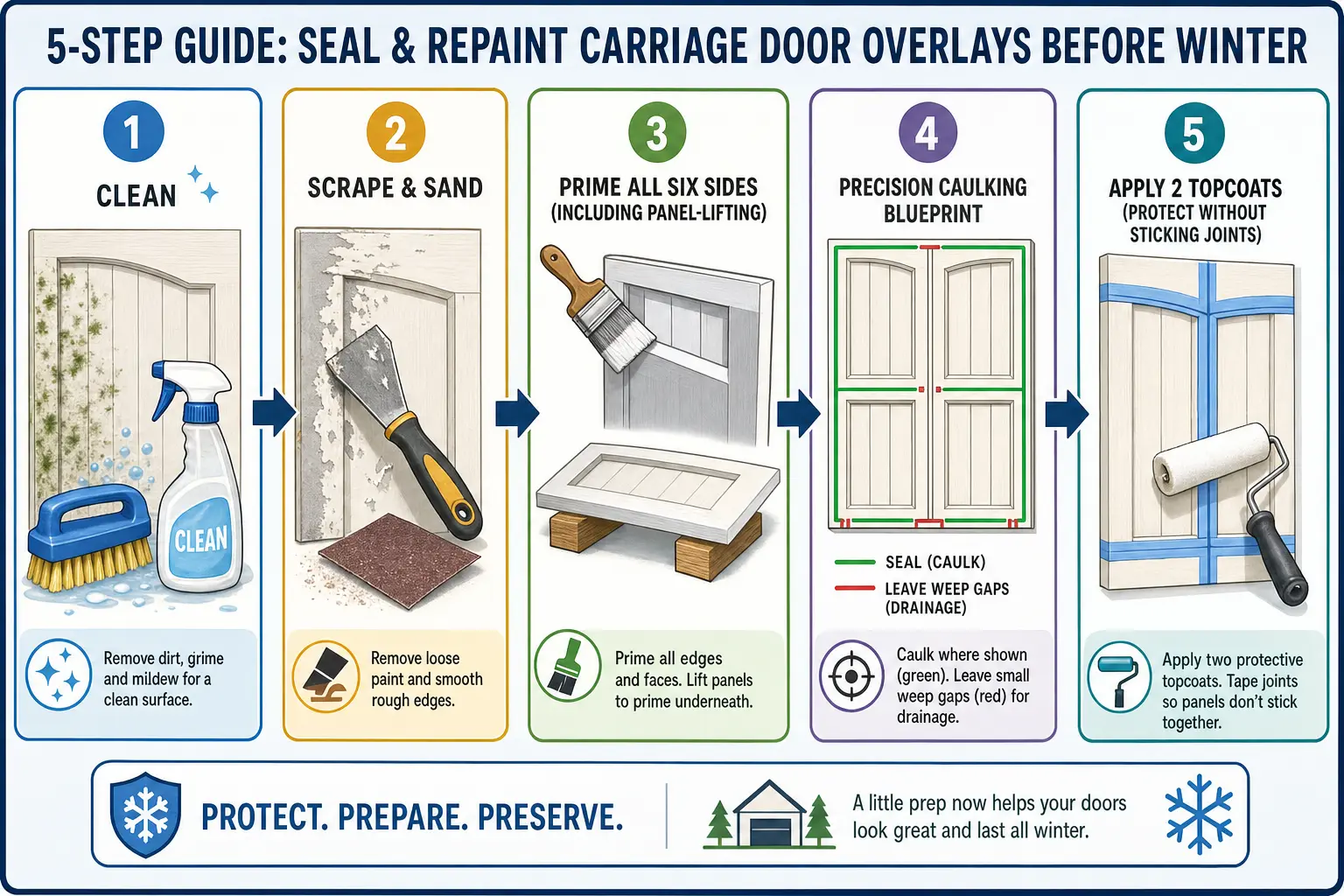
Step-by-Step Pre-Winter Sealing and Repainting Protocol
To ensure full defensive protection, execute this protocol during a 48-hour fall weather window when ambient and surface temperatures remain strictly between 35°F and 50°F (1.6°C to 10°C) for complete acrylic polymer coalescence.
- Surface Decontamination & Moisture Testing: Scrub all surfaces with a diluted TSP (trisodium phosphate) solution to remove road grime, wax, and mildew. Ensure substrate wood moisture content measures below 12% using a pinless moisture meter before applying any liquid coatings.
- Scraping & Feather-Sanding: Remove loose paint using a carbide scraper. Sand transition edges smooth with 120-grit sandpaper to eliminate raised paint margins that trap moisture.
- Mandatory 6-Sided Priming (The Panel-Lifting Hack): Manufacturers like Carriage House Door Co. require 6-sided sealing—front face, back lip, top, bottom, left, and right edges. Field data confirms unsealed bottom edges account for over 65% of lower-panel rot. Disengage your automatic opener, manually raise the door section by section, and prop each panel onto wooden blocks. This exposes the hidden top and bottom section joints, allowing you to prime all hidden edges using an industrial exterior binder or the best paint for garage doors.
- Precision Caulking Blueprint: Apply polyurethane caulk along all horizontal top trim edges and vertical side seams to block wind-driven snow. Crucial: Leave micro weep gaps along the bottom edge of horizontal overlays to allow internal condensation to drain freely.
- Topcoat Application: Apply two uniform coats of 100% exterior acrylic latex paint. To prevent panels from sticking together while curing, rub paraffin wax along contact joints or mask meeting rails with painter’s tape until fully cured.
Executing this routine alongside seasonal garage door stripping repair and verifying your garage door bottom seal replacement ensures a dry interior barrier. Neglecting panel joint edges can cause your door to bind, leaving your garage door frozen shut during mid-winter freezes. If extensive wood rot or frame distortion is discovered during prep, consult a technician for targeted garage door panel replacement before cold weather sets in.
Frequently Asked Questions
Can I paint my carriage door overlays in cold fall weather?
Yes, provided you use 100% exterior acrylic coatings formulated for low-temperature application (down to 35°F / 1.6°C). However, both ambient and surface temperatures must stay above this minimum threshold for at least 24 to 48 hours post-application to ensure proper film formation. Applying paint when overnight temperatures drop below freezing causes premature binder breakdown and spring peeling.
Why shouldn’t I caulk every seam around my garage door overlays?
Completely sealing all four sides of an overlay panel creates a moisture trap. While top and side seams must be caulked to block rain and melting snow, the bottom horizontal edge requires microscopic weep gaps. This allows trapped interior moisture and wood condensation to escape safely without generating delamination pressure.
How does painting my composite garage door a dark color void the warranty?
Composite and cellular PVC overlays absorb excess solar heat when painted in dark shades with low Light Reflectance Values (LRV under 38). Surface temperatures can exceed 180°F, softening polymers and causing structural warping or adhesive failure. Major door manufacturers mandate specific LRV thresholds to protect overlay integrity under direct sun exposure.
You May Also Like